Russia’s indoctrination and militarisation of Ukrainian children may amount to a crime against humanity – OSCE
Moscow Mechanism experts of the Organisation for Security and Co-operation in Europe (OSCE) have found that Russia’s policy toward Ukrainian children constitutes a deliberately designed system aimed at erasing Ukrainian identity. The mission concluded that the systematic indoctrination and militarisation of children may amount to a crime against humanity in the form of persecution on discriminatory grounds, while individual cases, including torture and unlawful deportation, bear the hallmarks of war crimes.
The OSCE published its report on July 9, titled “Report on Possible Violations and Abuses of International Humanitarian, Human Rights and Criminal Law related to Militarisation and Indoctrination of Ukrainian Children by the Russian Federation”.
ZMINA summarises the report’s key findings and the recommendations of the OSCE Moscow Mechanism mission.
Forty-one OSCE participating States invoked the Moscow Mechanism, mandating an expert mission to investigate the militarisation and indoctrination of Ukrainian children by Russia on 14 May 2026. The OSCE appointed three experts – Prof. Hervé Ascensio, Dr. Elīna Šteinerte, and Prof. Stefan Wolff – to establish facts, assess compliance with OSCE commitments, international humanitarian law (IHL), international human rights law (IHRL), and international criminal law (ICL), and to propose accountability measures and recommendations. The Mission had access to relevant information and was able to visit Ukraine; Russia did not cooperate.
This OSCE instrument was established in 1991. It has no connection to the Russian authorities; its name simply derives from the city where it was adopted. Since the beginning of the full-scale invasion, this is the sixth time the mechanism has been invoked regarding Ukraine.
A system built to erase identity
Forcible transfers and deportations of Ukrainian children remain among the gravest documented violations, the OSCE experts noted. Ukrainian official records identified 20,610 deported or forcibly transferred children as of June 2026.
The independent fact-finding group concluded that children deported to Russia have frequently been placed in foster families or subjected to adoption under Russian law. This violates Article 50 of the Fourth Geneva Convention and Articles 8, 9, 10, and 21 of the UN Convention on the Rights of the Child. Russia has systematically obstructed family reunification while failing to establish any mechanism to restore identity, as required by Article 8(2) of the UN Convention on the Rights of the Child and recommended by the 2023 Moscow Mechanism Mission.
In a comment to the news outlet ZMINA, Onysia Syniuk, head of analytics at the ZMINA Human Rights Centre, highlighted that the Moscow Mechanism experts clearly established that this Russian system did not emerge in 2022, but was initially implemented in Crimea in 2014. With the onset of the full-scale invasion, it was expanded across all occupied territories in a more aggressive, accelerated form, drawing on experience gained in Crimea.
 Onysia Syniuk
“The conclusion of the Moscow Mechanism experts emphasised once again that Russia’s policy toward Ukrainian children under its control is a well-planned system. The report identifies the main elements of this system: the use of education for indoctrination and militarisation, the imposition of citizenship, and legislation regarding terrorism and extremism. All of these are aimed at destroying Ukrainian identity and imposing a Russian one,” Syniuk said.
The report reveals that the Russian legislative architecture governing Ukrainian children in occupied territories constitutes a purposefully designed system. Initially implemented in Crimea in 2014, it was expanded to all occupied territories after February 2022 and further reinforced. The authors highlighted that this architecture intertwines:
- education law;
- youth policy;
- family law;
- citizenship regulations; and
- legislation on terrorism and extremism to produce a coordinated mechanism of indoctrination, militarisation;
- and the suppression of dissent.
You may also want to read: Sixty-three countries agree to develop joint strategy on return of deported Ukrainian children
First, Russian federal law treats education as an instrument of State security and identity transformation: federal educational standards prescribe the formation of Russian civic identity and loyalty as core objectives.
Second, passportisation – the acquisition of Russian citizenship – has been rendered de facto compulsory, as access to education, healthcare, employment, and basic services is conditioned on holding Russian documents.
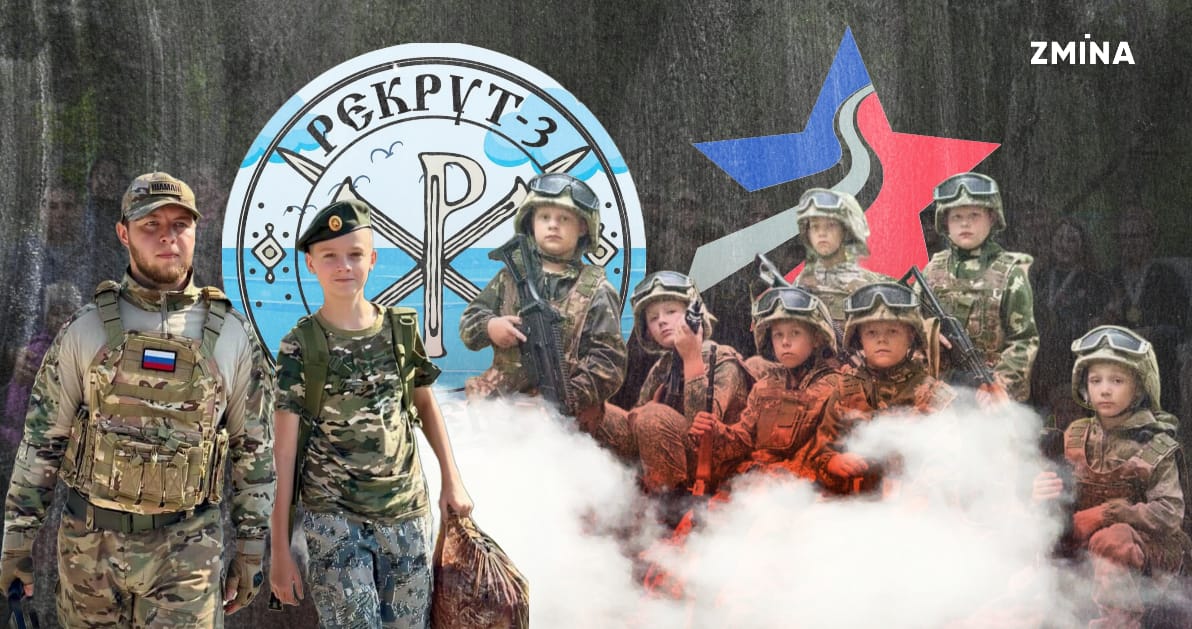
Third, the boundary between civilian education and military service has been systematically dismantled: mandatory subjects such as “Fundamentals of Security and Defence of the Homeland,” introduced in grades 8–11 from September 2024, incorporate weapons handling, Unmanned Aerial Vehicle (UAV) operation, and tactical medicine into the standard school curriculum.
Fourth, legislation on terrorism and extremism – principally Federal Law No. 114-FZ and associated strategic instruments – creates a framework under which expressions of Ukrainian identity, language, and historical memory are treated as security threats in Russia and the temporarily occupied territories. This is supported by the introduction of vague offences regarding the “discrediting” of the armed forces and the “rehabilitation of Nazism.”
You may also want to read: Not just Ukraine – Russia is preparing Ukrainian children for future wars elsewhere
Key implementing actors include the Ministries of Education and Defence, law enforcement authorities, Rosgvardiya, the Russian Orthodox Church, and state-sponsored military-patriotic youth organisations such as DOSAAF, Dvizheniye Pervykh [Movement of the First], Yunarmiya, and the Voin centres.
Schools as instruments of indoctrination
The document details how indoctrination permeates every level of the school system in the occupied territories. Russian curricula have replaced Ukrainian educational content entirely; Ukrainian-language instruction was formally eliminated by Russia’s Ministry of Education Order No. 729.
History textbooks promote Russian civilisational supremacy and erase Ukrainian national identity. The weekly compulsory “Razgovory o Vazhnom”і programme, starting from kindergarten age, embeds pro-war narratives in ordinary school life, while cadet classes and military-patriotic youth organisations extend pre-military preparation.
You may also want to read: Children in one of the schools in occupied Sevastopol are being militarised by Russian militant Pavel Klyasyuk
Preparing children for war
Militarisation extends beyond the classroom through state-sponsored military-patriotic youth organisations and re-education camps. Membership of “Yunarmiya” generates admissions advantages at military universities; the “Voin” centres provide structured training in weapons and UAV operation for children aged 14–18.
According to the OSCE expert group, conscription completes this pipeline: Ukrainian boys in the occupied territories receive pre-conscription notices as young as 16, and conscription is imposed upon reaching 18. This directly violates the prohibition on compelling protected persons to serve in the armed or auxiliary forces of the occupying state.
“While notices would generally be sent to all boys before their 18th birthday, a consistent pattern appears to indicate that Ukrainian boys are particularly targeted with such ‘early’ notices and the requirement to report to the conscription office, which has prompted many Ukrainian boys to flee from the occupied territories,” the researchers stated. They concluded that concerted recruitment efforts not only begin at school but are, in fact, an integral part of schooling.
Russia’s system is enforced through pervasive coercion. The expert group highlighted that pressure on parents, teachers, and children is both structural and individualised.
Parents who refuse to enrol their children in Russian schools are threatened with deprivation of parental rights; law enforcement agents accompany school officials on house-to-house visits to compel compliance. Teachers who decline to implement the Russian curriculum face dismissal, harassment, house searches, and detention.
Children are forbidden to speak Ukrainian in schools or public spaces; those who express pro-Ukrainian views, including on social media, face searches, interrogation, and even prosecution.
You may also want to read: 11 years of oppression and repression: how human rights in occupied Crimea are approaching zero
The OSCE mission received numerous accounts of the violations of the right to thought, conscience and religion of the Ukrainian children in Russia. These include Ukrainian children who have been placed in shelters run by the Russian Orthodox Church, being baptised without the consent of their legal guardians or being properly consulted.
Furthermore, in such centres, children are subjected to standard Russian educational programs with an added religious component that presents the Russian Orthodox Church as the only “right” choice, thereby diminishing the very existence of the Ukrainian Orthodox church.
“Noting the split of the Ukrainian Orthodox Church from the Moscow Patriarchate in May 2022, it is clear that the two churches are separate identities,” a group of experts stressed.
The fact-finding group also received reports of priests attending regular schools and supporting the activities of youth military organisations, thereby actively participating in the military-patriotic education of Ukrainian children. These actions cannot be reconciled with the freedom of thought and conscience protected by Article 14 of the UN Convention on the Rights of the Child, the report stated, concluding that Russia has explicitly violated these rights.
Coercion to acquire Russian citizenship is further exercised by denying access to healthcare, social services, and education, as well as daily necessities like banking, and by restricting the freedom of movement of those without Russian documents.
How experts classified the crimes
The authors scrutinised the treatment of Ukrainian children through the lens of international law. Under IHL, the group concluded that Russia has committed multiple violations, including:
- the unlawful transformation of the education system in breach of Article 43 of the Hague Regulations and Article 50 of the Fourth Geneva Convention;
- compulsion of children to participate in formations subordinate to the occupying power;
- alteration of the personal status and identity of children through passportization
- adoption;
- prohibited pressure to swear allegiance to the occupying power.
“By implementing this policy towards Ukrainian children under its control, the Russian Federation violates numerous norms of international humanitarian and human rights law: regarding the preservation of normal life in the temporarily occupied territories and the functioning of children’s educational institutions, as well as the content of this education; the prohibition against compelling individuals to swear allegiance to the occupying power; the prohibition on propaganda for service in the occupying state’s armed forces and the compulsion to serve in its armed or auxiliary forces; and the rights to identity, family life and family ties, information, and freedom of thought and belief,” human rights advocate Onysia Syniuk said.
Under international human rights law, the experts found systematic and overlapping violations of the UN Convention on the Rights of the Child, including the rights to identity, family, education, information, freedom of thought and conscience, health, and the right to liberty and security of a person.
“The best interests of the child – The paramount obligation under Article 3 of the UN Convention on the Rights of the Child – were disregarded in every dimension of Russia’s policy”.
Under international criminal law, the mission concluded that the practices of systemic indoctrination and militarisation may also amount to a crime against humanity in the form of persecution, directed against Ukrainian children on discriminatory grounds as part of a widespread and systematic attack.
In addition, the OSCE mission endorsed the determination by the UN Independent International Commission of Inquiry that the forcible transfer and deportation of Ukrainian children may also amount to a crime against humanity in the form of deportation and forcible transfer of population. They highlighted that the delays and obstacles to their return serve as an aggravating factor.
You may also want to read: Russia sent 48 Ukrainian children to psychiatric hospitals in the occupied Donetsk region on extremism charges – human rights advocate
Moreover, the mission identifies probable war crimes related to its mandate, including torture and inhuman treatment, causing great suffering to children, and unlawful deportation and transfer of children.
What the international community can do
The mission presented the principal recommendation addressed to all stakeholders is to immediately, effectively, and meaningfully recognise the centrality of the plight of Ukrainian children for their safety, identity and family life in the ongoing war and in all ceasefire and peace negotiations.
The OSCE experts further called on the Russian Federation to halt all practices of indoctrination and militarisation, to cease all coercion against children, parents, and teachers, to immediately facilitate the return of all deported children, and to establish a mechanism for the restoration of identity.
The report issued the following specific recommendations for Russia:
- Ensure, without delay, that children below the age of 18 years enrolled in civil and military schools do not undergo military training and are not subject to military-style discipline. The prevailing practice of cadet classes in regular schools should cease.
- Guarantee in law and in practice that all children and members of their families are free to express opinions that are critical of the Russian and occupation authorities, and the Russian war against Ukraine and its consequences, without fear of retaliation, including deprivation of liberty and other sanctions.
- Ensure free and unfettered access to pluralistic information, including in the digital environment, inter alia, by lifting restrictions on the operation of any Internet-based, electronic, or other information dissemination systems, and by ensuring free access to social media platforms for all children, with full respect for children’s online privacy.
- Ensure that children, their parents, and relatives are not put under any pressure, be it physical, psychological or social, to join child and youth military-patriotic organisations, including DOSAAF, “Yunarmiya”, “Orljata Rossii”, “Movement of the First”, and others.
It also called on Ukraine to continue strengthening its systems for the documentation, return, reintegration, and rehabilitation of affected children, and to sustain support for the families of those still held.
OSCE participating states and the wider international community are called upon to support accountability mechanisms, child-protection and return efforts, and international cooperation to end impunity for crimes against Ukrainian children.
The document outlines the following recommendations for the international community:
- Consider establishing a mission under the general mandate of UNESCO to monitor the functioning of the schools and recreational camps located in the occupied territories of Ukraine and those hosting Ukrainian children in the Russian Federation.
- Proactively offer their good offices to Ukraine and the Russian Federation to urgently facilitate the family reunification of all Ukrainian children in full compliance with Articles 9 and 10 of the UN Convention on the Rights of the Child.
- Ensure their territories are not used for activities that assist in, or contribute to, the efforts by the Russian Federation to indoctrinate and militarise Ukrainian children under its control.
Earlier, Freedom House, the Human Rights Centre ZMINA, and other human rights organisations published a report revealing how the regime of illegitimate Belarusian President Alyaksandr Lukashenko is involved in the displacement, indoctrination, “re-education,” and militarisation of Ukrainian children as part of Russia’s broader policy of eradicating Ukrainian national and cultural identity.
You may also want to read: Re-education disguised as recreation: how Belarus helps Russia remove Ukrainian children from occupied territories
The report’s authors called on the International Criminal Court to investigate these crimes and issue arrest warrants for Lukashenko; Dmitry Mezentsev, secretary of state of the Union State of Russia and Belarus; Mikhail Mishustin, chair of the Union State’s Council of Ministers and prime minister of Russia; and Belarusian Paralympic athlete Aliaksei Talai, head of a foundation implicated in the removal of Ukrainian children to Belarus.
Liked this article? Follow ZMINA on X, BlueSky, and LinkedIn, and help shape our editorial focus by filling out our feedback form here.