Sixty-three countries agree to develop joint strategy on return of deported Ukrainian children
The International Coalition for the Return of Ukrainian Children agreed to develop a joint strategy to implement a U.N. General Assembly resolution. The EU, the U.K. and Canada adopted the largest sanctions package against those involved in the deportation of Ukrainian children and announced more than $100 million in funding for their return, Ukrainian presidential initiative Bring Kids Back UA told ZMINA.
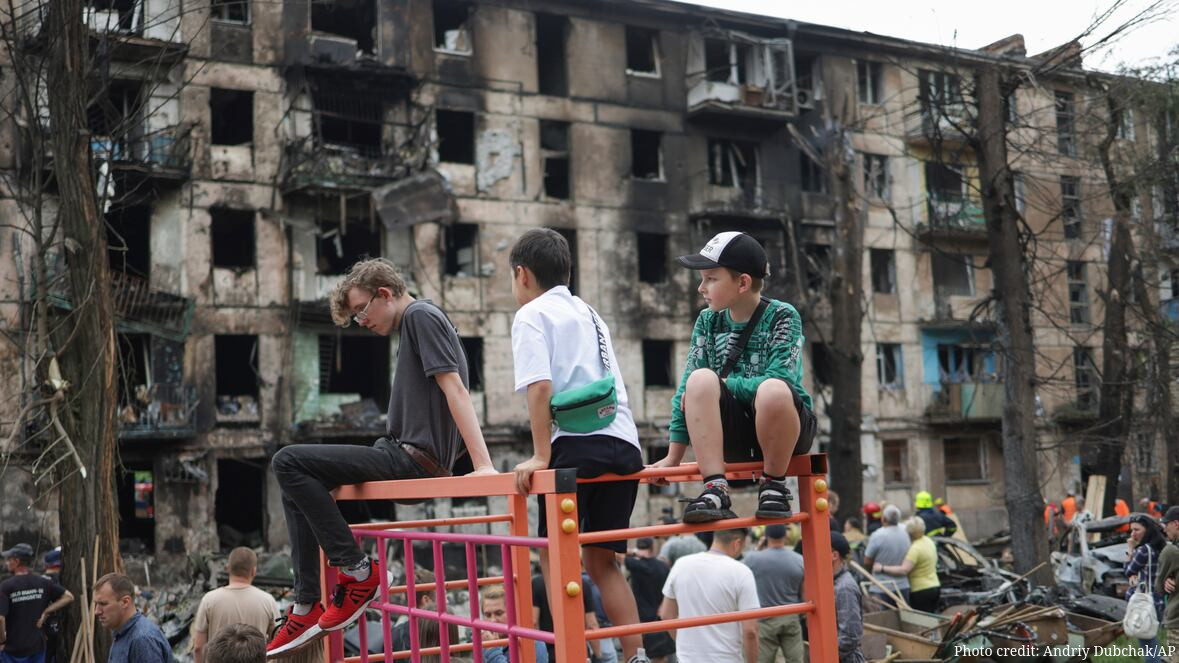 Illustrative photo
On 11 May 2026, the High-Level Meeting of the International Coalition for the Return of Ukrainian Children took place in Brussels, co-hosted by Ukraine, Canada, and the European Union. The meeting was attended by delegations from 63 countries and international organisations.
The objective of the meeting was to strengthen collective efforts to secure the safe return of children unlawfully deported or forcibly transferred by the Russian Federation in the course of its illegal war of aggression against Ukraine.
President Volodymyr Zelenskyy emphasised in his address to the members of the Coalition that the deportation of Ukrainian children cannot be treated as a local problem and demands a response from the entire international community:
“How did it become possible for Russians to simply abduct tens of thousands of children, hide them, tear them away from their families, and then teach them to hate the very country they were abducted from? When a country becomes such an evil force, a force that does not stop even at destroying the lives of children, this cannot be treated as just a regional problem, something happening somewhere far away. If a country commits such crimes against children, it means it is capable of any crime. And that is exactly why this challenge requires a global response,” the President stated.
The meeting in Brussels was preceded by the Civil Society and Expert Day, which brought together more than 200 participants in Kyiv on 30 April – including Ukrainian and international civil society organisations, researchers, open-source intelligence practitioners, diplomats, and representatives from the public sector, international organisations, and the media. The Day produced a Joint Civil Society Statement with 12 concrete calls to Coalition members – ranging from political and economic pressure on Russia to sustainable funding for reintegration and the protection of those who search for and return children. The Statement served as a direct contribution from the expert community to the substance of the 11 May discussions and was delivered to participants of the High-Level Meeting through the Minister of Foreign Affairs of Ukraine.
Speaking in Brussels, Minister Andrii Sybiha stressed that international efforts must inevitably be measured by concrete results, not statements:
“We speak not only about returning children — we speak about a triple return. Return every child, return Ukraine to every child, and return childhood to these children. Statements are not enough. Words of empathy are not enough. Actions, both political and legal, are needed to ensure accountability and bring our kids back home. And of course, the best thing we can bring to our children is peace,” the Minister stated.
He also outlined five priorities for the coalition’s work, including an action roadmap, support for mechanisms to return and reintegrate children, tighter sanctions and the enforcement of international justice rulings.
EU High Representative Kaja Kallas characterised the deportation as a deliberate state policy of Russia aimed at destroying Ukraine’s future generation:
“Of all the horrors of Russia’s war, the deportation and forced transfer of Ukrainian children is one of its worst crimes. Stealing children is not incidental. It is a deliberate Russian policy, a calculated attack on Ukraine’s future,” she commented.
“Removing children from their parents and their homes, taking them to a foreign country for adoption or into ideological camps, is a practice associated with imperialism and totalitarian repression. We know from the past — it is a crime that touches us all, regardless of geography or politics. It is a crime that merits a stronger and collective international response,” EU Commissioner for Enlargement Marta Kos added.
Participants reaffirmed their unwavering commitment to protect Ukrainian children in line with international humanitarian law and the UN Convention on the Rights of the Child, and emphasised that deportation and forcible transfer are part of a broader systemic pattern of Russian policy in the temporarily occupied territories of Ukraine.
Participants of the meeting in Brussels supported the transition of the Pilot Tracing Mechanism into a permanent national capability under the leadership of the Ministry of Justice of Ukraine. Financial, technical, and expert support will be provided by the participating countries of the Partnership Fund for a Resilient Ukraine (PFRU) – the United Kingdom, Canada, Estonia, Norway, Finland, Switzerland, and Sweden. The United Kingdom announced an additional £1.2 million for tracing and verification – including £600,000 for the Verification Centre and £600,000 for the Ukrainian Tracing Programme.
The United States confirmed a $25 million programme to support the identification, return, and rehabilitation of deported children through Ukrainian civil society; Lithuania announced a separate, dedicated call for civil society organisations working on facilitating returns and accountability; Germany announced €1.4 million for the Ukrainian NGO.
Participants agreed to develop a shared strategy for the Coalition to implement UN General Assembly resolution A/RES/ES-11/9, “Return of Ukrainian Children”, adopted on 3 December 2025. Coalition members are also committed to aligning political messaging, actively engaging UN actors and fora, and recording instances of Russian obstruction as non-implementation of the resolution.
The European Union announced €50 million in support of Ukraine’s child protection system. Meanwhile, Lithuania announced €10 million through the Joint Declaration on the Protection, Return, Rehabilitation, and Reintegration of Ukrainian Children, signed by the Foreign Ministers of Ukraine and Lithuania, particularly for the search, return, and rehabilitation of children.
In addition, Germany announced €1.4 million for a Ukrainian civil society organisation working with returned children and their families.
A number of Coalition members — including Slovenia, Croatia, and Georgia – confirmed the continuation of rehabilitation programmes and summer camp stays for Ukrainian children. Croatia reported developing a dedicated rehabilitation programme for returned children and their families.
Participants also underlined a holistic approach to holding Russia accountable. Canada announced CAD 3.4 million in support for the UN Human Rights Monitoring Mission in Ukraine, with the support extended for the next two years. Canada also ratified the Convention establishing the International Claims Commission for Ukraine, becoming the first country outside Europe to join this mechanism.
In addition, participants of the High-Level Meeting of the International Coalition for the Return of Ukrainian Children agreed to move from parallel unilateral measures to coordinated sanctions packages, synchronised in scope and timing across the jurisdictions of Coalition members.
The United Kingdom sanctioned 29 individuals and entities responsible for Russia’s campaign to forcibly deport, indoctrinate, and militarise Ukrainian children. Among those sanctioned are:
- The Centre for Military Sports Training and Patriotic Education of Youth, known as the “Voin” [Warrior] Centre, is a network of facilities operating across Russia and temporarily occupied Ukrainian territories, where children are subjected to military training and pro-Kremlin indoctrination.
- Yulia Velichko, the illegitimate “Minister for Youth Policy” of the self-proclaimed “Luhansk People’s Republic”, for issuing Russian passports to children from temporarily occupied territories and organising programmes exposing them to Russian ideology.
On 8 May 2026, Canada added 23 individuals and five entities to its Russia sanctions list. Those designated include children’s rights commissioners in occupied Ukrainian territories and officials overseeing military-patriotic youth programmes. The five listed entities include:
- The Voin Centre, the Yunarmiya regional branch in Sevastopol;
- A Russian state-run military-patriotic youth movement — the Educational and Methodological Centre “Avangard”;
- The Defence and Sports Camp “Avangard”;
- The Volgograd Regional Youth Volunteer Organisation Uchastie.
On 11 May 2026, the Council of the European Union adopted Council Decision (CFSP) 2026/1072, imposing restrictive measures against 16 individuals and seven entities responsible for the systematic unlawful deportation, forced transfer, forced assimilation, including indoctrination, and militarised education of Ukrainian minors. Listed entities include:
- The All-Russian Children’s Centres Orlyonok
- Scarlet Sails
- Smena, as well as the Nakhimov Naval School
- The DOSAAF Centre in Sevastopol
- The Avangard Military Camp.
Listed by the EU, individuals include regional children’s rights commissioners, youth camp heads, military-patriotic club leaders, and occupation administration officials. All listed persons are subject to asset freezes and travel bans; listed entities are subject to asset freezes.
Moreover, Norway confirmed its commitment to align with the EU sanctions package.
Ukrainian Foreign Minister Andrii Sybiha also welcomed decisions by the U.K., the EU and Canada to impose additional sanctions on individuals involved in the abduction of Ukrainian children, urging partners to increase pressure on Russia. Participants of the High-Level Meeting in Brussels agreed to move from parallel unilateral measures to coordinated sanctions packages, synchronised in scope and timing across the jurisdictions of Coalition members.
You may also want to read: Only 5% of those responsible for deporting Ukrainian children face global sanctions
The meeting concluded with a Co-Chairs Summary formally reaffirming that Russia’s obligation to return all unlawfully deported children must be addressed in any peace negotiations, and that all available tools, including sanctions, must be used to secure their immediate and unconditional return.
Canada will host the next Canada-Ukraine-Norway Conference in Toronto on 28-29 September, immediately following the U.N. General Assembly.
For reference: The International Coalition for the Return of Ukrainian Children was launched in Kyiv in February 2024 by Ukraine and Canada. Estimates suggest that more than one million Ukrainian children remain in the temporarily occupied territories under Russian control. The exact number of those deported and forcibly transferred remains unknown, as only Russia knows how many Ukrainian children it has abducted and refuses to disclose this data.
Ukrainian human rights defenders emphasise that the deportation and forcible transfer of Ukrainian children are not a side effect of war but a component of Russia’s systemic genocidal policy, aimed at erasing Ukrainian identity and severing children’s ties to Ukraine.
Stay connected with us via X, BlueSky, and LinkedIn – and while you’re here, please spare five minutes to fill out our survey and tell us what you’d like to see next.