Only 5% of those responsible for deporting Ukrainian children face global sanctions
On April 30, 2026, researchers, lawyers, and human rights defenders gathered in Kyiv for the Civil Society and Expert Day of the International Coalition for the Return of Ukrainian Children.
The day opened with remarks by the Deputy Speaker of the Verkhovna Rada of Ukraine, Olena Kondratiuk. She highlighted that Russia’s deportation of Ukrainian children is not just a crime carried out by individuals – it’s a system involving state corporations like Gazprom and Rosneft, the Russian Orthodox Church, and dozens of subsidiary organizations. Yet 80% of these entities remain unsanctioned by the U.S. and the European Union.
The Deputy Speaker of the Ukrainian parliament called for automatic unification of national sanctions lists and their expansion to cover corporate networks, Russian family members, and those who facilitate rather than directly commit these crimes.
ZMINA has recorded her speech at the Civil Society and Expert Day.
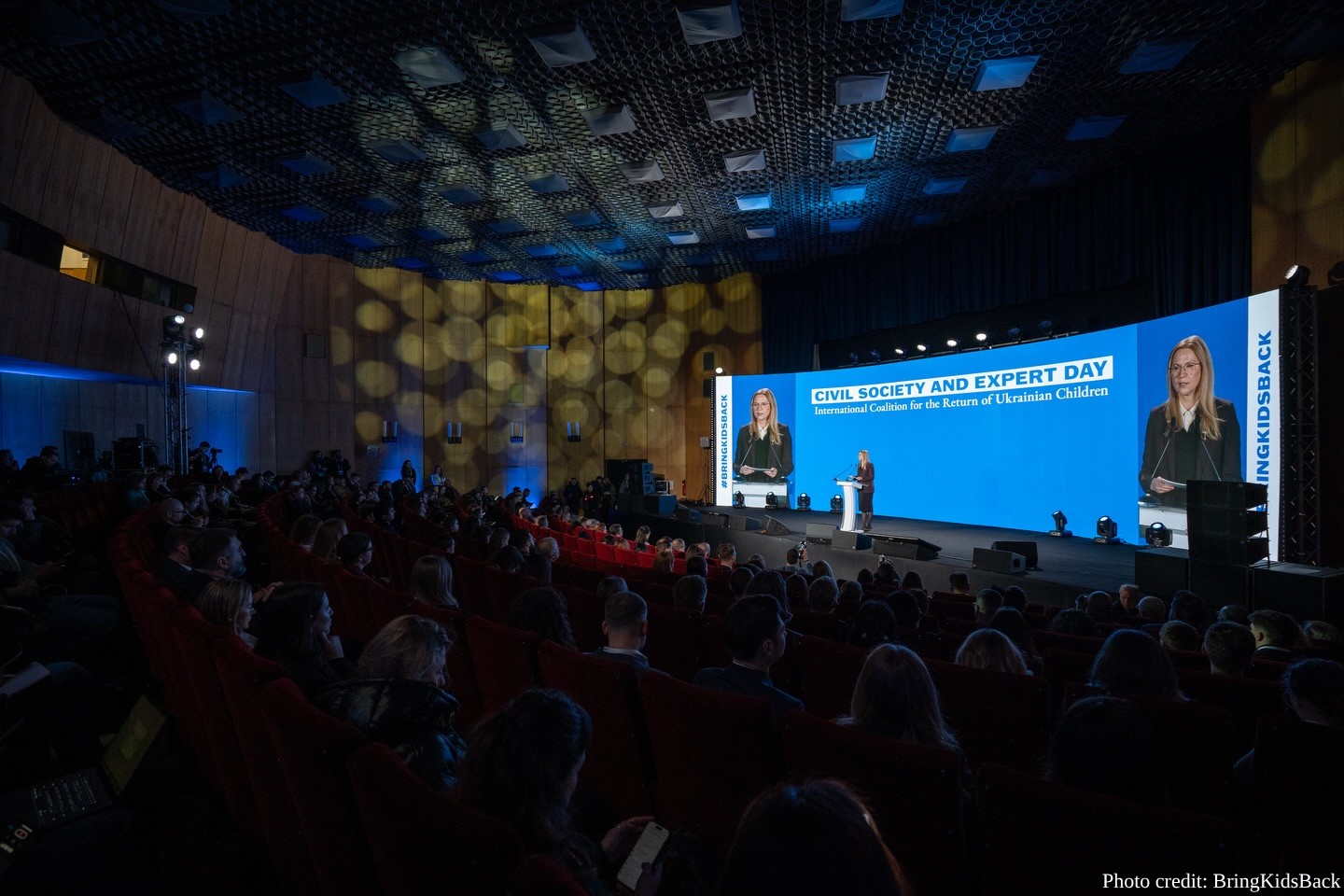 Olena Kondratiuk
Researchers, human rights defenders, lawyers, volunteers, and international partners who help us bring the truth to the world have gathered in this hall. Every day, you transform children’s testimonies into evidence on a path to justice.
As of today, Ukraine’s Ministry of Justice has verified 20,570 cases of deportation and forced displacement of Ukrainian children. However, this figure is far from final, as new data arrives daily.
According to human rights defenders’ estimates, hundreds of thousands of Ukrainian children are under Russia’s control -deported, forcibly displaced, or remaining in occupied territories at risk of further removal. Everything Russia is doing to them falls under the definition of genocide.
[…]
Each return of a Ukrainian child is a shared victory of the state, volunteers, NGOs, and, of course, our international partners.
On May 11, 2026, in Brussels, member states of the International Coalition for the Return of Ukrainian Children will meet at the level of foreign ministers to negotiate. What they will discuss largely depends on what we formulate here today [during the Civil Society and Expert Day] in Kyiv. I see many people in the hall with whom we regularly communicate, all with one goal: to bring Ukrainian children home. Everyone has their area of work.
Allow me to outline parliamentary work within the BringKidsBack.ua initiative. At the first stage, we started with the most important thing: we made the topic of Ukrainian children’s deportation impossible to ignore on any parliamentary platform in the world.
Dozens of national parliaments have adopted resolutions directly condemning the deportation of children as a war crime. This is not a declaration for declaration’s sake; it is legal and political documentation of fact, which serves as the basis for further actions and the establishment of justice.
The second stage was to systematically convey to parliamentarians of various countries, to all political leaders, information about what happens to children after their removal: forced indoctrination, militarization, and the rewriting of identity. These are not isolated cases, but a systematic assimilation policy aimed at severing children’s ties with Ukraine.
You may also want to read: Russia intensifies combat training for high schoolers in occupied Crimea — Irade human rights initiative
Russia wants to make these crimes simply invisible, hiding behind false concern for children’s welfare. That’s why it is so important to speak loudly about these problems at the international level.
And today I would like to thank all international leaders – from Ursula von der Leyen to Roberta Metsola, heads of missions in Kyiv, heads of missions of the Parliamentary Assembly of the Council of Europe, the NATO Parliamentary Assembly, and many other international partners and political leaders – for raising this issue so high, for simply not remaining indifferent, and for understanding the problem Ukraine is facing now.
The third stage of parliamentary work was legislative changes. On my initiative last year, together with our colleagues, we adopted amendments to Article 438 of the Criminal Code of Ukraine, supplementing it with provisions that directly establish criminal responsibility for war crimes against children. This includes crimes of delaying children’s return, as well as their recruitment. These changes aligned Ukrainian legislation with international humanitarian law norms and should provide a specific legal basis for prosecuting the guilty.
Finally, we are all now at the fourth stage together. I am talking about our common task – the unification of sanctions lists for crimes against Ukrainian children.
An analysis of seven major jurisdictions on child-related sanctions, conducted by human rights defenders, found that only 5% of individuals and legal entities appear on all lists. 42% of sanctioned persons on Ukraine’s list are absent from foreign sanctions lists.
The latest study by Yale Humanitarian Research Lab directly proved for the first time the participation of major Russian state corporations – Gazprom and Rosneft – in the system of deportation and indoctrination of Ukrainian children. The study identified 44 subsidiary organizations connected to this activity. About 80% of them are currently not under U.S. and European sanctions.
Human rights defenders’ research also documents the systematic participation of the Russian Orthodox Church in the Russian Federation’s criminal policy toward Ukrainian children.
All this means sanctions must transition from masses of names to a clear hierarchy of responsibility. Sanctions lists must be segmented into political leadership, administrative coordinators, state corporations, and, of course, executors. Sanctions should be expanded to family members and connected networks. Believe me, this is what Russian officials fear most. Sanctions need to be imposed not only for direct actions but also for complicity.
Most importantly, we need a mechanism for rapid, automated unification of national sanctions lists worldwide.
[…]
Every returned child is not just a statistic; each is a specific child: Veronika Vlasova, Ilya Matvienko, Kira Obedynska, Marta Gladkova, Sashko Radchuk, and Lera Sydorova. These children have returned, but thousands of Ukrainian children are still waiting to return. This issue must remain unwavering in any negotiations. The return of all deported, forcibly removed, and displaced children must be an integral prerequisite for any future negotiation processes and any agreements.
Liked this column? Follow ZMINA on X, BlueSky, and LinkedIn, and help shape our editorial focus by filling out our feedback form here.