Political decision and a dangerous precedent: Experts comment on Poland’s release of the architect Butyagin, who was to be extradited to Ukraine
Poland’s release of Russian architect Aleksandr Butyagin is a political decision that bears signs of a violation of international law and encourages the aggressor state, Russia. The release was a part of a prisoner exchange – Butyagin was to be extradited to Ukraine on charges of illegal excavations in Ukrainian Crimea, which is temporarily occupied by Russia. Such opinions were expressed by human rights defenders and public figures, commenting on the ‘5-for-5’ prisoner swap that took place on April 28, 2026, at the Polish-Belarusian border.
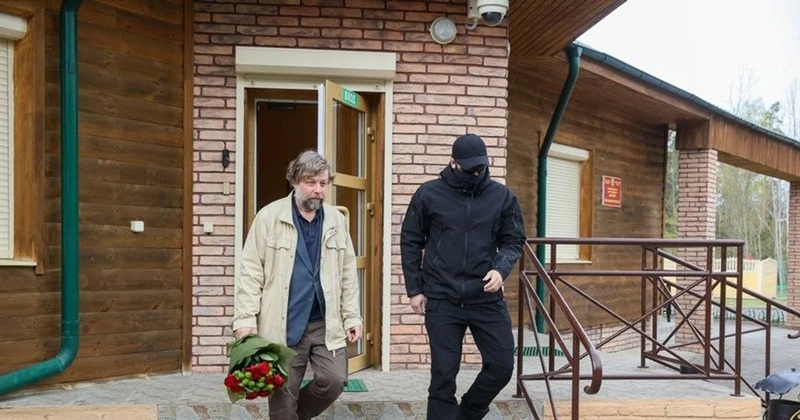 Aleksandr Butyagin during the transfer to Belarus. Photo credit: BELTA
First and foremost, they pointed out that Russia was likely involved in the exchange negotiations, while for Ukraine, this decision came as a surprise. The latter follows from the statement by Ukraine’s Ministry of Foreign Affairs spokesperson, Heorhii Tykhyi. He noted that Ukraine “learned with regret that, contrary to the previous decision of the Polish court, a Russian citizen – reasonably suspected of committing crimes on the territory of Ukraine, specifically in the removal of cultural property from Crimea – was ultimately not extradited to Ukraine.”
Journalist and human rights activist Anton Naumliuk, Mejlis of the Crimean Tatar People Chairman Refat Chubarov, and lawyer and Media Initiative for Human Rights expert Andrii Yakovliev expressed their opinions on this matter, ZMINA reports.
“The event was the result of complex diplomatic efforts and negotiations involving the intelligence services of at least several states — Poland, Moldova, Belarus, the USA, and Romania. I have no doubt that Russia was also directly involved in this process. At the same time, I do not know whether the Ukrainian side participated in these negotiations at any stage,’ Refat Chubarov wrote on his Facebook page.
Chubarov emphasized that he is sincerely glad for Polish journalist Andrzej Poczobut, as well as the Belarusian public activists and human rights defenders who gained their freedom as a result of this exchange.
At the same time, the politician noted that he is “weighed down by the realization that instead of the rigorous application of all international pressure tools to end the war, which daily brings unspeakable suffering to millions of Ukrainians, global practice is increasingly adapting to the rules imposed by the aggressor.”
In addition, Chubarov also mentioned Crimean political prisoners:
“There are more than 350 such today. More than half of them are Crimean Tatars… I have discussed various possible ways to release these people with my interlocutors […] However, none of the approaches I proposed involved bargaining, which, as today’s exchange demonstrates, presupposes the presence of an “asset” that is of interest to Russian intelligence services.”
Legal expert and analyst at the ‘Raphael Lemkin Society’ NGO, Daryna Pidhorna, noted that a state truly has the right to refuse extradition in favor of an exchange if it considers it more beneficial for its state interests, but the right to refuse is not unconditional:
“Poland was legally obliged to complete the review of the extradition request and officially notify Ukraine of the final decision. Moreover, the consent of the requester – i.e., Ukraine – to waive its demands should have been the subject of separate diplomatic negotiations. Judging by our MFA’s reaction, none of this happened,” she said.
According to the expert, this behavior creates a dangerous precedent: any extradition proceeding can, in theory, be canceled by the executive branch through a diplomatic exchange – moreover, without any explanation or even basic notification to the requester.
Journalist and human rights activist Anton Naumlyuk called the “liberations and exchanges we have become accustomed to” a political process, for which there is little point in applying a legal assessment.
“As is always the case with such exchanges, information is scarce, while doubts about justice are plentiful. It is not clear to what extent the decision to hand over Butyagin was coordinated with Ukraine. Ukraine’s Office of the Prosecutor General seems to have confirmed this: ‘The decision regarding Butyagin was made in the context of international agreements related to the exchange of detainees,” the journalist commented.
Naumlyuk also pointed out that among those exchanged, “it seems there is not a single Ukrainian.”
“It would have been at least partially fair, given that Butyagin – against whom Ukraine has claims due to his work in Crimea – was released, to expect the release of one of the Crimean political prisoners, especially since among them are several who are critically ill. But no, we would have known about that,” he writes.
In his conviction, there should have been a trial of Butyagin’s case in Ukraine. Not only because of the unconditional desire for justice of Ukrainians and Ukraine, whose sovereignty Butyagin violated with his work in temporarily occupied Myrmēkion, but also because his case could have become a precedent, marking the first time a legal judicial assessment was given to the work of professional archaeologists in occupied territories.
For his part, Andrii Yakovlev, an expert from the Media Initiative for Human Rights, emphasized that the Russian archaeologist was not released but handed over, and that the extradition procedure is currently incomplete. In Poland, Butyagin was designated a detainee at Ukraine’s request. There was no information that the Polish Minister of Justice had rejected the extradition request or that the appeal was rejected. How Butyagin exited the extradition procedure is currently unknown, the lawyer noted.
According to Yakovlev, there is a possibility that Butyagin could be detained in other European countries. However, he will obviously avoid such visits.
‘Butyagin still has the status of a suspect in the case led by Ukraine. It can be heard in absentia in Ukraine. Moreover, we know that he is definitely aware of these proceedings,’ Yakovlev said.
The detention of the archaeologist and the attempt to extradite him will serve as a warning to other Russians, the expert believes. In his opinion, from now on, archaeologists “are unlikely to publicize what they are doing” or, perhaps, they will abandon their activities in temporarily occupied Crimea. They will also be wary of visiting European countries.
To provide background, on April 28, 2026, Poland handed over to Belarus the archaeologist and historian Aleksandr Butyagin, who, by a Polish court decision, was to be extradited to Ukraine. The Russian was exchanged at the Polish-Belarusian border as part of a “5-for-5” swap. As a result of the exchange, three citizens returned to Poland. Among them is one of the leaders of the Polish national minority in Belarus, journalist Andrzej Poczobut, sentenced by the Lukashenko regime to eight years in prison on charges of allegedly inciting hatred and “calls for sanctions”.
The Office of the Prosecutor General, commenting on Butyagin’s handover, stated that the Ukrainian side consistently insisted on his extradition to hold him criminally accountable in Ukraine.
During the review of the request, Poland provided a proper assessment of the Ukrainian side’s materials and recognized them as sufficient to resolve the issue of extraditing the individual to Ukraine. The subsequent decision regarding Butyagin was made in the context of international agreements related to the exchange of detainees.
They also emphasized that they will continue to use all national and international mechanisms to hold the Russian accountable for committing crimes in Ukraine and Ukraine’s cultural heritage. This will proceed through the in absentia prosecution procedure.
Stay connected with us via X, BlueSky, and LinkedIn – and while you’re here, please spare five minutes to fill out our survey and tell us what you’d like to see next.