Why do Ukrainians living under occupation obtain Russian passports?
When people in Ukrainian-controlled territory learn that someone from the occupied territories holds a Russian passport, their first reaction is often condemnation: “traitor”, “they’ve come here to spy” and similar accusations. But behind this “choice” lies not loyalty to the aggressor state, but a carefully constructed system of legal, economic and physical coercion.
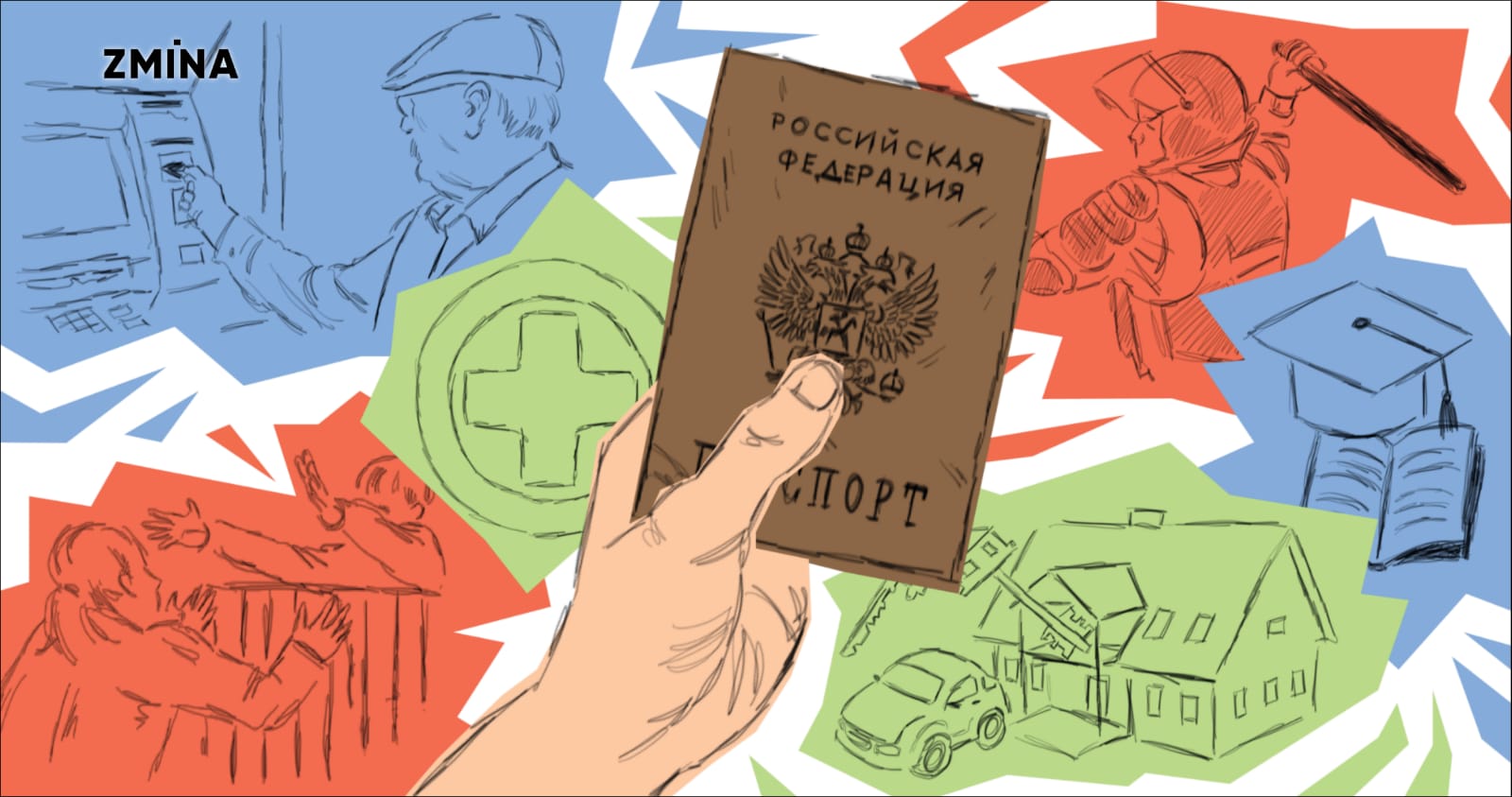
For more than a decade, Russia has been refining a system in the occupied territories of Ukraine that makes life without “Russian citizenship” virtually impossible: without it, people are denied medical treatment, school-leaving certificates, pensions and formal employment.
ZMINA spoke to a young woman who left temporarily occupied Donetsk and gathered insights from human rights defenders to explain why obtaining a Russian passport under occupation does not amount to betraying Ukraine.
“It’s easier to survive under occupation with a Russian passport than without one. Without support from relatives or anyone else, it’s simply impossible,” says 19-year-old Sofiia (name changed for security reasons), who left temporarily occupied Donetsk.
She obtained a Russian passport not because she wanted to become a Russian citizen, but because she needed it to receive her school-leaving certificate and, later, to leave the occupied territory.
“At school, they told us we had to get Russian passports before they would give us our school-leaving certificates. No passport meant no certificate, and I needed it to leave and enrol at a Ukrainian university,” Sofiia explains.
After reaching Ukrainian-controlled territory, she was able to have her grades in certain subjects transferred from her Russian school-leaving certificate to a Ukrainian one. She took external examinations in the subjects that had not been part of the curriculum in temporarily occupied Donetsk – Ukrainian language and history.
However, forced passportisation extends beyond education.
“After 2022, you needed health insurance to receive medical care, but the policy wasn’t valid without a Russian passport. You could only leave if you had a Russian passport because they wouldn’t let you through with a ‘DPR’ passport (Initially, in the occupied parts of Donetsk and Luhansk regions, the occupying authorities issued documents modelled on those of the so-called DPR and LPR rather than Russian passports. These documents were used in the occupied territories from 2015 to 2024). It was effectively invalid,” Sofiia explains.
Timeline: Russia’s forced passportisation of Ukrainians since 2014
Forced passportisation did not suddenly begin in 2022 – it is a longstanding, systematic practice that the Kremlin has refined over the years.
2014, Crimea. Following the illegal annexation of the peninsula on 18 March 2014, Russia declared everyone living in Crimea and Sevastopol at the time to be Russian citizens.
Residents could refuse Russian citizenship only by submitting a written declaration within one month. However, those who did so immediately faced difficulties finding employment and registering their place of residence, and lost access to free healthcare, says Olha Kuryshko, Permanent Representative of the President of Ukraine in the Autonomous Republic of Crimea.
 Olha Kuryshko, Permanent Representative of the President of Ukraine in the Autonomous Republic of Crimea
2015–2019, the Donetsk and Luhansk Regions (Oblasts). Initially, the occupation authorities issued documents of the so-called DPR and LPR rather than Russian passports. From June 2019, residents of these territories were able to obtain Russian passports directly through a simplified procedure.
July 2020. According to Oleksii Reznikov, Ukraine’s Deputy Prime Minister at the time, 200,000 Russian passports had been issued in the occupied parts of the Donetsk and Luhansk Oblasts.
November 2020. Ukraine filed a submission with the International Criminal Court (ICC) against Russian officials over the forced passportisation of residents of temporarily occupied Crimea.
At the time, the Prosecutor General’s Office stressed that Ukraine would not prosecute Ukrainians living in the occupied territories for obtaining Russian passports, as “Russian citizenship had been imposed on them by force”.
15 December 2020. According to human rights defenders, 583,143 passports of the so-called LPR and 671,631 passports of the so-called DPR had been issued in the occupied territories of Ukraine.
Residents of the occupied territories had also received nearly 442,000 Russian passports: 168,381 in the Luhansk region and 273,461 in the Donetsk region.
As Russia occupied more Ukrainian territory following its full-scale invasion, forced passportisation expanded accordingly.
July 2022. Kremlin leader Vladimir Putin signed a decree simplifying the procedure for obtaining Russian citizenship for all Ukrainian citizens – effectively extending what had previously been a “regional” practice to the entire country. In response, Ukraine’s Ministry of Foreign Affairs stated that such passportisation was legally null and void and would have no consequences for Ukrainian citizens.
April 2023. Putin issued a decree giving residents of the newly occupied parts of the Donetsk, Luhansk, Zaporizhzhia and Kherson Oblasts two options if they wished to remain in their homes: voluntarily accept Russian citizenship or obtain a permanent residence permit through a simplified procedure.
Those who did neither faced the threat of being classified as “foreigners” and deported – despite international law explicitly prohibiting the forcible transfer or deportation of civilians from occupied territory.
December 2024. Documents issued by the so-called DPR and LPR, which the occupying authorities had been forcing Ukrainians to obtain since 2014, became invalid.
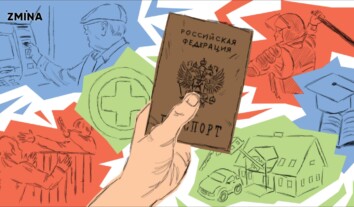
Russian passport and a passport of the so-called “DPR”. Photo from occupation sources.
January 2025. People living in occupied territory without Russian passports were classified as “foreigners” and ordered to ‘legalise’ their status or leave by the end of April 2025.
 Photo from Russian media outlets
December 2025. Although Russia had been declaring homes in the temporarily occupied territories “ownerless” and seizing them since 2014, the Russian occupying authorities enshrined this practice in federal law. The measure applied in particular to Ukrainians who did not hold Russian passports.
In March 2025, Russia’s Ministry of Internal Affairs stated that 3.5 million Russian passports had been issued in the temporarily occupied territories of Ukraine. However, this figure does not indicate support for Russia – it shows how effectively the system of coercion operates.
Why people really obtain Russian passports
The reasons vary, but they have one thing in common: people often need a Russian passport not because they want Russian citizenship, but to meet their basic needs and, sometimes, to save their lives.
Healthcare. Free medical care, including emergency treatment, is available only to those with compulsory health insurance, which cannot be obtained without a Russian passport.
Education. Obtaining a school-leaving certificate recognised in the occupied territory requires a Russian passport. Without one, a child cannot complete their schooling or enrol at an educational institution. The certificate may also be needed after leaving for Ukrainian-controlled territory, particularly to provide proof of education and make it easier to obtain Ukrainian documents.
Pensions and social benefits. Since 2023, pensions and social benefits in the temporarily occupied territories have been paid exclusively under Russian law, which requires recipients to hold a Russian passport.
Employment. Employers are required to register their employees under Russian law or face fines, making formal employment largely inaccessible to those without Russian passports.
Property. Real estate and land belonging to people who have not obtained Russian citizenship may be declared “ownerless” and seized.
Threat of deportation and separation from children. People without Russian passports are officially classified as “foreigners” and threatened with deportation. An especially severe form of pressure involves threats to deprive parents of their parental rights and remove children from families that refuse Russian citizenship.
Physical intimidation. Human rights organisations have documented cases of beatings, searches and detentions targeting people for their pro-Ukrainian views and refusal to obtain Russian passports.
According to Sofiia, some people living under occupation still have not obtained Russian passports, most of them older residents. However, Russia continues to exert intense pressure on them to do so.
“These people refuse to obtain Russian passports for as long as they can, until they are forced to – for example, by being dismissed from their jobs. It’s impossible to find another job without a Russian passport. They also can’t see a doctor and have to treat themselves at home,” Sofiia explains.
Sofiia stressed that refusing to obtain a Russian passport while living under occupation is extremely risky, as Russian security forces regularly carry out searches.
“Soldiers or police officers turn up supposedly ‘to ask a few questions’, but they end up simply searching the flat. If they discover that someone doesn’t have a Russian passport and has held on to their Ukrainian passport since 2014, they see that alone as grounds for persecution,” Sofiia says.
There have also been reported cases in the temporarily occupied parts of Kherson and Zaporizhzhia Oblasts where Russian occupying forces killed civilians for refusing to obtain Russian passports.
What human rights defenders advise
The key point for people in Ukrainian-controlled territory to understand is that obtaining a Russian passport under coercion has no legal effect on a person’s Ukrainian citizenship.
Ukraine does not recognise documents issued by the occupation authorities, so there is no formal procedure for renouncing such a passport – there is nothing to renounce. Legally, the person remains a Ukrainian citizen.
The Office of the Ukrainian ombudsman for human rights has repeatedly stressed that forced passportisation is a serious violation of international humanitarian law, not an expression of the population’s free will. Those affected by this practice are not accomplices to a crime, but its victims.
If you know that citizens of Ukraine have faced forced passportisation under occupation or have already been forced to obtain a Russian passport, human rights defenders recommend the following:
Document the circumstances of the coercion – including the type of pressure used (threats, intimidation or denial of services), the date, location and people involved, provided it is safe to do so.
Report the forced passportisation to Ukrainian law enforcement agencies or the Office of the Ukrainian ombudsman for human rights. Doing so will not expose the person affected to legal liability; instead, it will help document the crime committed by the occupying authorities. You can contact the Office:
- By post: 21/8 Instytutska Street, Kyiv, 01008, Ukraine;
- By email: hotline@ombudsman.gov.ua;
- By phone: 0 800 501 720, 044 299 74 08. When submitting a report, the person who suffered from this crime should provide their full name, date of birth, place of residence, the circumstances in which the passport was obtained (including any pressure, threats or intimidation), and contact details.
Do not be afraid to speak openly in Ukrainian-controlled territory. Silence and shame only reinforce the stigma surrounding the issue, while openly explaining how people are coerced helps remove the unfair blame placed on those affected.
Sofiia urges Ukrainian society and the media to discuss forced passportisation more frequently and openly – so that instead of automatically labelling people “traitors”, they recognise that the practice is part of a deliberate policy by the occupying authorities to drive Ukrainians from their homes.
“When a Ukrainian is forced to obtain a Russian passport, that doesn’t mean they are considered Russian. That passport isn’t valid at all,” Sofiia stresses.
For people living under Russian occupation, it is often not a question of choosing between a Russian passport and a Ukrainian one. Obtaining a Russian passport can determine whether they are able to live a normal life, receive medical treatment, work, study or leave.
Liked this article? Follow ZMINA on X, Bluesky and LinkedIn, and help shape our editorial focus by filling out our feedback form here.