Jammed, then struck: how Bakhmut’s Free Radio reinvented itself as a watchdog
Free Radio began as the dream of a 21-year-old journalism graduate and went on to become the voice of Bakhmut. After the city was destroyed, Free Radio became a watchdog for transparency among Donetsk Oblast’s local authorities operating in exile.
After Russia launched its full-scale invasion, Free Radio continued broadcasting remotely despite Russian attempts to jam its signal. Later, the building housing its newsroom was directly hit.
Anastasiia Shybiko, co-founder and director of Free Radio, told ZMINA how the outlet continues to operate without its radio broadcasts, how it prompts officials and government representatives to correct their mistakes, and how it pushes local authorities in Donetsk Oblast to become more transparent and responsive to residents.
This is the third article in a series about relocated media outlets.
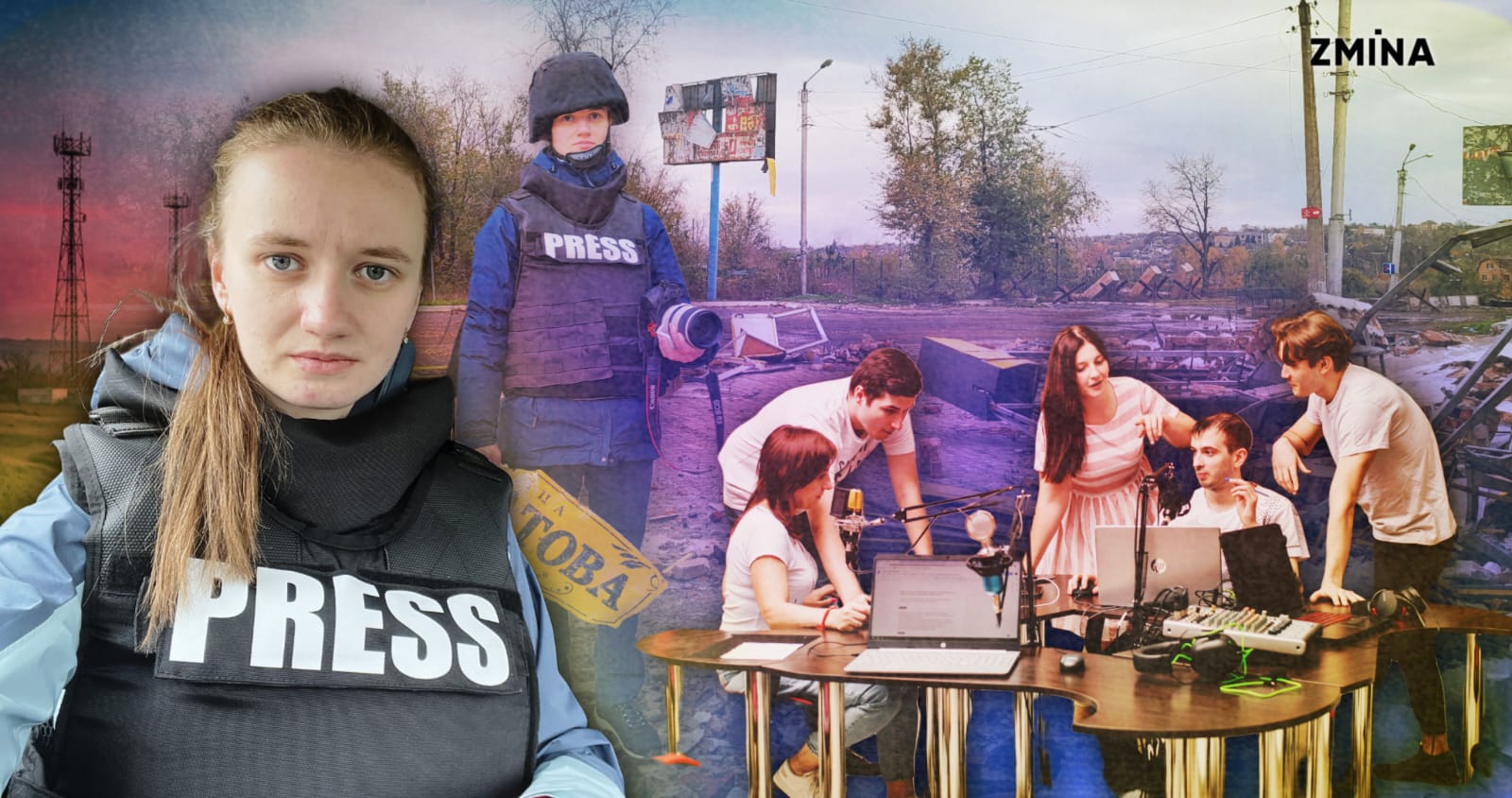
After 24 February 2022, 25-year-old journalist Anastasiia Shybiko felt like a real resistance fighter. When Russia launched its full-scale invasion, she was staying at her brother-in-law’s three-storey house in the village of Lubianka, near Hostomel in Kyiv Region (Oblast). When Russian forces occupied the village, gunshots rang out in the yards as the soldiers began shooting dogs. When they entered the house where Anastasiia was staying, they asked whether there were any dogs and ordered the residents to lock them away. Her brother-in-law managed to get the frightened dog into one of the rooms and shut the door.
That decision proved crucial. The Russian soldiers ransacked the house but never looked inside the room where the dog was locked up. That was where Anastasiia and her husband had left their personal belongings, electronic devices and legally owned civilian firearms. The work-related materials and photographs on their phones could have meant an instant sentence from the occupying forces.
Knowing that the Russian soldiers might still find them, the couple hid their electronic equipment, took their weapons and set off into the unknown. For four days, they made their way through dense undergrowth and small wooded areas in the Russian-occupied Kyiv Oblast, constantly risking their lives as they headed towards Ukrainian-controlled territory. Eventually, they made it to safety.
Had that dangerous journey through the forests ended differently, Free Radio’s story might well have come to an end or, at the very least, taken a very different course.
Nowadays, Free Radio operates as a news website, with little left of its radio broadcasting past beyond the name. Yet behind that name lies the dramatic history of an FM radio station from Bakhmut. With the city destroyed by Russian forces, the outlet no longer has the broadcasting capacity, funding or technical resources needed to reach occupied territories from Kyiv as it once did. Nevertheless, its team continues to work remotely, keeping people informed despite the war.
Youthful ambition and a broadcasting licence
Free Radio began with a willingness to take risks and a dose of youthful idealism. Its founder, Anastasiia Shybiko, was a determined 21-year-old journalism graduate of Ivan Franko National University of Lviv. While working as a freelance correspondent in the conflict zone and contributing to Hromadske Radio, she met many community activists and volunteers, including Dmytro Koziarskyi and Illia Lysenko.
Illia Lysenko founded the ASAP EMS Hottabych charitable foundation, which provided emergency medical evacuations and rescued wounded people from the front line (ASAP EMS stands for As Soon As Possible Emergency Medical Services – Ed.). Dmytro Koziarskyi was also involved in the foundation’s work.
The volunteers were well aware of the urgent need for Ukrainian-language broadcasting in frontline and occupied areas, so they encouraged Anastasiia to take a chance and set up a radio station in Bakhmut. Anastasiia recalls that her enthusiasm and desire to do something truly meaningful led her to accept the challenge without hesitation, pack her bags and move to the Donetsk Region (Oblast).
 Anastasiia Shybiko, journalist and co-founder of Free Radio
This was in 2017. In May, Anastasiia began developing the station’s concept and navigating a seemingly endless series of legal procedures. To start broadcasting, she had to secure a licence and a frequency from the National Council of Ukraine on Television and Radio Broadcasting. While dealing with the bureaucracy, she continued travelling to the front line to produce reports for national media outlets.
“The idea was to create a local radio station for Bakhmut and the surrounding area. A genuinely local station. At the time, there was only Holos Donbasu, run by Ukraine’s public broadcaster, Suspilne. All the others simply rebroadcast programmes from elsewhere. And that made little sense because locals did not listen to a station from, say, Lviv, with programmes, news and adverts all about Lviv. That’s why we wanted a station that was truly local,” Anastasiia explains.
She adds that the occupied territories were just 20 kilometres away, meaning people there could also tune in to Free Radio from Bakhmut:
“We produced news bulletins covering both Ukrainian-controlled and occupied territories, as well as analytical programmes and other content. Initially, the idea was to provide people living under occupation with Ukrainian content. We wanted to show them that they mattered to us and that we hadn’t forgotten about them. There was no propaganda or ridicule involved.”
On 9 January 2018, the project finally received its long-awaited broadcasting licence. Free Radio went on air on 5 April.
Building a team and securing the first grant
When Anastasiia shared her idea with colleagues and friends in Kyiv during the preparations, the question she heard most often was: “Where are you even going to find people in Bakhmut?” Finding qualified staff did indeed prove difficult. She ended up hiring a journalist and a sound engineer who supposedly had experience but neglected their duties.
That was when Anna Serdiuk stepped in to help. A friend of Anastasiia’s and a reporter for Channel 24 at the time, she had met Anastasiia through media training programmes. She joined the project as an editor while continuing to work in television.
The team decided to change its approach to recruitment and hired two young local residents through a job advertisement – Diana Sharodi and Denys Rudenko. Both were students with no professional journalism experience but a strong desire to work and learn.
Anastasiia and Anna, who was helping remotely, began teaching them the basics from scratch, from writing news stories to presenting radio programmes.
Before long, the station began airing its first news bulletins and in-depth interviews with local officials and volunteers on pressing issues. Interestingly, one of the earliest and most frequent requests from listeners in the occupied territories was for… weather forecasts. The team had not originally planned to include them in the broadcasting schedule, but once they realised how important this information was to people living under occupation, they quickly added weather forecasts to their programmes.
In its early days, the radio station relied almost entirely on enthusiasm and occasional financial support. The first substantial contribution came from a pro-Ukrainian businessman from Horlivka, who understood the importance of establishing a Ukrainian media outlet in the Donetsk Oblast. The station also received small private donations, while volunteers provided office equipment and second-hand gear. However, Anastasiia knew that donations alone would not sustain the station for long, so she began looking for grant funding in 2017 and submitted her first application that year.
A major turning point – and a lifeline for the station – came on 1 August 2018, when Free Radio received its first grant from the European Endowment for Democracy (EED). The grant provided funding for two years, giving the team a long-awaited sense of stability and the reassurance that the station would not have to shut down overnight. According to Anastasiia, this support was crucial: without it, Free Radio would most likely have ceased to exist before it had properly got off the ground.
A friend of Dmytro Koziarskyi developed the outlet’s website free of charge, paid for its hosting himself and provided ongoing technical support.
In August 2018, Anna Serdiuk became editor-in-chief of Free Radio. In doing so, she accepted a lower salary than she had earned at Channel 24 and gave up the stability and predictability of her previous job to join a brand-new media outlet – small, local and based close to the front line.
“What national media outlets lack is that close connection with their audience. We discovered, for example, that a hospital lift had broken down and seriously wounded patients had to be carried up to the third floor every day. We reported on it several times, and eventually the lift was repaired. Or take my colleague Oleksandr Chervonenko, who once came in proudly announcing that he had seen someone reading his article on their phone on a trolleybus. They were reading it because it dealt with local problems that directly affected most people in the city. That was what inspired me,” Anna Serdiuk explains, reflecting on her decision to join Free Radio.
 Free Radio’s studio in Bakhmut, 2021
Russian occupying forces systematically tried to jam Free Radio’s signal by installing jamming equipment and transmitters directly on the Donetsk television tower in occupied territory. Despite this, the team looked for legal and technical ways to keep broadcasting, secured new broadcasting permits and changed frequencies to keep reaching listeners on both sides of the line of contact.
Free Radio managed to stay on the FM airwaves in Bakhmut until November 2022. Journalists Anton Zikas, Tetiana Sarzhevska, Yevhen Vakulenko and Yevheniia Heiko presented daily news bulletins for listeners across the Donetsk Oblast.
Full-scale war and reporting under fire
When Western media outlets and intelligence agencies began warning of a possible full-scale Russian invasion, the station’s management held three emergency planning meetings to develop a detailed contingency plan for the worst-case scenario.
At the time, the team had around 15 members. About 10 were based in Bakhmut, while several others, including Anastasiia Shybiko, regularly travelled between Bakhmut and Kyiv.
The team saw signs of escalating hostilities in Donbas as early as 17 February, a week before the full-scale invasion. Anastasiia recalls that Russian forces shelled a kindergarten in Stanytsia Luhanska that day, followed by attacks on bus stops and streets in towns and cities across the Donetsk and Luhansk Oblasts. For the newsroom, this was the final signal that a major war was already here. However, the journalists believed that eastern Ukraine would bear the brunt of the attack and did not anticipate an advance on Kyiv.
On 18 February, the newsroom rented accommodation in safer parts of Ukraine where all staff members could relocate if necessary. The team also received their salaries in advance.
“Our first priority was keeping everyone safe. Getting back to normal operations came second. There were plenty of people in Bakhmut waiting for the Russians to arrive, as well as officials whose loyalties were questionable. They didn’t like journalists and could have been the first to turn us over to the enemy if the city was occupied,” Anastasiia says.
On 24 February, when news of the invasion broke, Anastasiia urgently sent staff members additional funds so that everyone would have cash available to evacuate.
Despite the team’s evacuation, Free Radio continued broadcasting remotely in Bakhmut via the local television tower.
“You can produce radio programmes from anywhere, and the signal is sent to the television tower over the internet. We continued broadcasting our own content for a while, but then switched to rebroadcasting Ukrainian Radio because we realised we didn’t have enough resources to cover the entire news agenda,” Anastasiia explains.
In March 2022, as the threat of airstrikes on Bakhmut grew increasingly serious, Free Radio focused much of its reporting on residents’ safety. While journalist Yevhen Vakulenko remained in the city, the newsroom continued covering the most pressing problems with public services and security.
Anastasiia Shybiko recalls that the local authorities spent a long time pretending nothing was happening. Mayor Oleksii Reva, who had led Bakhmut since 1994, repeatedly insisted that “everything is under control”. Even after the first strikes and fatalities, Free Radio openly reported on the dangers facing residents. Yet a full alert was still not declared in the city. Municipal workers continued mowing lawns, trimming bushes and tending roses as though life were carrying on as normal.
One particularly revealing incident occurred on 22 March, when Bakhmut residents received emergency alerts through smartphone apps, but the outdoor sirens never sounded. A Free Radio journalist immediately sought an explanation from Oleksii Roslov, head of the Bakhmut District State Administration, and discovered that the centralised warning system had malfunctioned because of the fighting. Following the media coverage, officials admitted the failure and urgently arranged for the State Emergency Service to activate the sirens manually. However, according to Anastasiia, the city authorities did not urge residents to evacuate until the situation had become critical and Bakhmut was already without electricity or communications.
Anastasiia Shybiko and Dmytro Koziarskyi, whom she married in 2020, continued visiting Bakhmut regularly until November 2022, even as fierce fighting for the city was under way. They repeatedly travelled to the Donetsk Oblast to report from the front line, but the atmosphere in the city was marked by overwhelming tension, fear and anxiety.
Relentless artillery shelling and almost daily strikes that killed civilians had pushed residents to the brink of exhaustion. Many people had already fled Bakhmut by then, but medical staff, municipal workers and those who could not or would not leave their homes remained in the city, along with some who were waiting for the arrival of the “Russian world”.
Living under the constant threat of death left residents extremely sensitive to anything happening around them. They reacted aggressively to journalists carrying cameras. When Anastasiia tried to film daily life at informal street markets, frightened and distressed residents physically confronted her, pushing her, trying to hit her and shouting angrily: “You come here filming, and then we get shelled!” Only Dmytro’s intervention managed to defuse the situation.
Beyond the psychological strain, there was also the very real threat of people helping Russian forces direct their fire. Among those who remained in the city were traitors who actively passed information about Ukrainian troop movements and positions to the pro-Russian Telegram channel “Bakhmut Z Artemovsk”. Geolocation data and photographs appeared on the channel almost immediately after shelling. The journalists witnessed one such incident themselves.
When a Russian missile exploded just 300 metres away, Anastasiia and Dmytro noticed a man behaving very suspiciously. They immediately alerted the police. After checking the man’s phone, officers thanked them for drawing attention to him and took him away. Shybiko suspects he may have been a spotter for Russian forces.
Suspicion was running at an all-time high in the war-ravaged city, and anyone carrying a camera was seen as a potential enemy. On one occasion, Anastasiia photographed remnants of Soviet monuments to Lenin and Artem that the local authorities had formally removed but left hidden behind a low fence.
After spotting them taking photographs, members of the local Territorial Defence Forces immediately followed the journalists’ car, suspecting that they were documenting military positions. To resolve the misunderstanding with the soldiers, who were exhausted and under constant stress, Anastasiia had to make an urgent call to the Ministry of Defence.
On the night of 2–3 August 2022, Russian aircraft carried out a direct strike on the building housing Free Radio’s office. It was a large industrial building, with a vehicle repair workshop on the ground floor and the newsroom on the first floor. The airstrike completely destroyed the building – the blast blew out its walls and reduced the concrete floor slabs to rubble. Fortunately, the newsroom staff had already evacuated and taken their essential equipment with them, so no one was injured. However, Russian forces later stole that same equipment from the home of Dmytro Koziarskyi’s brother during the occupation of the Kyiv Oblast.
 Anastasiia Shybiko outside Free Radio’s destroyed office
To justify yet another crime against civilian infrastructure, Russian propaganda outlets and Russia’s Ministry of Defence immediately spread another false claim. They reported the “destruction of a nationalist deployment site” and an “Azov headquarters“. In reality, there were no military facilities or personnel in the industrial building that housed the vehicle repair workshop and newsroom. Instead, Russian aircraft had destroyed another civilian building in Bakhmut with a precisely aimed aerial bomb.
Free Radio was forced to stop broadcasting altogether only in late autumn 2022, when the team lost contact with the local engineer and the equipment kept shutting down because of constant shelling and power fluctuations. The television tower was later destroyed in April 2023.
Becoming a media watchdog
After the full-scale invasion and the occupation of most of Donetsk Oblast made it impossible to continue broadcasting to these areas, Free Radio significantly shifted its focus and took on a watchdog role, scrutinising the actions of public authorities and holding them accountable.
Although parts of the Donetsk region remain under Russian occupation, local authorities and military administrations from occupied and frontline “hromadas” in the Donetsk Oblast, local government areas that each include one or more nearby settlements, continue to operate, employ staff and receive substantial funding from the state and local budgets. Monitoring their activities, spending and decisions has therefore become one of the newsroom’s main priorities.
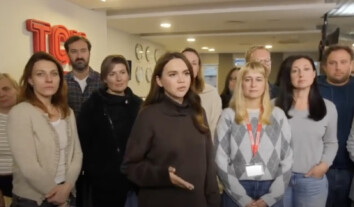
 Free Radio’s fifth anniversary
The journalists monitor how effectively and transparently officials manage public funds during the war. As part of this work, Free Radio conducted an extensive study examining the websites, social media accounts and practices for handling information requests across all hromadas in the Donetsk Oblast. The study also drew on the experience of more than 20 journalists from other media outlets in the region.
The findings formed the basis of a ranking of the openness of hromada leaders in Donetsk Oblast during the full-scale war. The study revealed stark contrasts – from officials who completely ignored residents and concealed budget spending (“do not communicate at all”) to examples of openness and effective public engagement. This monitoring has prompted local authorities to respond: following the publication of the findings, some military administrations began publishing reports more frequently, while several hromadas even revived their official communication channels to keep residents informed.
According to Anastasiia Shybiko, the study not only helped the team gain a deeper understanding of developments in the region but also gave them a concrete, measurable way to influence local administrations:
“We gained a better understanding of the situation across the region and how the authorities’ approaches differ from one hromada to another. We highlighted areas where certain hromadas could improve and established a baseline against which we can compare and track the progress we encourage them to make. This gives us a way to measure our impact on improving transparency and accountability.”
To assess openness, the team examined practical aspects of how local authorities operate: how easily ordinary residents could contact officials (whether contact details were publicly available), how active local authorities were online (through their official websites and social media accounts), and whether officials published their own local decisions and news rather than simply reposting information from national-level sources.
The ranking had an almost immediate impact, prompting local authorities to respond and address shortcomings in their work. One notable example was the Soledar City Military Administration. Just days after Free Radio published its analysis, officials issued a detailed notice listing all available communication channels, including hotlines, the official website and social media pages, to explain exactly how residents could contact their local authorities.
The Druzhkivka City Military Administration responded in a similar way. Immediately after the study was published, officials issued an official statement addressed to residents of the hromada, setting out all the ways they could contact the administration, including hotline numbers, email addresses for enquiries and its official online channels.
The cases of Soledar and Druzhkivka clearly demonstrated that journalistic scrutiny can make a difference in practice. Publicly highlighting shortcomings in transparency encourages officials to improve communication, holds them accountable to displaced people and residents of frontline areas, and helps restore dialogue between local authorities and their hromadas, even amid evacuation and war.
Free Radio’s study prompted a widespread response across almost all of the Donetsk Oblast. Following Soledar and Druzhkivka, other local administrations were quick to respond to the publication of the openness ranking, including those in Velyka Novosilka, Staromlynivka, Chasiv Yar, Illinivka and numerous other hromadas across the region.
Officials across the region began addressing shortcomings in their communication with residents by updating contact details, improving their official online pages, reminding residents how to get in touch and publishing information about their activities more frequently.
According to Anastasiia Shybiko, this response from the authorities provided clear evidence that journalistic scrutiny works and can compel officials to change their practices.
Through its watchdog role, Free Radio prompted local authorities across the Donetsk Oblast to take action and demonstrated that, even amid evacuation, occupation and war, officials can and should be encouraged to engage in open dialogue with their hromadas.
Another striking example of how Free Radio’s investigative reporting helps save lives and corrects official negligence involved shelters for residents evacuated from the Donetsk Oblast.
The Ministry for Communities, Territories and Infrastructure Development of Ukraine published what it described as an updated list of temporary accommodation facilities for internally displaced people. However, Free Radio’s journalists thoroughly checked every entry and contact detail on the list.
The findings were shocking: the information officials had presented as the “latest data” was already more than a month out of date, and two of the three shelters officially listed in the region had long since closed. Calls to all the phone numbers provided by the government went unanswered, leaving people fleeing shelling with no way to reach anyone through these “official” contacts.
Shybiko emphasises that this outcome – from quickly identifying false information to securing concrete corrections in government documents – illustrates the very purpose of journalism during wartime.
“The errors were corrected in the next update because we drew attention to them,” Anastasiia notes.
Despite all the challenges, the destruction of the office, the evacuation and the forced changes to the station’s operations, Shybiko dreams of the day when Free Radio will once again be heard on radio sets across the liberated areas of the Donetsk Oblast. She wants to believe that this is not an impossible dream, but simply a matter of time before the Armed Forces of Ukraine liberate Ukrainian Donbas. When that day comes, Ukrainian radio will return to the airwaves in Bakhmut and other cities across the region, and journalists will face another major task – monitoring, documenting and reporting on the vast and complex process of rebuilding their home region.
Liked this article? Follow ZMINA on X, Bluesky and LinkedIn, and help shape our editorial focus by filling out our feedback form here.