“It’s now the occupiers’ military commandant’s office”: Who is moving into Ukrainians’ homes in the temporarily occupied territories?
Russia is not just seizing Ukrainian territory – it is systematically reshaping its demographic, social, and property landscape. Alongside the “nationalization” of Ukrainians’ homes in the temporarily occupied territories, the Kremlin is implementing a large-scale policy of settling its own citizens in these regions.
It is not only military personnel. Russians from remote regions, their families, and labour migrants are being settled in abandoned or seized homes – all accompanied by systematic violations of international humanitarian law.
ZMINA has previously reported on how the Russian occupiers declare Ukrainians’ property in the temporarily occupied territories “ownerless” and expropriate it. This article examines who is moving into Ukrainians’ homes and how the process works in practice.
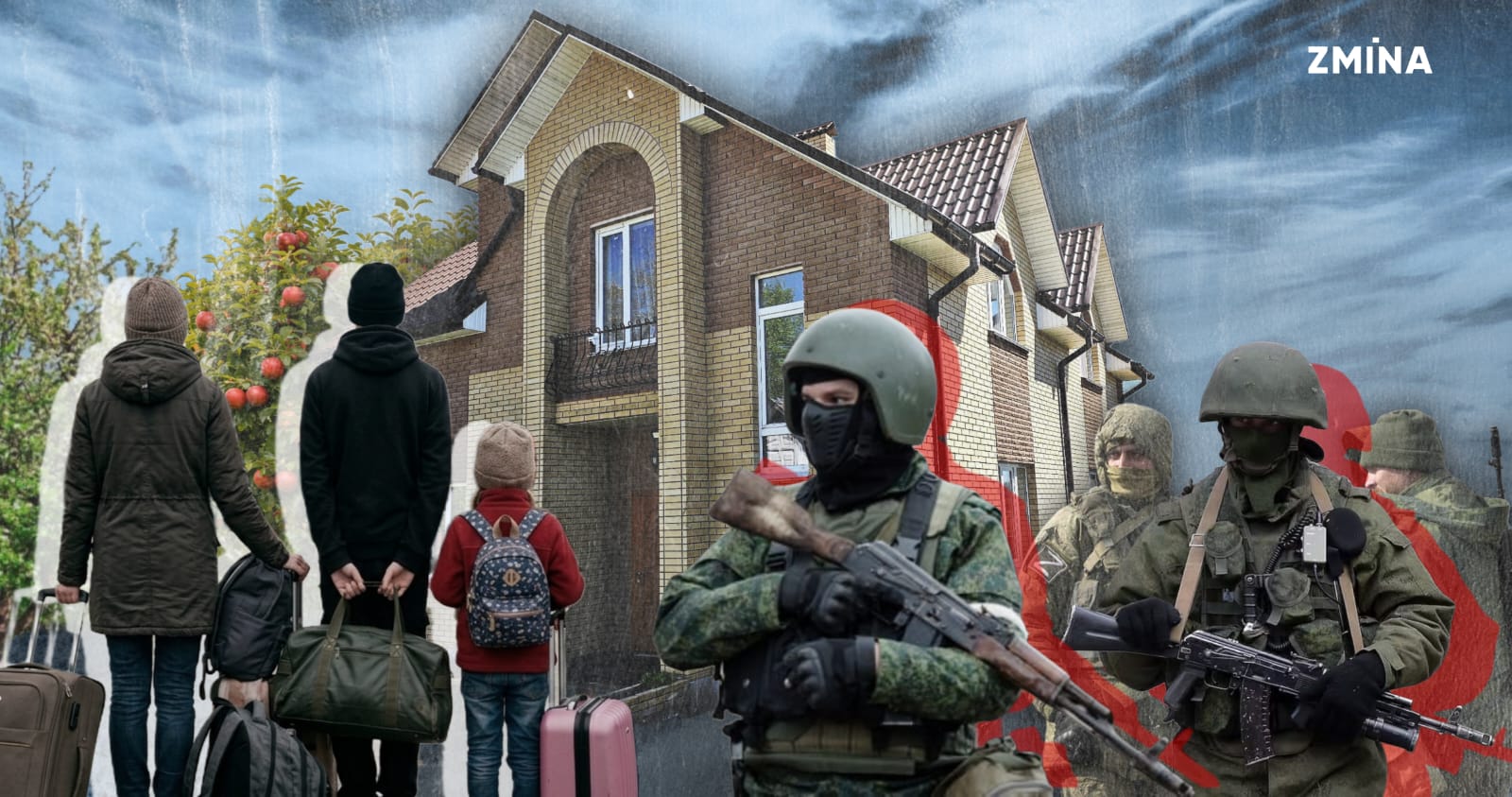
When Oleksandraі and her husband bought a house in a village in the Luhansk Oblast, they planned to spend their entire lives there. The house was not new, but that did not matter to the couple – they gradually rebuilt it themselves, investing time, money, and effort.
“We bought the plot there because my sister and parents lived nearby. We really wanted to be close to them. We bought the house from an elderly woman and spent a long time restoring it: repairing the foundation, the walls, the heating – everything with our own hands, so we became deeply attached to the place. We also planted a large young orchard ourselves – some of the trees had not even started bearing fruit when we left [the occupied territory],” Oleksandra recounts.
The couple also built a home for their elderly parents on the land.
“We had planned to bring my parents to live with us in time – we had even fully fitted out a kitchen for them in the extension. We had done almost everything to live calmly and the way we wanted. Unfortunately, that did not happen,” Oleksandra says.
After the start of the full-scale invasion, Oleksandra’s husband joined the defence of Ukraine. She remained in the occupied area with their children and did not leave for several months, as the family hoped it would all end quickly. In August 2022, she left the occupied Luhansk Oblast with her children.
How arbitrary settlement takes place under occupation
The house was left in the care of neighbors and her parents. They visited regularly and maintained the yard to give the impression that the house was occupied, but this proved insufficient. According to Oleksandra, information about empty homes spreads quickly – aided by local residents who have collaborated with the Russian occupiers.
“Neighbours called my parents and told them to come immediately. When they arrived, they were met by armed young men in balaclavas. They identified themselves as the Russian military commandant’s office and demanded the keys to the house immediately. My parents tried to resist – they showed the original documents for the house, but the occupiers did not even look at them,” she says.
You may also want to read: Russia is ready to export its scheme of passport issuance into EU, post-Soviet countries and other European states – report
The confiscation of Ukrainians’ housing is often presented by the occupying authorities as a legally formalised process. To this end, they use a mechanism for declaring property “ownerless”: individuals are required to travel in person to the occupied territory, obtain a Russian passport, and re-register their property under the rules of the occupying state. If they refuse or are unable to do so, the property is declared “nationalised.”
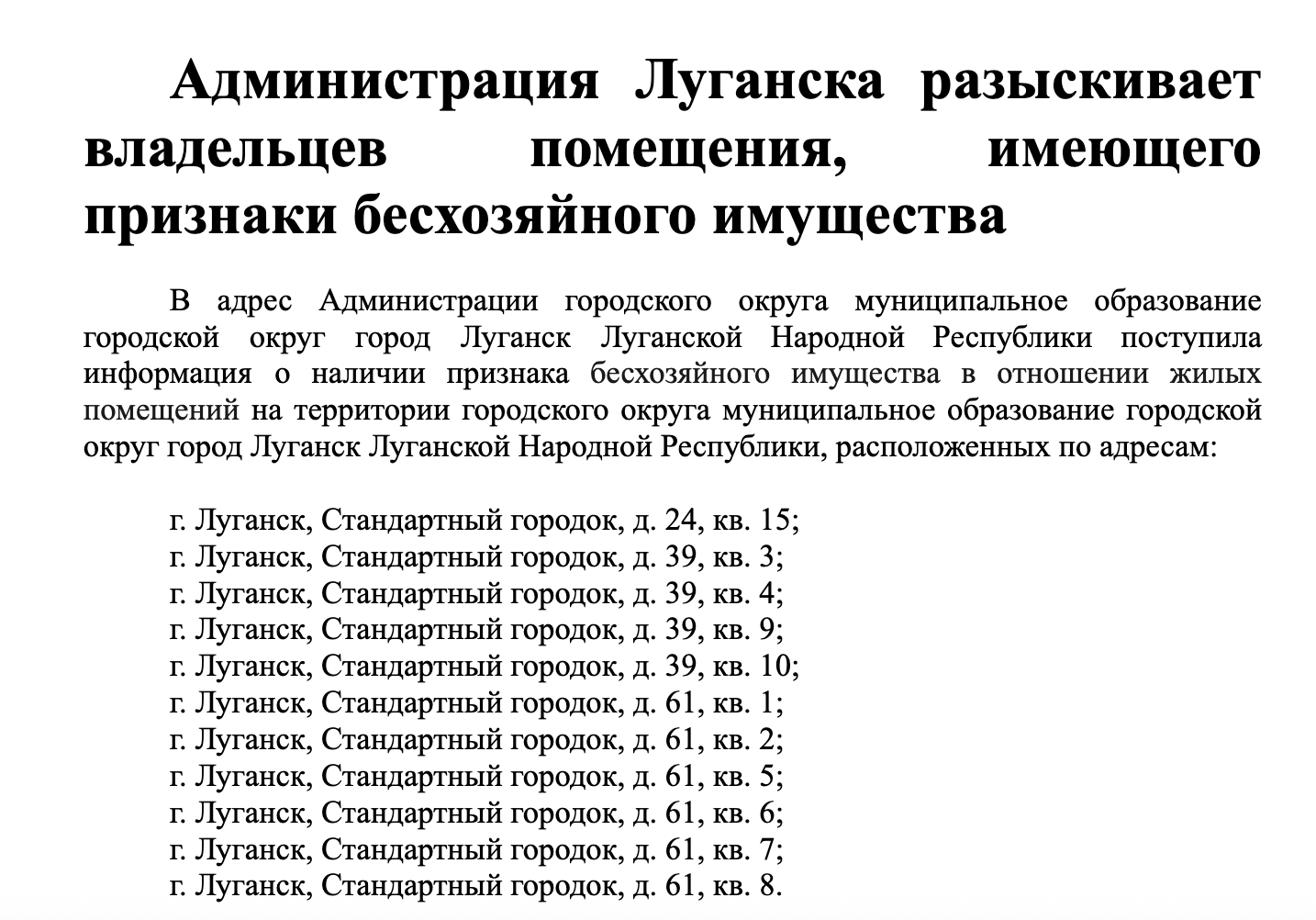 A list of “ownerless” housing published by the occupation administration of Luhansk on March 26, 2026.
In 2025, this mechanism was further entrenched in Russian legislation, without clear criteria and with no provision for compensation or the return of property.
In practice, however, even these formal “procedures” are often ignored, as in Oleksandra’s case – her property was not included in any lists of “ownerless” housing, and the family was not offered the option of re-registering the plot under Russian law.
“The official power of attorney for the house, which I issued in government-controlled Ukraine and sent to my parents via Europe, was also declared ‘invalid’ by the occupiers. As with the original documents before, no one even bothered to look at it, and the keys were not returned,” Oleksandra says.
From neighbours, Oleksandra learned that the house was first occupied by one group of Russian soldiers, then another – all from the so-called military commandant’s office. Later, the occupiers began rotating so frequently that it is now impossible to determine how many “residents” are living there.
International humanitarian law prohibits an occupying power from imposing its legislation in occupied territory, confiscating private property without compensation, or transferring its civilian population into occupied territory.
When Oleksandra’s parents managed to enter the house secretly, the family saw the aftermath of looting:
“Some of the furniture had been taken out of the house, and the washing machine was gone. The toilet had been ripped out as well. The occupiers took it away.”
After leaving the occupied territory, Oleksandra struggled for a long time to bring herself to report the loss of her home to the Ukrainian police, and when she finally did, she encountered refusals due to a lack of evidence.
“I didn’t report it because it was emotionally difficult. I still hoped we would return home. Now, of course, I understand that this will last a long time. I went to the police – the first time they told me to provide evidence. I explained that I have no way of photographing my home under occupation, or asking someone else to do it – it’s very dangerous. They refused to register the complaint several more times. When I went there again, I suggested going together to gather that evidence. After that, they finally agreed to accept my report, registered the case, and told me to keep its number. I still have it to this day,” Oleksandra says.
The Kremlin plans to bring in hundreds of thousands of new Russian residents
It has recently emerged that the Russian authorities have already developed a long-term strategy for settling the occupied territories. According to Russian media reports, Vnesheconombank, along with relevant institutions, has prepared 15 master plans and 10 planning projects for the occupied parts of Donetsk, Luhansk, Zaporizhzhia, and Kherson Oblasts. According to these documents, nearly 114,000 Russians are to be resettled by 2045, with more than 225,000 people involved in implementing the projects overall.
You may also want to read: From “soft power” to torture chambers: patterns of Russia’s seizure of new states based on Ukraine’s experience
In this way, the Kremlin is signalling that it does not view these territories as temporarily occupied, but as a space for long-term settlement and transformation.
To encourage relocation, the occupying state offers financial incentives, subsidised mortgages, and guaranteed employment. Separate programmes target doctors and teachers, who are promised significantly higher pay for working in the occupied territories. The occupiers also actively recruit labour migrants from abroad.
For example, Volodymyr Saldo">і , the occupiers’ appointed “governor” of the occupied Kherson Oblast, has “instructed officials to expedite the creation of a register of ‘ownerless’ property” in order to provide incoming workers with housing from this pool.
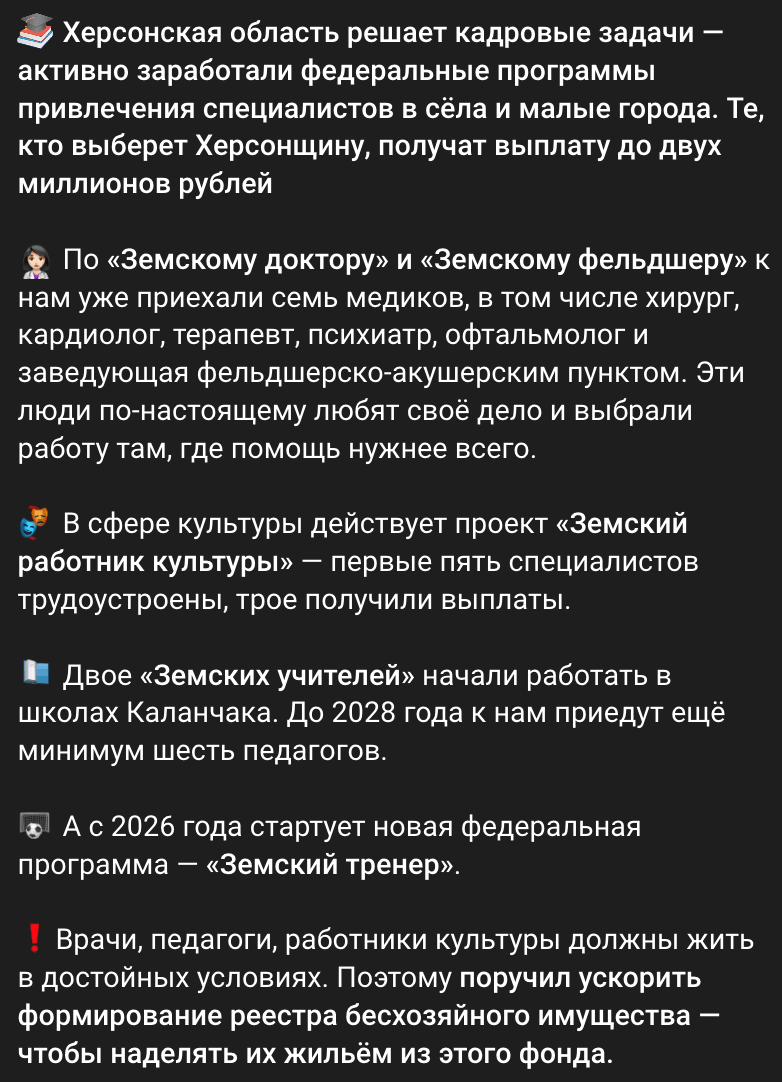 Screenshot from Volodymyr Saldo’s Telegram channel
At the same time, pressure on those who remain under occupation is increasing. According to Oleksandra, even having access to Ukrainian television can lead to threats of punishment.
“My parents still had Ukrainian television for some time. The occupiers went down the street and warned: if, in a month, we see a satellite antenna at anyone’s home, we’ll take them to the ‘basement’і …,” she says.
Language support: ZMINA volunteer Lisa DeHaven
Liked this article? Follow ZMINA on X, BlueSky, and LinkedIn, and help shape our editorial focus by filling out our feedback form here.