Blind Crimean political prisoner Oleksandr Sizikov discharged from hospital and being transferred to prison in Minusinsk
Blind Crimean political prisoner Oleksandr Sizikov, whom the occupying authorities “sentenced” to 17 years in prison in the “Hizb ut-Tahrir case”, wrote in his letter that he has been discharged from the Prison Regional Tuberculosis Hospital in Krasnoyarsk, Russia, and is being prepared for transfer back to the prison in Minusinsk.
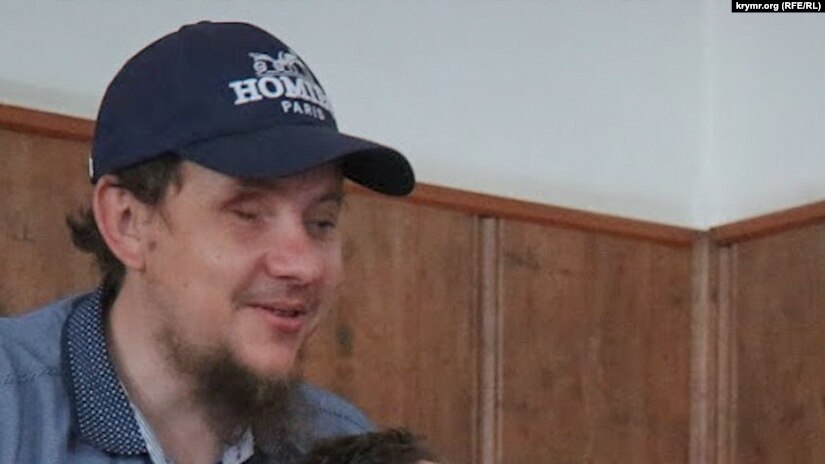 Oleksandr Sizikov. Source: Radio Free Europe/Radio Liberty / Crimea.Realities
While in the hospital, he underwent three medical examinations. The Kremlin prisoner was discharged on 10 June, 2026. According to Sizikov, he was due to be transferred on either 13 or 18 June to the facility where he is serving his unlawful sentence.
“I would like to thank everyone in advance, whatever happens“, Sizikov wrote.
 Source: the Telegram channel “Support for Oleksandr Sizikov”
Oleksandr Sizikov is a defendant in the so-called fourth Bakhchysarai Hizb ut-Tahrir case. He was born on 12 October 1984 in Simferopol and later moved with his family to the village of Turhenivka in the Bakhchysarai district, where he attended the local school. In 2002, he enrolled at Sevastopol National Technical University to study Automation and Computer-Integrated Technologies.
After graduating, he found work outside his field of study, in construction. He later became an assistant operator at a petrol station in Sevastopol. In 2006, he converted to Islam.
In June 2009, Sizikov was struck by a car while riding his bicycle. Later that year, he was assigned the highest level of disability status. From then on, he was assisted in his daily life by fellow villagers and Imam Edem Smayilov, until the imam himself was detained by the FSB and accused of “terrorism”.
Unable to accept the imam’s arrest, Sizikov, with the help of two pensioners, staged solo protests in April 2019 and May 2020 and attended court hearings.
Sizikov was detained on 7 July 2020 following searches at the homes of his friends. The FSB claims that he “established a Hizb ut-Tahrir terrorist cell in 2015” and that Alim Sufianov and Seiran Khairedinov became members of the group. As evidence of Sizikov’s guilt, the Russian security service cites books belonging to the religious and political organisation that were found during the searches. However, they were not printed in Braille.
On the day of his detention, the illegitimate “judge” of the “Kyiv District Court” in temporarily occupied Simferopol, Olha Kuznetsova, ordered house arrest as a preventive measure.
On 14 October of the same year, the “court” ordered that Sizikov undergo a month-long inpatient forensic psychiatric examination at Sevastopol City Psychiatric Hospital.
Officers of the occupation “police” took Sizikov from his home on 14 September 2024 and drove him to an undisclosed location. Prior to this, he had been under house arrest.
A day earlier, on 13 September, the Military Court of Appeal in Vlasikha, near Moscow, sentenced the political prisoner to 17 years in prison. However, the security officers did not present any documents bearing an official seal while detaining Sizikov.
Staff at the medical unit of the Simferopol’s Pre-Trial Detention Centre No. 1 refused to accept documents concerning the political prisoner’s health condition.
ZMINA previously reported that Sizikov was deported from temporarily occupied Crimea to a Russian prison despite protests by his lawyer, Safiie Shabanova, and her demands that the transfer be suspended on medical grounds.
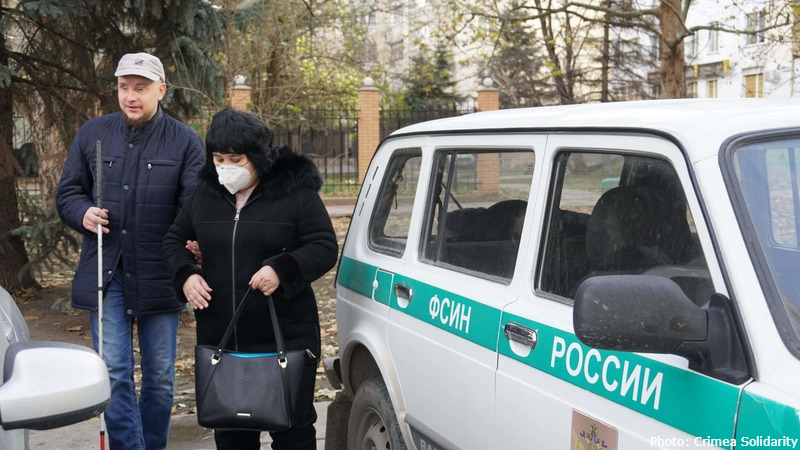 Oleksandr Sizikov and his lawyer Safiie Shabanova
It later became known that he had been taken to a prison in the city of Minusinsk in Russia’s Krasnoyarsk Krai, more than 5,000 kilometres from Ukrainian Crimea.
In March 2025, the Crimean man was transferred from prison to the Krasnoyarsk Tuberculosis Hospital No. 1 for medical examinations.
It became known in late April 2025 that Sizikov could be released from prison on health grounds. According to the convict’s mother, Olena Sizikova, the case materials were submitted to the court on 4 April 2025 after her son had been taken to a hospital in Russia’s Krasnoyarsk Krai for a medical examination.
The defence maintained that the Crimean man’s medical condition is included in the list of illnesses approved by the Russian government that prevent individuals from serving their sentences. His lawyer sent a corresponding request to Vadym Bulhakov, head of the “Federal Penitentiary Service Directorate for the Republic of Crimea”, demanding that a medical commission be convened and that the court be petitioned for her client’s release.
However, the head of the Crimean penitentiary service said at the time that he did not have the authority to file such a petition because, according to Bulhakov, Sizikov was only temporarily present in Crimea.
In May 2025, the Minusinsk City Court in Russia’s Krasnoyarsk Krai ultimately ordered the political prisoner’s release from prison due to his medical condition.
However, on the night of 23 October 2025, “police” officers carried out a search and detained Sizikov again in order to return him to prison to serve his unlawful sentence.
In March 2026, Sizikov, who was suffering from a prolonged cold, complained that he was being forced to remain on his feet for 16 hours a day without being allowed to lie down in the prison in Minusinsk, Krasnoyarsk Krai.
Keep up with ZMINA on X, BlueSky, and LinkedIn – and help us improve by answering a few quick questions here about our English-language coverage.