‘Had they detained foreign nationals, there would have been a greater outcry’: Over four years of efforts to free OSCE staff abducted by Russia
At the start of the full-scale invasion, the OSCE Special Monitoring Mission (SMM), which operated in the occupied parts of the Donetsk and Luhansk regions, came under increasing pressure. In March–April 2022, Russian and Russian-controlled media launched a campaign to discredit the organisation. Meanwhile, the mission’s staff faced growing intimidation, harassment and hostile public rhetoric.
On 31 March 2022, Russia refused to extend permission for the OSCE SMM to operate in the occupied territories. On 1 April, the mission ceased its operational activities and continued with administrative work only. However, this did not automatically end local staff members’ status as OSCE employees. Their contracts remained in force, and they retained immunity as officials of an international organisation.
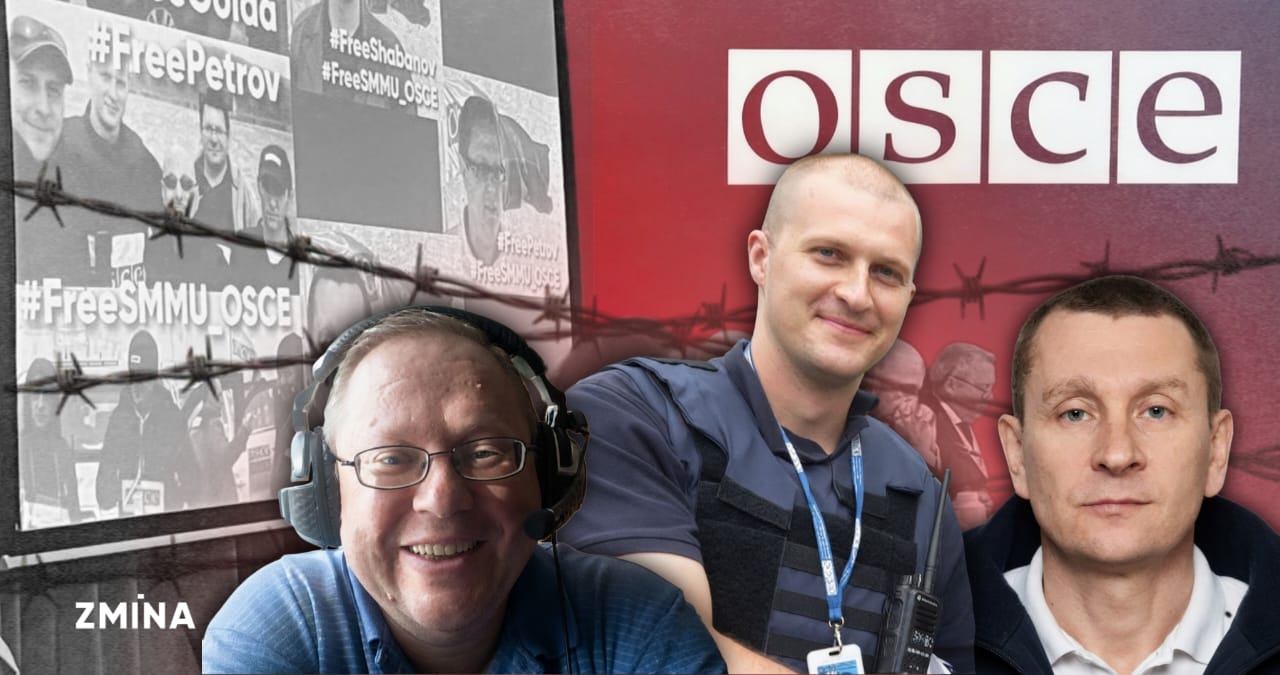
Yet in April 2022, militants from the illegal “Luhansk People’s Republic” (“LPR”) and “Donetsk People’s Republic” (“DPR”) effectively abducted three Ukrainian OSCE staff members. On 1 April, they “detained” Vadym Golda, a security assistant, in Donetsk. On 14 April, they “arrested” Maksym Petrov, a translator, in his flat in Luhansk. The following day, they abducted Dmytro Shabanov, a security assistant, from a private house in Stakhanov (now Kadiivka) in the Luhansk region.
All three were held incommunicado, without contact with the outside world, for a prolonged period. Accounts indicate that they were subjected to physical and psychological violence.
The so-called “LPR” charged Petrov and Shabanov with “treason”, treating them as citizens of the self-proclaimed entity. In September 2022, following a so-called trial in occupied Luhansk, both men were sentenced to 13 years in prison and sent to Krasnolutska Penal Colony No. 19 in Vakhrusheve, in the Luhansk region.
In July 2024, a “court” run by the occupation authorities in Donetsk found Vadym Golda guilty of “espionage” and “sentenced” him to 14 years in prison. He is currently held in Makiivka Penal Colony in the Donetsk region.
In January 2025, the judgments against Shabanov and Petrov were brought into line with Article 275 of Russia’s Criminal Code (“treason”). Both men were subsequently transferred to Russia: Dmytro Shabanov to Penal Colony No. 9 in the Omsk region and Maksym Petrov to Penal Colony No. 1 in the Chelyabinsk region.
The Ukrainian Legal Advisory Group (ULAG), a non-governmental organisation, advocates on behalf of all three Ukrainian OSCE SMM staff members.
ZMINA spoke to Ievgeniia Kapalkina, a lawyer working with ULAG to represent the families of Dmytro Shabanov and Maksym Petrov.
This article examines how international law applies to the detention and prosecution of OSCE staff who enjoy immunity, the conditions in which they are now held, the organisation’s efforts to secure their release, and the work of Ukrainian human rights defenders to protect their rights.
What did the occupation authorities charge Dmytro Shabanov and Maksym Petrov with, and under which country’s laws were they tried?
In 2022, they were convicted of “treason” under Article 335 of the so-called criminal code of the “LPR”. In January 2025, the judgments against Dmytro and Maksym were brought into line with Russian criminal law through the application of Article 275 of Russia’s Criminal Code, which covers “treason”. However, their cases were not re-examined on the merits, and their prison terms remained unchanged.
 Dmytro Shabanov
It is telling that Russia effectively recognised the judgments handed down by the “LPR court” and brought them into line with its own criminal law.
Could the “LPR”, an illegal armed group, prosecute Ukrainian citizens for “treason against the LPR”?
The so-called “LPR” authorities considered Ukrainian citizens living in the territory under their control to be their own “citizens”. This, of course, contravenes international humanitarian law.
Dmytro Shabanov and Maksym Petrov were permanent residents of the territory, but remained Ukrainian citizens and had obtained neither Russian passports nor “LPR” documents. Nevertheless, the so-called “LPR” administration treated them as its own “citizens” and prosecuted them for “treason”. This is one of the central contradictions in the case.
 Maksym Petrov
The timing also matters: Shabanov and Petrov were sentenced about a week before Russia formally declared the occupied territories part of Russia.
Unlike their counterparts in the “LPR”, the so-called authorities in the “DPR” did not automatically declare residents of the occupied territory to be their “citizens”. How can this be explained?
The so-called “DPR” had its own procedures for determining and documenting who it considered its “citizens”. The investigation into Vadym Golda began under the so-called criminal law of the “DPR”. After Russia declared the occupied territories part of Russia, he was convicted under Article 276 of Russia’s Criminal Code, which criminalises “espionage” by foreign nationals or stateless persons. The Russian authorities treated Golda as a Ukrainian citizen. The offence was therefore classified differently in his case than in those of Shabanov and Petrov.
 Vadym Golda
Could this circumstance be used to challenge the convictions under international or Ukrainian law?
The fact that Russia formally announced the “incorporation” of the occupied territories after the judgments were handed down does not alter the legal assessment of those judgments. The occupation of Ukrainian territories and the activities of the occupation administrations established there remain unlawful, as do the judgments handed down by the so-called courts and their subsequent alignment with Russian law.
Likewise, treating Ukrainian citizens as “LPR citizens” cannot legitimise their prosecution or alter their status as Ukrainian citizens.
The OSCE itself takes the same position. Its Secretary General and leadership have repeatedly demanded the immediate release of the detained staff members, stressing that they enjoy functional immunity for acts performed in the course of their official duties. In May 2022, the OSCE Secretary General explicitly described their detention as unjustified, while the organisation said it would continue working to ensure that their privileges and immunities were respected.
Were Shabanov’s and Petrov’s trials open to the public?
As far as I know, their trials were extremely brief and took place behind closed doors. Russian and “LPR” media were present only when the judgments were announced.
Although the circumstances of their cases were largely similar, the two men were tried in separate criminal proceedings. The judgments concerned virtually identical charges and were handed down at almost the same time.
 Dmytro Shabanov and Maksym Petrov during a sham “court hearing” in the occupied Luhansk region in autumn 2022
 Access to the full judgments and case files remains limited. We cannot reliably establish what evidence the charges were based on, what evidence the court examined or who testified in these cases.
Communications concerning Dmytro Shabanov and Maksym Petrov have already been submitted to the UN Human Rights Committee. They set out in detail the circumstances of their detention, prosecution and conviction, along with our legal assessment of possible violations of international humanitarian law and international human rights law.
Which specific provisions were violated?
We refer to the safeguards set out in the Fourth Geneva Convention relative to the Protection of Civilian Persons in Time of War, particularly those concerning the treatment of protected persons, the prohibition of unlawful coercion and guarantees of a fair trial.
We also cite provisions of the International Covenant on Civil and Political Rights, including the right to liberty and security of person, the prohibition of torture and ill-treatment, and the right to a fair trial.
We also question the lawfulness of the prosecution itself and the application of the occupation authorities’ laws to Ukrainian citizens, and address the circumstances of their prolonged incommunicado detention.
What do we currently know about the conditions in which Dmytro Shabanov, Maksym Petrov and Vadym Golda are held, and about their health?
Since his transfer to the penal colony in the Chelyabinsk region (Penal Colony No. 1, administered by the regional directorate of Russia’s Federal Penitentiary Service), Maksym Petrov has repeatedly been placed in a punishment cell. The exact reasons are unknown. Under Russian prison law, prisoners held in punishment cells face restrictions, including on telephone calls. According to his family, Maksym has had no telephone contact with them since 12 January 2026.
All three have health problems that require proper medical care and regular treatment. According to the information available to me, prolonged detention in poor conditions has taken a toll on their health. Their access to the treatment they need remains limited.
According to people held alongside Dmytro Shabanov in a penal colony in the Luhansk region, he began complaining of persistent back pain after being interrogated while held incommunicado.
According to the available information, Maksym Petrov was in the internal medicine ward of a prison medical facility in the Chelyabinsk region from 17 November to 23 December 2025.
The issue of access to medical care for all three men has been raised with the Ukrainian and Russian ombudsmen and the OSCE Secretary General. Turkish representatives later became involved following a meeting with Sadettin Kalkan, an ombudsman, held with support from the Ukrainian Embassy in Türkiye. The Russian authorities then said that Maksym Petrov was “fine”. However, his family received no information about his diagnosis, health or treatment. The situation is similar for Dmytro Shabanov.
At the same time, while they remain in places of detention on hostile territory, I do not want to publicly disclose specific diagnoses, details of their health or the medication they need, for security reasons.
Relatives can send medicines and food to prisoners. The procedure and frequency depend on the rules of the particular colony. The question is whether the parcels actually arrive in full. The families know that at least some of them, including medicines, do reach the men.
Why did the occupation authorities target Ukrainian OSCE staff despite their status?
These prosecutions should be seen in the broader context of Russia’s campaign against the OSCE following the start of the full-scale invasion. Russia effectively forced the organisation out of the occupied territories by preventing the Special Monitoring Mission from continuing its work.
Ukrainian citizens were left most vulnerable in these circumstances. International staff had been evacuated from the occupied parts of the Donetsk and Luhansk regions in early March 2022, but Ukrainian national staff remained.
They clearly found themselves under the direct control of the occupation authorities and faced prosecution after carrying out their official duties with the OSCE SMM.
Moreover, their detention did not provoke the international outcry that would inevitably have followed the arrest of foreign OSCE staff.
Who is investigating these cases in Ukraine, and under which provisions of the law?
Pre-trial investigations are ongoing in Ukraine. Law enforcement agencies are conducting them under the supervision of prosecutors from the Prosecutor General’s Office and regional prosecutor’s offices. The investigations concern possible violations of the laws and customs of war under Article 438 of Ukraine’s Criminal Code. At this stage, I cannot draw firm conclusions about the findings or whether those responsible have been identified.
Are negotiations currently underway to secure the release of Dmytro Shabanov, Maksym Petrov and Vadym Golda?
I can confirm that both Ukraine and the OSCE are continuing their efforts. The details of the negotiations – Russia’s specific demands, the parties’ positions and the scope for meeting those demands – are not shared with the families for confidentiality and security reasons. Representatives of the Ukrainian authorities and the OSCE Secretariat involved in this work say these restrictions are necessary because disclosing specific details could jeopardise efforts to secure the men’s release.
However, keeping negotiations confidential should not mean leaving families without information. Even informing families that particular steps in the negotiations have produced no results is an important part of maintaining open and effective communication with them.
 Ievgeniia Kapalkina, a lawyer at ULAG to represent the families of Dmytro Shabanov and Maksym Petrov
 Securing the return of Ukrainian civilians from Russian captivity remains extremely difficult, as Russia is deeply reluctant to agree to their release. You have worked with the families of civilian captives for many years. Why do you think efforts to establish an effective international mechanism for freeing Ukrainians unlawfully held by Russia have so far been unsuccessful?
In my view, the problem is not a lack of international legal rules protecting civilians. It is that the mechanisms for enforcing those rules are not always effective enough to compel a state to fulfil obligations it deliberately ignores.
The situation is particularly difficult for civilians unlawfully held by Russia. Prisoners of war have a defined status under international humanitarian law, and exchange mechanisms exist to secure their return. There is no equivalent procedure for civilians. Their release therefore depends largely on diplomatic and political pressure on Russia, as well as Russia’s own willingness to comply with international law.
Russia is not only unlawfully holding Ukrainian civilians but also trying to create formal grounds for doing so – by forcing people in the temporarily occupied territories to obtain Russian passports and prosecuting them on charges including “treason”. People are sentenced to lengthy prison terms and transferred to remote regions of Russia. This makes securing their return even harder and highlights the need for an international mechanism that goes beyond documenting violations to exert meaningful pressure on the state responsible for those violations.
In my view, we therefore need a mechanism capable of exerting enough pressure to secure civilians’ release, even when Russia refuses to fulfil its international obligations voluntarily.
The OSCE Parliamentary Assembly held its annual session in The Hague on 4–8 July this year. You attended on behalf of the families of OSCE staff unlawfully convicted on fabricated charges. Could you tell us more about the event?
On 5 July, a side event during the OSCE Parliamentary Assembly’s annual session focused on securing the release of Dmytro Shabanov, Maksym Petrov and Vadym Golda. In my remarks, I pointed out that, in “Ukraine and the Netherlands v. Russia”, the European Court of Human Rights had established that Russia exercised effective control over the relevant areas of the Donetsk and Luhansk regions even before it attempted to annex them in 2022. This is crucial to assessing Russia’s responsibility for the actions of entities under its control, including the unlawful prosecution and detention of OSCE staff.
I stressed that this case is part of a wider problem. Although Russia supported the mandate of the OSCE Special Monitoring Mission to Ukraine, both national and international staff now face persecution precisely because they carried out their official duties.
Securing the release of OSCE SMM staff is a matter of both humanitarian concern and international security. If staff can be detained and held for years for carrying out their official duties, this poses serious risks to future missions and undermines states’ willingness to send their citizens to serve on them.
 An OSCE Parliamentary Assembly side event on securing the release of Dmytro Shabanov, Maksym Petrov and Vadym Golda, July 2026
 OSCE participating States and the OSCE Parliamentary Assembly need to maintain diplomatic pressure, press for the International Committee of the Red Cross (ICRC) and the OSCE to have access to the detained men, and work to secure their release. They must also ensure that the unlawful judgments are not recognised, support international investigations, seek accountability for those responsible and maintain pressure through sanctions.
This must remain a standing item on the OSCE’s agenda. Dmytro, Maksym and Vadym are now in their fifth year of unlawful detention by Russia. The fact that efforts to secure their release are continuing is therefore not enough in itself. We need to discuss concrete results: what has been achieved, what steps have been taken and what exactly is preventing their return. OSCE participating States must also speak out clearly about the unlawful detention of Ukrainian civilians, including OSCE staff, acknowledge that Russia is violating its obligations and use the OSCE’s existing mechanisms to respond to those violations.
The men’s release would also provide a tangible indication of Russia’s willingness to honour its commitments.
Margaryta Shabanova, Dmytro Shabanov’s wife, also attended the session in The Hague. What did she say in her address to the OSCE?
Margaryta spoke at a side event organised by Boris Dittrich, the OSCE Parliamentary Assembly’s Special Rapporteur, and at the Assembly’s plenary session.
She stressed that her husband and his colleagues had been carrying out the mandate of an international mission agreed by all 57 OSCE participating States, including Russia. If existing mechanisms are not working, the international community must find new tools and rethink its approach to securing the release of OSCE officials.
She called for greater involvement by the parliaments, foreign ministries and diplomatic services of OSCE participating States, which can influence negotiations and support efforts to secure the release of unlawfully detained Ukrainians.
She asked that her husband and his colleagues continue to be named publicly and that their families receive support. She also urged those involved to demand that Russia respect the men’s basic rights and to use every available diplomatic, political and legal mechanism to end their harrowing captivity as soon as possible.
During its session, the OSCE Parliamentary Assembly adopted the Hague Declaration, demanding that Russia immediately release all unlawfully detained civilians and prisoners of war…
Yes, this was an important outcome of our advocacy efforts.
Provisions concerning Dmytro, Maksym and Vadym were added to the OSCE Parliamentary Assembly’s Hague Declaration, calling for safe conditions of detention, access to lawyers and medical care, and contact with their families until their release. These additions resulted from joint efforts by the Ukrainian parliamentary delegation, Boris Dittrich, the Assembly’s Special Rapporteur, and Ukrainian human rights defenders.
The Hague Declaration set out the official position of the parliaments of OSCE participating States and provided a further international tool for advocating for the men’s release.
Late last year, the OSCE Parliamentary Assembly created a dedicated Special Rapporteur position to work towards the release of the three OSCE staff members. Do you work with him, and if so, how?
In late November 2025, Pere Joan Pons, President of the OSCE Parliamentary Assembly, appointed Boris Dittrich, a member of the Dutch parliamentary delegation, as the Assembly’s Special Rapporteur on securing the release of Dmytro, Maksym and Vadym. The appointment followed a request from the families for a dedicated position within the Assembly and consultations with Sharon Hodgson, Chair of the Parliamentary Support Team for Ukraine. The role carries a specific mandate within the Assembly.
Under this mandate, Boris Dittrich is tasked with exploring every avenue for strengthening the Assembly’s efforts to secure the three staff members’ release, coordinating advocacy and working with international partners to complement the OSCE Secretary General’s diplomatic efforts. He is also expected to maintain regular contact with the families.
As the representative of Shabanov’s and Petrov’s families, I discuss developments in their cases with Boris Dittrich, along with issues that need international attention and possible next steps in our advocacy.
This cooperation has already led to concrete action. As mentioned earlier, a side event dedicated to the men’s situation took place on 5 July 2026 during the OSCE Parliamentary Assembly’s annual session in The Hague.
Another outcome of our work was a joint statement issued on 24 July 2026 by Boris Dittrich and Steve Cohen, the OSCE Parliamentary Assembly’s Special Representative on Political Prisoners. They expressed deep concern over the prolonged unlawful detention of Shabanov, Petrov and Golda and called for their release.
Some Ukrainian human rights defenders have repeatedly called for targeted sanctions against individuals involved in unlawfully holding Ukrainians captive. Do you support these calls?
Yes, I support targeted sanctions against individuals involved in the unlawful detention and persecution of Ukrainian civilians.
Sanctions must be based on firmly established facts and target individuals where there are grounds to believe that they are personally responsible for, or directly involved in, the violations concerned.
Sanctions alone, however, are not enough. Systematically documenting violations, preserving evidence, maintaining diplomatic pressure and holding those responsible to account through available international justice mechanisms are equally important.
How often do the Ukrainian authorities raise the issue of securing the unlawfully convicted OSCE staff members’ release in their international engagement?
Ukrainian officials responsible for this work say they regularly raise the issue in OSCE forums and bilateral discussions.
Volodymyr Zelenskyy, President of Ukraine, publicly called for the release of the three Ukrainian OSCE staff members in his address to participants at the OSCE Parliamentary Assembly’s 33rd session on 4 July 2026.
As far as I know, these discussions take place at several levels and across different forums. This matters because, as we keep stressing, the issue goes beyond an individual humanitarian case.
We need to assess not only whether the issue is being raised internationally, but also how effective the existing tools are and whether they are delivering concrete results.
The OSCE has its own political and diplomatic tools to help secure its staff members’ release, but these efforts have not yet led to Russia freeing them.
The cases of Shabanov, Petrov and Golda show that their status as staff members of an international organisation has not been enough to protect them from unlawful detention and imprisonment.
It is known that securing the release of Shabanov, Petrov and Golda remains one of the priority issues for Feridun Sinirlioğlu, the OSCE Secretary General.
Families of prisoners of war and civilian captives have repeatedly criticised the work of the International Committee of the Red Cross. Dmytro Lubinets, the Ukrainian Parliament Commissioner for Human Rights, has also publicly criticised the ICRC for not doing enough to press for access to places where Ukrainians are held in Russia and the occupied territories. How do you assess the ICRC’s efforts in this regard?
I too have serious concerns about the effectiveness of the ICRC’s work.
In 2014, the ICRC engaged in dialogue with the parties to the conflict and gained access to some facilities where Ukrainians were held, including in the occupied territories. It registered detainees, assessed detention conditions and helped restore contact with their families.
Today, the ICRC does not have full access to all facilities holding Ukrainian prisoners of war and civilians in Russia and the temporarily occupied territories. The ICRC itself acknowledges this.
According to their families, the ICRC has not visited any of the three OSCE staff members in detention, either in the temporarily occupied territory of Ukraine or in Russia.
Russia has also failed to confirm through the ICRC’s Central Tracing Agency that it is holding Shabanov, Petrov and Golda. Their families have extracts from the Register of Defenders of Ukraine Held Captive by the Aggressor State, maintained by Ukraine’s National Information Bureau, which lists their status as “unconfirmed”.
Another important point in Shabanov’s and Petrov’s cases is that Russia treats them as people convicted of so-called ordinary criminal offences. This does not, in itself, strip a person of protection under international humanitarian law or relieve the detaining state of its obligation to provide information about their whereabouts and treatment.
You did not mention Golda. Has Russia failed to confirm his detention for the same reasons?
Yes, the reasons are similar.
If Russia does not even confirm that it is holding people it has formally convicted, what does this mean for other groups of Ukrainians it unlawfully detains?
We regularly encounter cases in which Russia fails to provide information through ICRC channels about the whereabouts of people it holds. We cannot know how complete Russia’s own records of these people are, however, because we have no access to the relevant Russian registers and systems.
International humanitarian law provides a mechanism for keeping track of these people. Russia and Ukraine must supply information about prisoners of war and other protected persons in their hands to the ICRC’s Central Tracing Agency through their national information bureaux. The Agency acts as a neutral intermediary between the parties. This is particularly important for any potential “all-for-all” release agreement.
Ukraine, for its part, continues to document cases even when Russia does not confirm that it is holding the people concerned. The Ukrainian authorities enter their details in state registers, open individual case files and gather evidence. This is crucial: the absence of confirmation from Russia does not mean that a person is not being held captive. We have already seen people who were considered missing or even presumed dead return from Russian detention.
This is why the Ukrainian authorities responsible for negotiations must check and update their lists of unlawfully detained citizens. In my view, for any potential “all-for-all” release agreement, these lists must include every Ukrainian for whom there is credible information indicating unlawful detention, whether or not Russia has confirmed it.
Ukraine and its international partners must maintain their position: Ukraine’s temporarily occupied territories remain part of Ukraine. Russia’s replacement of people’s documents, imposition of Russian citizenship or other unilateral changes to their status must not deprive them of protection under international humanitarian law.
The Fourth Geneva Convention explicitly states that people in occupied territory cannot be deprived of its protection by any changes introduced by the occupation authorities, including the annexation of the territory.
This position must therefore be consistently upheld both internationally and in negotiations to secure the release of unlawfully detained Ukrainian citizens.
Russia unlawfully detains Ukrainian civilians, tortures them into making false confessions, then tries them on fabricated charges and transfers them to pre-trial detention centres or penal colonies in Russia. On what legal basis does Russia arrest and detain Ukrainian civilians?
Russia is bound by international humanitarian law in occupied territory. Russian law cannot determine the legal grounds for depriving civilians of their liberty.
International humanitarian law permits the deprivation of civilians’ liberty only in very limited circumstances. In particular, Article 78 of the Fourth Geneva Convention permits the internment of civilians in occupied territory only for imperative reasons of security. Relevant procedural safeguards must also be respected, including the right to appeal the decision and to have it reviewed periodically.
The fact that Russia has brought criminal proceedings against someone and convicted them under Russian law does not in itself make their detention lawful under international law. This is especially true where torture, coerced self-incrimination, fabricated charges or the denial of a fair trial are involved.
It is important to document the full sequence of violations, from the initial detention through the trial and subsequent imprisonment. This helps reveal not just an individual case, but the process used to try to give unlawful detention the appearance of lawful criminal prosecution.
Ukraine must continue working on several fronts at once – documenting violations, holding those responsible to account, maintaining international diplomatic pressure and securing the release of unlawfully detained Ukrainians.