‘The most frightening moment is when you are left on your own’: How Crimean Solidarity supported people for 10 years
On 26 June, Russia’s Ministry of Justice added the Crimean Solidarity civic movement to its register of “foreign agents”. The movement subsequently announced that it was ceasing its activities and intended to challenge the Russian authorities’ decision.
For those involved in the initiative over the past decade, its closure means more than the dissolution of an organisation. Crimean Solidarity was a place where the families of political prisoners could receive assistance, report the persecution of their loved ones, find information about court hearings and searches, or simply meet others facing similar circumstances following Russia’s occupation of Crimea.
This article examines the movement’s importance both in resisting political repression in Crimea and in providing vital support to affected families, as well as the consequences of its closure that are already being felt.
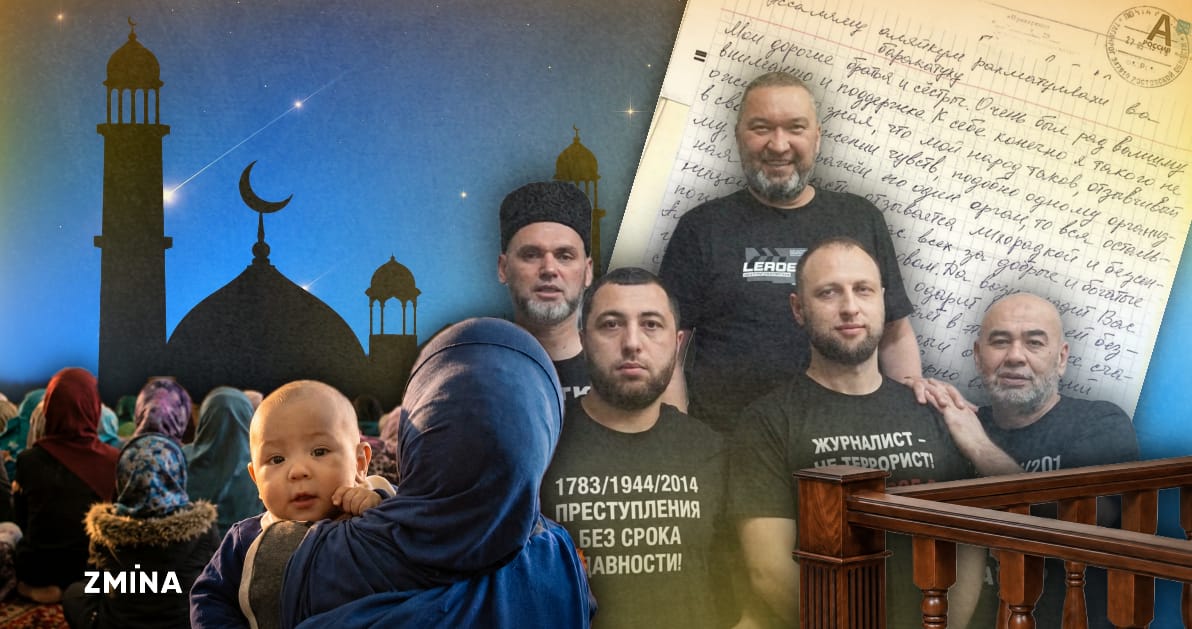
The initiative was established in April 2016 as a mutual support network for people facing politically motivated persecution in occupied Crimea. Its work expanded over the years to include covering trials, documenting repression, supporting the families of political prisoners, delivering parcels to those held in pre-trial detention, and arranging assistance from lawyers and human rights defenders. Members of the movement themselves frequently became targets of persecution.
“We became one team”
For the relatives of political prisoners, this work was not an abstract concept but a source of practical, everyday support. The wife of a Crimean political prisoner, whom we will call Sofiia for security reasons, recalls that Crimean Solidarity was much more than a source of information. After her husband’s arrest, she and other relatives needed daily support. At monthly meetings, families could exchange news, discuss the prisoners’ health, receive assistance and simply spend time together.
Members of the movement called the families to ask how they were coping, whether they needed help, whether they were facing any problems at home, and whether they needed food or parcels for their imprisoned relatives. Together, these efforts formed a comprehensive support system for the families. The volunteers did far more than organise meetings. They visited pre-trial detention centres to deliver food and other essentials to political prisoners. They also supported the families directly, providing financial assistance, help with everyday tasks and manual work around the home.
Sofiia recalls that after her husband’s arrest, around five Crimean Solidarity activists and volunteers came to her home and asked what needed to be done around the house. The volunteers also visited other families: searches had left some homes with damaged doors or broken windows, while others had urgent household problems that still needed attention. Sofiia needed help too. Her family heated their home with coal and firewood, and she was left alone with three young children when several tonnes of coal had to be unloaded. The volunteers came with shovels, filled sacks with coal and carried them to a storage area.
On the morning of the search, the officers were preparing to take Sofiia’s husband away, but his lawyer was initially denied entry to the house. He stood outside the gate starting early that morning, explaining that he was there to represent Sofiia’s husband, and was allowed inside only after the search had ended. The lawyer then told Sofiia that her husband would be taken away and advised her to pack some warm clothes for him, as the weather had already turned cool. For her, this showed how Crimean Solidarity combined legal assistance with personal care and compassion. The lawyer had professional duties to perform, but he also understood what the family was going through as a loved one was taken away. Lawyers and other legal professionals later travelled to attend court hearings, including in Rostov-on-Don, Russia, where cases against Crimean political prisoners were heard. For their relatives, this meant that their loved ones continued to receive legal protection and attention throughout the lengthy proceedings.
Crimean Solidarity’s work, however, extended beyond legal assistance. The movement also supported political prisoners by encouraging people to write to them. Postcards bearing photos of prisoners were prepared in advance for its meetings. Attendees could take one, write a few words and send a message to someone behind bars.
 Letters to political prisoners at a Crimean Solidarity meeting. Archive photo, 2018. Photo: Oleksandra Yefymenko
For political prisoners, these letters became a vital link to the outside world. Sofiia recalls that when her husband was transferred from Rostov to a penal colony, she received a bag containing his belongings through a consul. Among his clothes, she found a folder containing letters, postcards and photos that he had kept for two years.
“When I opened the bag, I found an entire folder of letters, postcards and photos that had accumulated over those two years. Just think: my husband had not thrown them away or destroyed them. He had sent them back with his belongings. The letters from children were decorated with tiny rhinestones, and every single one was still in place. I still keep all of it at home in Crimea, and I think he will read those letters again when he is released.“
She also recalls attending a meeting in Sudak with her young child in the winter of 2018. During the event, security officers entered the café and spent the rest of the day checking the documents of everyone present.
“We, the relatives, had become a close-knit team because we could always count on their help and support. Sometimes we would arrive for our monthly meeting only to find the doors shut because of an alleged bomb threat. People travelled to these meetings from all over Crimea, but if one venue was unavailable, someone would always say, ‘Let’s go to my house – it’s big enough for everyone.’ So we would all go there and squeeze in together, but the meeting would still take place.”
 Russian security officers at a Crimean Solidarity meeting in Sudak. Archive photo, 2018. Photo credit: Oleksandra Yefymenko
“An information vacuum”
Over the course of a decade, Crimean Solidarity also became an important source of information not only for the families of political prisoners, but also for journalists, human rights defenders and international organisations. Viktoriia Nesterenko, a human rights defender and project manager at the Human Rights Centre ZMINA, says it was through the movement’s Facebook page that she began following the persecution of Crimean Muslims more systematically. In 2018, she came across a report about the imprisonment of Server Mustafaiev, a Ukrainian human rights defender and citizen journalist. She subsequently began monitoring events on the peninsula more closely, watching Crimean Solidarity’s live coverage of searches and court hearings and sharing information about the persecution.
Nesterenko was particularly struck by the case of human rights defender Riza Izetov. Just a week before his arrest, they had discussed the issue in the comments section of one of her posts. Seven days later, Nesterenko saw a report that he had been detained.
“While I was in Sri Lanka, I wrote him a letter. I told him that I worked to defend human rights, that I wanted all political prisoners to be free and that I wanted people to remember them and tell their stories abroad.“
 Riza Izetov in a Russian occupation court in Simferopol. Archive photo, 2020. Photo: Oleksandra Yefymenko
According to Viktoriia, Crimean Solidarity’s importance extended far beyond its journalistic work. The movement was also highly trusted by people in Crimea:
“The consequences [of their closure] will be harmful for people in Crimea, the human rights community and the international community alike. Crimean Solidarity was not merely a journalistic movement – it was a network that supported both political prisoners and their families. Local people placed great trust in the movement and knew where to turn for assistance, protection of their rights or help bringing rights violations to public attention. Journalists, human rights defenders and the international community likewise trusted the information shared by Crimean Solidarity.”
One consequence of the end of Crimean Solidarity’s work is already clear: reports of searches may not emerge until several days after they take place. Previously, relatives could contact the movement to report a search, detention, a prisoner’s health problems or other developments and ask for the information to be made public. That established channel is no longer available. According to Sofiia, many relatives, friends and neighbours followed Crimean Solidarity’s social media pages and relied on them for information.
“Crimean Solidarity’s closure has left an information vacuum. Many relatives, friends and neighbours followed its pages, but now I can only get news from Ukrainian social media channels and may not read about a search in Crimea until several days later. You find yourself wondering whether anyone came to support the family and whether they had lawyers. There used to be a contact number on the platform that relatives could call at any time if something happened. Now the question is: if your loved one falls ill or is placed in a punishment cell or disciplinary isolation unit, whom do you tell?” she says.
 People welcome activist Enver Krosh in February 2018. In 2022, he became one of the defendants in the Dzhankoi Hizb ut-Tahrir case. In the background, citizen journalist Remzi Bekirov, who is now also imprisoned, is filming him. Photo credit: Oleksandra Yefymenko
For people living under occupation and witnessing persecution in their communities, this information has direct practical value. It tells them what has happened, where to seek help and whether the affected family has received support. It also enables human rights defenders and journalists to respond more quickly and verify reports.
Crimean Solidarity itself operated under relentless pressure for years, so its closure came as no surprise to its members. A Crimean lawyer involved in the movement, whose name is being withheld for security reasons, says it had long been clear that the Russian authorities intended to keep up the pressure on the initiative. Further evidence of this continued to emerge, with the persecution of lawyers, including female lawyers, among the clearest examples. In his view, being designated a “foreign agent” creates an additional obstacle in a lawyer’s relationship with their clients: the stigma makes any association with the lawyer potentially damaging, above all for the people they represent.
At the same time, the lawyer does not believe that Crimean Solidarity’s closure will immediately change the entire support system. In his view, its absence will be most noticeable in the media:
“Crimean Solidarity’s absence is felt primarily in the media. Prisoners, their relatives and others affected must now find their own ways to draw attention to their cases and secure a response from the public and international institutions.“
 Russian police in Sudak during a Crimean Solidarity meeting. Photo credit: Oleksandra Yefymenko
“The movement made my husband’s case known beyond Crimea”
Alime (whose name has been changed for security reasons), the wife of another Crimean Tatar political prisoner, first came into direct contact with Crimean Solidarity immediately after her husband’s arrest in 2019. She had, however, known about the movement since 2016, when mass arrests began in Crimea.
According to Alime, Crimean Solidarity emerged from a spontaneous gathering of political prisoners’ relatives and their lawyers. It later became one of the leading voices reporting on repression on the peninsula while supporting affected families. Alime says the movement adapted its work to meet the families’ changing needs:
“When disaster strikes your family and a loved one is led away in handcuffs, your first reaction is fear, shock and a sense of complete isolation. So many families could have been left to face their suffering alone from that moment on. Hundreds of children would have been left without their fathers, placing an even greater burden on the women left to cope alone. That was when Crimean Solidarity stepped in.“
“At first, the family only needed legal assistance, which was provided, with a lawyer available to the family around the clock. Over time, however, it became clear that a woman whose husband had been taken away also needed to feed and clothe her children, ensure that they received an education and obtain medical care for them. The movement therefore focused its work wherever the need was greatest at any given time.“
This became Alime’s own reality in 2019, when officers came to her home and took her husband away. She was left alone with her many children, all of whom were minors, and had to find a way to support them without her husband, who had been both her main source of support and the family’s sole breadwinner.
“Crimean Solidarity helped me find and pay for a lawyer and supported my family both financially and emotionally. They brought us food and, when needed, medicine. They also helped with firewood, repairs to household appliances and other practical tasks. Whenever transport was a problem, activists helped us get the children to a doctor,” Alime says.
The support gradually expanded to include political prisoners’ children. The movement organised celebrations, educational courses, excursions, and rest and recuperation programmes for them, while also offering psychological support to families when needed. Volunteers helped families get their children ready for school and organised activities for them. Alime says the support of male members of the movement was particularly important to her sons, who deeply missed having their father present. These men spent time with them, offered advice and practical help, and, through their own example, sought to fill some of the void left by their father’s absence.
“What I am most grateful for is that they always followed one principle: ‘Every child is our shared responsibility.’ They did more than sympathise with us – they genuinely shared our burden. They helped get the children ready for school and organised worthwhile activities for them. Men from the movement were always there for our boys, who deeply missed their father’s support, and tried to fill that void through their example, advice and practical help. And it worked.“
 A Crimean Solidarity meeting. Archive photo, 2020. Photo credit: Oleksandra Yefymenko
Keeping her husband’s case in the public eye also remained important to the family. Activists and citizen journalists attended court hearings, streamed them live and published reports. Their work brought her husband’s case to the attention of people beyond Crimea. Alime sees public attention as one way of protecting political prisoners from isolation and arbitrary treatment in detention. She believes the Russian authorities cannot ignore the attention surrounding a particular family when others rally around it. Alime was saddened by Crimean Solidarity’s formal dissolution, but does not believe that it marks the end of the idea itself.
“We were deeply saddened by the news that Crimean Solidarity had been formally dissolved. Of course, we understand that this is only a change in how it operates and by no means the end of the idea itself. Organisational structures may disappear, but personal connections and the willingness to help remain. Crimean Solidarity is first and foremost its people, who continue their work every day. But the lack of information is certainly being felt. Over the years, we and the movement had become one: we kept our finger on the pulse and knew what was happening every day.“
Crimean Solidarity is no longer available as a shared platform. For those who remain in occupied Crimea, the main consequence may be the loss of a familiar source of information. Human rights defenders will have to spend more time finding and verifying information. Families will need to find new ways to report the persecution of their loved ones. Political prisoners themselves risk becoming less visible to the wider public. For ten years, Crimean Solidarity worked to prevent precisely this.
Language support: ZMINA volunteer Lisa DeHaven
Liked this article? Follow ZMINA on X, BlueSky and LinkedIn, and help shape our editorial focus by filling out our feedback form here.