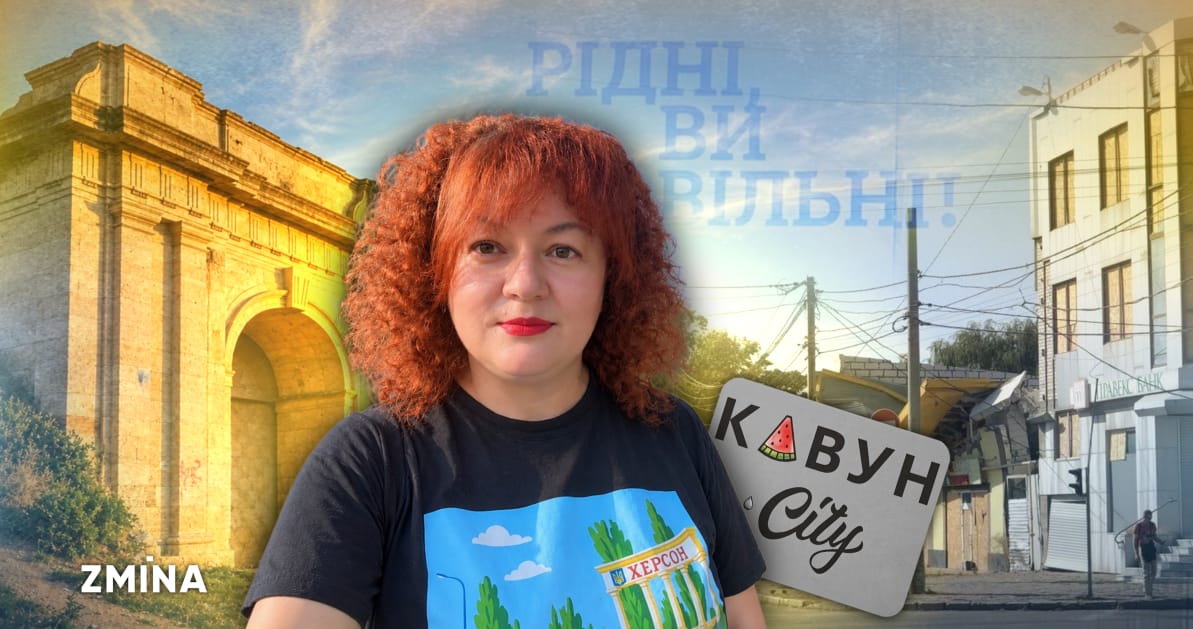
How a Kherson news outlet survived Russian occupation and now documents war crimes
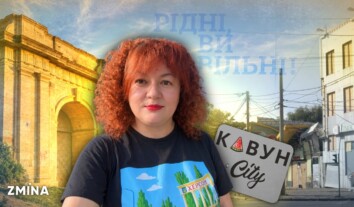
On 13 May 2022, Russians arrived at the apartment of Kherson journalist Yevheniia Virlych. She managed to hide while her husband, Vladyslav, escaped with help from others. They still faced almost two more months under occupation, moving between safe houses, undergoing checks and eventually escaping through 40 Russian checkpoints using documents bearing different names.
But the story of Kavun.City is about more than survival. It is the story of a regional news outlet that continued reporting under occupation and, since Kherson’s liberation, has been documenting war crimes, helping bring those responsible to justice through the courts and even opening its own merchandise shop.
Read Kavun.City’s story in the latest article in our series about relocated media outlets.
‘Don’t open the door. It’s the Russians’
That day in occupied Kherson began like any other, but for journalist Yevheniia Virlych, it unfolded like something out of Stalin’s purges of 1937. She and her husband, Vladyslav Hladkyi, barely left their apartment, as Yevheniia knew that, as a journalist, she was among the first on the lists for a “sweep”. Friends had given them keys to nearby apartments in case of raids. Meanwhile, rumours were circulating around the city that helped keep their whereabouts secret: Yevheniia and her husband were supposedly already in Poland, having celebrated their birthdays in Wroclaw that January, as their birthdays fell close together. Only those closest to them knew the truth; everyone else believed they had evacuated to Poland.
Meanwhile, they were being checked. On 5 March, communications and electricity suddenly went down in Kherson. When Yevheniia stepped into the corridor to check the electricity meter, she was horrified to discover that the circuit breaker had been ripped out, taking part of the electrical fittings with it. After checking the other floors, they realised that only their electrical panel had been damaged. Neither the utility services nor the emergency repair teams answered their calls.
“I came up with an explanation in case I managed to get through to the utility services. I would say I was in Mykolaiv and that my neighbours had told me something had happened and the electricity meter had been ripped out. In theory, they could have checked whether I was telling the truth, but that would have taken considerable effort on the part of the Russian security services, and I don’t think they had time for that on 5 March 2022,” Yevheniia explains.
The couple had power banks, so they decided to stay calm, avoid revealing that they were home and refrain from posting anything about the incident. However, by that evening, things began to make sense. A man named Dmytro Savluchenko sent Vladyslav a message on Telegram, offering: “I’ll sell a meter and three metres of cable”. Yevheniia believes this was simply a way of checking whether they were actually at home. It later emerged that Savluchenko was an open collaborator with the Russian occupation authorities. On 24 June 2022, his car was blown up in Kherson, killing him at the scene.
The May visit of the voronokі was therefore just another episode in this tense game of cat and mouse. That morning, a friend she used to meet regularly for coffee called her. They had not seen each other for some time, so her friend suggested having coffee in the courtyard. Yevheniia poured freshly brewed coffee into a flask and went outside.
Yevheniia says she found it extremely difficult to stay indoors all the time, so she occasionally ventured outside. To avoid being recognised, she had straightened her naturally curly hair and dyed it brown instead of red. She also wore clothes no one had seen her in before the occupation, which she had brought back from Poland. That day, she was wearing a pink hoodie.
They had barely settled down when a black car drove into the courtyard and stopped outside the entrance to Yevheniia’s apartment building. Four people got out: two in civilian clothes and two in military uniforms without insignia. When they greeted the women, their accents made it clear they were Russian.
Yevheniia recalls that her heart began racing and she was gripped by fear. But years of professional and personal experience had taught her to act decisively rather than give in to her emotions in a crisis, and that instinct kicked in immediately. She had the keys to a safe apartment directly opposite with her. Yevheniia managed to send her husband a brief text message: “Don’t open the door. It’s the Russians.” She and her friend then quietly slipped into the neighbouring apartment.
Her husband was already preparing to escape from the apartment. They lived on the third floor, and the roof of a clinic and a bank extended beneath their windows, offering a possible escape route if he jumped down onto it. However, the Russian occupiers did not immediately try to break down the door. Instead, they decided to wait and posted a lookout outside the building entrance.
This was when Yevheniia’s father, Mykhailo, stepped in – a man with nerves of steel and a fondness for spy stories. Yevheniia had also texted him about the danger, and he set off to help. The lookout noticed him approaching, apparently on his way to fetch water with a large plastic bottle. But Mykhailo reacted quickly: he calmly went up to the fifth floor and stepped into the shared entrance area. Once the lookout had returned to his post, Mykhailo came back downstairs and left the building with Vladyslav.
They put on a convincing performance for the lookout: Vladyslav played an angry passenger, berating Mykhailo, who was posing as a taxi driver, for having “parked God knows where”. The Russian fell for the act, and Vladyslav managed to escape the trap.
They had to move between nearby safe houses several more times before 9 July, constantly feeling as though they were in the enemy’s sights.
On one occasion, someone sent Yevheniia a message claiming that the Russians were looting the local history museum.
“I was immediately suspicious because the museum’s director, Tetiana Bratchenko, had quickly begun collaborating with the occupiers, so it didn’t make sense. A little later, their television channel aired a report about an exhibition the Russians had opened at the museum. So my instincts were right. They wanted to lure either me or someone else to the museum,” Yevheniia recalls.
According to the journalist, the Russians had detained the person who contacted her and forced him to send her those messages.
How Kherson became “Kavun”
Journalism seems to have been in Yevheniia Virlych’s blood. She was born in Feodosiia, Crimea, Ukraine, but moved to Kherson, where her father was from. She qualified in two fields – engineering economics and finance – and worked in both for many years. Yet she wanted to try something different: she had a talent for writing and dreamed of becoming a journalist.
Her interest in journalism ran in the family. Her grandfather, Avhust Virlych, whose life was both remarkable and difficult, had trained as a journalist and teacher. The Soviet authorities persecuted him because of his background: although he was ethnically Hungarian, they somehow regarded him as German. Shortly after Germany’s surrender, he was deported to a special settlement in the Urals, where he remained until 1954. Despite the repression he faced, Avhust Virlych actively researched the Holodomor and Stalinist repression. He published around 20 books, both independently and with co-authors, and a lane in Kherson is now named after him.
Yevheniia herself had been passionate about Ukrainian literature since her youth, at a time when such an interest was still considered somewhat “exotic”. She organised visits to Kherson by writers including Serhii Zhadan, Maks Kidruk and Oleksii Chupa. She was not doing it professionally – she simply enjoyed it.
A turning point came with the major media reform launched in 2015 to end state and municipal ownership of print media. The municipal newspaper Khersonskyi Visnyk closed, but its website remained. Yevheniia Virlych compares it to a suitcase without a handle – difficult to carry, but a shame to abandon. Editor-in-chief Iryna Salikhova, whom she had met through volunteer work supporting the military and civilians, invited Yevheniia to join the team.
She believes her analytical skills helped her write about money – where it was going and how it was being spent. She also sought out journalism training courses, read her grandfather’s work and drew inspiration from Polish reportage. Together, these experiences helped her learn the profession.
To secure funding for her projects, Yevheniia applied to donor organisations and received subgrants from the Committee of Voters of Ukraine, the Regional Press Development Institute and Internews. Later, a network of local news outlets began taking shape in Ukraine under the ABO Local Media Development Agency, building on formerly state- and municipally owned media. Its naming concept combined a city’s name with the word “City”.
As the name “Kherson City” was already taken, Yevheniia decided to draw on local associations and asked readers on social media what they associated with Kherson. There were three options: watermelons, tomatoes and shipbuilders. Watermelons won the vote, and Kavun.City was born (kavun is the Ukrainian word for watermelon). Its first article, published on 17 October 2019, examined how accessible the city’s infrastructure was for wheelchair users.
Initially, Yevheniia and Iryna Salikhova ran the outlet together. Iryna later moved away from journalism to pursue other work, while two experienced professional journalists, Kseniia Vichkitova and Illia Kontishev, joined the team. Illia has been serving in Ukraine’s Defence Forces since December 2023.
Kavun.City deliberately chose not to run a traditional news feed, instead publishing between two and 10 articles a day.
“Our editorial team focused on what really mattered to people: social projects such as changes in utility tariffs, tourism, festivals, issues concerning occupied Crimea and well-researched historical reporting. My third qualification is in history, and Illia Kontishev is also passionate about the subject. So one of our key goals became promoting Kherson’s authentic Ukrainian history to counter Russian imperial myths, including debunking false claims about the ‘Potemkin pantheon’ and exposing Russian disinformation,” Virlych elaborated.
Language was another matter of principle. Although donors advised publishing in Russian to reach a wider audience, Yevheniia says she refused to compromise: “We are a Ukrainian-language news outlet.” Only a few blogs and advertisements on the website remained in Russian.
“For Kherson at the time, this was a real media revolution which, despite the scepticism of some experts, formed a loyal circle of readers who came to the outlet for quality and honesty.”
24 February: between warning signs and the reality of occupation
As fears of a full-scale war grew in the months leading up to the invasion, Kavun.City refrained from publishing reports about a possible Russian attack for some time – the editorial team was unsure what to make of the warnings. In November or December 2021, a friend asked Yevheniia over coffee whether Russia would invade. Yevheniia admitted that she did not know what to make of the situation.
The situation felt surreal, with conflicting signals coming from different directions. In February 2022, Deputy Prime Minister Iryna Vereshchuk officially inaugurated a bus route from Chonhar to Kherson, even though the buses were supposed to travel along stretches of road that were reportedly mined. Had the mines been cleared? The editorial team discussed this in disbelief: on the one hand, it seemed that preparations for peace were under way; on the other, the whole situation felt deeply strange. A few days later, an alarming report emerged about a Russian landing force near the Kakhovka Hydroelectric Power Plant. However, the press office of the Security Service of Ukraine (SBU) asked the outlet to publish information stating that these were supposedly scheduled military exercises.
On 21 February, billboards bearing the number “450” appeared around the city – military slang meaning that everything was calm. On 22 February, friends in occupied Crimea sent messages about unusual movements of Russian military equipment towards mainland Ukraine. Yevheniia thanked them for the information but still believed it was another attempt at intimidation. On 23 February, she was still talking to a man from Crimea who had brought wine from the peninsula. By the following morning, everything had changed irreversibly.
By 24 February, Russian troops had reached the Antonivskyi Bridge, and the first occupying forces entered Kherson on 25 February. By 1 March, the city was completely surrounded. Buzkovyi Square (Lilac Square) became a grim symbol of those days. Russian forces in tanks and armoured personnel carriers opened fire on the territorial defence fighters there, killing many of them. Armed with nothing but Kalashnikov rifles, these fighters were effectively civilians who had stood up against armoured vehicles.
A news outlet without a newsroom: how Kavun.City operated in occupied Kherson
Mayor Ihor Kolykhaiev remained in Kherson and tried to coordinate the work of municipal services and the city council until Russian forces abducted him on 28 June 2022. While Kolykhaiev was still in office, the city council continued publishing information about pharmacies that were operating and bread distribution.
Kavun.City shared this information with its readers.
The outlet had no formal editorial presence in the city, but residents sent information by email and through messaging apps. Yevheniia believes they did so because they trusted her.
The journalists carefully screened the information they received. Sometimes readers sent images containing obvious Russian propaganda or photographs of people attending protests. Yevheniia firmly refused to publish the latter, as the images could be used to identify participants in demonstrations against the occupation.
At the same time, the journalists managed to expose the occupiers’ activities. For example, Illia Kontishev discovered that Russian forces had looted the Kherson newsroom of Suspilne, Ukraine’s public broadcaster, where he had previously worked, and were trying to set up their own propaganda television station there. Illia initially published his findings under his own name, but subsequent articles appeared under the Kavun.City name.
The remaining grant funds and support from the National Union of Journalists of Ukraine helped keep the outlet afloat. For two months, Yevheniia and her husband barely left their apartment. Oleksii Polukhin, a supporter of the outlet, occasionally passed on information from the city, although Yevheniia repeatedly warned him about the risks. On 9 May, Russian forces stopped Oleksii, searched his phone, found photographs of shelling and held him captive for more than two months. During interrogations, Russian forces tried to beat information about other people out of him and also questioned him about the newsroom. However, thanks to their precautions and a stroke of luck, Yevheniia and her colleagues managed to avoid encountering the occupiers.
The psychological pressure was immense. The rare moments that gave them reason to celebrate were things that would have seemed strange in peacetime. The sound of strikes on the village of Chornobaivka meant that Ukrainian forces were somewhere nearby. On 20 April, their wedding anniversary, Yevheniia decided to make syrnyky (cottage cheese pancakes) to create at least some sense of normality. Just then, an acquaintance messaged her with news that collaborator Valerii Kuleshov, who had posed as a volunteer, had been killed. “Kuleshov was killed?” she asked. “Yes. Happy wedding anniversary,” the acquaintance replied.
Meanwhile, the Russians were also targeting the outlet online. On 28 March, a large-scale DDoS attack hit the entire ABO network of local news websites, including Kavun.City, bringing down the network’s central technical infrastructure. The Russian occupiers also added Kavun.City to Roskomnadzor’s blacklist.
Documents from partisans and a journey through 40 checkpoints
Under occupation, everyone used VPNs, but staying in Kherson was becoming increasingly dangerous – potentially deadly. An acquaintance sent them a message: “What are you thinking? It’s time for you to leave!” Yevheniia says they knew they were unlikely to be allowed through the checkpoints with their own identity documents. But the acquaintance offered a solution: they could send him their photographs and receive “new” documents. Yevheniia does not know where he obtained them. The documents were delivered through a mutual acquaintance and identified the couple as Anna and Oleh.
When a neighbour told Yevheniia that the Russians had been asking about her again, she realised they could not afford to wait any longer. They arranged to leave with private drivers. At the time, the journey cost 6,000 hryvnias per person, compared with 10,000–18,000 in the early days of the occupation. They invited a friend who worked as a programmer to travel with them. It proved to be the right decision: three days after he left, Russian forces came to his home.
At 5am, the passengers gathered near the Fabrika shopping centre. Then came the most difficult part: the journey from Kherson to Zaporizhzhia via Vasylivka, during which they had to pass through 40 checkpoints. At 26 of them, their documents and bags were subjected to particularly thorough searches.
“The fear was overwhelming. People literally forgot to breathe, but they had to keep smiling and hold themselves together,” Yevheniia Virlych recalls.
The couple may also have been fortunate enough to get through because a family with children with disabilities was travelling with them.
Throughout the journey, they carried decoy phones with Russian SIM cards, while keeping their own SIM cards carefully hidden. When they finally passed through the grey zone and saw Ukrainian soldiers, everyone burst into tears. A soldier stepped inside their vehicle. After the intimidation they had endured from Russian troops, whose rifles constantly twitched in their hands and could strike someone with a rifle butt, the Ukrainian soldiers’ careful and courteous manner came as a striking contrast.
Someone asked the soldier if they could hug him, but he declined. Yevheniia suspects he had already received so many hugs that he simply could not take any more.
After relocating to Kyiv, the Kavun.City team resumed its work in full. Nothing brought them greater joy than the liberation of Kherson.
From local news to war crimes: what Kavun.City took on after Kherson’s liberation
The outlet now has one staff journalist and two freelancers reporting on current events in Kherson. With the city under constant shelling, their work can put their lives at risk.
Freelance journalist Ivan Shestopalov was originally just an acquaintance of Yevheniia’s. She says that during the occupation, he proved to be deeply committed, intelligent and pro-Ukrainian, helping Ukrainian partisans and military personnel. After Kherson’s liberation, she invited him to work with the outlet, only to discover that he had long dreamed of doing so. He now provides the newsroom with regular news updates. He has come under attack twice. On one occasion, a drone struck a shopping and entertainment centre while he was inside, leaving him with a concussion. In a separate attack, he suffered a leg injury.
“I tell my colleagues that no striking footage is worth risking their health for. I ask them to put their own safety first. We have deliberately decided not to undertake demanding reporting assignments under shellfire. I admire the journalists who do this, but as editor-in-chief, I cannot bring myself to assign such work to my team. Our focus remains somewhat different,” Yevheniia explains.
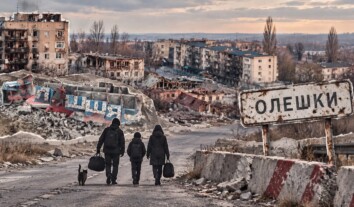
According to Ms Virlych, Kavun.City was among the first news outlets to report on people going hungry in the occupied town of Oleshky.
“Of course, information from occupied territories is difficult to verify. But when we heard about the situation, we decided to take the risk of publishing it without corroboration from multiple sources. We felt that reporting on the possibility of people going hungry was more important than strictly following professional standards. We also receive information from Oleshky residents who have managed to leave. In the end, we turned out to be right.”
The team focused on documenting war crimes, exposing those who sided with the occupiers, covering court proceedings and working with law enforcement agencies.
The editorial team also ventured into unfamiliar territory, producing a documentary about the tragedy caused by the destruction of the Kakhovka Hydroelectric Power Plant.
“I was once deeply impressed by a documentary made by colleagues from the Sumy Region (Oblast) about their work. They filmed it entirely on an iPhone – on the road, talking to people, without professional editing, simply showing things as they were. I realised that this kind of approach would feel the most genuine and convey people’s emotions particularly well. And that was precisely what I wanted – to capture the emotions people felt when remembering that day,” says Yevheniia Virlych.
She shared the idea with her friend Olha Tsilynko, who would later feature in the documentary. They decided to show what happened on 6 June 2023, when the city authorities, volunteers and ordinary residents who wanted to help worked remarkably well together.
“So I brought together a group of people: ordinary residents, myself, an administration employee and Roman Mrochko, the former head of the city military administration. And that’s how it all got started.”
The documentary focuses on the main perpetrator – Russia. It makes the case that the destruction of the hydroelectric power plant was neither an accident nor a consequence of the fighting, but a deliberate act of terrorism by Russian forces. Through accounts from those affected and expert assessments, the filmmakers document Russia’s crime against the environment and humanity, which has permanently transformed southern Ukraine.
Kavun.City also examines the significance of convictions in absentia (in the defendant’s absence) for collaborators and traitors. One article explains that such convictions of collaborators and war criminals are far more than a formality – they are an effective legal means of holding perpetrators accountable. Although prison sentences can only be enforced once those convicted have been arrested or extradited, the rulings already make it possible to seize and confiscate their property in Ukraine, as demonstrated by the conviction of collaborator Volodymyr Saldo. They also prevent those convicted from managing their assets remotely.
In addition, proceedings in absentia provide a formal legal basis for placing those involved on international wanted lists through Interpol and subsequently seeking their extradition if they are found outside Russia. The article emphasises that each such conviction establishes a formal legal record of a crime for which there is no statute of limitations, restricting those responsible from travelling freely around the world or retaining their wealth.
In the same context, Kavun.City also reported on the sentencing of war criminals. One article covered a court’s decision to sentence a Russian armed forces officer born in Feodosiia to life imprisonment for his involvement in war crimes against civilians during the occupation of the Kherson Region (Oblast).
In particular, the article details the charges against the convicted officer, including issuing criminal orders, personally taking part in shelling civilian sites and attacking unarmed residents, and organising acts of violence while Russian forces occupied part of the Kherson Oblast. As the officer is evading justice, he was convicted in absentia. The conviction provides grounds for placing him on an international wanted list and confiscating his property.
The editorial team also identified key administrators of the notorious Telegram channel “From Mariupol to the Carpathians”, which regularly announces shelling attacks, publishes manipulative content and collects information about Ukrainian cities.
It all began with what seemed like a minor lapse in online caution: journalists noticed a Telegram Premium account using the name Zlata among the subscribers to Kavun.City’s official channel. Their curiosity prompted them to investigate the profile, and what began as a simple check developed into a full-scale open-source intelligence (OSINT) investigation.
In her profile picture, a young woman was wearing a T-shirt bearing the logo of the Russian propaganda outlet “From Mariupol to the Carpathians”. From there, the journalists followed a trail of clues, examining posts she had written for the pro-Russian channel and photographs taken at events organised by the occupation authorities in Henichesk.
Using facial recognition tools and comparing photographs from the Russian social network Odnoklassniki, the journalists identified the administrator as Natalia Dorosheva with more than 92% confidence. Dorosheva had previously worked at a children’s outpatient clinic in Kherson and was a dog lover. The investigation also identified Oleksandr Sheptura, a former lieutenant colonel in the Donetsk police and a collaborator, as the channel’s main coordinator. His online activity quickly revealed his connection to the outlet.
According to Kavun.City’s investigation, criminal activity lay behind these seemingly ordinary profiles and supposedly “patriotic” rhetoric. Together, the two administrators turned the “From Mariupol to the Carpathians” channel into a tool of terror and psychological intimidation. They not only spread Kremlin narratives but also regularly “announced” attacks on Ukrainian cities, helped direct shelling, collected information about civilian movements and reported on where strikes had hit.
While Sheptura called for the destruction of civilian infrastructure, Dorosheva travelled around the occupied parts of the Kherson Oblast under the banner of Russian “volunteer” organisations, exposing Ukrainian children to propaganda. Instead of gaining the audience reach and media attention they sought, both now face formal legal proceedings over alleged war crimes, and their details have been entered into wanted persons databases.
The case involving the 12-year prison sentence handed down to Tetiana Kamenska, owner of the Kherson television and radio company VTV Plus, illustrates how media collaborators are being brought to justice in Ukraine. Kamenska, who had previously received the title of “Honoured Journalist of Ukraine”, knowingly placed her television channel at the service of Russia’s propaganda machine during the occupation of Kherson. The channel broadcast interviews with occupation officials and covered the Russian-organised ‘referendums’.
The court sentenced Kamenska in absentia to 12 years in prison, ordered the confiscation of her property, valued at more than 30 million hryvnias according to the Kherson City Military Administration, and banned her from working as a journalist for 15 years.
Yevheniia Virlych, editor-in-chief of Kavun.City, personally testified against Kamenska in court. Virlych says the editorial team is committed not only to documenting crimes committed by the occupation forces and media figures who have sided with them, but also to actively cooperating with law enforcement agencies and the courts, providing evidence to support convictions.
A Kherson-themed shop: an additional source of funding for Kavun.City
Meanwhile, Kavun.City is exploring new ways to grow. The team has opened a small shop selling merchandise and other products, bringing it closer to its goal of becoming a fully self-financing independent Ukrainian media outlet in the region.
“I’d always wanted to set up a business alongside the media outlet. I knew from the outset how difficult it was for local media in Ukraine to make money. It was entirely my idea. I’d come across similar ventures in Poland and Germany, where, for example, a media outlet might also run a café. But I specifically wanted a business selling souvenirs. We worked out how to make it happen ourselves, within the editorial team. Eventually, we found a platform that handles printing and production, so all we have to focus on is design and promotion,” Yevheniia explains.
Today, the Kherson-themed shop sells both Kavun.City merchandise and other products that evoke memories of the Kherson region.
The shop has yet to generate substantial profits, and the team is still learning, with guidance from marketing consultants:
“We have plans for a second phase of the shop, but they’re still taking shape. For now, the shop generates enough income to cover at least our listing on Ukr.net [a Ukrainian news aggregator] and the technical services we use, including video-editing and graphic-design software and other paid tools. I think that’s not bad.”
Kavun.City has effectively lived several lives. It began as a local news outlet, continued reporting during the occupation despite having no newsroom in the occupied city, made it through dozens of Russian checkpoints, resumed its work after Kherson’s liberation and now documents crimes that have yet to be examined in court. The circumstances, the dangers and the journalists’ responsibilities have all changed, but one thing has remained constant – the need to tell Kherson’s story in its own voice.
Perhaps that is precisely what gives Kavun.City its purpose today. The occupation sought to strip Kherson not only of its people, homes and territory, but also of the right to tell its own story. By continuing to publish in Ukrainian, document crimes, report on life in the city and find ways to sustain its financial independence, the outlet is reclaiming that right every day. Even if that now means selling T-shirts, souvenirs and a little “Kherson vibe” alongside its investigative journalism.
Хештеги: Kherson, Kavun City, Russian occupation, Ukrainian journalism, war crimes, media freedom, Ukrainian resistance, displaced media, collaboration, accountability
Liked this article? Follow ZMINA on X, Bluesky and LinkedIn, and help shape our editorial focus by filling out our feedback form here.