Identical texts, old allegations and millions of views: How major Telegram channels target the Anti-Corruption Action Centre
Identical wording, posts published at almost the same time and old allegations that resurface whenever a new news peg emerges. An analysis of major Ukrainian Telegram channels reveals how waves of negative posts targeting the Anti-Corruption Action Centre (AntAC) and its representatives can attract hundreds of thousands or even millions of views.
Alongside Maryna Khromykh, an advocacy expert at AntAC, ZMINA examined how this process works, where the claims about “188 million” and a “blind” AntAC head Vitaliy Shabunin driving a Tesla originated, and why repeatedly circulating the same allegations matters.

How Telegram fuels waves of negative coverage
The scale of smear campaigns on Ukrainian Telegram channels was revealed by a monitoring study, whose findings were published on 23–24 September by MP Yaroslav Zheleznyak. He analysed 100,815 posts published between 1 June and 23 September 2026 across 20 major anonymous Telegram channels. Of these, 6,305 were classified as attempts to discredit individuals. Routine news mentions and quotations were excluded from the count. Only posts that directly targeted a specific person were included.
Vitaliy Shabunin, head of the Anti-Corruption Action Centre, was among the main targets. Zheleznyak identified 62 posts aimed at discrediting him, the second-highest figure in the sample. Only Mykhailo Fedorov was targeted more frequently, with 72 posts. They were followed by Semen Kryvonos, director of the National Anti-Corruption Bureau of Ukraine (NABU), and Petro Poroshenko, Ukraine’s fifth president, with 56 posts each, and investigative journalist Yurii Nikolov, with 19.
Zheleznyak also sought to identify which channels were spreading similar attacks. He provisionally divided them into two networks which, he believes, may have links to the Security Service of Ukraine (SBU) and the Defence Intelligence of Ukraine (DIU), respectively. In the first network, Shabunin was the most frequently targeted individual, with 42 posts aimed at discrediting him – more than any other person.
The study therefore found that AntAC faced more information attacks than any other non-governmental organisation, with the intensity of these attacks exceeding even those directed at opposition political parties.
Negative coverage of Shabunin and the anti-corruption community, however, is not confined to a single channel or isolated posts. The same individuals and similar claims appear repeatedly on channels with large audiences. As a result, an allegation may no longer seem to be merely the claim of a single anonymous channel. After being repeated dozens of times across different channels, it can begin to take on a life of its own as a news story.
Zheleznyak had previously described how this process works. In July, while analysing paid-for posts targeting NABU and the Specialised Anti-Corruption Prosecutor’s Office (SAPO), he claimed that a story could first appear in one source, then be picked up by a small Telegram channel with more emotionally charged wording, before spreading to major anonymous channels almost simultaneously. He estimated that these channels could have had a combined audience of more than 12 million subscribers.
Duplicate posts, inflammatory rhetoric and millions of views – haven’t we seen this before?
Others have also observed similarities between posts, their near-simultaneous publication and the repeated use of the same allegations against Shabunin and anti-corruption organisations. These were not isolated incidents: monitoring identified hundreds of such posts on Telegram and other social media platforms.
After Vitaliy Shabunin was served with a notice of suspicion on 11 July 2025, Ukrainian media watchdog Detector Media analysed media coverage of the case. Using the Semantrum monitoring service, researchers identified 580 publications about Shabunin over just three days, from 14 to 16 July. They found that 172 of these mixed facts with evaluative judgements, while some failed to include any response from Shabunin himself or representatives of AntAC.
Detector Media also identified 114 critical articles across 64 websites and 58 posts across 21 Telegram channels. Analysts noted that posts were duplicated and shared between channels, often using emotionally charged and aggressive language. Similar narratives or reposts appeared on Insider UA, Realna Viina, Times of Ukraine, Battalion Monaco, ZeRada and other channels.
These posts reached particularly large audiences when channels with millions of subscribers picked them up. At the time of the study, for example, Insider UA had around 2.1 million subscribers, Realna Viina nearly 1.6 million and Advokat Prava around 1.2 million. Trukha, which had almost 3.3 million subscribers at the time, also published a post about Shabunin.
Detector Media identified three distinct waves of coverage. The first began on 14 July, before the court decided on a preventive measure for Shabunin. One of the most widely circulated claims was that years of support from American and European partners did not necessarily make the activist a “good guy”. At the same time, posts portrayed Shabunin as dependent on Western grant providers and as an “agent of Western influence”.
The second wave came on 15 July, the day the court imposed a preventive measure. Analysts recorded 63 publications during this wave: 45 on websites and 18 on Telegram. The posts revisited Shabunin’s military service and the payments he received while serving, while also circulating statements made by his critics.
A third wave emerged the following day. Between 2 p.m. and 8 p.m. on 16 July, Detector Media recorded another 48 publications. Almost all focused on a familiar allegation: that Shabunin had allegedly appropriated a vehicle intended for use by the Armed Forces of Ukraine, which had in fact been used for that purpose. Over the three days, the focus shifted from one negative narrative to another: grant providers and “Western influence”, military service and payments, and finally the vehicle.
Detector Media analysts noted at the time that coverage of the case showed signs of a coordinated information campaign. Their assessment was based not simply on the large volume of critical coverage, but on a combination of factors:
- successive waves of posts appearing within short periods;
- duplicated content across channels;
- recurring narratives;
- aggressive language.
What an automated analysis of posts about AntAC reveals
The Anti-Corruption Action Centre team also decided to investigate whether these posts followed a systematic pattern. To do so, AntAC developed a detailed prompt instructing an AI model to act as a data analyst and open-source intelligence (OSINT) researcher. Its task was to analyse posts from five major Ukrainian Telegram channels: Insider UA, Ukraina Seichas, Realna Viina, Ukraine Online and Times of Ukraine. The study covered the period from 1 July 2025 to 31 July 2026.
“Why these particular Telegram channels? MP Yaroslav Zheleznyak published an investigation that established links between their administrators and the Security Service of Ukraine. Specifically, he found that the administrators had been granted deferments from military service through the SBU. Given that the SBU is under the direct influence of the President’s Office and Zelenskyy himself, we considered it appropriate to focus on these channels for now, as their persistent negative coverage suggests that this reflects the policy of the President’s Office,” said Maryna Khromykh, an advocacy expert at AntAC.
The task went beyond simply identifying mentions of AntAC. The AI model was instructed to:
- count negative, neutral and positive posts;
- track how frequently the organisation was mentioned;
- identify periods of peak activity;
- examine recurring allegations and distinct waves of coverage.
One hypothesis was that AntAC, Vitaliy Shabunin and activists associated with the organisation were being systematically targeted by the Telegram channels under review. Another involved comparing the frequency of such posts with negative coverage of other civil society organisations, activists, independent media outlets and journalists. The prompt also explicitly warned against drawing conclusions based solely on the total number of mentions. Instead, the analysis had to account for the monitoring period, duplicate posts, the composition of the sample and differences in the number of keywords used for each group.
The prompt placed particular emphasis on identifying coordinated efforts to amplify certain narratives, including similar or identical texts, posts published at almost the same time and the repetition of the same claims across different channels. The model was also instructed to examine negative posts for derogatory labels, unsubstantiated allegations, emotionally charged language, attempts to discredit individuals through their grant funding, accusations of evading military service, distorted quotations and information taken out of context. Other indicators included near-identical texts, identical wording and the simultaneous spread of posts across multiple channels.
To identify waves of coverage, the model was instructed to compare publication times, the events that prompted the posts, similarities in texts and headlines, accompanying photos and videos, links, quotations, and even unusual wording or errors repeated across posts. For each wave, AntAC sought to establish when it began and ended, the order in which posts appeared, the number of channels and posts involved, the main narrative, the total number of views and the degree of similarity between texts.
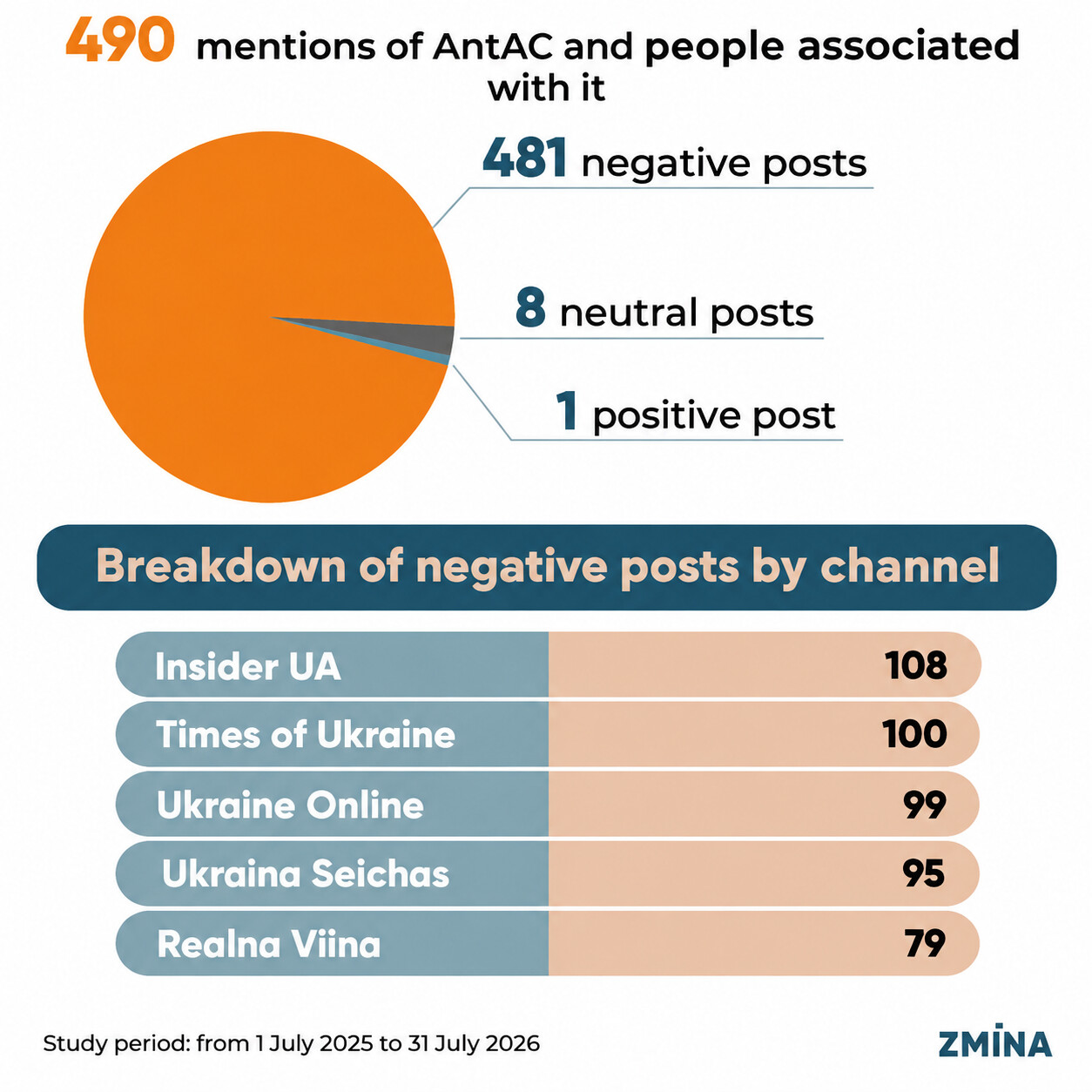
The Anti-Corruption Action Centre shared the findings of its analysis with ZMINA. The resulting table contained 490 unique posts mentioning AntAC, Vitaliy Shabunin, Daria Kaleniuk, Orest Rudyi or terms associated with the organisation.
All 490 posts in the table were marked as having been manually reviewed. Of these, 481 were classified as negative, eight as neutral and one as positive.
The number of negative posts in the sample was highest on Insider UA:
- Insider UA – 108;
- Times of Ukraine – 100;
- Ukraine Online – 99;
- Ukraina Seichas – 95;
- Realna Viina – 79.
Most negative posts focused on Shabunin’s military service, mobilisation and health. Other recurring themes included the defence of NABU and SAPO, grant funding, income and property, and accusations of lying and exerting pressure on the media.
According to Khromykh, repeatedly circulating the same allegations can be effective even when people do not believe each individual claim. In cognitive psychology, this is known as the illusory truth effect: the more often someone encounters a statement, the more familiar and credible it may seem. Over time, people may forget where they first came across the information but retain a general impression that “there’s always something negative being written about them”.
Khromykh believes that, in AntAC’s case, this gradually creates a lasting negative perception of the organisation: that it cannot be trusted, that its activists work for grant money or personal gain, evade military service, depend on donors or “cover up” wrongdoing by anti-corruption agencies.
This is particularly damaging for a civil society organisation, as trust directly affects its ability to operate. It determines whether the public, journalists, officials and international partners take AntAC’s findings and proposals seriously. If an organisation is subjected to negative coverage for years, any position it takes in the future may be judged through the lens of that reputation.
“It is not just the organisation that is discredited, but also the ideas and proposals we advocate. An information attack shifts the debate away from questions such as ‘Is this reform, proposal or idea necessary, and what arguments support it?’ towards ‘Who are the people promoting it, and can they be trusted?’ As a result, it becomes easier for our opponents to keep discrediting us rather than engage with the substance of our proposals,” Khromykh noted.
Khromykh also noted that such attacks drain resources. Instead of focusing solely on research, developing proposals and communicating with authorities or partners, the team must also spend time refuting allegations, providing context and defending its reputation.
“Personal attacks weaken an organisation by targeting its people. When campaigns systematically target individual staff members – Shabunin, Kaleniuk and others – their professional work becomes the focus of personal attacks. This places additional reputational, security and psychological burdens on those who publicly represent the organisation and may make the team’s experts less willing to speak publicly,” Maryna added.
AntAC also believes that the consequences may extend beyond the organisation itself: systematically discrediting a prominent civil society organisation could fuel distrust of civil society organisations more broadly.
New stories, old allegations
A new wave of attacks aimed at discrediting AntAC does not require fresh allegations. All it takes is a new story to which familiar negative claims about AntAC or its representatives can be attached. A single post can report on a recent event while reminding readers of earlier allegations, even when they have no connection to the event itself.
On 17 September 2026, lawyer Oleh Shram wrote that he could not find Daria Kaleniuk, executive director of AntAC, in Ukraine’s Unified Register of Advocates, although some sources described her as an advocate. The question of her professional status quickly escalated into a more sensational story. Major Telegram channels alleged that Kaleniuk had falsely claimed the status of an advocate, while one headline even referred to her as being suspected of fraud.
The posts published by different channels were almost identical. At 12:31 p.m., Realna Viina claimed that Kaleniuk had “claimed the status of an advocate”, while Times of Ukraine used almost the same wording at 1:01 p.m. The posts began by claiming that she was not listed in the register, followed by Shram’s statements, before abruptly shifting to an unrelated issue: an old allegation that AntAC had stolen UAH 188 million in international technical assistance funding. Questions about Kaleniuk’s professional status gave way to suggestions of dishonesty, followed by references to the organisation’s alleged “financial misconduct”. There was no substantive connection between these claims.
The Times of Ukraine post received around 387,000 views, while the Realna Viina post attracted approximately 256,000 – more than 643,000 views combined. This does not represent the number of unique readers, as the channels’ audiences overlap and view counters record views of individual posts. Nevertheless, the figures show how widely the same claims were circulated.
That same day, the story spread beyond Telegram. UNN, UNIAN, Fakty and Advokat Post all reported on Shram’s statement. Some articles focused solely on Kaleniuk’s professional status, but UNIAN also mentioned the UAH 188 million allegation. In this way, the old claim found a new route into public discussion through news websites.
Where did the UAH 188 million figure come from?
The allegation was not new. It had been circulating since at least May 2026, following claims made by blogger Volodymyr Boiko. AntAC suspects that he added together the grants the organisation received between 2022 and 2025 (UAH 41 million, 37 million, 58.5 million and 51.5 million respectively) and described the entire amount as “stolen”. The receipt of grant funding was effectively portrayed as theft, without any evidence that Shabunin, Kaleniuk or other staff members had misappropriated any of the money. Meanwhile, AntAC regularly publishes financial reports on how grant funds are spent, along with audit results, on its website.
The September story provided an opportunity to revive the allegation in news feeds without presenting any new evidence. Rather than being treated as news, it had become an established negative portrayal of AntAC: whenever a new critical story emerged, readers were reminded of the earlier allegation.
Tesla, vision loss and the ‘blind’ driver
A similar pattern emerged earlier, in June, when a Facebook post by Shabunin about buying a Tesla Model Y became the pretext for another wave of attacks. On 19 May, he announced that he had ended his military service because of problems with his eyesight, having lost most of his vision. His statement and the decision of the military medical commission were reported by Detector Media, LB.ua and Interfax-Ukraine, among others. By June, Telegram posts had turned his statement about losing most of his vision into claims that Shabunin was “unable to see” or “blind”, suggesting that he had declared himself blind while continuing to drive a car.
Once again, the channels published almost identical texts. Times of Ukraine ran a headline claiming that “blindness does not prevent someone from driving”, and virtually the same wording appeared on Realna Viina, Vsevidyashchee OKO and Ukraine Online. All of them alleged that Shabunin had emphasised the car’s relatively low price to divert attention from questions about his eyesight, before once again bringing up the UAH 188 million allegation.
The timeline was also compressed to make the story more provocative. More than three weeks passed between Shabunin’s discharge from military service on 19 May and his post about the Tesla on 10 June, yet several channels portrayed the purchase as having taken place “immediately after his discharge”.
Another old allegation was added to the story: that Shabunin had supposedly “kept for himself” a vehicle purchased with donations “for the Ukrainian Armed Forces”. In fact, as AntAC explained, members of CEO Club had bought the 2005 Nissan Pathfinder with their own money, without holding a public fundraiser, and handed it over to Shabunin while he was serving in the military. In July 2026, he filed a lawsuit against the State Bureau of Investigation (SBI) over the agency’s claim that he had unlawfully used a vehicle provided as humanitarian aid. ZMINA also reported on the case at the time.
The June posts thus brought together three separate stories: the Tesla purchase in connection with Shabunin’s health and discharge from military service; the UAH 188 million in grants; and the dispute over the vehicle provided to him during his military service. The new story served merely as a pretext for repeating familiar allegations.
The Times of Ukraine post received around 408,000 views, Realna Viina’s approximately 280,000, Vsevidyashchee OKO’s more than 215,000 and Ukraine Online’s 192,000. Together, the posts attracted over a million views, although this does not represent unique reach because the channels’ audiences overlap.
Why Telegram matters
The systematic spread of negative content about AntAC through major Telegram channels has consequences that go far beyond damaging the reputation of a single organisation. According to Maryna Khromykh, these attacks directly affect AntAC’s ability to hold the authorities to account and advocate for reforms.
The scale of these campaigns is particularly significant given Telegram’s role in how Ukrainians consume news. According to a 2025 study by the civil society organisation Internews Ukraine, 72% of Ukrainians used Telegram to get news – the highest proportion of any social media platform. Overall, 86% of respondents got news from social media, while 37% relied on it as their only source of news.
Traditional news sources, meanwhile, reached a much smaller share of the audience. In 2025, 31% of respondents used news websites, 33% used television, 13% radio and just 4% print media as sources of news. Over the past decade, social media was the only type of media to grow in popularity as a source of information.
Telegram in Ukraine therefore cannot be seen merely as another platform for spreading rumours or reposting news from elsewhere. For a substantial share of the audience, it is one of their main sources of information. As AntAC’s advocacy expert explains, this makes repeated exposure particularly significant: when the same claim appears almost simultaneously on several major channels, users may encounter it multiple times throughout the day, each time from a seemingly different source.
This is particularly concerning given that only 6% of respondents who were aware of disinformation correctly assessed the accuracy of all three news stories presented to them during the study. Yet 75% of this group were confident in their ability to recognise disinformation. Telegram’s extensive reach therefore comes with the risk that a repeatedly circulated claim may be seen as corroborated simply because it appears across multiple sources.
How to avoid becoming part of a smear campaign
Information attacks against anti-corruption activists go beyond negative social media posts. They can form part of a broader campaign of pressure that affects not only individuals’ reputations but also the work of civil society organisations.
Hanna Chekhovych, project manager at the Human Rights Centre ZMINA, notes that efforts to systematically discredit members of Ukraine’s anti-corruption community have been ongoing for years. In May 2026, ZMINA published an article titled “Factory of Distrust”, examining how a negative narrative surrounding Vitaliy Shabunin and AntAC had been built up over the years. In its analytical report “Systemic pressure on anti-corruption actors: practices of 2025–2026”, human rights defenders documented similar tactics used to discredit staff at the National Anti-Corruption Bureau of Ukraine (NABU) and other members of the anti-corruption community.
According to Chekhovych, such campaigns often go hand in hand with other forms of pressure, including criminal proceedings, searches and the seizure of equipment. These measures make it harder for anti-corruption activists to do their work and force them to spend time and resources defending their reputations.
“As a result, instead of discussing the corruption schemes, violations and abuses exposed by AntAC, public attention shifts to allegations against the anti-corruption activists themselves. This raises an obvious question: who stands to gain if the public stops trusting those who expose corruption? Clearly, this situation may primarily benefit those whose activities these activists are investigating and seeking to bring to light,” Chekhovych emphasised.
Anyone can avoid inadvertently contributing to the spread of such campaigns by following a few simple guidelines:
- Check the original sources. If a Telegram channel reports a serious allegation, look for the original statement, document or post it refers to.
- Read beyond the headlines. Sensational wording can exaggerate facts, take them out of context or present speculation as proven wrongdoing.
- Follow reliable news outlets. Prioritise those that verify information, cite their sources and give different sides an opportunity to respond.
- Do not mistake repetition for evidence. Just because the same claim appears on several major channels does not mean it has been verified by multiple independent sources.
- Think twice before sharing questionable posts. Even reposting something with a critical comment can help an unverified allegation reach a wider audience.