From defending students’ rights to an “informal chat” with the Security Service of Ukraine – all it takes is one protest: what is happening to Priama Diia?
At first glance, the independent union Priama Diia (Direct Action) focuses on routine student issues: defending rights, campaigning for better dormitories, and hosting lectures. But in recent years, a very different story has unfolded. Yet a very different story has been unfolding around the independent union Priama Diia (Direct Action) in recent years. Its members have been sought out at universities and visited at home, while their lecturers and parents have been questioned about them. Criminal proceedings have now been opened against a former leader of its Lviv branch, who is suspected of disseminating symbols of the communist totalitarian regime.
At the heart of this story is a broader conflict that extends well beyond a single criminal case. Priama Diia openly identifies as a left-wing union. Meanwhile, its opponents label the activists “communists” and “radical leftists”, questioning their support for Ukraine. The organisation’s members believe these labels offer a convenient way to discredit their work. They also view a series of encounters with law enforcement officers in different cities as a broader pattern of pressure. The Human Rights Centre ZMINA has previously documented some of these incidents.
ZMINA gathered accounts from Priama Diia activists in several cities and examined the case against Maksym Shumakov, the positions of his defence team and the union’s opponents, and the organisation’s public activities. We explore where the accusations of “communism” and pro-Russian sympathies come from, which claims the facts support, what Priama Diia actually does and what evidence points to systematic pressure over its civic activism.
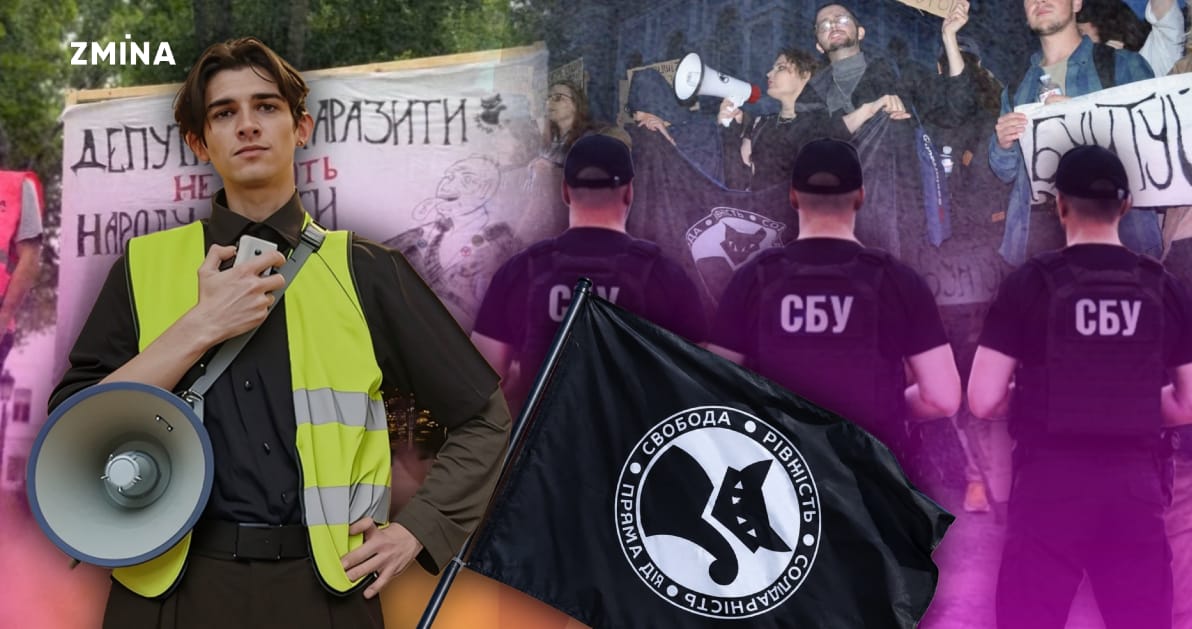
From Facebook posts to a criminal case: what is Maksym Shumakov suspected of?
On 24 July 2026, Maksym Shumakov, former head of the Priama Diia student trade union’s branch at Lviv National University, went to a police station hoping to finally begin the process of recovering his devices, which had been seized during a search more than a year earlier. Instead, he was served with a notice of suspicion.
Shumakov says police called him earlier that day, inviting him to the station to formally request the return of his property. When he arrived, another investigator invited him into an office and served him with the notice. He was never allowed to submit his request for the return of his property that day.
Shumakov is suspected of disseminating and publicly using symbols of the communist totalitarian regime under Article 436-1(1) of the Criminal Code of Ukraine. The provision carries a penalty of up to five years’ restriction of liberty or imprisonment, with or without confiscation of property.
The criminal proceedings were opened on 21 January 2025.
 Maksym Shumakov at the launch of the Human Rights Centre ZMINA’s report on the situation of human rights defenders and civic activists in Ukraine in 2025. 30 April 2026
The story began long before he was served with the notice of suspicion. On 10 June 2025, law enforcement officers searched Shumakov’s home in Lviv and seized a phone, a laptop, documents and USB drives. Some of the devices belonged to another person (a fact ZMINA has confirmed through its own sources), but the officers seized them too. At the time, Shumakov was a witness in the case.
By the summer of 2026, the devices had still not been returned to him, despite his lawyer’s repeated requests to the investigators for their return.
The notice of suspicion, dated 14 July 2026, alleges that Shumakov posted images containing communist and Nazi symbols on his public Facebook page between 2021 and 2023. The investigator further alleges that the activist was ideologically motivated and sought to spread communist ideology.
The document lists eight publication dates: 5 May, 28 October, 7 and 29 November 2021; 14 March, 5 May and 14 November 2022; and 4 May 2023.
Olha Veretilnyk, Shumakov’s lawyer, told ZMINA that the defence team had matched the dates listed in the notice to posts on the activist’s page. According to her, most were reposts of commentary and educational material, including writings by Slavoj Žižek, the Slovenian philosopher; material discussing, analysing and critiquing Marxism and Karl Marx’s works; and articles on contemporary Russian ideology.
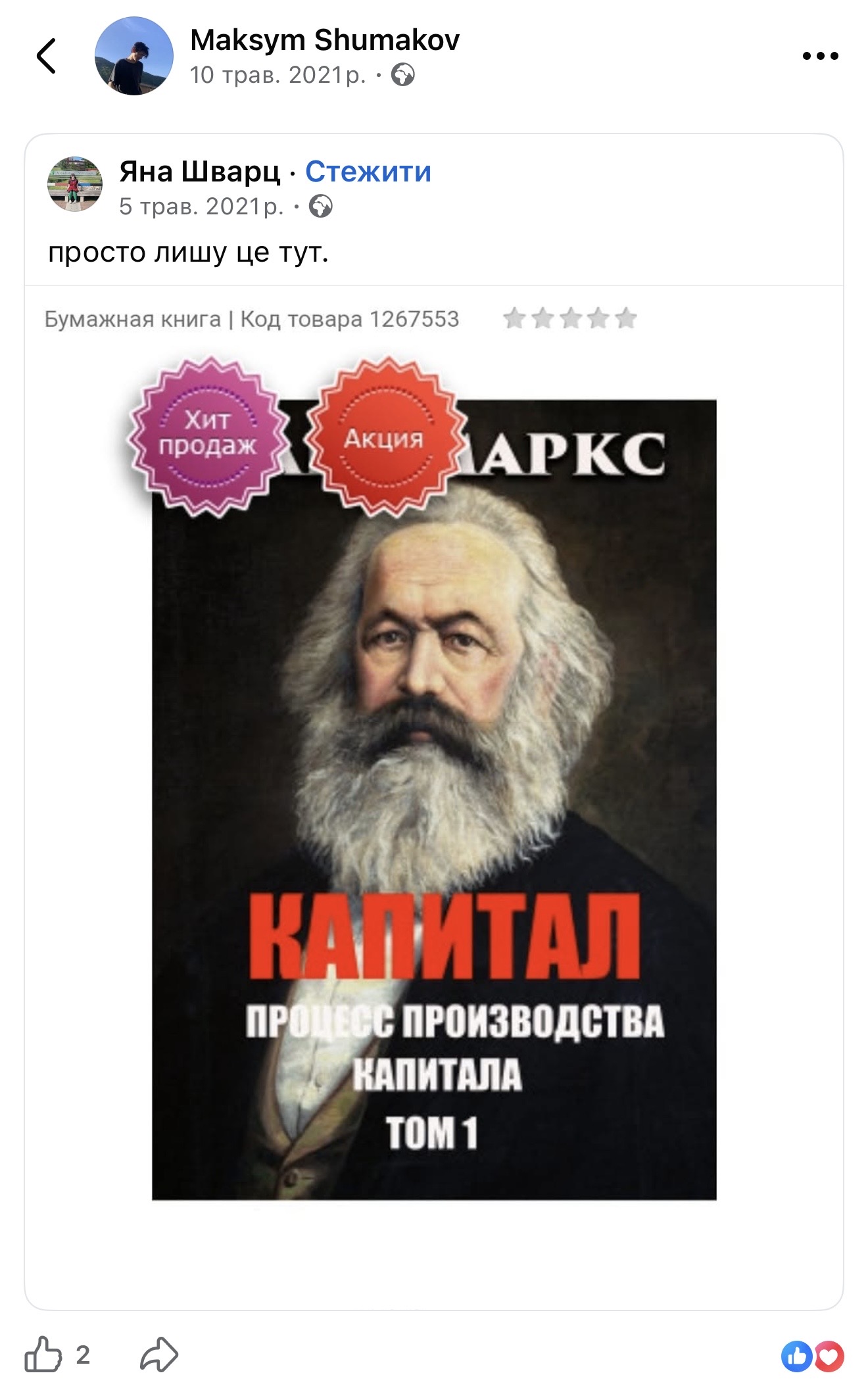
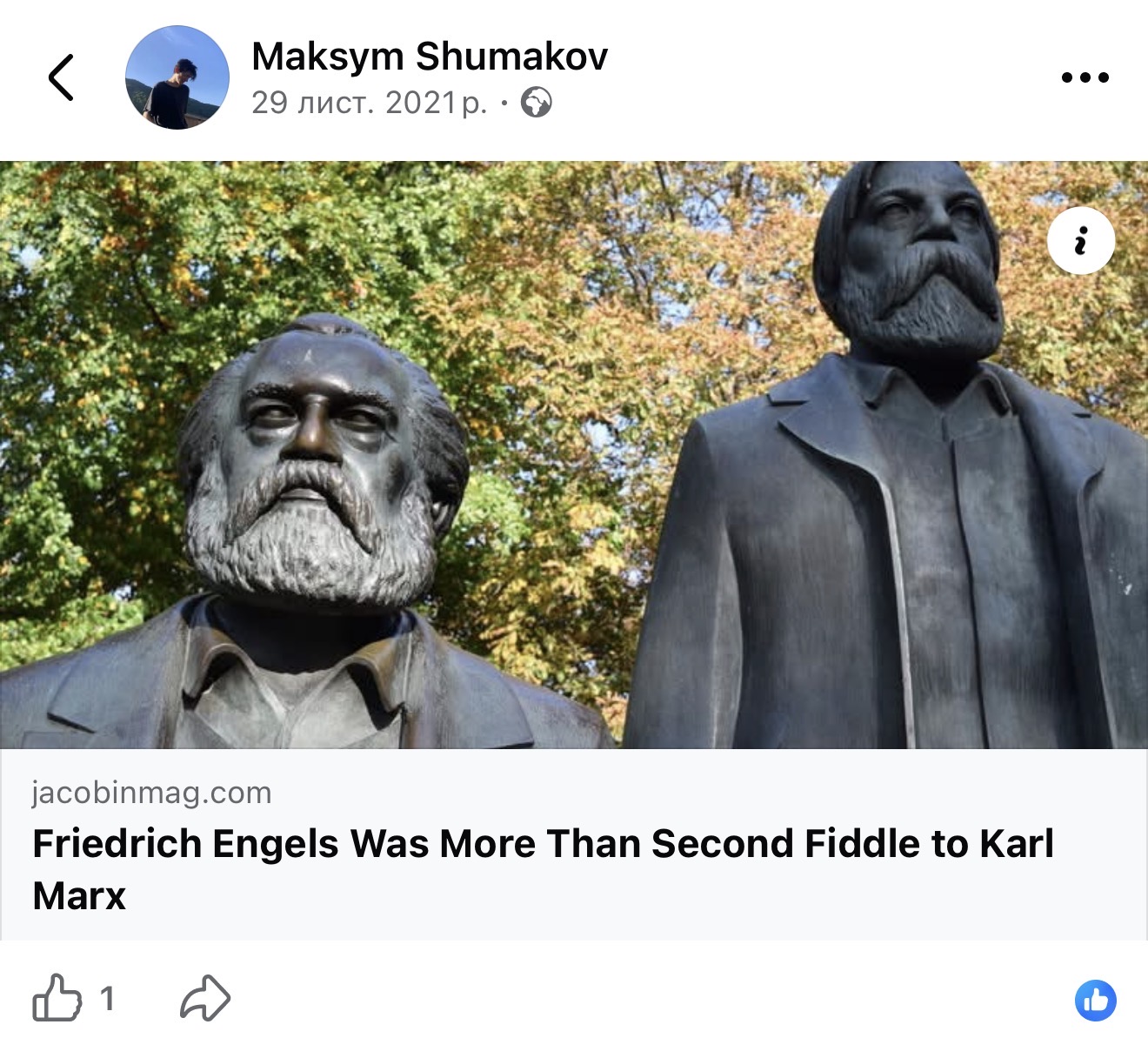
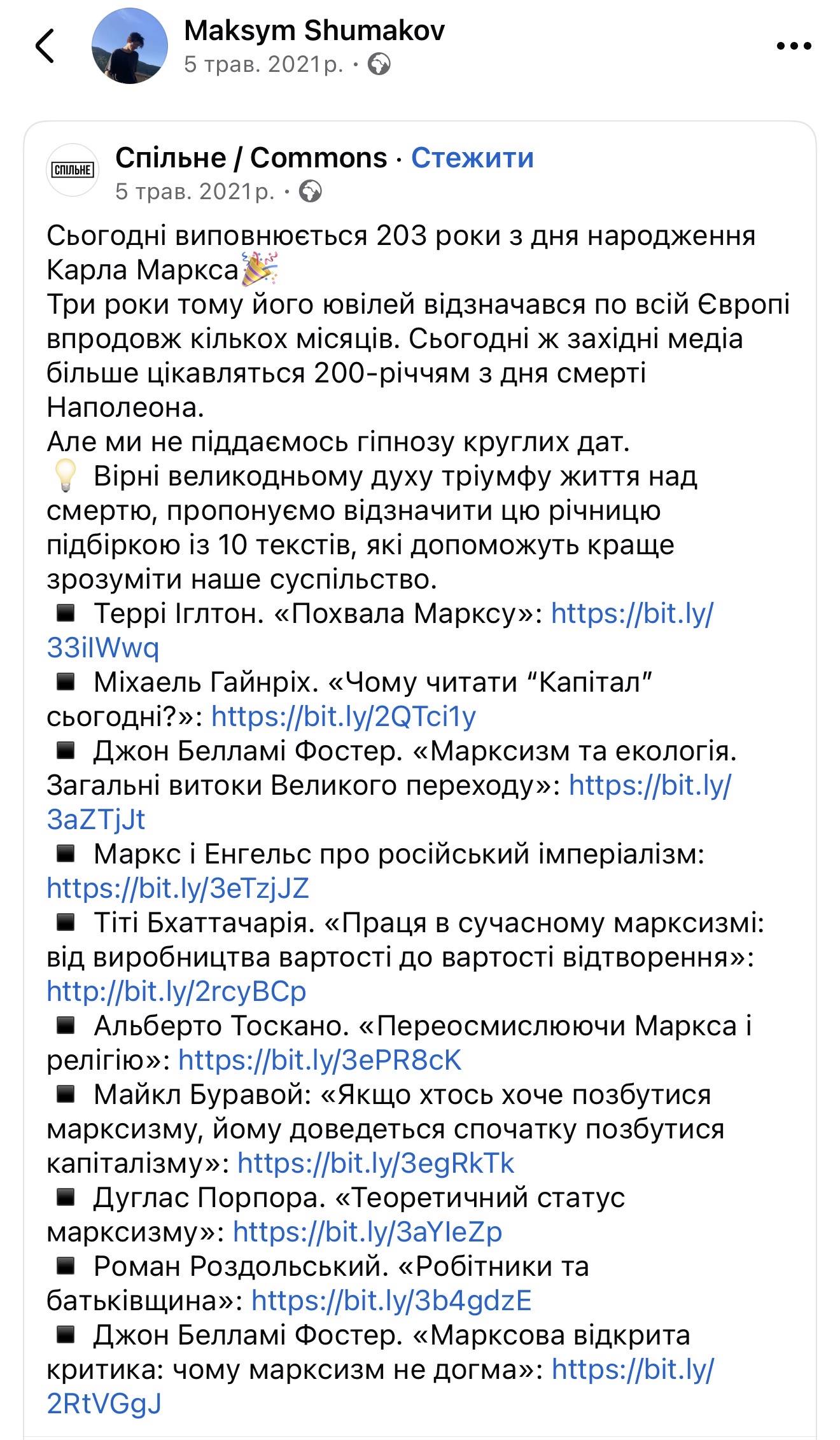
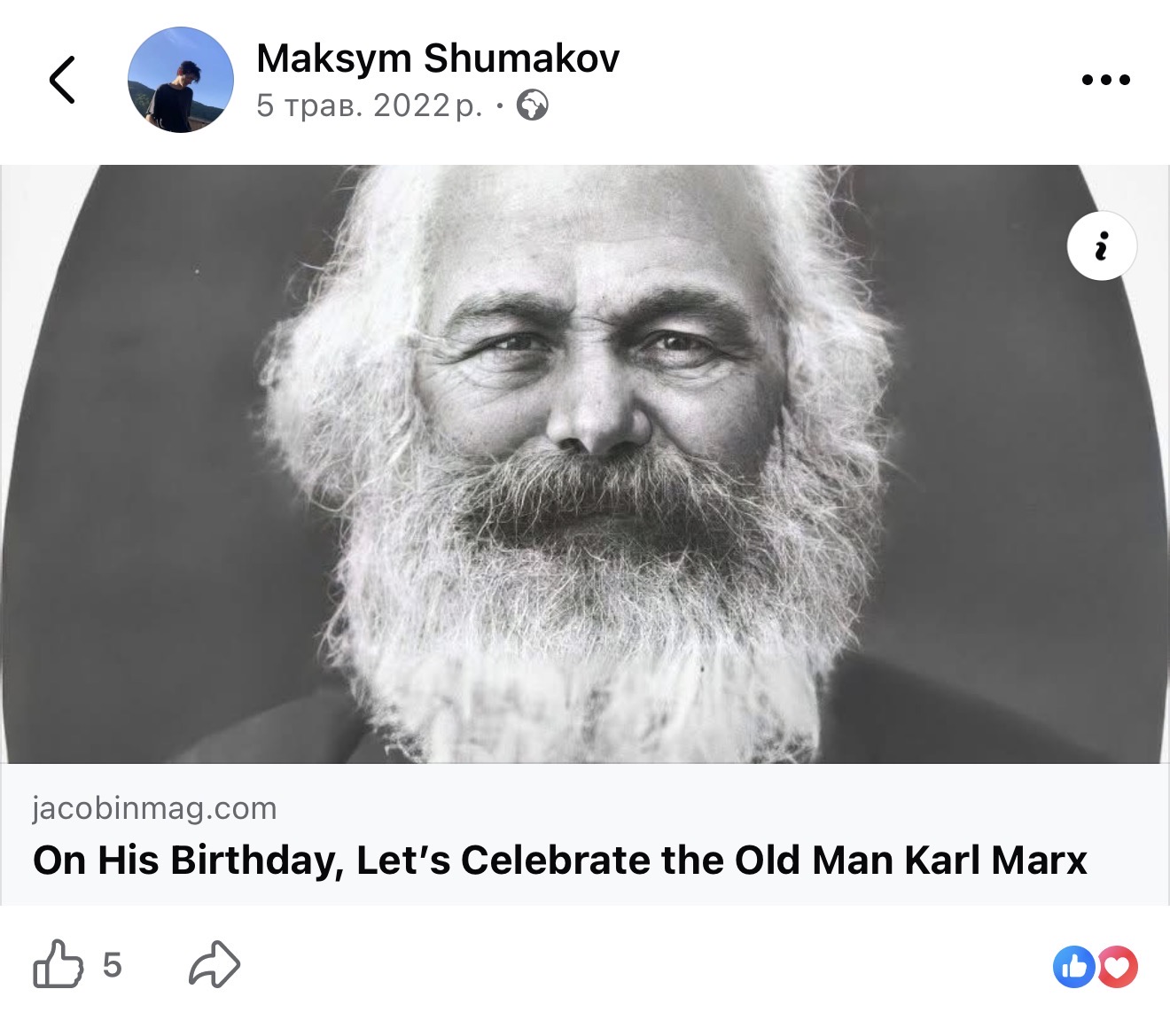
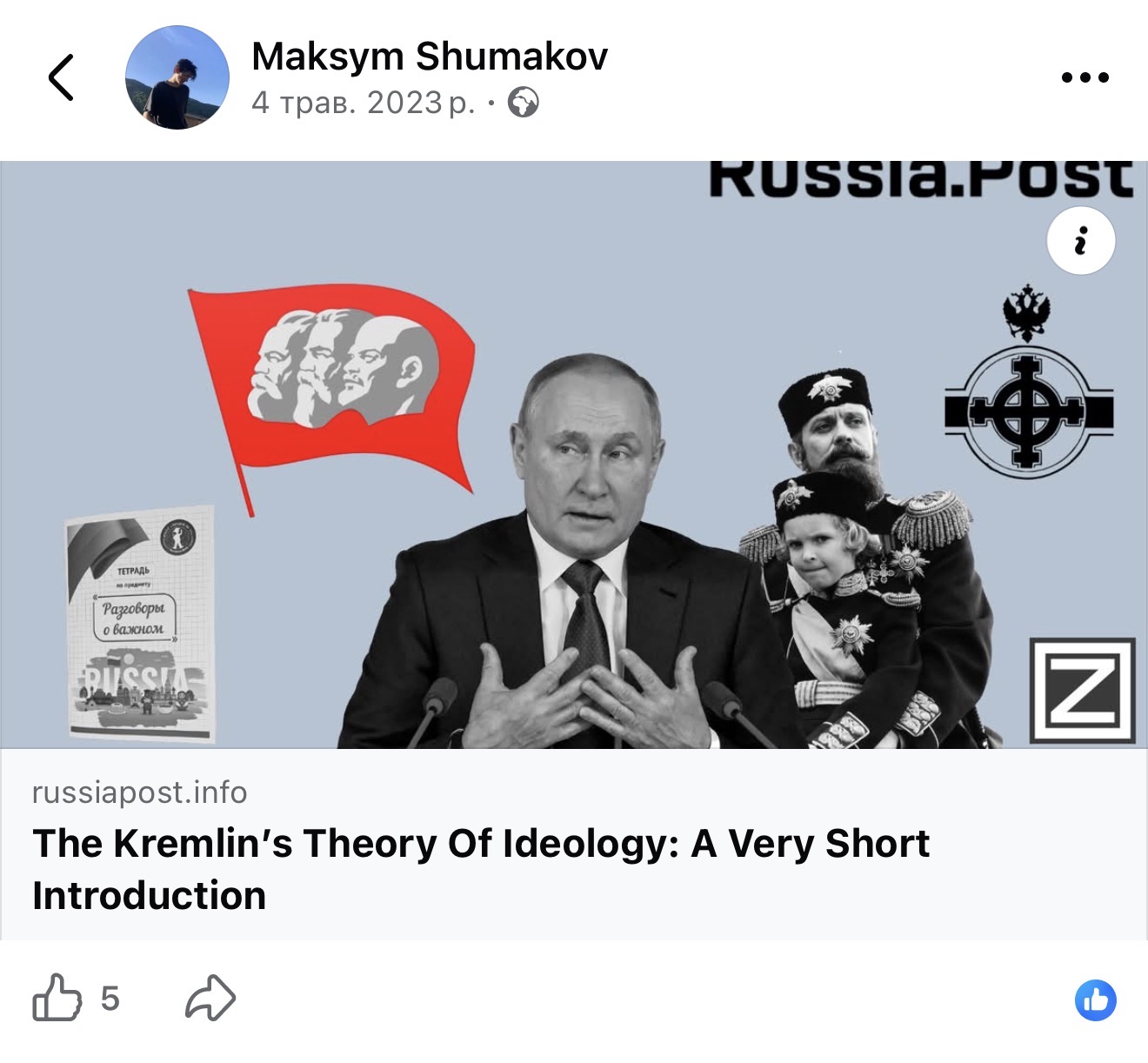
Maksym explains that many of the posts that drew the investigators’ attention were related to his studies at the Faculty of Philosophy. He says they included English-language writings by contemporary Western philosophers and material from left-wing publications, including outlets that have supported Ukraine since Russia launched its full-scale invasion. The activist regards these posts as educational and research material, rather than propaganda promoting a totalitarian regime.
Some of this material is discussed in an expert report based on a forensic art examination. Shumakov’s lawyer provided ZMINA with a forensic art expert’s report covering some of this material. The expert reviewed 11 images from Maksym’s Facebook page to check for communist or National Socialist symbols. They flagged several items, including portraits of Vladimir Lenin and Karl Marx, the hammer and sickle, five-pointed stars, and a Celtic cross.
The examination did not, however, assess the content of the posts themselves, their context or the purpose of sharing them. The report only identifies elements in the images that the expert classified as communist and National Socialist symbols.
Immediately after being served with the notice of suspicion, Shumakov was summoned for questioning. On his lawyer’s advice, he invoked his right to remain silent under Article 63 of the Constitution of Ukraine, declining to testify until the defence reviewed the files. Veretilnyk now plans to decide on the next steps and will most likely commission an alternative expert assessment of the posts, as the defence disputes that they fall within the prohibitions set out in Article 436-1 of the Criminal Code of Ukraine.
Maksym is convinced that the criminal proceedings are no coincidence. He links the attention from law enforcement to his work with Priama Diia, the independent student trade union whose Lviv branch he had long been active in. The organisation raised concerns about living conditions in student dormitories, sexual harassment in educational institutions, students’ rights and transparency in university governance. It also submitted requests to university administrations and organised public events. Shumakov was also involved in human rights work and openly supported the LGBTIQ+ community.
He says scrutiny from law enforcement intensified just as the union stepped up its work at Lviv University, particularly around the election of the rector.
How a left-wing philosopher who supports Ukraine became part of the story
One post that Shumakov’s defence team has linked to the dates listed in the notice of suspicion stands out. It concerns Slavoj Žižek, a Slovenian philosopher and one of the best-known left-wing intellectuals today.
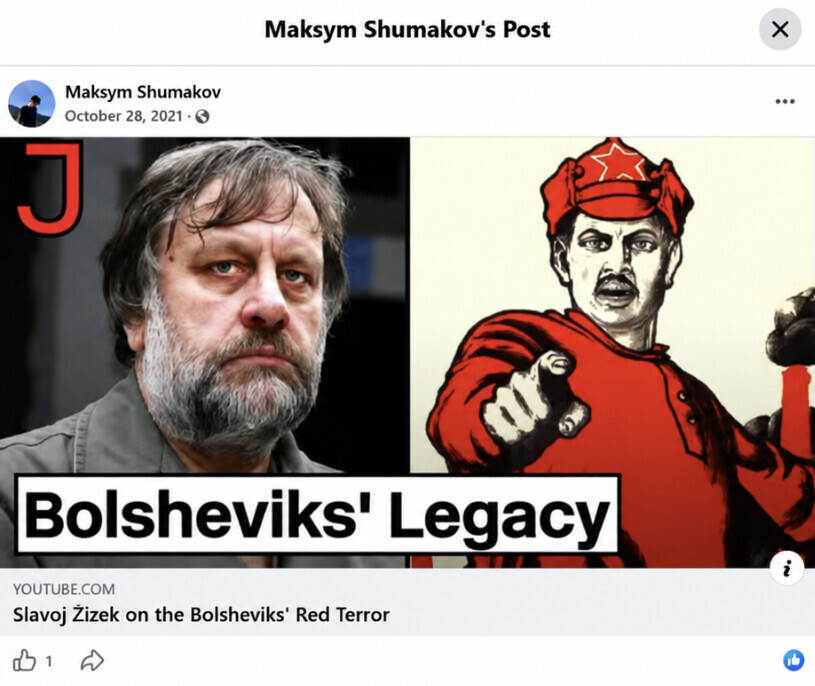
Since Russia launched its full-scale invasion, he has consistently defended Ukraine’s right to resist and criticised those on the Western left who framed the war solely as a confrontation between Russia and NATO or called for an end to military aid to Ukraine. As early as June 2022, Žižek wrote in The Guardian that pacifism was the wrong response to Russian aggression and that Ukraine needed full support. He also stressed that leftists who justified Russia’s actions or tried to “understand” Russia were effectively ignoring the plight of the country under attack.
Žižek has maintained this position since. In a January 2025 interview with The Kyiv Independent, he criticised the Western left for romanticising Russia and rejected the notion that Ukraine was fighting someone else’s “proxy war”. The philosopher stressed that, following Russia’s invasion, Ukrainians faced a choice not between war and peace, but between resistance and the threat of ceasing to exist as a nation. He also pointed out that Ukraine’s ability to negotiate at all owed much to its resistance and international support.
Including Žižek’s work in the case adds a layer of irony. He is a prominent left-wing author who has publicly supported Ukraine for years, actively challenging pro-Russian sentiment on the Western left.
Who is supporting the activist, and who is calling for his punishment?
Several activists and organisations publicly came to Shumakov’s defence after he was served with the notice of suspicion.
Vladyslav Starodubtsev, a historian and civic activist, wrote that although he was critical of some of Priama Diia’s activities, he did not consider it a pro-Russian organisation and saw no grounds for treating its activists as a threat to the state. In his view, the criminal proceedings could themselves serve as a means of exerting pressure, regardless of whether the case resulted in a conviction.
Starodubtsev highlighted the consequences a person faces even while an investigation is ongoing: searches, the seizure of devices, legal fees, questioning, constant stress and risks to their reputation. Even if the proceedings were eventually closed, he stressed, Maksym could remain publicly labelled as someone who had been “prosecuted over communist symbols”, while the circumstances and outcome of the case would attract far less public attention.
He also described Shumakov’s case as a possible example of selective enforcement of criminal law. Starodubtsev noted that one need not share the activist’s views or sympathise with Priama Diia to criticise such prosecution. In his view, using criminal proceedings to pressure people over their civic activism poses a risk to civil society as a whole.
The anarchist initiative Chornyi Stiah (Black Flag), most of whose activists volunteered to fight on the front line in February–March 2022, also expressed solidarity with Shumakov. Its members stressed that, despite fundamental differences with Priama Diia over political approaches and practices, they opposed his criminal prosecution. They urged others to support the activist and follow the case.
Meanwhile, a campaign against Shumakov emerged on social media. The organisations Khoruhva and the All-Ukrainian Association of Great-Power Nationalists published posts about him under the slogan “Jail the communist”.
The authors of the posts described Maksym as part of “radical left-wing circles” and alleged that he had promoted Marxist–Leninist ideas and translated related literature. They justified their stance by citing the Soviet communist regime’s crimes against Ukraine – the Holodomor, political repression, deportations and Russification – and called for “a forceful public response” to any attempts to romanticise communist ideology. Their statement effectively associated these crimes with Shumakov’s views and activities, creating the impression that his work also amounted to endorsing or justifying the Soviet regime’s crimes.
The reaction to the case could itself become another significant factor. According to ZMINA’s sources, far-right activists may be planning to attend future hearings in Shumakov’s case as an organised group. ZMINA will monitor the situation, as this could be an attempt to influence the proceedings through pressure.
Iryna Yuzyk, Project Manager at the Human Rights Centre ZMINA, said that, according to information she had received from the left-wing movement, members of far-right groups were determined to secure at least a conviction for Maksym Shumakov, if not a prison sentence.
“They plan to run publicity campaigns and turn up at court hearings with their demands. I suspect they’ll come dressed the way they like: swastikas on their T-shirts, skulls on their balaclavas, bucket hats pulled down over their eyes. These are their usual tactics for exerting this kind of pressure.
Just this spring, a large group of far-right activists turned up at a court hearing in Kharkiv concerning a private family law matter. Two people of the same sex were seeking legal recognition of their family through a court ruling. They simply intimidated the judge, and the two gay men’s application was rejected – partly, the men believe, because of the pressure on the court”, the human rights defender said.
Home visits, attempts to locate activists at universities and “informal chats”
In interviews with ZMINA, Priama Diia activists from different cities describe similar experiences. Law enforcement or security officers visit some at home, look for others at their universities, or try to contact them through their parents or educational institutions’ administrations. The activists say they often receive no formal summons. Instead, they are invited to “have a chat” and asked about other union members, its events, international contacts and sources of funding.
Some of these incidents are documented in the Human Rights Centre ZMINA’s 2025 report on the situation of human rights defenders and civic activists. Priama Diia members described others to journalists while preparing this article.
One public confrontation involving Priama Diia took place in Lviv in the summer of 2025. Students there were running the “Free School”, an educational project conceived as an alternative to traditional university education. Students from several Lviv universities organised lectures and discussions where they could explore topics beyond their formal curricula.
On 21 July, three men entered the Hnat Khotkevych Palace of Culture during one of the sessions. They demanded that the event stop and called the participants “lefties who are ruining the country”.
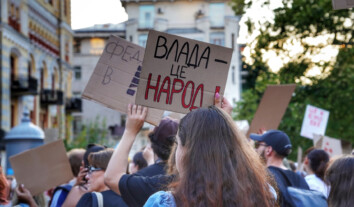
That same day, Priama Diia members joined a protest in Lviv against legislative changes restricting the independence of the National Anti-Corruption Bureau of Ukraine (NABU) and the Specialised Anti-Corruption Prosecutor’s Office (SAPO). According to Maksym Marynych, a union activist, they recognised one of the young men who had turned up at the Free School. He was accompanied by several other young men. A confrontation broke out between them and the activists: one tried to snatch a placard, while an argument with another almost escalated into a fight.
The dispute continued the following day, although the opponents did not return in person. The Khotkevych Palace’s management received an email accusing the venue of providing space for a “left-wing organisation”. The management then said it could not guarantee participants’ safety and decided to stop hosting the Free School.
According to the activists, management raised no objections to the topics or content of the sessions. Instead, representatives of the venue said they had separately looked into Priama Diia’s activities and had reservations about the union. They cited older publications stating that its members included Marxists and anarchists. The union’s current representatives stress that these accounts concern earlier generations of members, whose activities they had no involvement in.
A few months later, similar scrutiny of activists’ political views took a different form.
In early October 2025, people identifying themselves as officers of the Security Service of Ukraine (SBU) visited an educational institution in Kyiv. They were looking for a female student who was a member of Priama Diia. ZMINA is withholding her name for her safety.
The student only learned about the visit roughly a week later from a lecturer. She says the people who identified themselves as security service officers had asked about more than her studies. They wanted to know about her address, parents, banking history, academic performance and “civic stance”.
They left neither a summons nor a formal invitation for the activist to speak with them.
At the time, she was not among the union’s most active members and had taken part in only a few public protests in July 2025 – in support of NABU and SAPO’s independence and against the possible appointment of Andrii Vitrenko, an MP, as Minister of Education and Science.
The activist believes that her participation in these protests may have drawn law enforcement officers’ attention and that they were trying to obtain information about the organisers through her.
Similar incidents occurred in other cities. In Lviv, people came looking for a Priama Diia member during university classes and passed on requests through a lecturer and fellow students for him to get in touch. In Uzhhorod, people who introduced themselves to activists as SBU officers contacted the father of a former member of the organisation. In another city, which ZMINA has chosen not to name to avoid putting activists at risk, union representatives reported an “informal chat” between law enforcement officers and the administration of an educational institution ahead of a planned protest. Following that conversation, the activists were urged to call off the protest.
This recurring pattern points to systematic pressure on the organisation rather than a series of unrelated incidents.
Whether the similarities alone are enough to support that conclusion is a separate question. But another is equally important: why are people identifying themselves as officers of Ukraine’s main security service taking an interest in students across different cities, some of whom have no formal status in any criminal proceedings and are primarily involved in campus activism? And in such cases, where is the line between the SBU’s legitimate work to protect state security and interference in civic activism?
To avoid offending MPs: Priama Diia says SBU officers asked activists not to display a photo backdrop at a protest supporting NABU and SAPO
Another incident that Priama Diia activists regard as pressure took place in Kyiv in July 2025, during protests against restrictions on the independence of NABU and SAPO. Serhii, a member of the initiative, described what happened to ZMINA. His name has been changed at his request for his safety.
 Priama Diia at protests in support of NABU and SAPO’s independence in July 2025
For one of the protests, Priama Diia members were preparing an interactive photo backdrop. On a large banner, they painted a caricature of an MP bearing the symbols of parties whose representatives had supported the legislative changes. The MP was pointing a gun marked with the bill number at a protester who was holding a placard and giving him the middle finger. The activists cut a hole where the protester’s face would be so that people attending the protest could pose for photos with the banner.
Serhii says there was no elaborate political message behind the idea: the activists simply wanted to offer something different from the usual protest placards and give people a chance to take souvenir photos. Yet even before the backdrop appeared at a protest, he says, SBU officers had taken an interest in it.
“The next morning, I learned that SBU officers had called my parents and those of a friend who had also been actively involved in the preparations, insisting that we should not bring the banner to the protest. Two SBU officers also went directly to another activist’s home – her room in a student dormitory – and then, with the dormitory manager present, spoke to her about why we should not bring the banner,” Serhii said.
The men then left the activist their contact details.
These visits and phone calls left some union members worried about their safety. They therefore decided not to bring the photo backdrop to the penultimate protest, held in Ivan Franko Square.
But that was not the end of the story.
On the final day of the protests, the activists arranged to meet at the office in the morning, collect the banner and head to Mariinskyi Park together. On his way, Serhii received a call from the activist who had been visited in her dormitory the day before. She told him that the two men had now come to the office.
Serhii warned several other members to stay away from the office for the time being, but decided to go himself. When he arrived, the conversation was already underway. He says one of the men greeted him and said they had been “trying for a long time” to meet him.
According to Serhii, the men were no longer insisting that the activists abandon the photo backdrop altogether. Instead, they asked them to wait until Ukraine’s parliament, the Verkhovna Rada, had voted to restore the anti-corruption bodies’ independence before displaying it.
An audio recording of the conversation obtained by ZMINA confirms that the men tried to persuade the activists to delay displaying the backdrop until the vote was over. One of the men, who identified himself during the conversation as a representative of “the service”, said: “You’re all for this bill, aren’t you? Let them vote. Then set up your photo backdrop.”
He also called the photo backdrop “an outright provocation” and said the request stemmed from concerns about the possible consequences. He argued that the image could spark a confrontation or other “situations beyond anyone’s control”. Elsewhere in the conversation, the man says “the service” wants to prevent actions that it believes “could have a negative impact”, and suggests that the activists call in future to seek advice on organising protests.
“If you meet us halfway, that would be great. If you go your own way, we’ll occasionally ask you to refrain from actions that, in our view, could have a negative impact,” he can be heard saying on the recording.
At the same time, the officers assured the students that they supported their civic activism and wanted to prevent street confrontations between them and the far right. One of the men even asked to be given the banner after the protest “as a trophy”. The activists did not hand it over.
Serhii also recalls another remark that shaped how the activists interpreted the conversation as a whole. He says the men made it clear that, had they been dealing with older people, the conversation might have gone differently. As it was, they claimed they were going easy on the students and did not want to “crack down on” them.
“In the end, although we were shaken, we brought our photo backdrop to the protest in Mariinskyi Park. We didn’t put it up straight away, but at some point during the debate and vote in the Verkhovna Rada. That unwanted encounter meant we arrived much later than planned. But we did put it up, people came over to take photos, and the fact that the protests had achieved their goal lifted our spirits,” Serhii added.
 Priama Diia’s interactive photo backdrop at protests in support of NABU and SAPO’s independence in Kyiv in July 2025
For the activists themselves, however, the matter did not end with the protests. Long afterwards, Priama Diia members continued discussing the security of their office and internal communications, as well as the safety of union members.
Anastasiia Soloviova, a lawyer at the Human Rights Centre ZMINA, focused first on the legal status of such “informal chats”. She explained that someone who has no formal status in criminal proceedings is under no obligation to attend an informal meeting at the SBU’s invitation or answer questions. The procedure for calling someone in for questioning, including the use of a formal summons, must comply with the Criminal Procedure Code of Ukraine. A conversation to which someone is invited without an official document is therefore voluntary.
The human rights defender also questioned the grounds for the SBU’s interest. The law does not permit the Security Service to be used to persecute people for their political beliefs or lawful civic activities.
“Simply being a member of a student trade union, taking part in peaceful protests or holding particular political views does not provide grounds for operational investigative activities. If information about a person’s political views, family, address or banking details is collected without a proper legal basis, this may indicate an intrusion into their private life and pressure on them for exercising their constitutional rights, rather than legitimate work to protect state security,” Anastasiia explained.
She noted, however, that individual incidents are difficult to substantiate without documentary evidence. But in her view, a recurring pattern of informal chats, calls to activists’ parents or enquiries about them at educational institutions raises serious questions about the legality of law enforcement officers’ actions.
Does “left-wing” mean “communist”? Why Priama Diia faces criticism and what the union actually stands for
Priama Diia has faced accusations of “communism” for years, partly simply because it identifies as left-wing. Yet “the left” encompasses widely differing political traditions, from social democracy and democratic socialism to anarchism, Marxism and authoritarian communism. Being on the left of the political spectrum does not, in itself, imply support for either the Soviet regime or present-day Russia.
Priama Diia’s left-wing outlook is most evident in how it addresses education, work and social rights. It describes itself as a grassroots student trade union founded on the principles of equality and libertarian education. Its goals include accessible education, adequate student stipends and decent living conditions in dormitories, protection from exploitation and discrimination, a greater say for students in university governance and the development of non-hierarchical forms of self-governance. The organisation also opposes the commercialisation of education and the excessive power of university administrations.
Historically, Priama Diia’s members have held a range of left-wing views, including Marxism and anarchism. The organisation’s old website contains texts on syndicalism, the struggle against capitalism and support for various “liberation and emancipation movements”. Priama Diia’s manifesto criticised the modern education system as hierarchical and based on competition.
Here, however, it matters when those views were expressed. Priama Diia has existed in various forms in Ukraine since the 1990s, while the current organisation was founded in 2008. Its membership, branches and political priorities have changed over time. Today’s activists describe themselves as a new generation of the union and reject the idea that they should automatically be held responsible for the positions of people who represented it 10 or 15 years ago. After the full-scale invasion began, the union effectively resumed its activities under new circumstances, setting out to foster mutual aid among students across Ukraine and defend their rights during the war.
What about Russia?
The label “pro-Russian leftists” is particularly at odds with Priama Diia’s current public activities. In its recent publications, the union explicitly identifies Russia as the aggressor and discusses Russian imperialism. Following Russian strikes on Ukrainian universities, it has written about the deliberate destruction of Ukraine’s education system and student community. In an article on political activism under martial law, Priama Diia also noted that, after the full-scale invasion, some activists had turned to volunteering and supporting Ukraine’s defence forces, while others had joined the military themselves.
Its support has gone beyond social media posts. Priama Diia has run public fundraising campaigns for its activists who joined the military and supported appeals to buy equipment for service personnel.
Where the accusations come from
Priama Diia’s opponents draw on the union’s history, older publications and the political ties of successive generations of its activists.
One criticism concerns the Rosa Luxemburg Foundation, a German political foundation closely associated with the Die Linke party. Its Kyiv office has operated in Ukraine since 2016, using German federal funding to support non-profit civil society organisations and initiatives, including those working on labour rights, gender equality, Roma rights and LGBTIQ+ rights. Among the partners and projects it has publicly supported in Ukraine are the Centre for Social and Labour Research and individual projects run by the Ukrainian Center for Holocaust Studies. The foundation is also a long-standing partner and funder of “Be Like We Are”, an independent Ukrainian healthcare workers’ movement originally called “Be Like Nina”.
According to the activists, their contacts with the foundation were specifically raised during “informal chats” with people identifying themselves as SBU officers. Priama Diia’s opponents also publicly cite its cooperation with the foundation to support claims that the union is pro-Russian. Yet cooperation with the Rosa Luxemburg Foundation does not, in itself, substantiate those claims: the foundation works with a range of Ukrainian civil society and research initiatives and, after the full-scale invasion began, publicly condemned Russia’s aggression against Ukraine and expressed support for its Ukrainian partners.
Other criticism centres on past anti-militarist positions and campaigns. Here, the context is more complex. For some on the European and Ukrainian left, anti-militarism has traditionally been a core political commitment: criticism of armed forces, the military-industrial complex, NATO and rising defence budgets formed part of their identity for decades. After 2014, and especially after 24 February 2022, Russia’s aggression forced various groups on the left to reconsider these positions.
Judging by its public activities, today’s Priama Diia does not advocate an end to Ukraine’s armed resistance to Russia. On the contrary, it supports people fighting in Ukraine’s defence forces, raises funds for them and describes Russia’s invasion as an act of imperialism. This does not mean that all union members share the same views on the military, the state or the war. But criticism of militarism as a political phenomenon cannot automatically be equated with support for an aggressor state.
Liked this article? Follow ZMINA on X, BlueSky and LinkedIn, and help shape our editorial focus by filling out our feedback form here.