‘China and Russia keep Myanmar’s regime afloat’: ACLED’s Su Mon on the hidden war
Nearly one in three people in Myanmar now needs humanitarian aid, five years after the military’s 2021 coup plunged the country into civil war, exposing more than 90% of the population to violence within five kilometres of their homes. More than 100,114 people have been killed since the takeover, according to the latest data from the monitoring group Armed Conflict Location & Event Data (ACLED), which tallies media reports of violence.
ACLED’s Asia-Pacific senior analyst Su Mon has spent years tracking the war’s toll on civilians. In this ZMINA interview, she explains the pattern behind the military’s near-total impunity, how China and Russia help shield it from accountability, and what the international community could still do.
 Su Mon
What drew you to human rights work?
My research centres on conflict and democracy. I joined ACLEDі in 2021, right after the military coup in Myanmar. Before that, I focused on political parties, elections and decentralisation. But when the coup escalated into a full-scale war, I shifted my focus to political violence, armed groups, and the impact on civilians. That involves recording everything from arbitrary arrests, torture and forced conscription to displacement, sexual violence, protests, riots, battles and remote violence, including landmines, airstrikes and heavy artillery. Ultimately, I hope this data can provide a better understanding of conflict patterns and root causes and help inform the public, journalists, and decision-makers working to build policies and programs for peace.
We at ACLED track the whole spectrum – from peaceful demonstrations and riots to community clashes, major military escalations, and key political shifts such as peace deals, arrests, or changes in territorial control. To give users a clear, reliable, and real-time understanding of political violence and protests, we use a standardised methodology and draw on more than 5,000 local and regional sources. These data serve as a vital resource for academics, journalists, humanitarian groups, and policymakers everywhere. Beyond data collection, we’ve built practical tools like our Conflict Index and Conflict Exposure Calculator to help people assess risk and make informed, strategic decisions.
What does your work entail at ACLED?
As a regional expert for the Asia-Pacific, I work with our data and produce analysis. I track and assess local conflict situations to ensure our data reflects what’s happening on the ground. This means constantly reviewing our methodology, collaborating with team members and partners, refining our datasets, and publishing analysis reports. On the external side, I help make sense of the data for the public, whether through region- or theme-focused reports, briefings, panel discussions, or media appearances.
What is the current situation in Myanmar?
Deadly conflict has been raging across Myanmar ever since the military coup in 2021. But fighting between the military and ethnic armed groups isn’t new – the military has been clashing with one group or another since independence in 1948. What has really changed since the coup is how massive and widespread the resistance has become. Hundreds of new pro-democracy armed groups have popped up, with many fighting side by side with long-standing ethnic armed organisations, while others operate on their own against the military.
The military has now lost control of large parts of the country – the largest territorial losses it has experienced since the colonial period. Thousands of people have died in conflict since the coup and the war has spread to the majority of Myanmar’s townships. More than 90% of the population has reportedly been exposed to violent events within 5 kilometres of their homes over the past five years. The scale of the conflict makes it difficult to describe it as simply an isolated political crisis; it has become a nationwide armed conflict with profound humanitarian consequences.
The military held staged elections in 2025і , presenting them as a pathway toward civilian government, with coup leader Min Aung Hlaing claiming victory and becoming president. However, the elections have not brought an end to the conflict or meaningfully reduced repression. Under the new political arrangement, people continue to face repression, including arrests for online criticism of the military. Young people face forced conscription, while civilians in contested areas remain vulnerable to arson, airstrikes, extrajudicial killings, and other forms of violence.
On top of that, support from the governments of China and Russia has helped the junta continue its operations. The military has managed selective bilateral ceasefires with a few ethnic armed organisations, but those deals haven’t turned into any kind of real peace process. Right now, there’s still no credible or inclusive political path forward that can tackle the root causes of the conflict and finally bring the fighting to an end.
How has the resistance movement changed since 2021?
Resistance to the coup – the Spring Revolution – started as nationwide peaceful protests with people from all walks of life resisting the coup. At first, protesters were simply calling for a return to democracy – asking that the National League for Democracy (NLD), led by Nobel laureate Aung San Suu Kyi, be allowed to form the government, and demanding the release of political prisoners. But when the military responded with brutal force, it transformed the movement into a mix of non-violent activism and armed resistance aimed at pushing the military out of politics once and for all to build a democratic federal union.
 Members of the People’s Defense Forces (PDF) who have taken up arms against Myanmar’s military junta are seen on a front line in Kawkareik, Myanmar, 31 December 2021
The military shot protesters in the head with snipers, made nighttime arrests of journalists, political activists, students, community workers, NLD members, and people involved in the Civil Disobedience Movement. Many detainees were tortured, sexually abused, or killed during interrogation. The military also arrested family members, seized property, and used collective punishment against people associated with the resistance.
This led to the formation of community-based People’s Defence Forces and other local defence groups across the country. Initially focused on protecting communities from military raids and persecution, many gradually became more organised and shifted toward guerrilla warfare. This development was largely driven by the military’s continued use of force, including village raids, arson, artillery attacks, and the abduction of civilians.
Then, around 2022–2023, resistance groups increasingly incorporated commercial drones into their operations. This helped them to challenge the military’s battlefield advantage and shift from primarily defensive operations toward more offensive campaigns, including attacks on military camps and police stations. Operation 1027і , launched in October 2023, became a major turning point. That offensive created significant momentum for the resistance and led to the military losing control of large areas of territory, particularly in northern Shan State and later in other parts of the country.
 Ta’ang National Liberation Army (TNLA) fighters are among three groups currently allied in an offensive against the Tatmadaw
How the military regained momentum
Since mid-2024, the military has regained momentum. China is increasingly involved in brokering ceasefires between the military and ethnic armed organisations. Agreements have reduced fighting on some fronts and affected the flow of weapons and ammunition to other resistance groups that are still fighting.
At the same time, the military improved its ability to counter drones used by resistance groups and strengthened its air defence capabilities, with military support from Russia and China contributing to this adaptation.
More recently, the military organised elections to try and put on a civilian face and win back international standing. But with fighting, military operations, and airstrikes still raging across the country, they prefer to rely on brute force than actually resolve political issues through political means, even with elections and a supposed civilian government in place.
A pattern of impunity
In March 2026, the military carried out an air strike on a detention facility holding its own prisoners of war (POWs), days after killing at least 30 people in an attack on Nyaunglebin township. You told ACLED earlier that “it now targets civilians and detainees with impunity”. Why does it use this tactic?
There are two separate points I want to highlight here: first, the military’s use of airstrikes against civilians, and second, how the military treats political prisoners and prisoners of war.
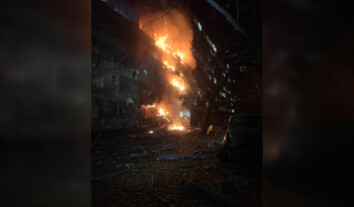
There is a clear pattern of the air strikes targeting gatherings of civilians. If we look at the data, civilian buildings such as schools, monasteries, churches and hospitals have been repeatedly targeted. These are places where displaced people seek shelter, children go to school, and ordinary civilians gather. They may also be places where people injured in fighting receive medical treatment.
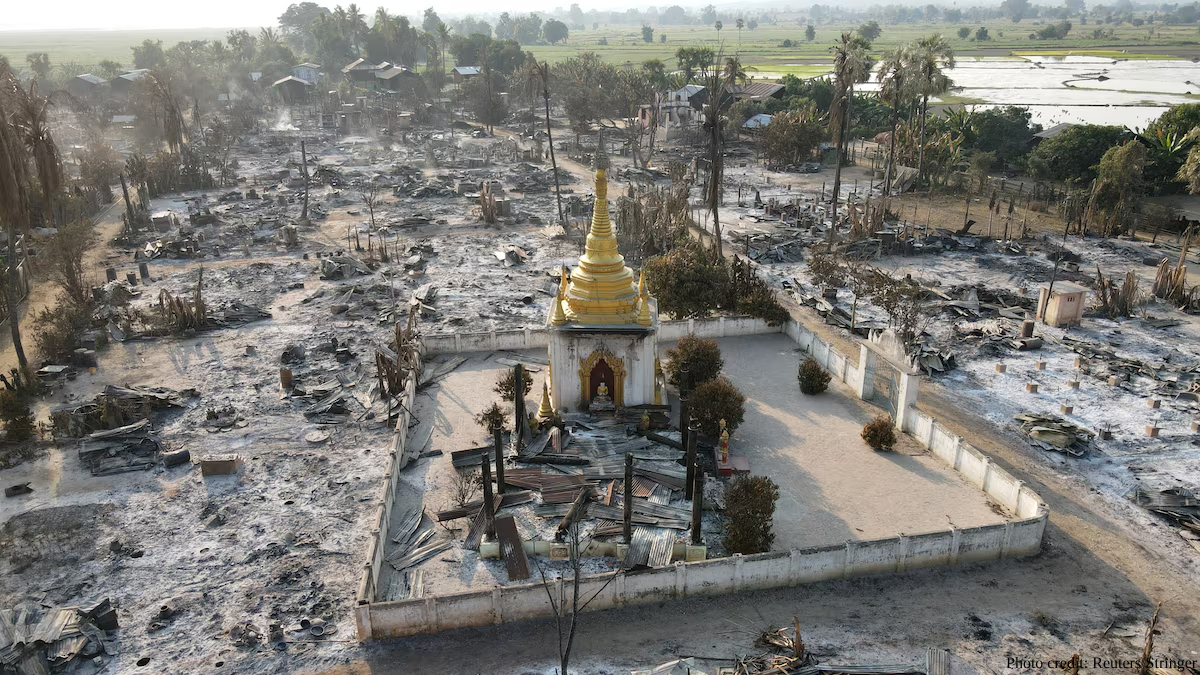 An aerial view of Bin village of the Mingin Township in Sagaing region after villagers say it was set ablaze by the Myanmar military, in Myanmar February 3, 2022. Picture taken with a drone
The military has also targeted social and cultural events, including festivals, donation ceremonies, New Year celebrations, which take place on different dates among Myanmar’s ethnic communities, and weddings. There have even been attacks on tea shops where people gather to watch football or internet shops where locals go because electricity and internet services have been cut off in conflict areas.
This suggests a broader pattern: the military is willing to strike entire gatherings and treat civilian deaths as collateral damage if one or more resistance members will also be present in a crowd, or if they calculate the attack will affect public support of resistance groups.
Targeting detention centres is the latest example of this pattern. The military calculates that civilian and prisoner casualties are an acceptable cost or believes air strikes on these sites are worth it to weaken their adversaries.
This brings me to the second point: the treatment of prisoners of war and political detainees. There is extensive reporting of resistance members being tortured and killed after capture by the military. There are also numerous reports of detained resistance members being shot, including cases in which the military claimed they were attempting to escape.
Many such cases are difficult to document because they occur in areas where independent monitoring is limited. There is little credible evidence that the military treats captured resistance fighters in accordance with international humanitarian law.
The same pattern can be seen in the treatment of political prisoners. Activists, journalists, and people who have criticised the military have been detained and subjected to degrading treatment, torture, inadequate healthcare, and other abuses. Political detainees have died in custody, including reportedly as a result of injuries sustained during interrogation, denial of medical treatment, and abuse in detention. Some people released from prison have subsequently died or suffered severe health consequences after being deprived of adequate medical care.
So, to come back to your question, the military’s attacks on civilians have been emboldened by a culture of impunity, and the targeting of detention centres represents another disturbing extension of that pattern.
It also reveals the military’s broader attitude toward people under its control, whether they are civilians, political detainees, or captured combatants.
The international community should therefore be careful not to interpret the regime’s decades-long strategy of regular symbolic releases of limited numbers of political prisoners as evidence of a genuine political opening or an end to repression.
Releasing a few detainees, who were imprisoned on spurious charges in the first place, does not address the broader system of arbitrary detention, torture, airstrikes against civilians, and impunity. What matters is whether there is a genuine and sustained change in behaviour, accountability for violations, and respect for international humanitarian and human rights law.
Who are the most vulnerable people in Myanmar when it comes to human rights abuses?
Before the coup, the answer was a lot simpler. Abuses were mainly targeted at specific political rivals and ethnic minorities, especially those from the least-developed ethnic states, along with members of the NLD party, students, and human rights activists.
After the coup, more and more people became vulnerable and victims of human rights abuses. The military began targeting anyone who opposed their rule, including unarmed civilians of any ethnicity, activists, journalists, civil servants, students and people involved in the civil disobedience movement.
That said, minority groups like the Rohingya remain among the most vulnerable of all. They’re caught in overlapping conflicts ranging from communal violence and systematic persecution to power struggles involving Rakhine ethnic groups, the state military and Rohingya armed organisations. They face violence both inside Rakhine State and in refugee camps in Bangladesh.
On top of that, their lack of citizenship and legal protection leaves them with virtually no protection against persecution or extrajudicial killings. They are the most vulnerable.
How Russia and China keep the junta afloat
What role do Russia and China play in sustaining the Myanmar military’s war effort?
China and Russia have been crucial in keeping Myanmar’s military regime afloat by backing them with diplomacy, weapons, tech and funding. That support makes a huge difference: it lowers the regime’s costs of repression and helps it withstand relentless armed resistance.
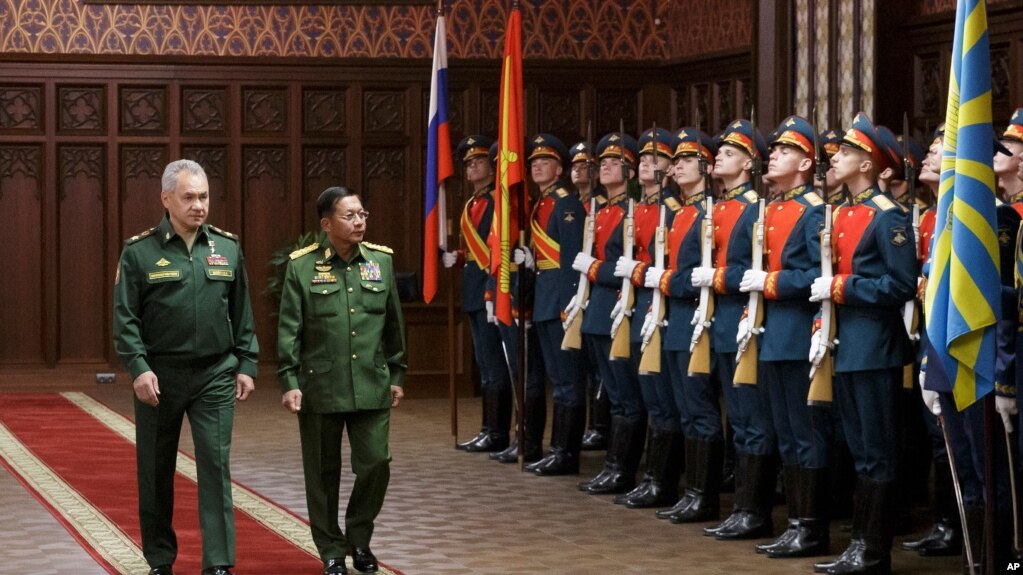 Russian Defence Minister Sergei Shoigu, left, and Senior General Min Aung Hlaing, Commander-in-Chief of Myanmar’s armed forces, walk past the honour guard prior to their talks in Moscow, Russia, on 22 June, 2021. Photo: Russian Defense Ministry Press Service
Without this lifeline, the junta would struggle to maintain its military operations or defend its positions against resistance groups. Plus, on the global stage, China and Russia shield the military at the United Nations, blocking attempts to apply stronger international pressure or coordinated action against them.
Since the 2021 coup, this support has become more extensive and strategically significant. Military training and air defence systems reportedly provided by China and Russia in 2024 have strengthened the junta’s ability to respond to the growing use of drones by resistance groups. Russian-made helicopters and fighter jets have also been central to the junta’s aerial operations, which have caused widespread destruction and civilian casualties.
Meanwhile, Chinese software and digital technologies have reportedly enhanced the military’s surveillance capabilities, strengthening its ability to monitor opposition and expand state repression. These forms of assistance, therefore, contribute not only to battlefield effectiveness but also to the military’s broader coercion of the population.
China’s economic and diplomatic engagement further reinforces this system. Through regional cooperation mechanisms such as the Lancang–Mekong Cooperation framework, China has helped maintain the junta’s international connections and reduce its diplomatic isolation. These relationships may also facilitate regime access to essential resources, including oil and gas, through connections with countries such as Iran. Such access is significant because it can help sustain the military’s operations, including airstrikes, despite international sanctions and economic pressure.
China’s and Russia’s support should be understood not as isolated acts of assistance but as part of a broader system that enables the junta to maintain military capacity, suppress opposition, and resist international efforts to weaken its rule. But this external support does not eliminate the military’s internal weaknesses; rather, it helps compensate for them, allowing the junta to prolong the conflict even as it continues to face substantial resistance.
Lessons from Ukraine
You took part in the “Crimea Global” international conference in Kyiv. What can you tell us about that experience?
For me, coming from a country riven by conflict, visiting Ukraine was a far more touching experience than just attending a conference. Before the event, I got a chance to visit Lviv and Kharkiv to meet with government officials.
It was inspiring to see how the Ukrainian authorities and citizens keep the country running despite being attacked day and night. It takes immense physical and mental strength, but Ukrainians have turned the challenges of open aggression from a larger neighbour into resilience and assets.
What moved me most is the Ukrainian people’s spirit: despite everything they’ve endured, they hold on to their integrity and remain hopeful for sustainable peace, democracy and freedom.
Where can Ukraine and the international community help
How could Ukraine support human rights advocacy on Myanmar?
We can learn a lot from Ukraine – from diplomacy and combating disinformation to wartime governance. What stood out most to me is how Ukraine turns weaknesses into strengths, which takes incredible courage, intelligence, and unity.
Fighting a well-resourced adversary is tough, but staying united is even harder. Ukraine has shown remarkable resilience both on the battlefield and diplomatically, building strong support across the region. Its rise as a leader in drone tech shows how extreme pressure can drive innovation.
Those fighting for a democratic Myanmar can draw key lessons here on staying united, communicating effectively and turning constraints into opportunities.
What can Ukraine do to support human rights in Myanmar?
Ukraine can expand coordination with human rights groups working on Myanmar to exchange expertise, share practical solutions for accountability, and build stronger international cooperation. Stronger cooperation between Ukraine and Myanmar’s democratic representatives could help address this gap.
The UN provides an important example. Myanmar’s Permanent Representative to the UN, Kyaw Moe Tun, has continued to represent positions aligned with the democratic resistance. However, his position at the UN is now challenged by the military-controlled government, and he would need the support of Ukraine and other like-minded country leaders to continue representing the Myanmar democratic force.
Ukraine could provide or rally such support and also work more closely with resistance-aligned Myanmar representatives and human rights actors to coordinate advocacy on human rights, accountability, and international justice.
Such cooperation could also create a stronger platform for both countries to raise concerns about violations and support the implementation of international human rights mechanisms. In this way, cooperation would move beyond individual relationships toward more sustained institutional collaboration at the international level.
What should the international community understand about the connection between Ukraine and Myanmar?
The international community – especially liberal democracies – needs to recognise that the struggles in Myanmar and Ukraine are part of the same fight for democracy and freedom. Anti-coup resistance groups in Myanmar and defenders of Ukraine are both standing on the frontlines against authoritarian forces that threaten global democratic values and aspirations.
Instead of focusing strictly on short-term geopolitical interests, world leaders should back those fighting for their basic rights. Supporting them isn’t just about helping individual nations; it’s about defending national sovereignty, human rights, and international law.
If authoritarian aggression is allowed to succeed, it weakens these core principles everywhere.
Democratic nations must join forces through diplomatic, economic and humanitarian support to resist authoritarianism and fight for a genuinely stable, rules-based order, for the prosperity of all.
Not a war over power
What would you like people to know about Myanmar and the work you do?
At its heart, people in Myanmar are fighting for democracy and federalism – a system in which civilians govern the country and different ethnic groups have equal rights and political status. This isn’t just a civil war over power; it’s a defence against a military regime that uses violence and coercion to strip away basic freedoms and dignity.
Peaceful political reforms started in 2012 when the military regime recognised the people’s will and their votes for a more democratic country, but the 2021 coup destroyed those hopes. That’s why the 2025 military elections must be seen as a sham to maintain military rule under a civilian facade, rather than an attempt to genuinely share power with civilians, let alone a step towards democracy.
After decades of struggle for democracy since the first military coup in 1962, Myanmar people are passionate about a real revolution that brings about sustained democratic change.
Australia’s role
Australia has been a consistent supporter of Myanmar’s pro-democracy movement. Is that support doing enough?
The people of Myanmar are grateful for Australia’s continued support and engagement with Myanmar pro-democracy actors, especially at a time when cuts to US foreign assistance have severely affected education and health services in conflict-affected areas.
However, this support is still far from what Australia is capable of, particularly as some regional countries continue to engage with and support the military junta, effectively throwing it a lifeline that helps sustain the very system responsible for the humanitarian crisis.
Australia needs to support Myanmar’s democracy movement more boldly to help prevent further deterioration of the human rights situation. This could include deeper engagement with human rights organisations and pro-democracy activists, working with regional allies to build stronger support for Myanmar’s democratic forces, and playing a more active role in shaping the international narrative around the crisis.
Engaging with the junta is unlikely to resolve the conflict. Treating the military as a legitimate political partner without meaningful conditions risks normalising state violence and ongoing human rights abuses. Australia can play a stronger role in making clear that meaningful conflict resolution requires addressing the root causes of the crisis, supporting democratic forces, protecting civilians, and ensuring accountability for human rights violations.
What more could Australia do to support human rights in Myanmar?
Australia has been providing important support at the local level, but what may be needed now is stronger institutional support. Australia could take a firmer and more proactive position in holding those responsible for human rights violations accountable. This could include working more closely with human rights organisations, international mechanisms and UN human rights bodies to document violations, strengthen accountability efforts, and push for concrete action.
Without stronger institutional measures and tangible results, other forms of support may have a limited impact. Supporting communities on the ground is important, but if the actors responsible for violence and human rights abuses continue to operate without meaningful consequences, the underlying situation is unlikely to change.
Australia, therefore, has an opportunity to complement its local-level assistance with stronger diplomatic and institutional efforts to support accountability and protect human rights in Myanmar.
Having researched this war for so many years, what gaps in international law – humanitarian or criminal – do you think it has exposed? Are there areas where you believe the law needs to be strengthened, clarified, or rethought to better address what you’ve documented in Myanmar?
While I’m not a legal expert, years of tracking conflict and human rights violations in Myanmar and Southeast Asia make one thing clear: the biggest hurdle isn’t the law itself, but a lack of political will, state cooperation, domestic accountability, and enforcement.
Conflict data shows that neither international nor domestic laws are being effectively applied in Myanmar. No perpetrators have been investigated or convicted locally, let alone internationally. The military junta, responsible for major war crimes, including killing civilians and POWs, remains above the law, shielded in part by the 2008 Constitution.
On top of that, Myanmar isn’t a party to the Rome Statute of the International Criminal Court (ICC) or the International Covenant on Civil and Political Rights, making justice even harder to pursue.
Some international proceedings and UN investigations are underway. The ICC and an Argentine federal court have both taken up cases concerning the Rohingya genocide and crimes against humanity. So far, though, only the Argentine court has issued international arrest warrants for 25 officials under universal jurisdiction.
You may also want to read: Nicaragua’s authorities committed crimes against humanity – United Nations
Even so, these legal frameworks have limited reach for actors to detain suspects or secure convictions. These cases take years, while perpetrators are free and continue committing atrocities. If we still haven’t seen accountability for the Rohingya genocide, it raises serious doubts about when extrajudicial killings and human rights abuses committed since the coup will ever be addressed.
Governments fail to meet international obligations when perpetrators can travel freely, receive diplomatic cover from allies, and actively undermine global legal systems. There’s a gap between international law and the ability to enforce it, granting abusers impunity at the victims’ expense.
This lack of enforcement also allows other countries to prioritise economic and strategic interests and continue business as usual with state actors responsible for crimes.
Liked this interview? Follow ZMINA on X, Bluesky and LinkedIn, and help shape our editorial focus by filling out our feedback form here.