‘I found out about the criminal case from the news’: Why Russia orders the arrest of journalists in absentia and what risks this poses to them
Russia is increasingly using criminal prosecution as yet another tool to pressure journalists who document its crimes and report on the war.
As of May 2026, the Institute of Mass Information, a civil society organisation, had documented more than 30 cases of Ukrainian and foreign media workers being subjected to criminal prosecution in absentia, including the opening of criminal cases, arrests in absentia, the handing down of sentences and placement on wanted lists. Russian courts charge journalists with “extremism”, “terrorism”, spreading “fake news” about the Russian army or “inciting hatred”, even though such cases are based on their reporting, public statements or professional activities. For many, this means not merely an entry in Russian court records, but genuine risks when travelling abroad.
ZMINA spoke to Ukrainian journalists who are being persecuted by Russia because of their work to find out how fabricated criminal cases are changing their lives, whether these cases pose a genuine threat and why the Kremlin is increasingly using illegitimate courts in occupied territories and courts in the Russian Federation as an element of information warfare.
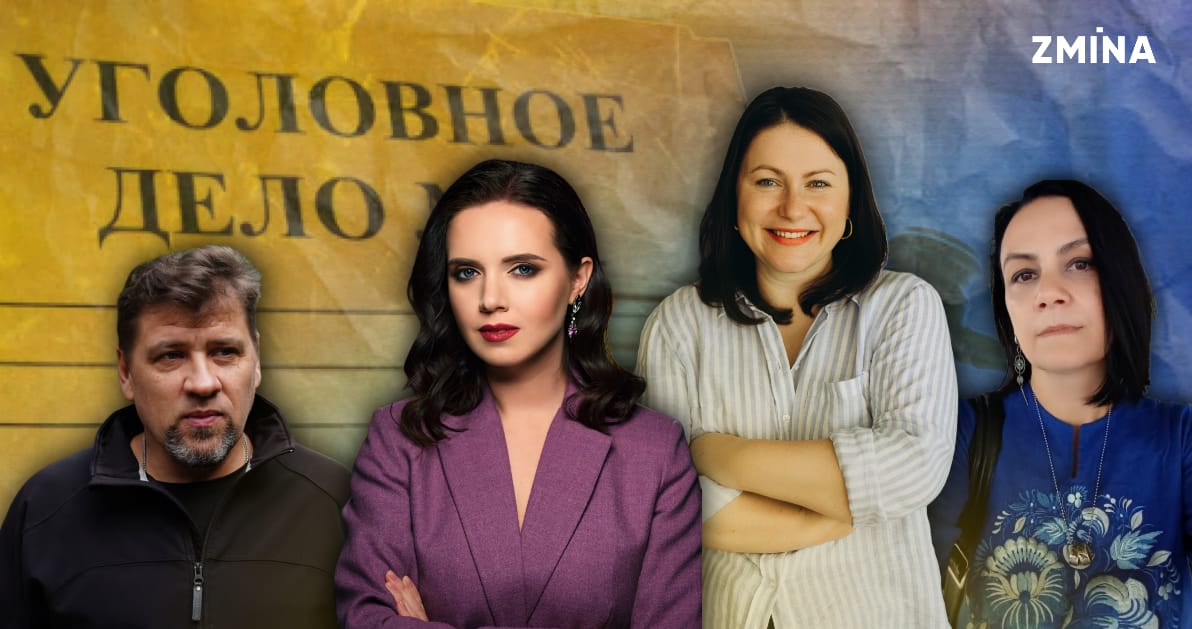
“It feels very strange when a former Ukrainian judge persecutes you on behalf of Russia”. Aleksina Dorohan
Aleksina Dorohan, a journalist at Krym.Realii, a project of Radio Liberty, left Crimea shortly after its occupation in 2014, having first formally renounced the Russian passport that the Kremlin imposes on Crimeans.
The journalist learnt by chance that Russia had opened a criminal case against her. A lawyer appointed by the Russian authorities sent copies of the documents to Aleksina’s address in occupied Crimea. However, the documents contained no information about the substance of the charges. They revealed that the FSB was conducting a pre-trial investigation against her and that the Kyivskyi District Court of occupied Simferopol had already ordered her arrest in absentia. The arrest order was issued by “judge” Andrii Dolhopolov. However, the journalist could not find any information about the hearing itself, even on the court’s website.
“I read the documents very carefully and tried to understand exactly which article I was being charged under. The documents stated only that it carried a sentence of up to 20 years’ imprisonment. I considered various possibilities, but it turned out to be ‘terrorism, extremism and alleged participation in an illegal armed formation’.”
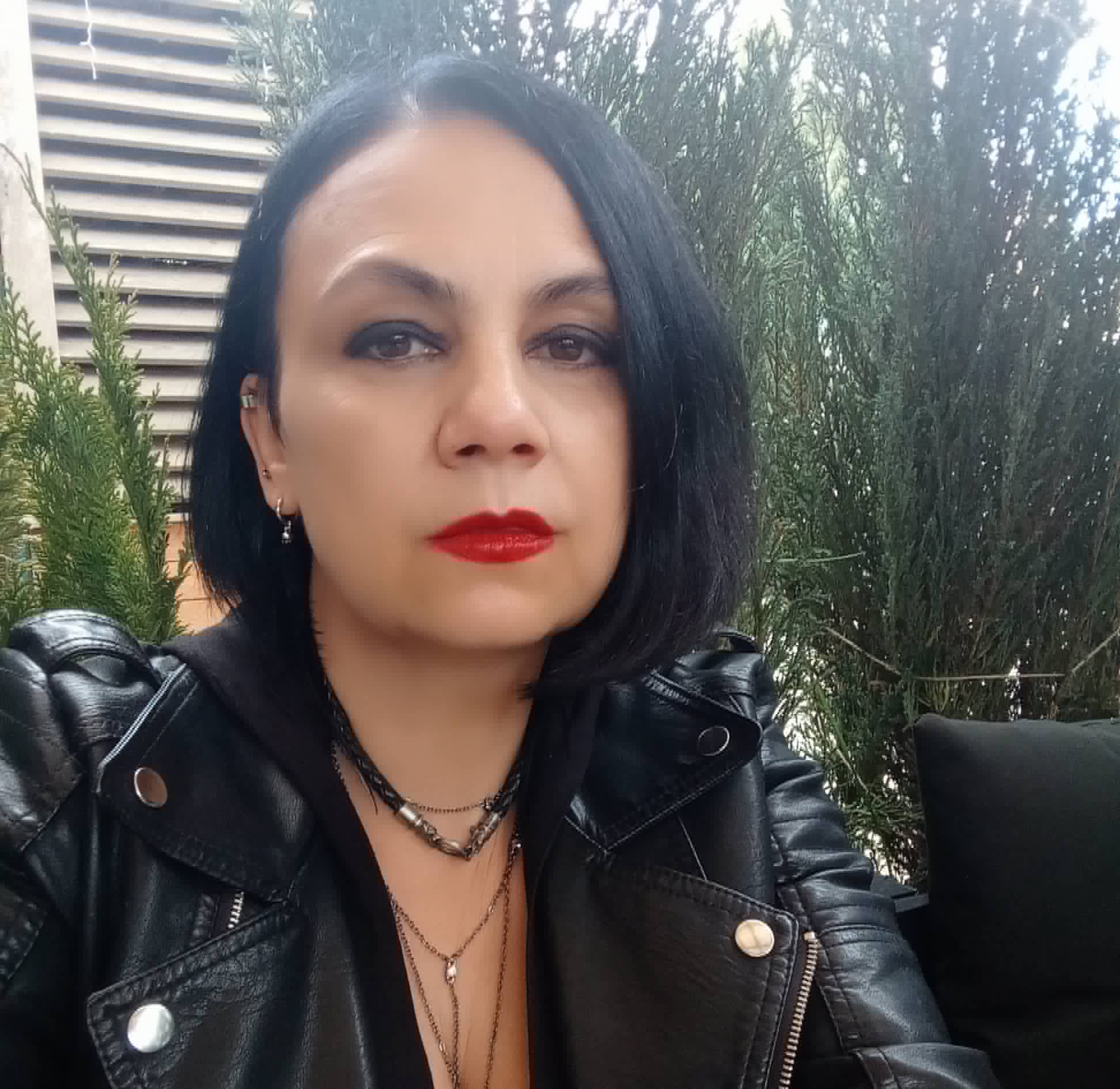 Aleksina Dorohan. Photo courtesy of the journalist’s personal archive
Dorohan had known Andrii Dolhopolov, who now serves as a “judge” in Russia’s occupation court system, since before the occupation of Crimea. At the time, he served as a “judge” at the “Kyivskyi District Court” of Simferopol under Ukrainian law and presided over her divorce proceedings. Following the occupation, Dolhopolov joined the Russian judicial system. In 2025, while serving as a “judge” at the Russian-controlled “Kyivskyi District Court” of Simferopol, he ordered her arrest in absentia.
“It feels very strange when someone who once worked in the Ukrainian judicial system is now involved in your political persecution“, Aleksina Dorohan says.
According to Dorohan, concealing information about court hearings is part of how this persecution works. People may spend years unaware that a case has been opened against them or that their arrest has been ordered in absentia. This puts them at risk when travelling abroad if Russia attempts to use international mechanisms to locate or extradite them.
“I think this is done deliberately so that people remain unaware of the action being taken against them until the last moment and have no opportunity to respond. They can then be detained without warning, and Russia can seek their extradition“.
The journalist later managed to gain access to the criminal case file. According to the documents, Russian investigators accuse her of involvement in the Noman Çelebicihan Battalion. The accusation is based on testimony from two people who had themselves previously been prosecuted for alleged involvement in the battalion.
The Russian case file states:
“As a member of the aforementioned illegal armed formation, Dorohan A. V. actively participated in activities directed against the interests of Russia from an unspecified time in January 2016 until 1 June 2022 […] She performed duties supporting the activities of the illegal armed formation known as the ‘Noman Çelebicihan Crimean Tatar Volunteer Battalion’, including supplying its members with various food products and uniforms, preparing meals and running a smallholding […]“
Dorohan describes the charges as fabricated. She explains that she had indeed been to Chonharі , but only once – in 2015, when she covered the civil blockade of Crimea as a journalist. By contrast, throughout 2016, when Russian investigators claim she joined the battalion, she was working in Kyiv at the Black Sea Television and Radio Company:
“I went to Chonhar once in 2015 in my capacity as a journalist. In 2016, I did not leave the Kyiv region at all. This is easy to verify: my live broadcasts aired every week, and the news bulletins I produced aired every day. It is absurd to accuse someone who has worked in journalism for almost 30 years and has never worked in any other profession of involvement in the battalion“.
According to the journalist, the claim that she allegedly prepared meals and supplied members of the battalion is one of the clearest examples of the fabricated narrative underpinning the case. The only genuine reason her name appeared in the investigation file was that she had carried out a reporting assignment during the blockade of Crimea, which was covered by dozens of Ukrainian and international media outlets.
Dorohan also draws attention to the timing of the criminal case. She says she had been aware since the beginning of the occupation of Crimea that such a case could be brought against her, but does not rule out the possibility that the intensification of the persecution is linked to the launch of the “Cargo 200” project, which documents casualties among Russian military personnel from the occupied peninsula:
“As someone who has consistently covered Crimea, I understood that this kind of persecution could begin at any time. But I think the “Cargo 200″ project really hit a nerve. Instead of stopping me, however, they made me delve even deeper into the issue and speak out even more about how this system of persecution works.”
After the criminal case was opened, the journalist and human rights defenders began documenting all procedural violations. The Ukrainian Helsinki Human Rights Union submitted a complaint to the Prosecutor’s Office of the Autonomous Republic of Crimea, which opened criminal proceedings into the persecution of Aleksina Dorohan. Submissions are also being prepared for international bodies, including the Commission for the Control of INTERPOL’s Files and UN bodies. Dorohan stresses that the greatest danger lies not in the arrest order in absentia itself, but in Russia’s potential use of international mechanisms to persecute journalists.
“An arrest in absentia is specifically intended to enable extradition. In addition to INTERPOL mechanisms, Russia also uses bilateral international agreements. It is therefore vital that as many countries and international organisations as possible are made aware of such cases. This is not about fighting terrorism, but about the political persecution of journalists“.
“Every trip to the airport feels like an ordeal”. Iryna Zemliana
In March 2026, the Moscow City Court sentenced Iryna Zemliana, a journalist and media expert at the Institute of Mass Information, to 13 years in a general-regime penal colony in absentia. The sentence was handed down by Russian judge Vitalii Bielytskyi. She was convicted under three articles of the Russian Criminal Code: attacking a representative of a foreign state, inciting hatred and disseminating “fake news about the Russian army“. The prosecution arose from events in Warsaw on 9 May 2022, when Russian Ambassador Sergey Andrieiev was doused with a red liquid during a protest. Zemliana denies any involvement and describes the case as entirely fabricated. Like many other Ukrainians, the journalist learned of the sentence from Russian media reports. She has never received the criminal case file.
“I have never seen my case file. Everything I know about the sentence, I learned from Russian news reports. It is an absurd situation, but that is how their system works“, Zemliana says.
 Iryna Zemliana. Photo courtesy of the media expert’s personal archive
Following the sentence, uncertainty became the greatest concern. Zemliana and her lawyers contacted INTERPOL to determine whether Russia had attempted to place her on an international wanted list. They have been waiting months for a response. Zemliana adds that the legal risks are only one of the consequences of the persecution. After the first criminal case was opened against her, the journalist began receiving a barrage of threats, while Ramzan Kadyrov, head of Chechnya, publicly declared his intention to find and punish her.
“The Polish police literally escorted me out of the country under guard. They warned me bluntly that I would be killed. British security experts even advised me not to drink from a cup unless I had washed it first and not to touch door handles with my bare hands because they feared I might be poisoned“, Iryna Zemliana says.
Since then, security concerns have become part of her daily life. The journalist plans every trip abroad with the political situation in her destination country in mind, while only those closest to her and her security advisers know her routes.
“Every trip to the airport feels like an ordeal. I never know whether I will get through border control without any problems or suddenly be detained. I have a security adviser who knows all my routes, as well as lawyers in different countries who are ready to act if necessary“.
Despite this, Zemliana says she has not changed the way she works and has no intention of doing so:
“Russia’s use of its Criminal Code is itself a tool of international terrorism. If we stop speaking out about Russia’s crimes, they will have achieved exactly what they want“.
“We document environmental crimes that could form the basis for international proceedings”. Vladyslav Balinskyi
Vladyslav Balinskyi, an environmentalist, journalist and staff member at Tuzly Estuaries National Nature Park, learnt by chance that he was facing criminal prosecution in Russia. His son used artificial intelligence to check and found information about criminal proceedings opened against Balinskyi in Russia. It later emerged that Balinskyi had been charged in absentia with disseminating “fake news about the Russian army” under Article 207.3 of the Russian Criminal Code and “damaging military memorials” under Article 243.4. According to the journalist, a Russian court has already sentenced him to 11 years in a strict-regime penal colony, although he was never officially notified of the proceedings.
The first charge concerns a report on the aftermath of Russian shelling of the Odesa coastline, during which Balinskyi documented the damage and spoke to local residents. The second one concerns the removal of Soviet symbols from the “Wings of Victory” memorial in Odesa, which he says did not comply with Ukrainian decommunisation legislation.
You may also want to read: Russians erect Stalin monument in occupied Melitopol
However, the journalist believes that the real reason for his persecution is his longstanding work documenting the environmental consequences of Russian aggression. Since the beginning of the full-scale invasion, Balinskyi and his colleagues have documented the consequences of the destruction of the Kakhovka Hydroelectric Power Plant, pollution of the Black Sea, mass deaths of cetaceans, the accident involving Russian oil tankers in the Kerch Strait and other acts of ecocide. They submitted the material they collected to Ukrainian law enforcement agencies and international partners as evidence of war crimes.
“We did more than simply report on these events. We collected field data, developed scientific methodologies and worked with European scientists and journalists before submitting all the material to the prosecutor’s office. This is no longer simply journalism – it is a body of evidence for investigating ecocide“.
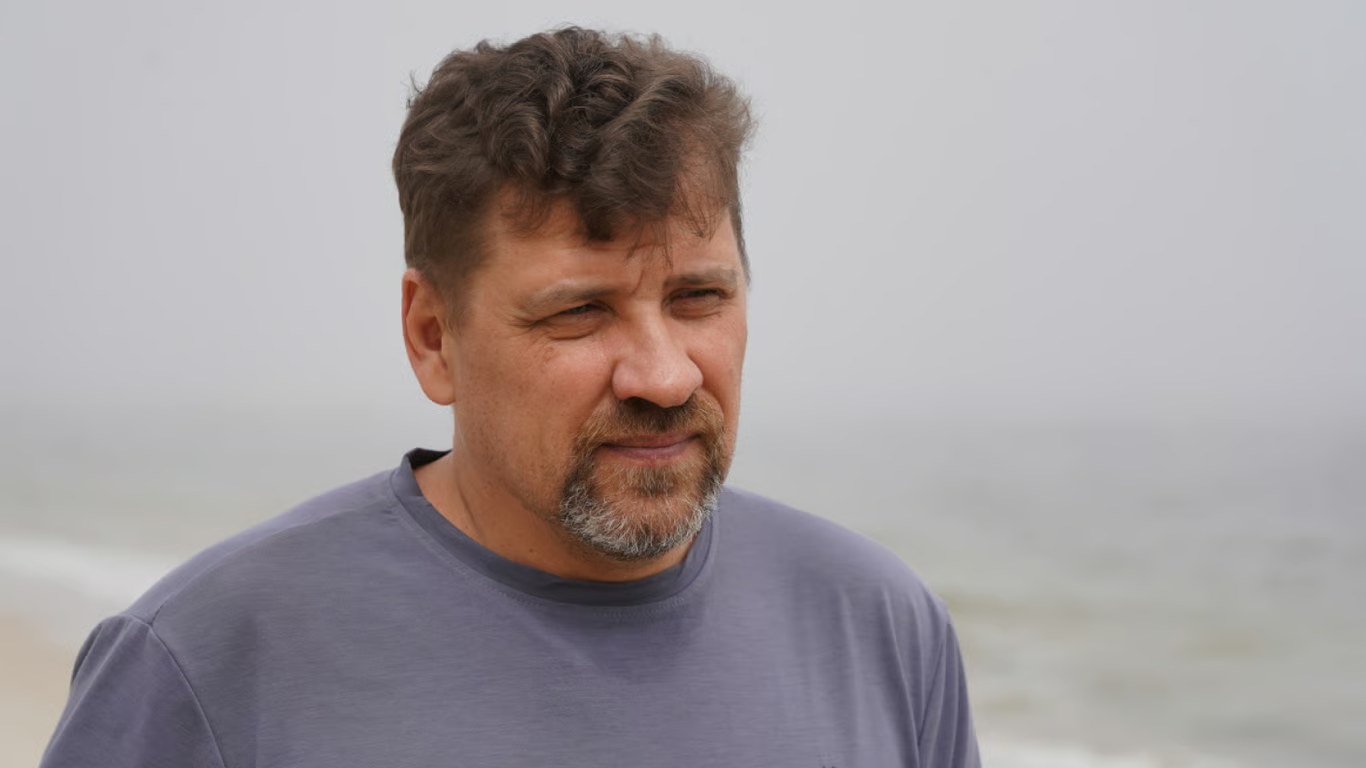 Vladyslav Balinskyi. Photo from publicly available sources
Balinskyi believes that this work is precisely what made him a target of Russian law enforcement agencies:
“I think they realised that this work would have consequences. We are documenting environmental crimes that may one day form the basis for international proceedings and claims for reparations. That is why they came after me“.
Alongside the criminal prosecution, a campaign to discredit the journalist was launched across Russia’s media sphere. According to Balinskyi, propaganda Telegram channels describe him not as a scientist, but as a “propagandist” and a “legitimate target”.
“They claim that I am not really engaged in scientific work, but use it as a cover to pass information about the movements of Russian vessels to the military. In reality, I have spent many years documenting the environmental consequences of the war. I believe it is this work that led to my persecution“, Balinskyi concludes.
Judge Nikolaeva Evgeniya of Moscow’s Basmanny District Court handed down the environmentalist’s sentence after just one hearing.
“I was placed on a wanted list while I was abroad with my children”. Yanina Sokolova
In 2024, Moscow’s Basmanny District Court sentenced Yanina Sokolova, a Ukrainian television presenter, in absentia to eight years in a general-regime penal colony. She was convicted of “inciting hatred and hostility” over remarks about Russians made in an interview with Ukrainian television channel NTA and on a programme on her own YouTube channel. The Russian court also banned the journalist from administering online resources for three years. The criminal prosecution was initiated on the instructions of Aleksandr Bastrykin, head of Russia’s Investigative Committee. It was not possible to verify the identity of the Russian judge who handed down the decision in the journalist’s case, as the case search function on the Russian court’s website was unavailable.
Sokolova learnt about the criminal prosecution not from the Russian authorities, but from Ukrainian journalists.
“I was abroad with my children when Radio Liberty called and told me that Russia had placed me on a wanted list. Russian propaganda channels then began calling me and asking me to comment on it live on air“.
 Yanina Sokolova. Photo credit: Vitalii Nosach, RBC-Ukraine
According to the journalist, one element of the case concerns her statement about the need to eliminate Russian occupying forces, while another concerns billboards advertising her television project on Channel 5:
“The first concerns alleged calls to kill Russians, which they classified as extremism. The second concerns an advert for my project bearing the slogan “This pisses off the Moskals [a derogatory term for Russians]”, which they described as inciting ethnic hatred.“
 The advertisement cited as the official grounds for Yanina Sokolova’s criminal prosecution in Russia. Photo from publicly available sources
Despite the sentence, Sokolova made a principled decision not to appeal to the Russian courts.
“I do not want to legitimise any of this. To me, this is a sham court and a sham law enforcement system. I do not recognise these decisions and have no intention of playing by their rules“.
The persecution has affected both her personal life and her professional work. The journalist says she now plans trips abroad far more cautiously, as the risk of detention is not limited to countries with close ties to Russia:
“When I travel abroad, I only post about it on social media after returning home. Russia makes extensive use of networks of operatives to target Ukrainian journalists. I was once detained at the border between Poland and Germany. They checked my documents for a long time and consulted among themselves before allowing me to continue my journey. Since then, I have been even more vigilant about my safety“.
“Russia uses courts as part of its punitive apparatus”. Yaroslav Yurchyshyn
Yaroslav Yurchyshyn, chair of the Verkhovna Rada Committee on Freedom of Speech, stresses that Russia’s use of legal proceedings to persecute Ukrainian journalists is part of a broader pressure campaign involving court sentences, international wanted notices, information attacks and threats.
According to Yurchyshyn, the Ukrainian journalists in question are not listed in INTERPOL’s databases. Ukraine continues to monitor the situation, while INTERPOL established a special group following the beginning of the full-scale invasion to review requests from Russia and prevent international mechanisms from being misused for politically motivated persecution.
“The risks at INTERPOL level are minimal. The greater danger comes from countries that have close ties to Russia. They may take action independently of any decision by INTERPOL“.
 Yaroslav Yurchyshyn. Source: his Facebook page
At the same time, Yurchyshyn says, the Kremlin is increasingly using Russian courts as part of its machinery of repression. The charges almost always follow the same pattern: journalists are accused of “terrorist activities”, “extremism”, “aiding the Armed Forces of Ukraine” or offences under other politically motivated provisions, with their words or reporting taken out of context.
“We see these cases as evidence that judicial power is being abused and that Russia has no independent judiciary. Its judiciary is simply part of the punitive apparatus“.
According to Yurchyshyn, the number of cases opened by Russia against Ukrainian journalists continues to grow. He believes that the use of legal proceedings to persecute them is only one component of a large-scale campaign against Ukrainian media.
“Russia understands that it will not achieve its objectives quickly, so it is preparing for a protracted war and deploying as many mechanisms as possible to pressure journalists. While the word “Press” on body armour once offered at least some protection, it now makes the wearer an additional target“.
According to the MP, the main purpose of these criminal cases is not only to create problems for individual journalists, but also to intimidate the entire journalistic community and attempt to use international mechanisms to restrict their work abroad.
“First and foremost, this is a means of intimidating not the people targeted by these criminal cases, but other influential figures. Second, it is an attempt to use international mechanisms to exert pressure. Third, it is an investment in the future. If Russia succeeds in achieving its objectives, it will persecute everyone who opposed it”.
Yurchyshyn also advises journalists to remain alert to the first signs of persecution, including large-scale bot attacks, attempts to hack their accounts and direct threats. In such cases, he recommends contacting law enforcement agencies, cybersecurity experts, and lawyers immediately.
“Being informed means being protected. Russia is hunting Ukrainian journalists and will use every available method to pressure them. The key is therefore to act quickly, document every incident and not deal with it alone“.
The stories of Ukrainian journalists whom Russia sentences in absentia, places on wanted lists or targets with criminal cases differ in detail, but follow a common pattern. In most cases, the charges stem from their professional work – reporting on the war, documenting war crimes, conducting investigations or making public statements about Russian aggression.
Liked this article? Follow ZMINA on X, BlueSky, and LinkedIn, and help shape our editorial focus by filling out our feedback form here.