Human rights advocates call for increased pressure to free imprisoned Ukrainian journalists
Human rights advocates and civil society organisations are calling for increased international pressure to secure the release of Ukrainian journalists held in Russian captivity, some of whom are in critical condition. Advocates and journalists’ organisations are working with international partners, including the European Union and Türkiye, to facilitate their release, a ZMINA journalist reported from a parliamentary commission meeting. Meanwhile, the families of the imprisoned journalists face challenges in confirming their status and lack sufficient state support.
 Photo credit: Oleksandra Yefymenko
This was discussed during a meeting of the Temporary Investigative Commission of the Parliament of Ukraine regarding the investigation of crimes committed by the armed formations of the Russian Federation against journalists and other media workers.
ZMINA project manager Viktoriia Nesterenko explained that the organisation systematically works on international advocacy for the release of journalists. ZMINA representatives participate in international events, conduct private meetings with diplomats, and prepare statements regarding violations of journalists’ rights and freedom of speech in temporarily occupied territories. Specifically, the organisation contributed to the preparation of a resolution by the Parliamentary Assembly of the Council of Europe regarding illegally imprisoned journalists.
According to Nesterenko, among the 27 journalists currently in Russian captivity are individuals who require urgent medical attention. She named Iryna Danylovych, Amet Suleimanov, Server Mustafaiev, and Tymur Ibrahimov, stressing their need for medical care.
“We believe that one mechanism that could be effective is separating civilians in captivity into separate groups – women, the ill, and so on. The same applies to journalists,” Nesterenko elaborated.
She noted that the proposal to release all civilians as part of an “all-for-all” exchange without additional conditions is currently not yielding the expected results. Therefore, ZMINA believes it is appropriate to seek separate mechanisms for the return of journalists and individuals in need of urgent medical treatment.
 Victoria Nesterenko. Photo credit: Oleksandra Yefymenko
The organisation also cooperates with Turkish government representatives. According to Nesterenko, work in this direction was intensified after the release of Nariman Dzhelial, which occurred through the mediation of Turkish President Recep Tayyip Erdogan. ZMINA representatives met with the Chief Ombudsman of Türkiye, representatives of the Ministry of Foreign Affairs, and the Chief Adviser to the President, Yalcin Topcu.
During the most recent meeting in May 2026, the organisation handed Türkiye lists of illegally imprisoned journalists and highlighted the most critical cases. Nesterenko reported that Türkiye is prepared to continue facilitating advocacy for their release, particularly for Crimean Tatars. At the same time, she said that the Russian leadership does not demonstrate the political will to resolve this issue, making it important to engage additional levers of influence and Ukrainian authorities.
The head of the National Union of Journalists of Ukraine, Serhii Tomilenko, also emphasised the importance of international solidarity and ongoing coordination with the families of imprisoned civilians. According to him, international journalist federations support campaigns for the release of Ukrainian colleagues, and the participation of released journalists and the families of those imprisoned in international events helps keep the topic in the spotlight.
Tomilenko also reported that, thanks to international support, it was possible to provide financial assistance to some families of illegally imprisoned journalists in 2026. This, in particular, helped the wives of those imprisoned to send parcels and visit their husbands in Russian penal colonies. At the same time, he urged that the level of information transparency regarding specific prisoners be coordinated with their families before launching public campaigns, as some fear that publicity might complicate their release.
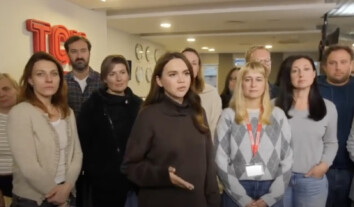
The first secretary of the National Union of Journalists of Ukraine, Lina Kushch, highlighted the difficulties families face when processing documents to establish the status of those illegally deprived of their liberty. In particular, she mentioned Olena Rudenko, who had previously spoken about attempts to obtain such confirmation for her sister, journalist Iryna Levchenko.
“Despite what seemed to be obvious facts – everyone knows about Iryna Levchenko – Olena Rudenko, her sister, has never managed to obtain such confirmation or establish the status,” Kushch said.
She also reported on the financial difficulties faced by the families of civilian prisoners. According to the first secretary, families are losing income while incurring additional expenses for legal assistance and maintaining contact with prisoners. As an example, Kushch cited a case where a lawyer requested 300,000 hryvnias for the first stage of the legal process regarding a journalist illegally detained in the Kherson Region (Oblast), and a single visit to a prisoner in a penal colony costs 20,000 hryvnias. Kushch stressed that the one-time aid of 100,000 hryvnias provided by the state does not cover such expenses. She also drew attention to the lack of a comprehensive rehabilitation programme for released civilian prisoners, including journalists, unlike that for prisoners of war.
Earlier, during a meeting of the Temporary Investigative Commission, Olena Rudenko spoke about the constant transfers of Iryna Levchenko and problems with correspondence.
To provide background, Iryna Danylovych, a Crimean nurse and citizen journalist who is held in Russian captivity, has complained about constant noise in Russian Penal Colony No. 7 in the city of Zelenokumsk.
Stay connected with us via X, Bluesky and LinkedIn – and while you’re here, please spare five minutes to fill out our survey and tell us what you’d like to see next.