Russian drone hits Odesa apartment block as overnight barrage leaves three dead and 29 injured nationwide
Overnight on 12 September, the Russian military attacked Ukraine with ballistic and cruise missiles, as well as attack drones, resulting in fatalities and injuries, including a child, the Air Force of the Armed Forces of Ukraine and heads of local regional military administrations stated. The main target of the strike was the Odesa Region (Oblast).
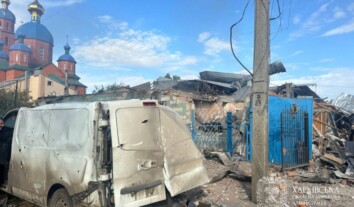
 Aftermath of the Russian attack in Odesa
At 18:00 on 11 September, the Russian military deployed Iskander-M/KN-23 ballistic missiles, eight Kalibr sea-based cruise missiles, six Kh-59/69 guided air-to-surface missiles, as well as 129 Shahed drones, S-8000 Banderol types, and Parodiia decoy drones. Half of the attack drones were jet-powered.
The main target of the strike was the Odesa Oblast. Civilian infrastructure was damaged there as a result of the Russian attack. According to the Head of the Odesa Regional Military Administration, Oleh Kiper, 12 injuries were initially reported. Later, the number of casualties rose to 23, including a five-month-old baby.
 Aftermath of the Russian attack in Odesa
As a result of the strike, the upper floors of a residential multi-storey building were completely destroyed. The blast wave damaged neighbouring buildings and a low-pressure gas pipeline.
At another address, three more residential buildings were damaged, one of them completely destroyed, along with a gas pipeline. At least six people, including a child, were hospitalised. The elimination of the attack’s consequences continues at the strike sites.
 Aftermath of the Russian attack in Zaporizhzhia
In Zaporizhzhia, Russian drones attacked the residential sector. The strikes caused fires and destruction. As a result of the hit, two people were kill,ed and four others were injured. They are receiving the necessary medical assistance.
According to the Head of the State Agency for Restoration and Infrastructure Development of Ukraine, Ivan Fedorov, a 64-year-old woman and a 37-year-old man were killed. Emergency responders recovered the man’s body from under the rubble of a destroyed building.
In two other locations, a private residential building and an outbuilding were damaged, followed by a fire.
 Aftermath of the Russian attack in the Dnipropetrovsk Oblast
In Kryvyi Rih, the Russian military struck an industrial enterprise. According to the Head of the Dnipropetrovsk Regional Military Administration, Oleksandr Hanzha, one person was killed and two others were injured.
On the northern border of Ukraine, repeaters capable of helping Russian forces control attack drones during strikes on Ukraine are operating again in Belarus, Ukrainian intelligence reports. Six such facilities have been detected along the border. Kyiv says it has sufficient capabilities to deal with the threat if it persists.
Previously, ZMINA reported that Russians killed 11 civilians and wounded 126 across Ukraine on 10 September.
Despite U.S. President Donald Trump’s promise, the war in Ukraine has not ended 24 hours after his inauguration. His further attempts to facilitate an unconditional ceasefire between Russia and Ukraine have also failed.
Related: Zelensky vows not to sign weak peace deal with Russia despite pressure
Meanwhile, Rikard Jozwiak, Europe editor at Radio Free Europe/Radio Liberty, has reported on X that EU ambassadors have once again been unable to reach agreement on extending personal sanctions imposed over Russia’s aggression against Ukraine. They will meet again on Monday – the day before the 15 September deadline.
“Slovakia still wants Usmanov and Fridman delisted, but the issue is now further complicated as France also wants Usmanov off the blacklist,” he wrote.
On potential peace talks, President Volodymyr Zelenskyy stated in an interview with DW that he is ready to meet with Kremlin leader Vladimir Putin at the G20 summit in Miami if Putin attends. He emphasised that a concrete result of the conversation is important above all. After this comment, Kremlin spokesperson Dmitry Peskov rejected the possibility of such a meeting, calling it “impossible”, AFP reported.
In addition, Indian Prime Minister Narendra Modi urged Putin for the second time in a month to enter negotiations, stating that dialogue and diplomacy remain the path to ending the war, and that India is ready to facilitate peace efforts.
As winter approaches, the United Nations says Ukraine will face its toughest winter since Russia’s full-scale invasion in 2022. The head of the UN’s development agency, Alexander De Croo, said Russia was systematically targeting Ukraine’s civilian infrastructure
“The worst-case scenario, and we’ll do everything to avoid that, is that at some point access to energy and electricity would be severely damaged, which means that access to heating would be severely damaged and that, for example, water systems and sewage systems would stop functioning. With the temperatures that you would get here, that would lead to circumstances which would be really close to a humanitarian catastrophe,” BBC World Service cites him.
To support long-term energy resilience, the Ukrainian energy sector’s needs for the coming decades are estimated at a minimum of $91 billion, with the main focus on investments in new generation, technologies and modern equipment. The timelines for some procedures have already been shortened for new energy projects in the country. A competition is also being launched to develop 1.5 GW of highly manoeuvrable generation capacity.
Stay connected with us via X, BlueSky and LinkedIn – and while you’re here, please spare five minutes to fill out our survey and tell us what you’d like to see next.