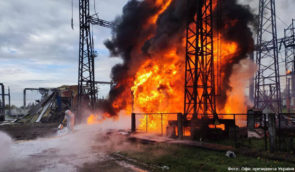
Russian strikes destroy 120-year-old convent in Stepanivka, Donetsk region
In the village of Stepanivka in the Kramatorsk District of the Donetsk Region (Oblast), police and military personnel evacuated 18 people from St Stephen’s Convent, which was destroyed by Russian guided aerial bomb strikes, the Donetsk Oblast police reported. Most of those rescued were nuns. Due to the shelling, the convent’s residents lost their homes, personal belongings and sacred objects.
 Photo credit: Proliska humanitarian mission
According to law enforcement officers, after the Russian bombing, the people who were at the convent requested help. A joint operation by the Donetsk Oblast police and soldiers from the 25th Separate Assault Regiment “Rys” (Ukrainian for “lynx”) was organised to rescue them.
Personnel from the Pokrovsk District Police Department and law enforcement officers from Oleksandrivka took part in the evacuation. They used armoured vehicles to transport people, while fighters from the police anti-drone battalion provided cover for the evacuation crews against potential attacks by Russian drones.
All 18 people were successfully transported to a safer location. According to the “Proliska” humanitarian mission, the evacuation took place on 11 November 2026. Initially, the people were taken to an interim evacuation point in Oleksandrivka, from where they are to travel to Poltava Oblast.
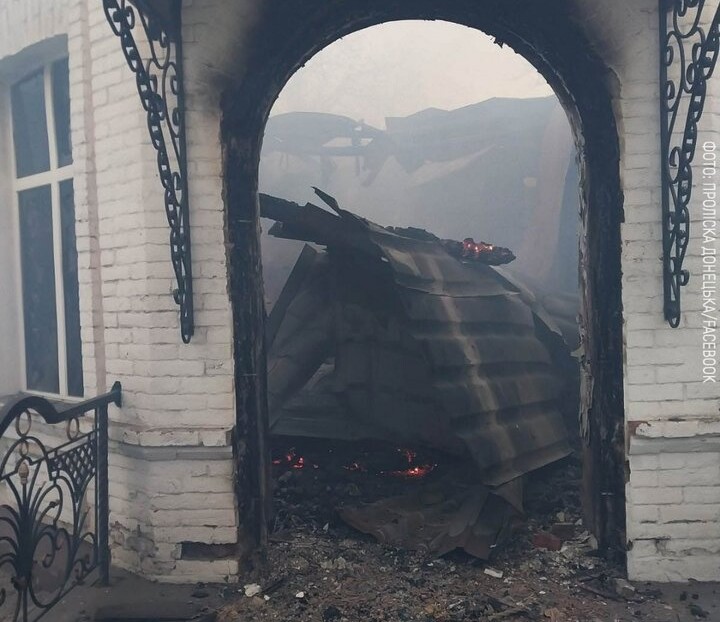
As Stepanivka village district head Valerii Davydenko told the public broadcaster Suspilne, Russian forces first attacked the convent on 4 November, and carried out a second strike overnight into 10 November 2026.
During the shelling, the people hid in a shelter, so none of them were killed or injured. However, the fire destroyed the buildings and property of the convent.
In particular, the Russians destroyed the building containing the church where services were held, the nuns’ cells, residential houses and guest houses, where pilgrims previously stayed, and outbuildings.
According to the village head, four local residents were among the convent’s residents; they had previously lost their own home due to Russian shelling and had found shelter in the convent.
Related: UNESCO adds Tauric Chersonese in temporarily occupied Crimea to “in danger” heritage list
The destroyed buildings were over 120 years old. They were built in 1902 for a hospital, which later housed operating, gynaecological and other departments. Later, an outpatient clinic was located there, and in 2006, the buildings were transferred to the convent.
As a result of the Russian strikes, the convent’s residents lost not only their place of residence but also personal belongings and sacred objects.
Stepanivka in the Novodonetske hromada, a local government area that includes one or more nearby settlements, regularly suffers from Russian shelling. According to Davydenko, at least 17 hits were recorded in the village even before the attack on the convent.
About 700 people lived here before the start of the full-scale invasion. Currently, only 18 residents remain in the village, mostly elderly people and those with health problems.
You may also want to read: Putin tries to exterminate us as a nation, as Hitler tried to exterminate the Jewish people during World War II
Due to constant shelling, there has been no electricity in Stepanivka since the end of June 2026. Residents get water from wells, and there is no gas supply in the village.
At the same time, some of the people who remain in the hromada have already experienced forced displacement. In particular, displaced persons from Avdiivka and Hirnyk live there, who do not want to leave their homes again.
Russian forces regularly attack religious sites in the Donetsk Oblast. On 22 September 2026, as a result of a Russian shelling of Kramatorsk, the Orthodox church of St John the Baptist sustained significant damage. The blast wave damaged the building’s walls, roof and dome.
In total, according to Ukrainian President Volodymyr Zelenskyy, Russian forces have killed about 120 members of the Ukrainian clergy since the beginning of the full-scale invasion. Approximately 800 more religious sites of various denominations have been destroyed or damaged by Russian attacks.
To provide background, Ukrainian experts point out that countries, including China, Greece, North Korea, Hungary, Slovakia, Iran, and Brazil, assist Moscow in killing Ukrainians in its war against Ukraine by funding the Russian budget through trade.
Human rights organisations and Ukrainian authorities emphasise that structural economic pressure remains a key tool to halt such atrocities. They urge every nation and individual government worldwide to strictly enforce global sanctions, close existing regulatory loopholes, and completely sever remaining commercial and technological ties with the Russian Federation. Civil society groups stress that any continued cooperation by foreign businesses directly contributes to the resources Moscow uses to sustain its ongoing war crimes and crimes against humanity in Ukraine.
Stay connected with us via X, Bluesky and LinkedIn – and while you’re here, please spare five minutes to fill out our survey and tell us what you’d like to see next.