Five hours along a mined road: How a family escaped the blockade of Oleshky and is returning to normal life
A humanitarian mission to rescue people in Russian-occupied Oleshky, on the left bank of the Dnipro River in the Kherson Oblast, is scheduled to take place from 27 October to 1 November 2026. According to Ukrainian estimates, up to 2,000 people may still be in the town itself, while around 6,000 people, including up to 200 children, remain in Oleshky and six neighbouring settlements.
The agreements between Ukraine and Russia provide for a ceasefire starting at 3 a.m. Kyiv time on 27 October 2026, the clearance of mines from routes into the town, the delivery of humanitarian aid, including food and medicines, and the opportunity for residents to leave through a humanitarian corridor.
However, the announced timeframe does not mean that humanitarian aid has already reached the town or that evacuations have taken place. Dmytro Lubinets, Ukraine’s Ombudsman, said that the United States would be involved in monitoring compliance with the agreements. He did not provide details of how this monitoring would work.
Meanwhile, the Ukrainian Ombudsman’s Office is gathering information about residents who need assistance, particularly older people, those with limited mobility and those unable to care for themselves.
Vitalii left Oleshky earlier, on 13 September 2026. His family could not wait any longer: they had enough food left to last approximately one month, and only if they ate once a day.
They set out on foot with several other residents. Ahead of them lay 23 kilometres of mined road, physical exhaustion and Russian drones that twice blocked their path.
Vitalii told ZMINA about life in Oleshky, where hunger had gripped the town for months, as well as his family’s escape from the blockaded town and their recovery in Ukrainian-controlled territory.
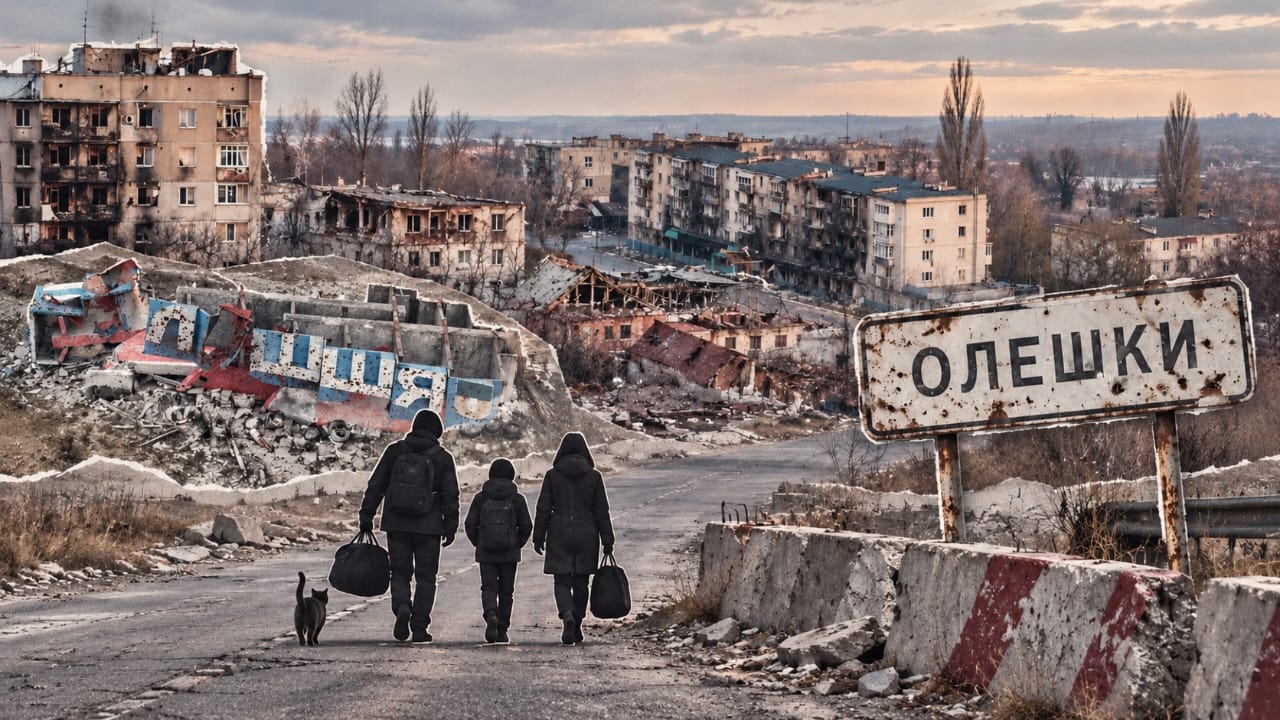
Food was measured by the cup
Before leaving the town, Vitalii and his family would cook just one cup of buckwheat or rice to share between the three of them. That was all they had to eat for the day. If they managed to buy a cucumber or tomato, they would make a salad with some purslane. It was their way of trying to stave off the hunger that never went away.
“When you have no food, when you can’t eat properly, when you have nothing at all – it’s a terrible situation, of course. You can’t afford anything,” Vitalii says.
You may also want to read: From “soft power” to torture chambers: patterns of Russia’s seizure of new states based on Ukraine’s experience
The family survived on supplies they had stocked up on earlier. According to Vitalii, food was still being delivered to the town’s only functioning shop in 2025. Back then, they could buy some provisions and put them aside. Later, they had to make those supplies last for months.
Vegetables grown in local gardens – cucumbers, tomatoes and courgettes – were still available at the market near the hospital. The family bought small amounts whenever they could to add some variety to their diet and get at least some vitamins.
“Other food items were becoming increasingly difficult to obtain. Vitalii gives the prices converted into Ukrainian hryvnias: a kilogram of flour costs 2,500 hryvnias. Ten eggs could be bought for the same price, but only through acquaintances, ‘by pulling a lot of strings’,” Vitalii said.
According to Vitalii, potatoes and onions were sometimes impossible to purchase, no matter how much someone was willing to pay. Instead, people offered to barter: a kilogram of potatoes for a kilogram of flour. Few were willing to agree to such an exchange. Having money no longer guaranteed that you could get something to eat. People might trade some of their supplies for something they needed more, or refuse to sell anything at all.
Related: European Parliament vice-president on hunger strike over trapped civilians in Oleshky
When Vitalii talks about the blockade, he recalls more than just the final months before his family left. He says the town had already endured a period from mid-December to mid-March when it faced both cold weather and food shortages.
The situation repeated itself during the warmer months. According to Vitalii, no food supplies were delivered to the town from late May to late September, and seriously ill and injured residents were not evacuated. His family left in September, so he learned about subsequent developments from outside the town.
He also describes how residents were unable to bury the dead. According to his information, around 50 bodies remained in the morgue, which could not function properly because there was no electricity.
“In summer, when there’s no electricity, the bodies just lie there rotting in bags,” he says, describing the conditions.
 Damaged monument at the entrance to Oleshky. Photo credit: 34th Separate Marine Brigade “Borysfen”
Two hours at the market, the rest of the day at home
Vitalii’s recollections paint a picture of a town where even a brief trip outside required caution. People would visit the market between around 8 and 10 a.m. After that, the streets would be empty. Moving around Oleshky was dangerous because of drones and artillery shelling. Most residents stayed inside their homes.
He estimates that around 1,500 people may have remained in the town. He does not know the exact number: with people staying indoors and only seeing their neighbours during brief trips outside, it was difficult to make an accurate estimate.
Meanwhile, residents had to manage without basic utilities. Vitalii says the centralised water supply stopped after the blowing up of the Kakhovka Hydroelectric Power Plant in 2023. Electricity was cut off on 23 October that year, while gas supplies stopped on 5 July 2025, he reported.
By the beginning of 2026, Vitalii’s family had lost access to all these utilities. There was also no petrol available to help them manage everyday life.
One of his most difficult memories is spending the winter in a third-floor flat. Without electricity, water or gas, the family had to find ways to keep warm and survive each day.
Yet Vitalii cannot single out one experience as the most difficult. He recalls the destruction of the Kakhovka Hydroelectric Power Plant, the blockade and nearby fires during which he helped save people and their homes. He also remembers members of the occupation administration going door to door with Russian soldiers, conducting “surveys” about the Kherson Oblast joining Russia.
“Every day is a challenge. Every day is different. Because if you make it through the day alive and unharmed, that’s already a victory,” he says.
When only the news headlines would load
Despite the isolation, Vitalii was able to keep up with events outside the town. He says that Oleshky still had access to Ukrainian mobile networks because of its proximity to Kherson, although the signal was weak.
Sometimes the internet connection was only strong enough to load news headlines. Opening the articles themselves to read the details was impossible.
Even that was enough to give him at least some idea of what was happening in Ukraine and around the world. Vitalii believes his town was more fortunate in this respect than more remote settlements. Ukrainian mobile networks were no longer available in Radensk or Kostohryzove.
The presence of Russian soldiers also dictated what people could say openly. Vitalii does not recall any protests during that period: residents tried to avoid provoking occupying soldiers.
“When people have guns and you don’t, they can dictate the rules,” he explains.
Vitalii also spoke to Russian soldiers on several occasions. They explained that they had joined the illegitimate war for the money: some needed to pay off their mortgages, while others were saving up for a flat, a house or a car.
When Vitalii asked what would happen if they were not being paid, they told him that everyone would go home and the war would end.
“So they’re cynically making money by killing people,” he says, summing up these conversations.
Vitalii did not try to negotiate with Russian soldiers to secure his own departure from the town. He knew of people who had tried to leave but were struck by drones or blown up. He is convinced that the presence of civilians benefits the occupying forces, who can use them as human shields.
 Vitalii’s apartment, destroyed by Russian shelling of Oleshky. Photos provided to ZMINA by Vitalii
Autumn could make the journey even more dangerous
The family decided to leave when their supplies were almost exhausted. Vitalii was keeping track not only of how much food they had left but also of how much time remained before the weather changed. He knew that autumn would bring rain and fallen leaves that could conceal mines and unexploded ordnance. Hazards that were still visible on the road in September could soon become impossible to spot.
In his view, waiting any longer would offer the family no advantage. In another month or six weeks, they would be even weaker, and the journey would be even more dangerous.
“When you’re in an occupied town, you realise you have to make decisions very quickly and act on them,” he says.
There was no trust left in the occupation authorities. Vitalii recalls reading statements by Volodymyr Saldo, the Russian-appointed “governor” of the occupied Kherson Oblast, while residents faced food shortages and a lack of basic utilities. According to Vitalii, Saldo denied that there was a humanitarian catastrophe and claimed that the town had everything it needed.
The family also contacted the Ukrainian Ombudsman’s Secretariat. Vitalii recalls being told in August that Russia was not responding to attempts to establish contact. All of this convinced him that staying meant continuing to go hungry, with no guarantee that help would arrive in time. Leaving did not guarantee their safety either, but it offered a chance. They decided to take it.
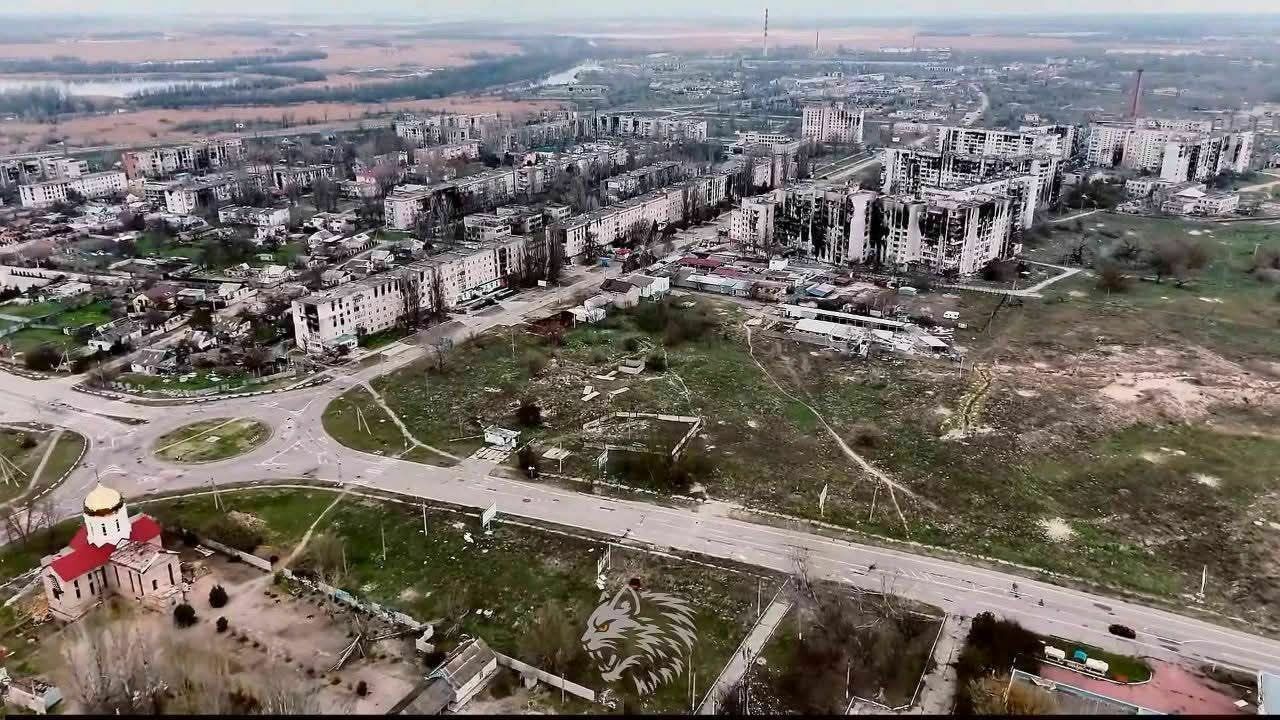 A bird’s-eye view of Oleshky. Some building facades have been blackened by fires. Photo credit: Oleshky City Military Administration
A drone hovered about three metres away
On 13 September 2026, at 8 a.m., a group of eight people set out from Oleshky, including Vitalii and his family.
He believed it was better for several families to travel together rather than alone. If someone came under shellfire, was struck by a drone or stepped on a mine, there would be others nearby who could help.
They had to cover 23 kilometres to reach Radensk. Vitalii led the way, carefully scanning the road ahead. The others followed directly in his footsteps.
“I was like a sapper, watching the road. The people behind me followed in my footsteps. We couldn’t take a single step to either side,” he recalls.
The journey took five hours. After a prolonged period of eating too little and barely moving around, the walk proved physically exhausting. Halfway through, Vitalii’s son could barely walk any further. He kept sitting down on the tarmac because his leg muscles had gone so numb that it was hard to keep going.
About a kilometre from Radensk, when the village was already close, a Russian drone hovered over the group. According to Vitalii, it was carrying an explosive device and was approximately three metres away from them. The group stopped.
Vitalii knew of cases where drones had prevented people from passing, forcing them to return to Oleshky. For his family, the prospect was particularly frightening: they no longer had the strength to make the journey back.
“That was the hardest moment for us because we were already so exhausted that we simply wouldn’t have been able to make it back,” he says.
“For about five minutes, the group stood beneath the drone, praying, crossing themselves and bowing. Eventually, it flew away,” Vitalii said.
They continued on their way, but after about 500 metres, a second drone carrying an explosive device blocked their path. Once again, they had to stop and wait.
The group eventually managed to reach Radensk. Local residents gave them food, provided somewhere to stay overnight and put them in touch with drivers and volunteers.
By 18 September, the family had reached the Domanove border checkpoint in Ukraine.
The family did not have to pay for their evacuation
Vitalii stresses that his family did not pay for their evacuation. Volunteers helped them leave the town and reach Ukrainian-controlled territory.
Upon their return, the family was met and given food and hygiene kits. They were then transported free of charge from Kovel, Volyn Oblast, to Kyiv and from there to a community of modular homes for families. They stayed there for three weeks.
He also says that another group of residents, including people he knew, had managed to leave the town before his family. They had completely run out of food by that point. But their ordeal did not end when they reached Radensk.
According to Vitalii, the people he knew reached Skadovsk, where they hoped to continue their journey out of occupied territory. A driver offered to arrange a free stay with a priest, promising them shelter, food and a few days to regain their strength. They agreed, but after they arrived, officers from Russia’s Federal Security Service (FSB) turned up.
Russian security officers demanded that the evacuees shout slogans in support of Russia, denounce Ukraine and Volodymyr Zelenskyy, and sing the Russian national anthem. They searched people’s phones, checking conversations in messaging apps and other information stored on the devices. Anyone whose phone contained something the occupying officers disapproved of was taken away. Vitalii later learned that the people he knew had eventually managed to leave. He says they had first been held for some time in what he described as “pits”. They are now in Ukraine.
 This is what the Zhytloselyshche neighbourhood of Oleshky looks like now. Photo credit: Oleshky City Military Administration
Even everyday life felt unfamiliar after returning to Ukrainian-controlled territory
After Vitalii and his family left Oleshky, he learned that Ukrainian heavy bomber drones were delivering food to the town. His family had not received any of this aid, as they had already left by then. However, their neighbours and acquaintances were still there.
Vitalii says he helped pass on information to facilitate the deliveries, marking locations where civilians were staying and identifying those who needed food most urgently. These were primarily elderly people and those with limited mobility.
Later, according to Vitalii, some residents began cycling to Radensk to buy food and stock up for the colder months.
However, the road remained mined. The fact that some people had managed to make it through did not mean it was safe. Vitalii speaks of people who have died along these routes and stresses that residents took these risks because they had to find food.
That is why he welcomes news of the planned humanitarian mission with hope, although he still has questions. His family had already waited for an evacuation in the spring of this year, but they were unable to leave at the time. That experience shapes how he views the new arrangements. He wants to know not only when the operation will begin, but also what its outcome will be for the residents. Will they be able to leave the town? What will happen to those who are physically unable to make the journey on foot?
“But what will happen to those who can’t make the journey? People with limited mobility, those who are seriously ill, older people? I have so many questions,” Vitalii says.
He fears that a one-off food delivery will not last long. He suggests that if the aid amounts to just ten kilograms per person, it might last a month at most. Without further deliveries or a way to leave, he believes people will find themselves in the same situation all over again.
“They’ll deliver humanitarian aid again, a month or two will pass, and we’ll be raising the alarm about the humanitarian catastrophe in Oleshky all over again,” he warns.
Reaching Ukrainian-controlled territory brought the family joy and relief. Vitalii says that throughout their time under occupation, all they wanted was to return home to Ukraine. But after leaving, they faced another lengthy process – recovering their health and readjusting to everyday life.
According to Vitalii, they had no access to quality medical care under occupation. Now they have to address the health problems that have built up over time.
“Even ordinary scenes of everyday life felt unfamiliar: traffic on the streets, people, open cafés and supermarkets. Vitalii recalls that transport services had not been running in Oleshky for at least a year and a half. For a long time, the family had barely ventured outside or interacted with other people. Now they had to get used to being out and about, shopping and socialising again.”
Being able to simply buy food is a pleasure in itself. Vitalii says he had missed Ukrainian food products. He considers the Russian products they had to consume under occupation to be of poor quality, but they had no choice at the time. Now, buying sweets, groceries and other everyday items brings him a joy he finds difficult to describe.
“When you’ve gone without these things and then suddenly have them all again, you feel a kind of joy that’s hard to put into words,” he says.
He also has to readjust to using technology in everyday life. After living in a town where bank cards did not work, paying with his phone on the Kyiv metro was another change he had to get used to.
A childhood spent indoors
According to Vitalii, his son has had the hardest time recovering. He is 13 years old. Before leaving occupied territory, the boy had not been outside at all for a year and a half because it was too dangerous.
He now struggles to connect with children his own age. His father attributes this to what he has been through: his son had to grow up in circumstances no child should ever have to face.
Vitalii speaks of the difficult experiences his son has endured and his mature outlook on life. At the same time, he sees how hard it is for the boy to start interacting with others again. The family is gradually adjusting to their new surroundings. Recovery does not happen the moment they pass through the checkpoint.
“But we’ll get through this. We’re moving forward, making progress and trying to adjust to normal life again,” Vitalii says.
 Marsyk, the Oleshky family’s cat, who was injured in Russian shelling. Photos provided to ZMINA by Vitalii
The story of two cats
Towards the end of the conversation, Vitalii mentioned that his family had also brought two cats with them when they left occupied territory. Their cat, Marsyk, had suffered burns in a drone attack. When the family left the town, they took him with them.
They also took a neighbour’s cat. Her owner had died, and the woman’s son had moved to Finland back in 2024. After being brought out of occupied territory, the cat eventually made it to Finland too.
Vitalii has few photos left of life in Oleshky. He explains that he had to destroy some of them before leaving, although he managed to save a few.
Speaking about his decision to leave the town, Vitalii stresses that everyone must make their own choice. For him, the deciding factors were his desire to keep living and the realisation that their supplies and strength would only dwindle over time.
Now he once again sees opportunities for his family that were out of reach during the blockade: receiving medical treatment, leaving the house, buying food and reconnecting with other people.
“When you take a step forward, you realise there are so many opportunities ahead of you and that you have to choose life,” Vitalii says.
Liked this article? Follow ZMINA on X, Bluesky and LinkedIn, and help shape our editorial focus by filling out our feedback form here.