European Parliament vice-president on hunger strike over trapped civilians in Oleshky
European Parliament Vice-President Pina Picierno has announced a hunger strike over the humanitarian situation in temporarily occupied Oleshky, she stated on social media on 20 October 2026. The move is intended to draw the international community’s attention to conditions in the town, located in the temporarily occupied part of the Kherson Region (Oblast).

Picierno emphasised that thousands of people in Oleshky are trapped in territory occupied by the Russian army and lack proper access to food and medicine.
“Mined areas make escape extremely dangerous: those who remain risk starving to death, and those who try to flee risk their lives,” the European Parliament vice-president said in a post on X.
Picierno explained that she had decided to go on hunger strike to draw international attention to the emergency in the town.
“We cannot look away. Let us show the residents of Oleshky that we have not forgotten them, that humanity is not lost and that their lives matter. Oleshky can wait no longer,” she wrote on Facebook.
About 1,700 people currently remain trapped in temporarily occupied Oleshky in the Kherson Oblast. The Ministry of Foreign Affairs of Ukraine has urged international partners to secure the safe evacuation of civilians. ZMINA reported that in late September, the Ukrainian military managed to deliver about four tonnes of food to residents of the temporarily occupied town using drones.
Meanwhile, Russian propagandists claim that the Ukrainian authorities are supposedly using the situation in temporarily occupied Oleshky to “divert attention from their own internal problems”, and that Armed Forces of Ukraine servicemembers are supposedly showing particular cruelty towards residents in the temporarily occupied territories because they consider them “collaborators”.
 Ombudsman Dmytro Lubinets Oleshky has been under Russian occupation since 2022 and its people are now trapped/ Photo: Ukraine’s Ombudsman Dmytro Lubinets
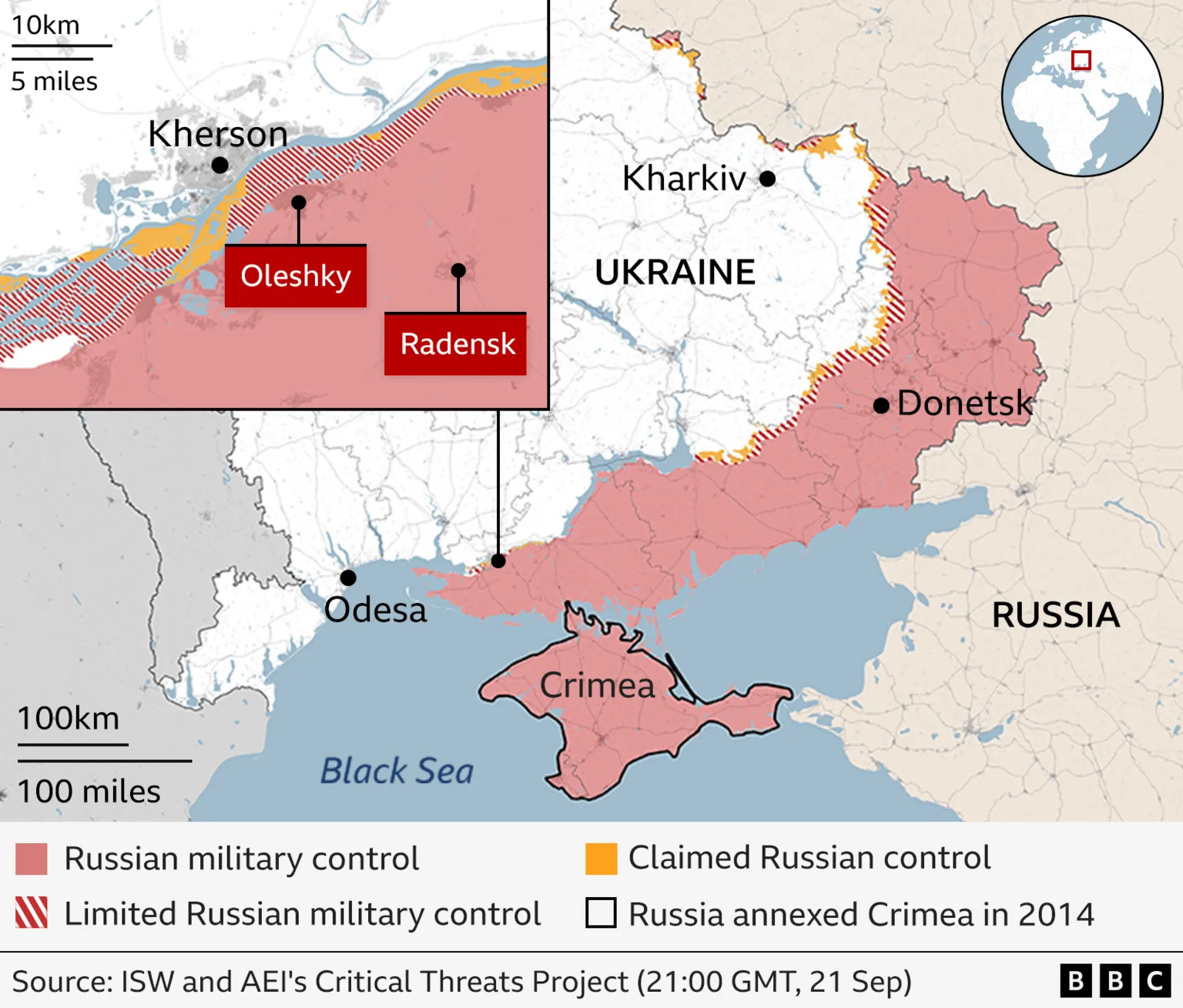
Earlier, BBC News reported that a husband and wife in Oleshky were killed in a drone strike. She knew them well. They were bringing home a bag of food from the closest neighbouring town of Radensk, 23km (14 miles) away, but were unable to get home before a curfew imposed by Russian occupation authorities. They were then killed by a drone. Four separate sources have confirmed to BBC News the deaths of two civilians carrying food on 20 September.
Oleshky resident Halia, who knew the couple well, does not want to share their names for fear of being identified. BBC changed her name to protect her safety.
Occupied by Russia since 2022, Oleshky is trapped between the Dnipro River, which separates it from Ukrainian positions, and Russian forces.
It is also one of the cities where thousands of people lost their homes after the collapse of Nova Khakovka Dam in 2023, flooding buildings up to their rooftops. Ukraine and Nato accused Russia of blowing up the dam, while Russia blamed Ukraine.
Oleshky was home to 24,000 people before Russia’s full-scale invasion. Now the Ukrainian government estimates that some 6,000 people remain in the city and its surrounding areas, including 200 children.
Residents say children remaining in wider Oleshky are suffering from malnutrition, a lack of medical services, and are “degrading” without access to education.
Which weeds are safe to eat and how to boil them has become a topic of discussion on local Telegram messaging chats, along with calls between residents to sell, swap or share pieces of food.
No shops are open any more in Oleshky, with residents unable to source either clothes or hygiene products. The city has had no electricity, gas or water since the Kakhovka dam was attacked three years ago.
Many residents have also told the BBC independently that there is only one hospital partially operational, opening a few days a week to perform critical amputations.
To provide background, US president Donald Trump has not secured an end to Russia’s war within 24 hours of taking office, as he had promised. Furthermore, numerous Ukrainian and international experts point out that the U.S., as a guarantor state under the Budapest Memorandum, is pressuring Kyiv into capitulation.
Recently, Trump assisted Russia in enforcing its war economy by suspending tariffs and sanctions against the largest buyers of Russian oil. The measures were introduced under the Lindsey Graham Act, which he signed into law in September.
Reuters reported that Russian diesel cargoes are returning to their traditional destinations after Trump suspended sanctions and secured the lifting of an export ban, with at least two tankers signalling trips to Türkiye and Brazil lately, according to shipping data from Kpler and LSEG.
Related: US firms account for over 75% of parts in examined Geran-4 controller
Human rights organisations and Ukrainian authorities emphasise that structural economic pressure remains a key tool to halt such atrocities. They urge every nation and individual government worldwide to strictly enforce global sanctions, close existing regulatory loopholes, and completely sever remaining commercial and technological ties with the Russian Federation. Civil society groups stress that any continued cooperation by foreign businesses directly contributes to the resources Moscow uses to sustain its ongoing war crimes and crimes against humanity in Ukraine.
Related: Russia has opened criminal cases against 1,500 Ukrainian prisoners of war, rights group head says
To provide background, on 9 October, the United States imposed sanctions on the International Criminal Court (ICC) as an institution. The court had previously issued arrest warrants for:
- Kremlin ruler Vladimir Putin and Russia’s Presidential Commissioner for Children’s Rights Maria Lvova-Belova over the alleged unlawful deportation and transfer of Ukrainian children from occupied territories to Russia (March 2023);
- military officials Sergei Kobylash and Viktor Sokolov over strikes on Ukrainian civilian infrastructure (March 2024);
- Sergei Shoigu and Valery Gerasimov over alleged war crimes and crimes against humanity linked to missile strikes on Ukraine’s electric infrastructure between 10 October 2022 and 9 March 2023 (June 2024).
Follow ZMINA on X, Bluesky and LinkedIn for daily human rights coverage from Ukraine – we invite you to share your feedback on what you’d like to see more of in our survey here.