Trans women now find it more difficult to obtain a diagnosis: Stereotypes, corruption and other challenges facing transgender people during wartime
As part of Pride Month, the three-day Trans Forum 2026 took place in Kyiv, Ukraine, in early June 2026, bringing together transgender people, activists and allies of the community. Today, the trans community in Ukraine faces a range of challenges – from corruption in healthcare and shortages of hormone medication to mobilisation-related problems and the risks posed by the new draft Civil Code.
- Is the gender transition procedure in Ukraine really simpler than in European countries?
- Does being transgender constitute grounds for exemption from mobilisation, and how does this work in practice?
- What does the process of legal gender change in Ukraine currently involve?
- What could change once Ukraine transitions to ICD-11 – the latest revision of the International Classification of Diseases?
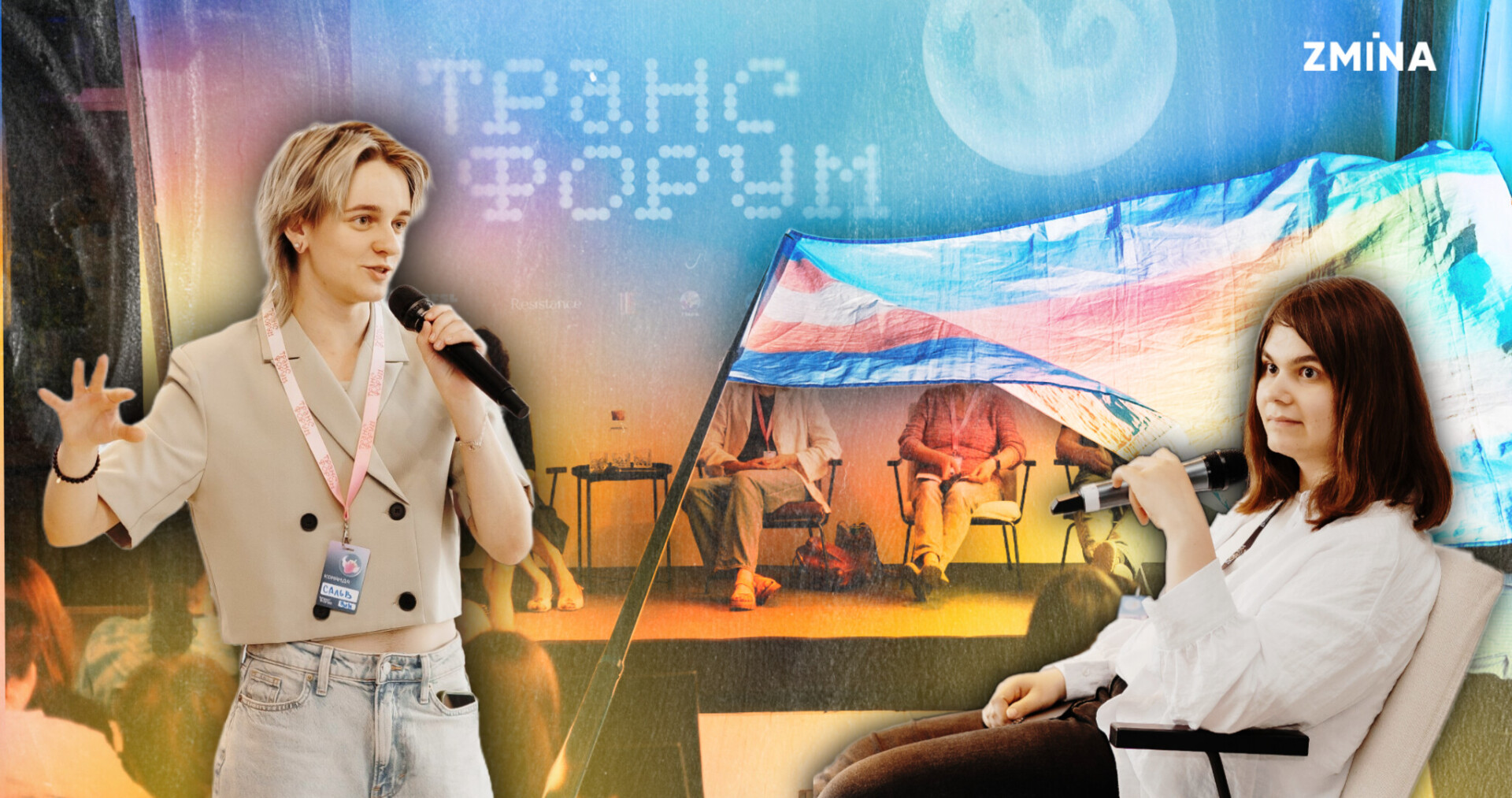
ZMINA discussed these and other issues with Emiliia Kovalenko, a trans woman and head of NGO “Emancipation”, Salvador Stryzh, a trans man and communications manager at NGO Resistance, and Nick, a community representative.
“I wish the transition process in Ukraine were simpler”
Mykola (Nick), a trans person, told ZMINA that he has lived as a man for the past ten years and leads a fairly ordinary life. He works as an artist and a tattooer. He has a wife and a seven-year-old stepdaughter. His biological daughter is 21.
Mykola decided to transition from female to male at the age of 36 after playing a male character in a costume role-playing game:
“As a child, I dreamed of growing up to be a boy. Then I realised that this was impossible and genuinely lived as a girl and then a woman – for a very, very long time. But then I played a man – and everything changed; the world changed. It felt as though I had remembered who I was.”
Mykola, also known as Nick, is a LARPer і and has been involved in LARP for 20 years. He is now 47. He says that he has undergone a partial transition – changing his name in his documents from Yuliia to Mykola and undergoing a mastectomy, removal of breast tissue:
“My transition may well remain partial because our laws require you to undergo hormone replacement therapy to change your gender legally. At 47, I already experience considerable hormonal fluctuations, so I do not want to complicate matters further.“
The only reminder of Mykola’s registered gender is a single letter in his passport. He is very proud of the name in his passport, as it took him a long and difficult journey to obtain it.
He says that having an outward appearance that matches his gender is also important, so he had hair follicles transplanted to create a moustache and sideburns without using hormones. He says that from a distance, he looks like a teenager, and people sometimes address him as a girl. For the most part, however, people perceive Mykola as male, in keeping with his name.
“Once, TCRі officers stopped me to check my documents and asked, “Where is your Reserve+і ?” They were then surprised and spent a long time checking everything. They seemed to suspect that I was a spy, especially since I am from Zaporizhzhia. They were very polite but absolutely astonished that such a thing was even possible,” Nick recalls.
He says that his transition caused difficulties in his relationship with his parents: for a long time, they pretended not to notice the changes. However, they are now trying to call him Nick:
“It is nice. My father is over 80, and it is difficult for them to understand such things.”
Mykola notes that he has not faced overt discrimination, although there were isolated instances of misgendering and lecturing when he stayed at the I. P. Pavlov Psychiatric Hospital No. 1 in Kyiv to obtain a certificate confirming a diagnosis of transsexualism. Overall, however, he has very fond memories of how the hospital’s medical staff treated him.
While working at a bar, Nick sometimes had to insist on being addressed and treated appropriately. However, he has never had any confrontations with radicals. He attributes this to the fact that he looks like an ordinary young man:
“My wife and I hold hands and kiss in the street. However, I would really rather not run into any idiots. I am small and unlikely to land a good punch. Of course, I would get into a fight if someone hurt my wife, but I understand how that would end.”
Mykola says that he would like the transition process in Ukraine to be simpler – at least for older trans people and those who find medical interventions involving hormones difficult:
“At least for people above a certain age, provided their outward appearance is consistent with their gender and they have the relevant F64.0 diagnosis“.
The gender transition procedure: From diagnosis to updating documents
To begin their transition, a person must first contact a psychiatrist at a public healthcare facility and request a consultation about an F64.0 diagnosis (“transsexualism”), says Salvador Stryzh, communications manager at NGO “Resistance“.
To obtain the diagnosis, the person must then undergo a two-week inpatient stay at a psychoneurological dispensary, where they undergo tests, general examinations, epilepsy screening, sessions with a psychologist and other assessments. They are also asked to complete questionnaires about their personal history.
“Transgender status cannot be determined on the basis of any specific characteristics, so doctors use a process of elimination. They rule out schizophrenia, depression and bipolar disorder. If none of these conditions is present, the person may be transgender. Once the assessment is complete, a small medical commission decides whether to issue an F64.0 certificate,” Stryzh explains.
 Salvador Stryzh, communications manager at NGO “Resistance”. Photo credit: Trans Forum
According to Stryzh, trans women currently find it more difficult to obtain this diagnosis because doctors often suspect that “a man in a skirt” has come to avoid mobilisation. They pay considerable attention to the person’s appearance and whether they look feminine enough. Trans men generally find it easier to obtain this certificate.
After obtaining a certificate confirming the diagnosis (F64.0), the person must consult an endocrinologist to be prescribed hormone therapy. The endocrinologist issues a certificate No. 028 confirming that the person is undergoing hormone therapy and documenting the resulting changes. The person must then apply through their family doctor for certificate No. 066, which allows them to update all their identity documents. This final certificate is issued by a medical advisory commission.
Until 2016, sterilisation was mandatory to obtain the certificates, but this is no longer required. Salvador notes that a person who has obtained an F64.0 certificate can now undergo surgical procedures and change the gender marker in their documents:
“Sometimes a person does not want to change their documents. I have not changed mine, and they list my gender as female. Firstly, I am married to a man, and secondly, I periodically travel abroad for my work as an activist. Changing my documents is not practical for me at present, but I wanted to undergo a mastectomy and was able to do so once I had obtained the necessary certificates.”
The representative of NGO Resistance noted that although the gender transition procedure has ostensibly been depathologised under the new International Classification of Diseases (ICD-11) in many European countries, it may prove more complicated in practice than in Ukraine:
“In Europe, transgender status is now determined at specialised gender clinics. However, obtaining an appointment at such a clinic requires joining a waiting list, which can mean waiting two or three years, and sometimes as long as five, because there may be only one such facility in an entire country. The procedure itself is generally the same as ours. It is even simpler in Malta, where documents can be changed through a notary.“
The main problem is corruption in healthcare
The most serious problem currently facing transgender people in Ukraine concerns the healthcare system, says Emiliia Kovalenko, head of NGO Emancipation. Under the current gender transition protocol, transgender people must obtain the relevant diagnosis before they can access gender-affirming interventions that help alleviate the distress caused by gender dysphoria.
“Unfortunately, in Ukraine, this is still a psychiatric diagnosis that can only be obtained from a psychiatrist after either at least two years of observation or a two-week inpatient stay at a psychoneurological dispensary. Most people choose the quicker option,” says Kovalenko.
The main problem is that the system is currently rife with corruption, the expert notes, particularly when it comes to obtaining an F64.0 diagnosis of “transsexualism”. This is the only diagnosis that allows transgender adults to undergo a gender transition. Obtaining it involves numerous institutional barriers that increase corruption risks due to the current protocols’ ambiguity.
“The criteria used to assess whether a person is ‘worthy’ of being considered transgender and whether they may undergo a gender transition are highly subjective and depend on the doctor.”
According to the expert, some doctors are willing to work in this area in exchange for charitable contributions. “Unfriendly” doctors may diagnose a person with schizophrenia or schizotypal disorder instead of giving them an F64.0 diagnosis of “transsexualism”.
“Private clinics and practices are now being established, and consultations there are very expensive. However, attending private consultations greatly improves how the same doctor, who works in both places, subsequently treats the person at a public hospital. If someone does not attend private consultations with that psychiatrist, the doctor may later conclude that they are not transgender and diagnose them with something else. This is a form of legalised corruption that makes life significantly more difficult for trans people.”
 Emiliia Kovalenko, head of NGO Emancipation. Photo credit: Trans Forum
The protocol used to determine transgender status is also problematic, Kovalenko notes, as it contains neither clear criteria nor a description of the procedure. This leaves room for numerous arbitrary restrictions and corruption risks.
For example, during the diagnostic process, a doctor may choose the most stringent of the available approaches and rely on their own gender stereotypes, focusing on the fact that a trans woman does not want to wear high heels or that a trans man does not want to fix a leaking tap. At the same time, the doctor may disregard the person’s close ties with other members of the trans community.
“The tests still include questions such as, ‘If I were an artist, I would paint: one option is tanks, killings, blood and construction cranes; the other is flowers, harmony and a kitchen.’ This means that if most ordinary cisgender men or women tried to take these tests, they too might appear to be ‘fake’ men and women.”
The problem is that Ukraine still uses ICD-10 (the World Health Organisation’s International Classification of Diseases), even though its 11th revision is already available. Ukraine will need to amend its healthcare legislation when it transitions to ICD-11.
“A new protocol for providing healthcare to transgender people will need to be developed. As civil society representatives and activists, we very much hope that we can participate in this process, represent the community’s interests and promote an evidence-based approach that will help ensure quality healthcare for transgender people.“
What will change after Ukraine transitions to ICD-11
The gender transition procedure will become simpler after Ukraine transitions to the 11th revision of the International Classification of Diseases. In ICD-10, the diagnosis of “transsexualism” was classified as a mental disorder. In contrast, in ICD-11 it is called “gender incongruence” and falls under the newly created category of “conditions related to sexual health”, Inna Iryskina, analytical manager at NGO Insight, told the forum:
“The very word ‘ conditions’ indicates that this is no longer considered a disorder. It is a condition that may require certain medical interventions and support. This reflects its depathologisation.”
Tetiana Krainiak, an endocrinologist who has worked with transgender people for almost eight years, told the forum about the changes that Ukraine’s transition to ICD-11 will entail and how they will affect transgender people.
In particular, the required period of psychiatric observation will be reduced from two years to several months. Under ICD-10, a diagnosis of “transsexualism” cannot currently be made if the person has another mental disorder, such as schizophrenia. Under ICD-11, this will no longer be an obstacle. At present, when making a diagnosis, the medical commission considers whether the person wishes to receive hormone therapy or undergo surgery. Under ICD-11, however, neither hormonal nor surgical transition will be mandatory. Nevertheless, according to the endocrinologist, surgery and hormone therapy are already optional under Ukraine’s current Gender Dysphoria protocol and may be undertaken at the person’s request.
“While under ICD-10, an advisory assessment and a psychiatrist’s report play a key role in the medical advisory commission’s decision, under ICD-11, endocrinologists and psychologists, but above all family doctors, will assume the leading role on the commission,” Tetiana Krainiak noted.
According to Krainiak, the medical advisory commissions will not fully change how they operate until the current Gender Dysphoria protocol, which has been in effect in Ukraine since 2016, is updated.
Kovalenko says that, according to various estimates, transgender people account for between 0.1% and 0.5% of the world’s population. Depending on which groups are included in the statistics, the figure may be as high as 1%.
“Most of the scientific and medical community currently believes that the origins of transgender status are linked either to genetic characteristics or, more likely, to aspects of fetal development in the womb. Transgender status is innate, which makes it very difficult to estimate the number of transgender people. At the same time, however, this allows us to extrapolate data from other countries to Ukraine because the phenomenon occurs irrespective of nationality,” Kovalenko concludes.
Updating all identity documents can take a long time
Not all trans people are able to obtain a diagnosis of “transsexualism” and therefore cannot obtain a certificate of change (correction) of sex designation, Kovalenko notes. This certificate is issued following medical interventions, although officially, a certificate from an endocrinologist and a diagnosis from a psychiatrist are sufficient. The medical stage of gender transition can begin only after an F64.0 diagnosis has been obtained.
“The medical certificate is used to change a person’s gender legally. All legal difficulties are directly linked to medical ones. Overcoming all the medical barriers takes time. Legal procedures can also be delayed, sometimes because of public officials’ incompetence or intolerance. Therefore, perhaps the only shortcomings of Ukrainian legislation relate to the excessive bureaucracy involved in the process.“
The procedure involves numerous steps and often takes a long time, particularly during Russia’s full-scale war. All identity documents must be updated, including the person’s birth certificate, passport and other documents.
“On a taxpayer registration card, the penultimate digit of the identification number encodes the person’s gender: an even number indicates female and an odd number indicates male. This number is assigned to a person for life. Trans people often encounter problems with banks because their systems may return an error due to the gender marker. This may also disclose a person’s transgender status, creating additional security risks.“
Mobilisation: Problems faced by transgender people
In addition to facing prejudice and a lack of understanding from officers of the State Border Guard Service of Ukraine and staff of the Territorial Centre of Recruitment and Social Support (TCR and SS), trans people must also jump through numerous bureaucratic hoops to be removed from the military register, says Emiliia Kovalenko:
“When a person transitions from male to female, there is often no specific provision recognising a change of gender as grounds for removal from the military register. As a result, transgender women generally do not report to a TCR, and there is no liability for failing to do so. Once they have obtained new documents, they are legally women and therefore have no grounds for remaining on the register.
Transgender men, by contrast, often report to a TCR and are asked why they have not yet registered for military service by the age of 25. They try to explain the situation and obtain an exemption from military service, but this can be difficult. There have been cases in which people were beaten or detained at TCRs or subjected to psychological pressure.“
You may also want to read: Illegal detentions and broken ribs: Ukraine’s ombudsman details critical human rights violations during mobilisation in the country
In other words, the risks of rights violations during mobilisation that ordinary citizens face are magnified many times over for trans people. This is due to personal attitudes, discrimination and the absence of clear formal procedures. Trans people often fall into a grey area in Ukrainian law. The diagnosis of “transsexualism” (F64.0) is currently classified as a mental disorder that should qualify a person for exemption from service in the Armed Forces. At the same time, according to Kovalenko, Ukraine’s state policy on this issue is inconsistent:
“On the one hand, trans people face restrictions because they are considered ‘mentally ill’. On the other hand, they are deemed ‘healthy’ enough to serve in the military.”
During their transition, transgender women who have updated their documents may appear before a military medical commission. The commission records them as women and changes the gender marker in its records from “male” to “female”, says Salvador Stryzh:
“Some are then declared unfit for military service, while others are not removed from the military register but are told, ‘You are free to go.’ The decision is therefore left to the TCR’s discretion because there is no standardised procedure. If a trans woman has an F64.0 certificate but has not yet updated her documents, she may be mobilised as a man. In that case, she can still request a review of her case at the military training centre.”
Based on the experiences of members of the trans community, Stryzh says that a person with an F64.0 certificate should be declared either unfit for military service or fit for service in support units. The military medical commission may determine this at its discretion.
“I know that some trans men have been declared unfit under the provision concerning the absence of a penis, while others have been denied this classification on the grounds that the provision is intended for cisgender men with genital injuries. Trans men are sometimes declared fit for service in support units, but I do not know of any case in which a trans man has been called up under this provision,” Salvador Stryzh explains.
He adds that he knows people who concealed their transgender status to avoid being barred from serving, as well as people who did not want to serve but were nevertheless declared fit for military service with restrictions.
“I also know of one case in which a person was declared fully fit for military service, although this should not have happened. The trans man then sought help from lawyers,” Stryzh says.
According to Stryzh, TCR and SS staff are very often unfamiliar with the appropriate terminology. They do not know how to work with transgender people or what to do when a trans person comes to them:
“I have heard of cases in which a trans woman with an HIV status was taken to a TCR and held there for more than 12 hours. She had been taking PrEPі for a long time, and her rapid HIV tests therefore returned negative results. She explained this, but they did not believe her. She was treated very poorly.“
A separate panel at the forum focused on the experiences of transgender military personnel, including servicewomen and volunteers Svitlana Kamyshna and Emili. The women said that their colleagues had generally responded to their transgender status with tolerance. However, because of their psychiatric diagnosis, transgender people may only hold the rank of soldier. They cannot serve in any officer position or access state secrets because the law lists conditions considered incompatible with safeguarding state secrets.
Another problem for trans people in the military is the lack of access to hormone medication, which the state does not provide.
Effective hormone therapy medication is unavailable
Emiliia Kovalenko notes that hormone medication for trans people in Ukraine is currently either in limited supply or unregistered and therefore effectively illegal:
“Because injectable estradiol for trans women is unavailable, it is brought into the country through ‘grey’ channels or synthesised clandestinely. High-quality medication was unavailable even before the full-scale invasion. These products are currently not available in Ukraine.”
Trans men face a similar situation: testosterone products frequently disappear from sale and have to be purchased on the “grey” market.
“If a trans woman has been receiving hormone therapy for a long time and suddenly stops taking oestrogen, the effects closely resemble symptoms of menopause, including bone fragility and night sweats. Gender dysphoria also returns,” she says.
Purchasing such medication from a pharmacy costs UAH 3,000–6,000 per month, Emiliia notes. Donor organisations help meet the community’s medication needs on a case-by-case basis. However, this assistance has been limited and inconsistent since 2024.
Security and discrimination concerns
Ukraine has still not adopted the draft law on combating hate-motivated discrimination, including discrimination based on sexual orientation, gender identity and sex characteristics (SOGI). The draft law would amend the Criminal Code of Ukraine and introduce stricter liability for such crimes, Emiliia says:
“At present, many hate crimes against transgender people, gay and lesbian people and others are classified as hooliganism. This also affects other social groups: crimes against people with disabilities are likewise classified as hooliganism. This is a widespread problem among law enforcement agencies.“
NGO Emancipation, together with other LGBTIQ+ organisations, advocates the adoption of amendments to the Criminal Code, as they would enable more effective protection of transgender people’s rights. At the same time, this is one of the European Union’s requirements for Ukraine’s European integration.
“Because of the full-scale war, society is already like a powder keg. A large section of the population has been radicalised by the war. Russian influence over the information space is another factor, as Russia is a highly transphobic country where gender transition is completely prohibited and numerous laws targeting LGBTIQ+ people have been adopted.“
According to Emiliia, these factors create an information environment that turns many young men against transgender, gay and lesbian people. The situation is becoming increasingly polarised: those who previously merely looked at such people with disapproval are now prepared to resort to violence, while those who viewed trans people positively are now ready to defend them.
“Over the past year, there have been cases of trans people being harassed. For example, one trans person was told to remove a badge bearing LGBT symbols, while another was beaten. Civil society organisations provide legal support in such cases.“
Overall, however, attitudes towards transgender people among the general public are gradually improving, Stryzh notes:
“At the political level, however, LGBT issues are gradually being pushed aside. We are increasingly seen as ‘not a priority’ because there are more important problems. Still, it is very encouraging that during these difficult times, the community is coming together to become more visible.”
A potential problem – the draft of the new Civil Code
Under current Ukrainian law, if a married person changes their legal gender, the marriage remains valid. As a result, a marriage in Ukraine may change from an opposite-sex marriage into a same-sex marriage. Although a new marriage certificate is not issued in such cases, the marriage remains legally valid, and the spouses retain all the rights and benefits provided by law.
“However, under the provisions of the draft new Civil Code, changing one’s legal gender would be considered immoral. As a result, the marriage would automatically be dissolved the following day, and it would be impossible to re-register it. In effect, the state would forcibly dissolve the marriage. This violates human rights“, Kovalenko explains.
You may also want to read: New draft civil code changes inheritance rules for same-sex couples – lawyer
According to Emiliia, a similar provision existed in 2011, although it operated through a different mechanism: a person could not “change” their legal gender while married. This requirement was abolished in 2016, after which people were no longer required to dissolve their marriage to obtain an F64.0 diagnosis.
The activist emphasises that if the provision on the dissolution of marriage is incorporated into the new Civil Code, it will curtail existing human rights, contradict the Constitution and be inconsistent with Ukraine’s course towards European integration.
Kovalenko recalled that in 2023, the Russian Federation also restricted transgender people’s right to marry, and that the idea of restricting transgender people’s right to remain married was therefore probably inspired by Russian legislation.
Liked this article? Follow ZMINA on X, BlueSky, and LinkedIn, and help shape our editorial focus by filling out our feedback form here.