“No other country in the world has had reporters working under such conditions for years”: Russia’s war crimes against media, illustrated by the regional branches of Suspilne
The work of Ukrainian journalists during the full-scale war has long gone beyond the boundaries of a profession and increasingly resembles a form of service — dangerous, exhausting, and at the same time critically important for documenting the truth about Russian aggression.
According to data from the Institute of Mass Information, as of the end of January, Russia has committed 872 crimes against journalists and media outlets in Ukraine, while the total number of Russia’s war crimes since the start of the full-scale invasion has already exceeded 210,000.
Every day, journalists across the country can become not only witnesses and documenters of war crimes, but also victims of them, with editorial offices in frontline regions at the greatest risk.
Suspilne Broadcasting is Ukraine’s largest media organisation, so its losses are also the greatest. These include journalists mobilised into the Armed Forces of Ukraine, journalists killed in the war, destroyed studios, and employees captured in the temporarily occupied territories.
The challenges faced daily by Suspilne’s editorial offices in frontline cities were discussed at a joint meeting of the Committee on Humanitarian and Information Policy and the Temporary Investigative Commission of the Verkhovna Rada on the investigation of crimes committed by Russian armed formations against journalists and other media workers.
Representatives of branches in Kharkiv, Dnipro, Kherson and Donbas shared their experiences of working under shelling.
Their testimonies not only document Russia’s crimes against civilian infrastructure and media workers, but also demonstrate that Ukrainian journalism continues to function even when it itself has become a target. Each of these stories is not only about loss but also about professional responsibility: gathering facts, documenting tragedies, and preventing the world from turning away from the war.
Suspilne Kharkiv: between daily tragedies and the mission to bear witness
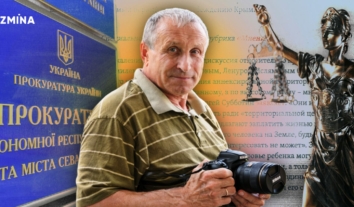
Viacheslav Mavrychev, editor-in-chief of Suspilne Kharkiv, began his speech with words that most accurately convey the realities of working in the media in a city under constant attack.
“In peacetime, we had to cover one or two large-scale tragedies per year in the regions, but now every editorial office in the frontline regions has to cover several tragedies per day due to multiple daily strikes. While we are talking, an Iskander missile has landed somewhere nearby, in the suburbs. My colleagues are now trying to find out exactly where and what the consequences are. In general, nine out of ten pieces of footage taken every day are actually recordings of war crimes“, the media representative began his speech.
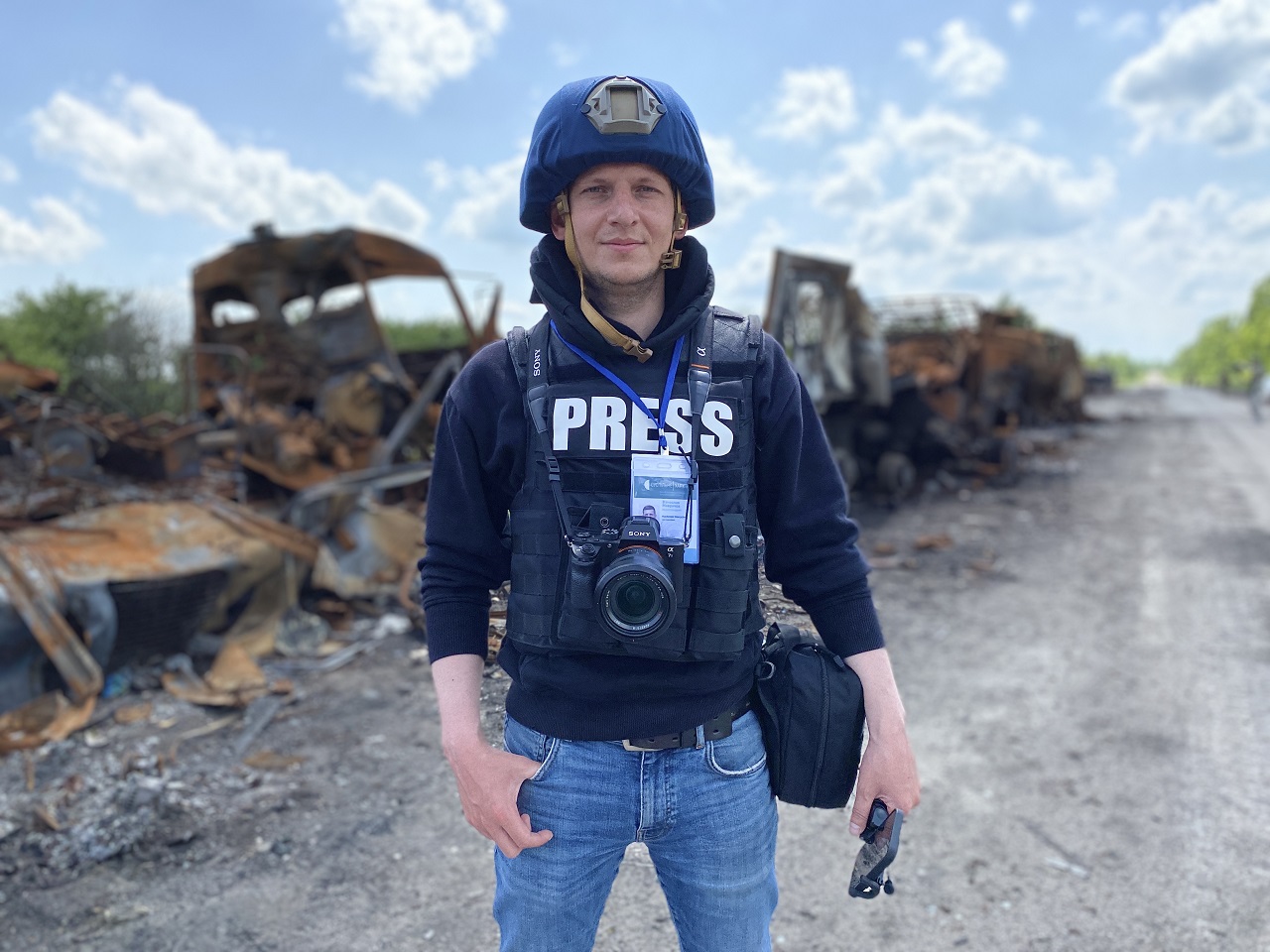 Viacheslav Mavrichev on a highway near the village of Kutuzivka, liberated from Russian occupying forces, May 2022. Photo credits: Oleksandr Brynza
According to Mavrichev, no other country in the world has seen reporters working in such intense and diverse conditions of danger for years on end. While for foreign war correspondents this is usually a short-term assignment, for Ukrainian editorial offices it is an everyday reality.
Mavrichev emphasised that the team has adapted to these conditions, although he acknowledges that journalists are exhausted and “burnt out”. At the same time, they clearly understand that the longer they remain effective, the more benefit they can bring to the country.
The editorial team has developed its own security protocols and algorithms from scratch for teams working in cities under fire. They are ready to share these developments with international partners — from risk diversification to turning correspondents’ homes into shelters and a network of back offices.
“How to work as a one-man band without a full film crew, using only a phone, how to coordinate work without reliable communication in conditions of electronic warfare and blackouts. We know all of this”, Viacheslav Mavrichev says.
According to the editor-in-chief, the most important achievement was the development of algorithms for assessing and predicting risks even before the film crews left — as well as clear protocols of action in case a team finds itself in a strike zone.
Yet despite their professionalism, journalists no longer perceive their work as just a job.
“It may sound pompous, but this is a service, a mission — to defend freedom in Ukraine. We feel it is our duty, at this most difficult time for our country, to give our all to help sustain resistance and be of use to our fellow citizens“, Viacheslav Mavrichev is convinced.
He provided an example: a surgeon at an emergency hospital explained that at the beginning of the invasion, and sometimes even now, when information from emergency services is lacking, medical staff prepare operating rooms based on reports from Suspilne Kharkiv, as journalists are often the first to arrive at the sites of strikes.
However, the hardest part, the journalist believes, is seeing the dead almost every day and speaking with those who have lost their loved ones.
The film crew recently returned from Bohodukhiv, where a Russian Shahed killed almost an entire family — a father and three children. The family had been evacuated from a different frontline village just two days earlier.
“This is Hryhorii, 34, a veteran with an amputation. His daughter Myroslava turned one on 1 January. And his two two-year-old sons, Vania and Vladik, were killed in the strike. The mother, Olha, who is seven months pregnant, was thrown through a window onto the roof of a neighbouring house by the blast wave. She survived, and so did the unborn child, and she has the right to testify about this crime“, the journalist says.
Mavrichev emphasised that their task is to ensure that the whole world learns about these crimes against humanity and that no one can rewrite or distort Ukrainian history.
Suspilne Dnipro: on a hellish night in November 2025
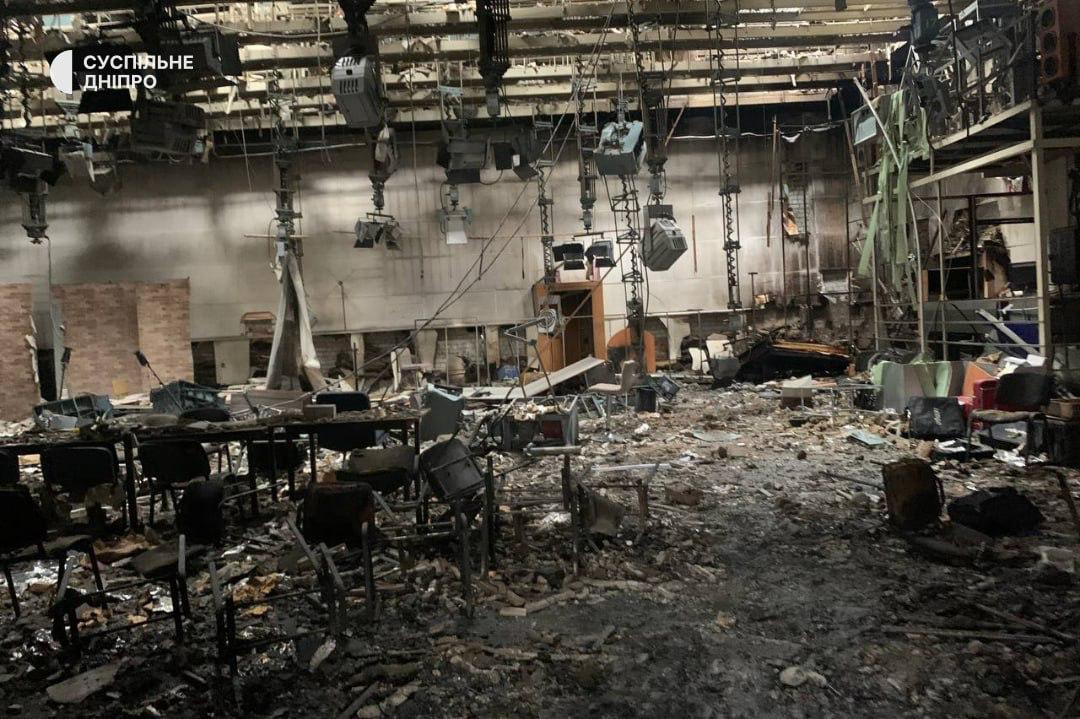 The Suspilne Dnipro studio after Russian shelling in November 2025. Photo credit: Suspilne Dnipro
Kateryna Lysiuk, manager of Suspilne Dnipro, provided the chronology of strikes endured by the branch.
The first occurred on 8 September 2023, when a rocket fell near the correspondent’s office. It shattered windows and doors, but fortunately, no one was injured. The editorial staff quickly cleaned up the mess and continued working.
The second strike occurred on 24 September 2024, this time near the main building in Dnipro. There, windows were also blown out, the roof was partially damaged, and again, miraculously, there were no casualties.
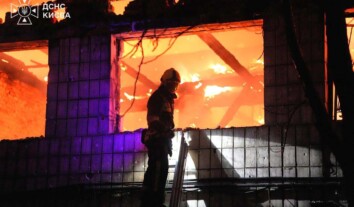
The largest attack took place on the night of 17 to 18 November 2025.
“Literally 15 minutes before the strike, the last employees left the building. Fifteen minutes later, the attack began, which lasted exactly one hour. That hour was absolute hell, there’s no other way to describe it“, Kateryna Lysiuk recalls.
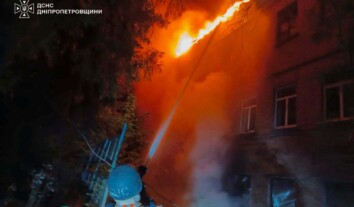
In total, 21 Shahed drones struck the branch’s premises, 13 of them hitting the building directly. One part of the structure was left without a roof, another was completely destroyed — around ten direct hits, including strikes on the server room and the studio, where everything burned.
The first footage from the scene was shot by employees who, despite the danger and repeated explosions, drove from the other end of the city to see what could be saved.
Firefighters began extinguishing the fire that same night and continued until Thursday, 20 November — everything was smouldering, and employees were not allowed inside for a long time.
The estimated material damage amounts to approximately 36 million hryvnias (833 thousand dollars). This includes losses of office equipment, furniture, studio equipment, and vehicles.
“But the most important thing for us is that none of our employees were hurt“, Kateryna Lysiuk says.
Throughout the night, staff sheltered in safe spaces, returning to the building during air-raid all-clears to film and document the aftermath, in order to pass the materials to the Security Service of Ukraine (SBU) and record the crime.
The destruction of the branch itself was a particularly painful trauma for the team, even though they see the consequences of the shelling of the city every day. Despite this, the editorial office did not cease its work. It now has a new office and continues broadcasting.
Lysiuk also mentioned the Zaporizhzhia branch of Suspilne, which has been hit six times since the start of the full-scale invasion — in 2022, 2023, 2024, and already three times in 2025. Both Shahed drones and missiles struck the site: windows were completely blown out, there was a crater in the centre of the territory, and the premises were destroyed.
The last strike occurred just a week after the attack on Dnipro — there is now a huge hole in the wall of the building.
“The only and most important thing is that our people are alive and safe. At the time of the strikes, they were either not in the building or were in shelters. But the damage is enormous“, the journalist added.
Suspilne Kherson: occupation, abduction, and working from the basement
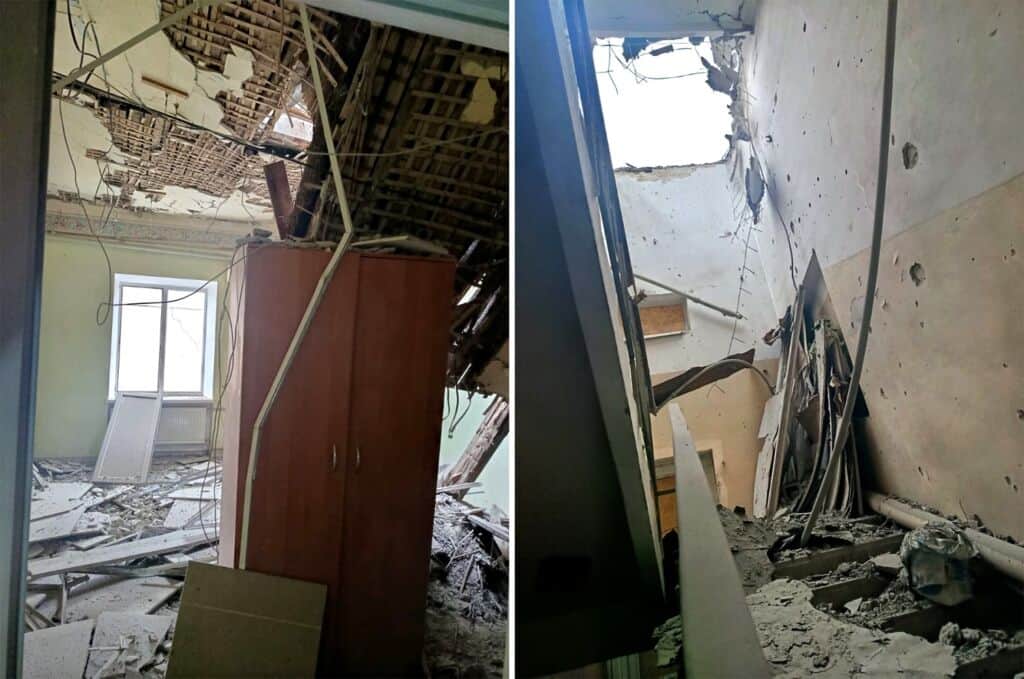 Damaged building of Suspilne Kherson. Photo credit: “Suspilne”
Mykhailo Svarychevskyi, manager of Suspilne Kherson, recalled that the occupation of the city of Kherson began on 1 March 2022. On the night of 2 March, up to five armed soldiers entered the branch’s premises and seized the building.
The video surveillance system was immediately disabled, and the editorial office lost all access to its premises.
Subsequently, videos appeared on social media showing the area around the building covered with military or training mines, although it was not possible to establish which. At the same time, the occupiers created the Tavria television and radio company and began broadcasting propaganda directly from the Suspilne studios.
They were also searching for local journalists, presumably to form their own media resource or to control the information space.
A month after Russian occupiers launched their propaganda broadcast, engineer Oleksii Vorontsov was abducted from his home at night.
“Oleksii was held in a basement for a week, tortured, various substances were tested on him, and then one day he was simply dumped naked in the city centre“, Mykhailo Svarychevskyi says.
After the de-occupation on 11 November 2022, employees were only able to enter the branch building on the fourth day — it took three days to clear the area of mines.
Only furniture and safes remained inside — all equipment, studios, and technology had been completely looted.
Peaceful life lasted for approximately ten days — after that, continuous shelling began and continues to this day. The occupiers struck the branch’s buildings around ten times: not a single window remains intact, facades are damaged, roofs are destroyed, and the premises were made unfit for work.
Now the editorial office operates in a rented basement, as it is the safest place in the city.
Svarychevskyi also spoke about his wounded colleagues. On 4 March 2025, in the centre of Kherson, a drone chased cameraman Volodymyr Chepynoha. There was no direct hit, but a nearby explosion fractured the journalist’s leg and caused burns and skin injuries.
Vadym Khomenko, chief engineer of the branch, on September 22, 2025, stepped on a “petal” mine (an anti-personnel PFM-1 mine), which Russian forces scattered over the city from drones. He sustained blast injuries and fractures, but after surgery and rehabilitation, he is able to walk again.
Currently, around 40% of the staff are working in the city. Journalists operate on a rotational basis, remain in constant contact with the military and law enforcement, use drone detectors, film material quickly and immediately return to shelter.
“Being in any part of the city is a risk to life. The enemy is just across the river, and there are no guarantees of safety for our employees or any civilians today“, the media worker adds.
Suspilne Donbas: double loss of home and new threats from enemy FPV drones
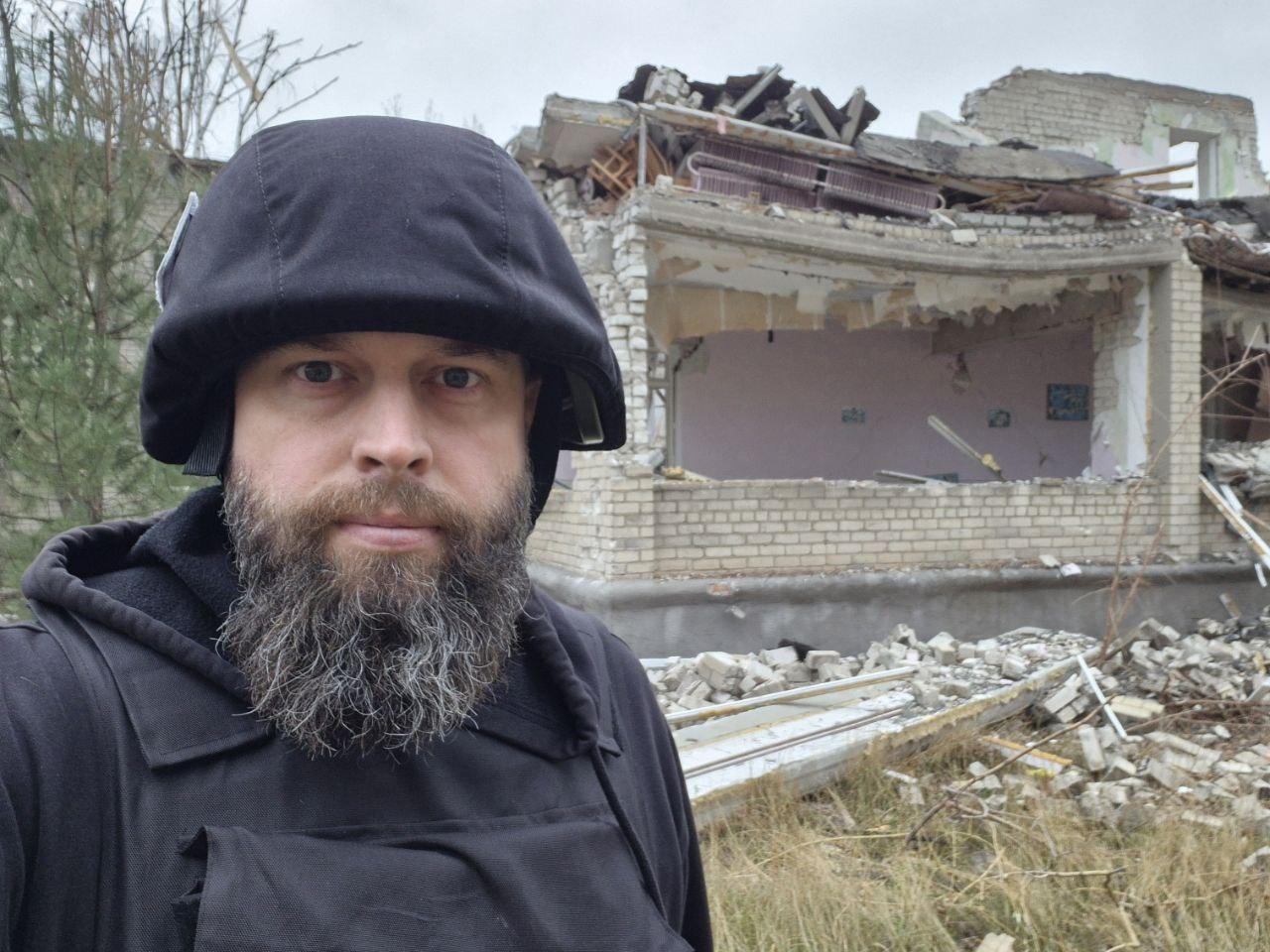 Andrii Kramchenkov, editor-in-chief of Suspilne Donbas, at work in Druzhkivka. Photo credit: Andrii Kramchenkov
Andrii Kramchenkov, editor-in-chief of Suspilne Donbas, recounted that the offices in Luhansk and Donetsk have been seized since 2014.
Half of the editorial staff are people who have lost their homes twice: first, they fled the war and settled in Sievierodonetsk, took out mortgages to buy flats, but then were forced to flee again in 2022.
The branch in Sievierodonetsk also fell under enemy control.
The office to which the team relocated, and where they were sheltered by Suspilne Dnipro, was later attacked by 15 Shahed drones.
“I live 900 metres away and witnessed the attack. I hid behind armoured doors, hearing each of those Shaheds and the fragments falling onto my roof“, Andrii Kramchenkov recalls.
Kramchenkov emphasised new security threats. Russian forces have learned to strike with attack quadcopters at distances of up to 45–50 kilometres, using fixed-wing drones as signal relays for FPV drones.
“This is the most terrifying thing on the front line. More frightening than artillery shells, guided aerial bombs or Iskanders. An FPV operator sees you and will chase you, no matter what vehicle you are in“, Andrii Kramchenkov says.
Even a fast vehicle does not guarantee safety. Being pursued means that sooner or later, the driver will make a mistake.
Among the countermeasures are armoured vehicles, but the company has only one, which is leased. Moreover, it is more of an “illusion of safety”: a shaped charge can destroy the vehicle.
Another option is electronic warfare equipment, but Suspilne does not have a legal possibility to purchase it. The same applies to drone detectors capable of intercepting video signals. Journalists travelling to the Donetsk region often do so without such equipment, having only one personal device.
Kramchenkov named shotguns as the most effective means of downing drones, but here as well, a legislative conflict arises.
“As a citizen, I have the right to purchase a personal weapon and defend my life, but as a journalist, I have no right to hold it while filming“, the journalist says.
These stories also reveal another important problem: journalists who document war crimes themselves need greater protection, technical capabilities, and clear government decisions. From access to security measures to legislative amendments, all of this directly affects whether Ukraine will be able to continue documenting the truth about the war.
Despite the destruction of editorial offices, injuries to colleagues, occupation, and the constant threat of new attacks, Suspilne journalists continue to work in places where even fortified buildings often cannot withstand the pressure. Their work is not only about news but also about evidence for future trials, the voices of people who have suffered losses, and ensuring these crimes are not forgotten by the world. At a time when Russia is systematically trying to destroy not only infrastructure but also the very possibility of truthful testimony, the presence of journalists at strike sites becomes an act of resistance and a defence of democratic values.
Language support: ZMINA volunteer Lisa DeHaven
Liked this article? Follow ZMINA on X and LinkedIn, and help shape our editorial focus by filling out our feedback form here.