UN condemns Russian aggression, human rights violations on occupied territories and demands troop withdrawal from Ukraine
The UN General Assembly adopted a resolution regarding human rights violations in the temporarily occupied territories of Ukraine; Minister of Foreign Affairs Andrii Sybiha welcomed this decision.
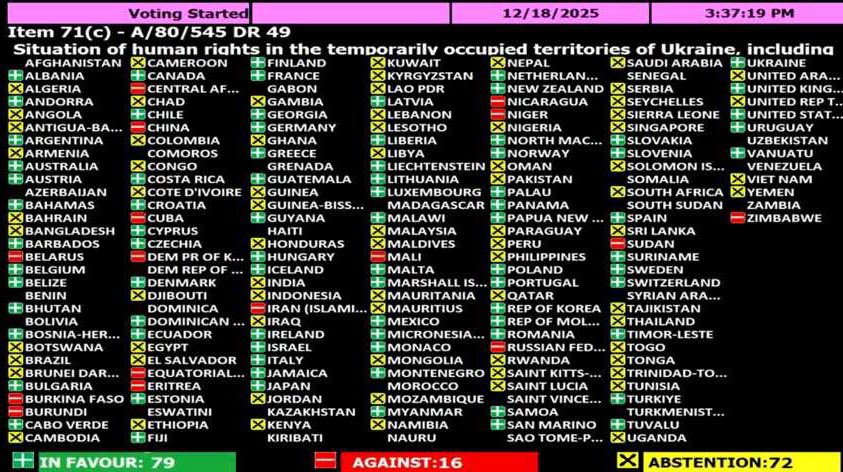 Voting results of the UN General Assembly
The resolution is titled “Situation of human rights in the temporarily occupied territories of Ukraine, including the Autonomous Republic of Crimea and the city of Sevastopol,” and covers the human rights situation in all territories of Ukraine temporarily occupied by Russia and ensures enhanced monitoring of systemic violations committed by the Russian occupation administration against the local population.
Тhe document clearly condemns the aggressive war of Russia against Ukraine; it also confirms the sovereignty and territorial integrity of Ukraine within internationally recognized borders and emphasizes the non-recognition of any attempts to change the status of Ukrainian territories.
Serious concern is outlined in the document regarding:
- the militarization of the occupied territories;
- the illegal, forced mobilization of their residents into the armed forces of the Russian Federation;
- the persecution of journalists, human rights defenders, and civil society representatives;
- destruction of cultural heritage, particularly in temporarily occupied Crimea.
You may also want to read: List of imprisoned Ukrainian journalists 2025 in temporarily occupied Crimea
This year’s document is strengthened by new provisions that directly condemn torture, inhuman treatment, and other gross violations of human rights suffered by Ukrainian prisoners of war and illegally detained civilians.
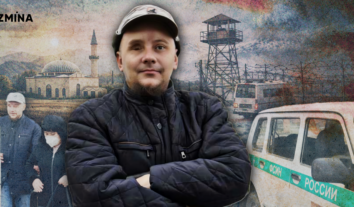
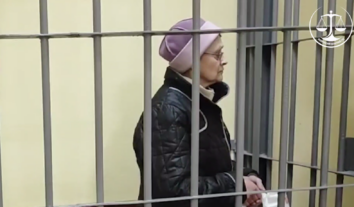
The UN General Assembly called on Russia to ensure unimpeded access for the International Committee of the Red Cross to places of detention of prisoners, to guarantee proper medical assistance, to carry out a full exchange of prisoners of war, and to release all illegally detained persons, including Crimean Tatars, civilians, political prisoners, and journalists.
Ukrainian news agency Ukrinform reported that the resolution relies on the findings of the Independent International Commission of Inquiry on violations by Russia, which confirm facts of enforced disappearances and torture both in the occupied territories and in Russia itself.
The UN General Assembly condemned Russia’s refusal to provide information about the fate of abducted and captive Ukrainians.
Moreover, the UN demands that Russia immediately cease aggression and withdraw all troops from the territory of Ukraine.
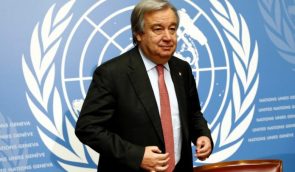
Minister of Foreign Affairs of Ukraine Andrii Sybiha welcomed the adoption of such a decision.
“Ukraine has initiated this resolution annually since 2016. The document strongly condemns Russia’s aggression, reaffirms Ukraine’s sovereignty and territorial integrity, and demands an immediate end to the war and withdrawal of Russian forces. The resolution strengthens international monitoring of grave human rights and humanitarian law violations and underscores the imperative of accountability,” he wrote on X.
Seventy-nine countries voted in favor of this document, 16 voted against, and 73 abstained. In particular, the opponents of this resolution were: Russia, Belarus, North Korea, China, Iran, Burkina Faso, Eritrea, Sudan, Mali, Zimbabwe, Burundi, CAR, Congo, Equatorial Guinea, Cuba, Nicaragua.
Earlier in December 2025, the U.N. General Assembly adopted a resolution by a majority vote demanding that the Russian Federation immediately and unconditionally return all illegally deported Ukrainian children. The Russians maintain that the kidnapped children were allegedly rescued, but Moscow hasn’t returned them to Ukraine.
Time Magazine, in its Review 2025, pointed out that the abduction of Ukrainian children is nothing new. It also occurred during Russia’s 2014 invasion of the Crimean Peninsula.
The Humanitarian Research Lab at Yale University has been tracking the children through Russian news reports, public databases, and social media posts. In March, the group succeeded in identifying more than 8,400 children who had been “systematically relocated” from Ukraine.
Moscow sometimes used military transport planes to take the children, who were then assigned to Russian foster families. As Nathaniel Raymond, executive director of the Yale group, told the Guardian, “This is likely the largest child abduction in war since World War II, comparable to the Germanification of Polish children by the Nazis.” The fear is that the children will vanish into Russia’s adoption system, homes, and reeducation camps.
The Times of London has reported that there’s evidence Russia has forcibly conscripted some of the children to fight against their homeland when they turn 18.
Stay connected via X and LinkedIn with ZMINA – and help build this platform with us by filling out our anonymous 5-minute survey here.