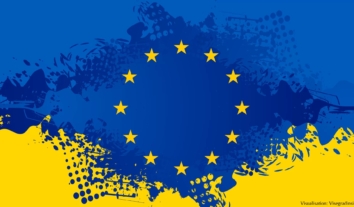
Three quarters of Ukrainians support Ukraine’s accession to the European Union
A clear majority of Ukrainians (86%) consider themselves informed about the EU accession process. Of these, 25% report being well or very well informed, while another 61% indicate some knowledge of the issue.
These are the results of the survey conducted by the research agency Info Sapiens on behalf of Transparency International (TI) Ukraine from June to July 2025.
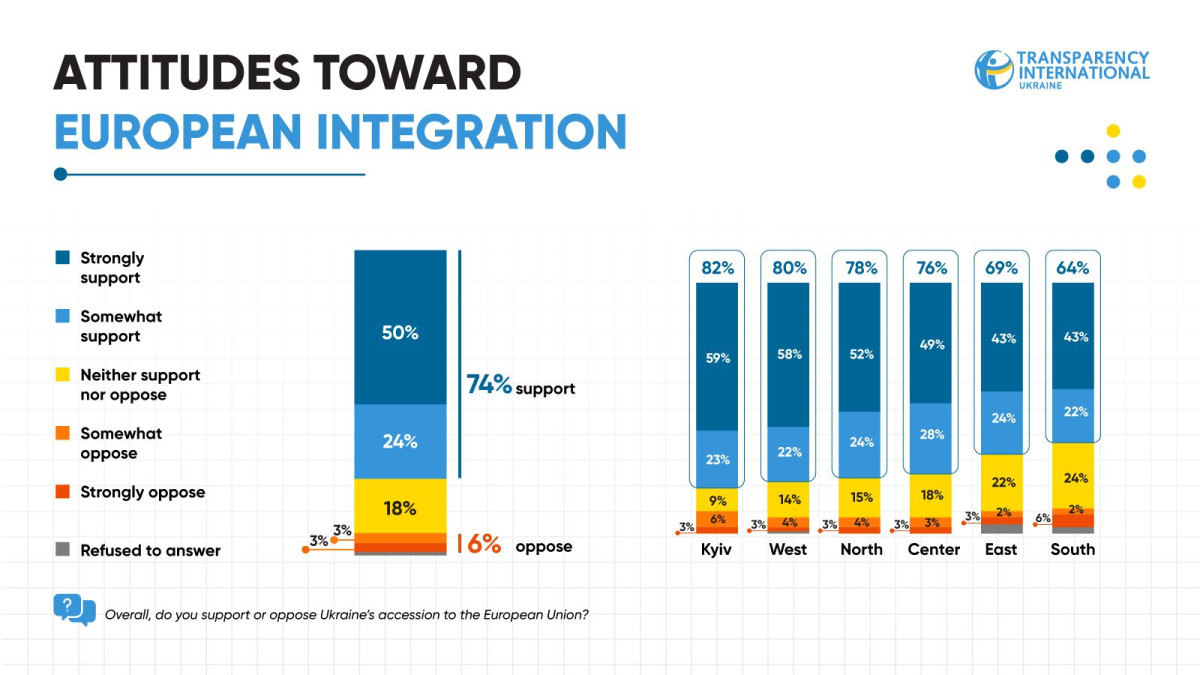
74% of citizens support Ukraine’s accession to the European Union. The strongest support comes from residents of Kyiv (82%), the western (80%), northern (78%), and central (76%) regions. In contrast, support levels are somewhat lower in the south (69%) and east (64%). Currently, 6% of Ukrainians oppose EU accession, while 18% remain undecided.
The most frequently cited expectations from EU membership are:
- a better future for children (65%);
- peace (60%);
- economic growth (60%);
- improved living standards and quality of life (59%);
- greater employment opportunities (58%).
Also, 55% of respondents believe that integration with the EU will help combat corruption in Ukraine, while 54% are convinced that EU membership will foster adherence to the rule of law.
Among the main concerns regarding EU accession, respondents cited:
- outflow of young people (48%);
- exploitation of natural resources (35%);
- immigration (31%);
- increased bureaucracy (30%).
Notably, 30% of respondents still identify potential deterioration of relations with Russia as a negative consequence of Ukraine’s integration into the EU, while 11% believe that the EU itself has no future. Overall, however, respondents associate EU membership with more advantages than disadvantages — 8% report seeing no disadvantages at all.
Forty-two percent of respondents remain optimistic about Ukraine’s accession prospects, believing the process will take up to five years. Nearly one-quarter (22%) estimate the timeline at between 6 and 10 years, while 12% are convinced that Ukraine will never obtain EU membership.
“The survey showed that Ukrainians approach European integration processes both thoroughly and critically. Importantly, when identifying the benefits and drawbacks of EU membership, citizens focus not only on issues that affect them personally — such as employment opportunities, education, or healthcare — but also on broader national issues, including the fight against corruption, security, and economic growth. It is especially encouraging that, after weighing these factors, people still overwhelmingly support EU accession. They also remain highly optimistic, believing that Ukraine will join the European family within the next five years — and this expectation is shared not only by the younger generation, but by much older citizens as well,” commented Andrii Borovyk, Executive Director of TI Ukraine.
The survey was conducted by the research agency Info Sapiens from June to July 2025. The sample included 1,015 respondents, who were representative by gender, age, locality type and size, and macro-region across government-controlled territories of Ukraine. The data collection method was telephone interviews (CATI).