Human rights defenders urge Zelenskyy to prioritize protection for war victims
In 2025, human rights defenders called on the government to designate an entity responsible for supporting people affected by the war. However, as of the beginning of 2026, there is still no government body that systematically manages this sphere.
Human rights advocates believe that following the liquidation of the Ministry for Reintegration of Temporarily Occupied Territories — a decision approved by the President — the head of state himself could initiate a revision of the support architecture and the creation of an effective government body, Alena Lunyova, Advocacy Director of the ZMINA Human Rights Center, stated this during the presentation of “Seventeen Priority Steps in the Field of Human Rights Protection in the Context of Armed Aggression Against Ukraine in 2026”.
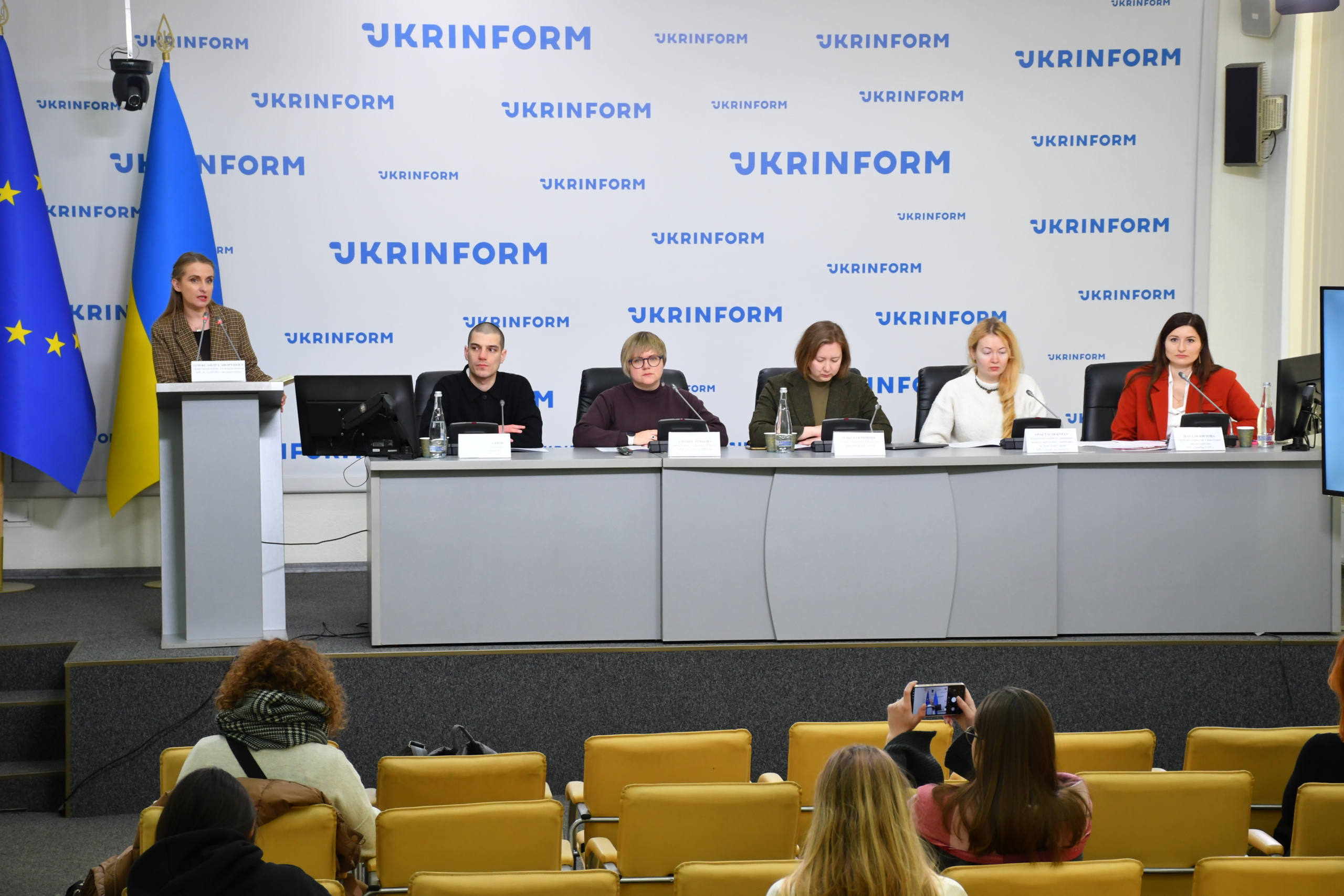 In the photo: Oleksandra Dvoretska, Dmytro Spafarov, Alena Lunyova, Olha Skrypnyk, Anastasiia Burau, Natalia Yurlova
A coalition of human rights organizations has outlined a list of priority steps to protect the rights of people affected by Russia’s armed aggression against Ukraine. This year, for the first time, the document includes a dedicated set of recommendations for the President of Ukraine.
According to Alena Lunyova, the number of priority steps has grown annually: from 10 several years ago to 17 this year. This is not only because challenges are increasing, she noted, but also because many recommendations remain unfulfilled for years, carrying over into subsequent agendas and taking on new forms.
You may also want to read: Government agencies have appointed officials responsible for the temporarily occupied territories: human rights advocate explains what this will change
“Previously, recommendations were addressed to the Verkhovna Rada and the Cabinet of Ministers, as they are the bodies responsible for formulating and implementing policies regarding internally displaced persons, residents of temporarily occupied territories, missing persons, and civilians illegally detained in occupied territories and the Russian Federation,” Lunyova elaborated. “But this year, we see issues that fall within the president’s sphere of competence.”
Human rights defenders identify peace negotiations as a key issue requiring presidential attention. The coalition emphasizes the necessity of incorporating the interests of war victims — primarily those living in occupied territories — into the negotiation process. This includes ensuring humanitarian access, adherence to international humanitarian law, search efforts for missing persons, and establishing avenues for safe exit from occupied areas.
“Throughout 2025, we made corresponding statements at least twice and emphasized that it is important to speak about the human dimension whenever we discuss any ceasefire issues or further peace negotiations,” the human rights advocate added.
A separate block of recommendations addresses security policy regarding residents of occupied territories. According to Lunyova, the excessive perception of people living in or fleeing occupation as a “risk” sometimes leads to undemocratic decisions — for instance, initiatives involving polygraph tests or the risk of losing citizenship.
ZMINA previously reported in Ukrainian on the risks of human rights violations if draft law No. 14230 is adopted in its current version. Specifically, ZMINA highlighted in Ukrainian concerns over the introduction of polygraph checks outside of criminal proceedings and detailed why the state cannot base mass screenings on polygraph tests.
Human rights defenders also insist on prioritizing the departure and support of youth from occupied territories.
“This is our potential, our resource, and this is the category that wants to leave,” Lunyova noted. “We must provide every possible support and ensure protection mechanisms for these young people who want to continue their lives in the free territory of Ukraine.”
You may also want to read: Children in one of the schools in occupied Sevastopol are being militarized by Russian militant Pavel Klyasyuk
She emphasized that the priority steps document serves as a working roadmap for the year. While recommendations may be updated as the situation evolves, the implementation of several points has already yielded positive results, particularly regarding educational access for youth from occupied areas.
“We continue to communicate and react to any emergency challenges as they arise. For example, just recently, we released an open appeal regarding the suspension of pensions for IDPs from occupied territories. Unfortunately, such emergency situations do occur. However, we believe that if the state implements even a portion of the recommendations we provide, the lives of those affected by the war will certainly become simpler and easier,” Alyona Lunyova concluded.
“Seventeen Priority Steps in the Field of Human Rights Protection in the Context of Armed Aggression Against Ukraine in 2026” is an analytical document prepared by the Coalition of Human Rights Organizations, which focuses on protecting the rights of individuals affected by the war. The full text of the document is available in both Ukrainian and English.