‘Justice must be restored’: Ukraine puts ‘judge’ who sentenced journalist Semena in occupied Crimea on trial
In 2017, Mykola Semena, a journalist at Radio Free Europe/Radio Liberty, found himself in the dock in occupied Crimea because of his professional work. It was one of the first cases on the Crimean Peninsula to clearly expose the occupation authorities’ crackdown on freedom of expression. Despite significant international outcry and calls to end the journalist’s persecution, the Russia-controlled occupation court, unlawfully established in place of a Ukrainian court, pursued the case through to conviction. The proceedings were presided over by Nadiia Shkolna. On 22 September 2017, she sentenced Semena to a two-and-a-half-year suspended prison sentence with a three-year probation period and barred him from engaging in public activities. In effect, she banned him from practising his profession.
As a result of the investigation and his conviction, Semena, who had serious health problems, was unable to leave the peninsula and obtain the treatment he needed in Kyiv for two and a half years. In February 2020, following advocacy efforts by Ukrainian and international human rights advocates, he was finally able to leave for mainland Ukraine. In 2021, Nadiia Shkolna herself went on trial in Ukraine. The relocated Prosecutor’s Office of the Autonomous Republic of Crimea charged her with a war crime for violating Semena’s right to a fair trial in occupied Crimea. The Holosiivskyi District Court of Kyiv has been hearing the case for more than four years. Meanwhile, Shkolna remains a judge on the illegitimate “Supreme Court of Crimea”, where, according to human rights advocates, she continues to hand down rulings in politically motivated cases.
Read the full article to learn how Mykola Semena was tried in occupied Crimea, why the actions of Shkolna constitute a war crime and how the case against her is progressing in a Ukrainian court.
A “case” over an “opinion”
After seizing Crimea in 2014, Russia began asserting control over the peninsula’s media landscape: television channels were taken off air and state-run media outlets were restructured. Media outlets and journalists who refused to cooperate were pressured into leaving.
The team at Krym.Realiiі , a Radio Liberty project, adapted its work to the new circumstances in Kyiv. However, a group of correspondents decided to continue working in occupied Crimea despite the risks.
Mykola Semena was one of those correspondents. His persecution began in April 2016, when FSB officers searched his home. A criminal case was subsequently opened against him on suspicion of calling for action aimed at violating “Russia’s territorial integrity”.
In 2017, the occupation authorities put Semena on trial on this charge. The case was prompted by his column “The Blockade is a Necessary First Step towards the Liberation of Crimea”, published in 2015.
As early as 2014, Russia established its own system of courts in occupied Crimea, operating under Russian law. This constitutes a direct violation of international humanitarian law, specifically Article 64 of the Geneva Convention relative to the Protection of Civilian Persons in Time of War.
The “Zheleznodorozhny District Court of Simferopol” was thus established in place of the Zaliznychnyi District Court of Simferopol. In May 2016, Kremlin leader Vladimir Putin appointed Nadiia Shkolna as a judge of this court by presidential decree. She took an oath under Russian law and began administering justice on behalf of the occupying power.
In 2017, Shkolna presided over the trial of journalist Mykola Semena.
During the proceedings, the journalist was effectively denied his right to a fair trial. The prosecution relied on a linguistic expert report prepared by a unit of Russia’s FSB, which claimed that the article contained calls to violate “Russia’s territorial integrity”. Independent experts, however, including Olena Novozhylova from Moscow, concluded that the article formed part of a public debate on the status of Crimea.
The Prosecutor’s Office of the Autonomous Republic of Crimea and the City of Sevastopol stresses that the judge disregarded the alternative expert opinions and refused to question one of the experts, demonstrating the court’s bias and dependence on the occupation authorities.
The journalist pleaded not guilty and said that the case against him was politically motivated. Both Semena and his defence pointed to numerous instances of bias shown by the Russian investigators.
In particular, Semena emphasised that the article contained no specific calls to action and formed part of an international public debate:
“The article was published in the ‘Opinions’ section. At the time, Crimea was being discussed internationally – at the UN, the OSCE and the Parliamentary Assembly of the Council of Europe, as well as in thousands of media outlets.”
He stressed that the expert assessment on which the prosecution relied was not objective:
“Olha Ivanova carried out an unlawful expert assessment. She is no expert – she graduated from a university in the Russian Far East with a degree in Chinese. Her assessment has no evidentiary basis whatsoever.“
Nevertheless, Shkolna found Semena guilty of calling for action aimed at violating “Russia’s territorial integrity” and handed him a two-and-a-half-year suspended prison sentence with a three-year probation period. During this period, the journalist experienced health problems but was unable to leave the occupied peninsula.
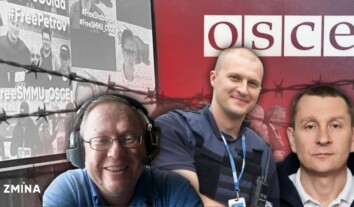
Ukrainian and international human rights organisations called for an end to the journalist’s persecution in occupied Crimea. They included the International Federation of Journalists, the European Federation of Journalists and the Office of the OSCE Representative on Freedom of the Media. Ukraine’s Ministry of Foreign Affairs, the US Department of State, the European Union and several international organisations condemned Semena’s conviction.
On 28 January 2020, Semena received a court order terminating his probation early and expunging his criminal record. Only then, on 18 February 2020, was he able to leave Crimea for Ukrainian government-controlled areas. He has not returned to his home in Crimea since. Semena regained both the right to work as a journalist, which had been taken away from him for two and a half years, and the opportunity to receive appropriate medical treatment.
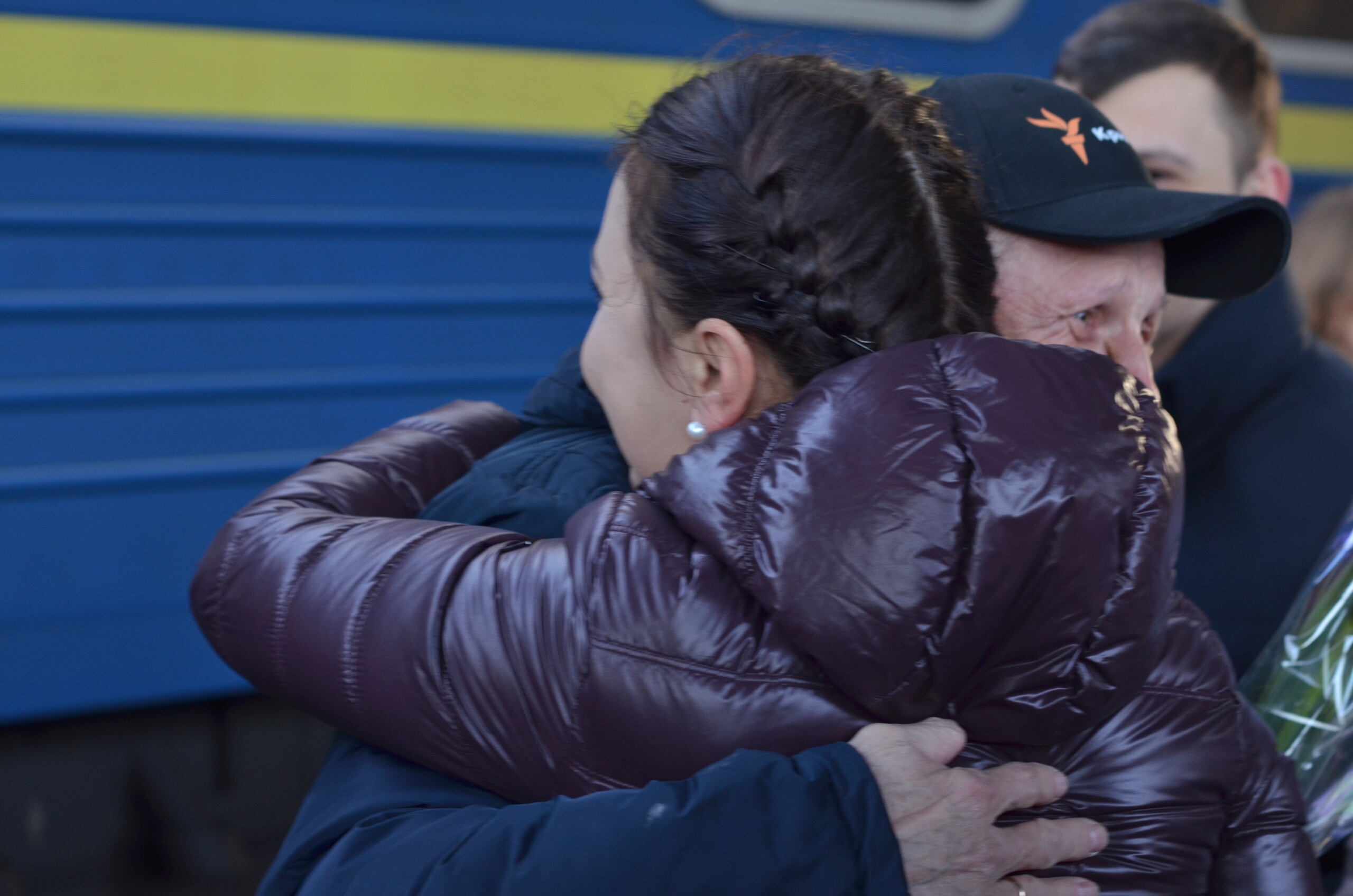 Tetiana Pechonchyk and her colleagues meet Mykola Semena in Kyiv. Photo credit: ZMINA
Why Ukraine has charged Shkolna with a war crime
The Prosecutor’s Office of the Autonomous Republic of Crimea and the City of Sevastopol, which had relocated from the peninsula to Kyiv, opened criminal proceedings against Shkolna. On 29 July 2019, she received formal notice that she was suspected of violating the laws and customs of war under Article 438(1) of the Criminal Code of Ukraine in connection with her handling of Semena’s case. This provision is used in Ukraine to investigate war crimes arising from violations of international humanitarian law.
The Crimean Prosecutor’s Office bases its case on breaches of the conventions governing the obligations of an occupying power during an international armed conflict. In particular, Article 64 of the Geneva Convention relative to the Protection of Civilian Persons in Time of War requires the laws in force before the occupation to remain in effect in the occupied territory. The occupying power must ensure the effective administration of justice under those laws and respect the right to a fair trial.
The establishment of courts incorporated into the Russian judicial system and the application of Russian law to judicial proceedings in occupied Crimea therefore constitute violations of international humanitarian law.
According to investigators, Shkolna was aware that the court had been established unlawfully, yet on 6 June 2016 she took the oath of office as a judge of the “Zheleznodorozhny District Court of Simferopol” and began serving on the court.
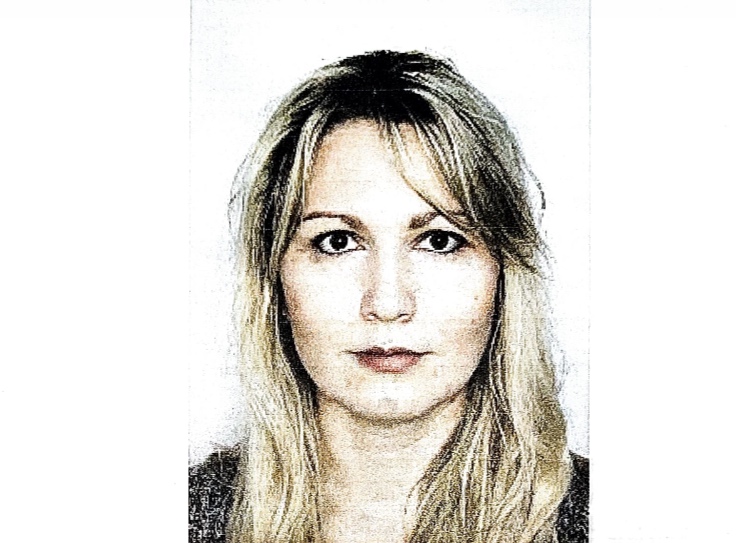 Nadiia Shkolna, a judge appointed by the occupation authorities. Photo: publicly available sources
In 2017, Shkolna presided over the trial of journalist Semena under Article 280.1 of the Russian Criminal Code, despite knowing he was a Ukrainian citizen and therefore a protected person under the Geneva Convention relative to the Protection of Civilian Persons in Time of War.
The Prosecutor’s Office of the Autonomous Republic of Crimea also states that Shkolna violated Semena’s right to a fair trial before a lawfully constituted court. She disregarded alternative expert opinions and refused to question an expert whose testimony could have challenged the findings of the forensic linguistic assessment prepared by an FSB expert, on which the entire prosecution case, and ultimately the conviction, were based.
According to the prosecution, this demonstrates her dependence on the occupation authorities and the bias inherent in proceedings aimed at prosecuting people who express pro-Ukrainian views.
In November 2021, the Crimean Prosecutor’s Office submitted the indictment to the court and obtained authorisation to proceed with a trial in absentia. Shkolna is currently wanted by the Ukrainian authorities.
Pavlo Chernyshenko, the prosecutor in the case, explained that if Shkolna is convicted and subsequently leaves the occupied territory, she could be detained so that the sentence can be enforced:
“The procedure provides for special court proceedings in the person’s absence. If the person remains in the occupied territory, they are effectively considered wanted. Once a judgment has been handed down, law enforcement units continue searching for the person so that the judgment can be enforced.”
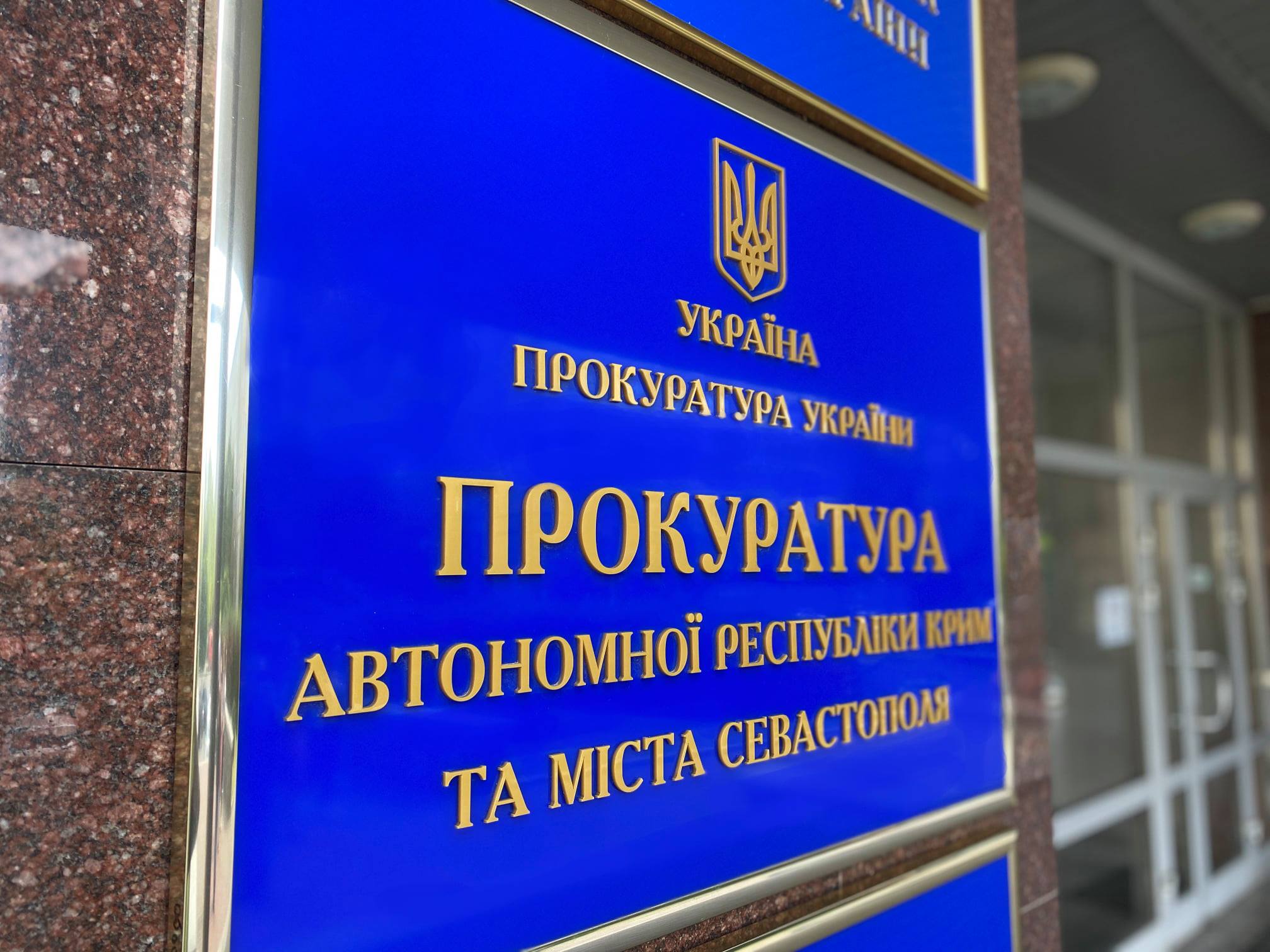 Prosecutor’s Office of the Autonomous Republic of Crimea. Source: the Prosecutor’s Office website
The Prosecutor’s Office of the Autonomous Republic of Crimea notes that it was the first authority in Ukraine to notify illegitimate judges serving in occupation courts that they were suspected of committing war crimes.
Five criminal cases in which the Crimean Prosecutor’s Office is prosecuting defendants under Article 438 of the Criminal Code of Ukraine are currently before the courts. These cases concern Mykhailo Bielousov, a judge of the “Kyivskyi District Court” of Simferopol who, after the occupation of Crimea began, breached his oath of office, joined an unlawfully established occupation court and convicted political prisoner Andrii Kolomiiets; his colleague Viktor Mozhelianskyi, who took similar action against Akhtem Chyihoz and Oleksandr Kostenko; Andrii Kulishov, who heard the case against Ilmi Umerov; the so-called three-judge panel in the Akhtem Chyihoz case – Viktor Zinkov, Ihor Kriuchkov and Oleksii Kozyriev; and the aforementioned Nadiia Shkolna.
Since 2014, the Crimean Prosecutor’s Office has submitted a total of 287 indictments against “judges” serving in occupation “courts”, with 169 convictions handed down to date. The cases involve not only war crimes but also high treason and other offences.
An ongoing crime
The case against Nadiia Shkolna is being heard by the Holosiivskyi District Court of Kyiv. The presiding judge is Olena Pervushyna, who previously served as president of the Court for many years. Although she ceased to hold this position after 2018, she continues to serve as a puisne judge. Shkolna is represented in the proceedings by defence lawyer Valentyna Makarenko.
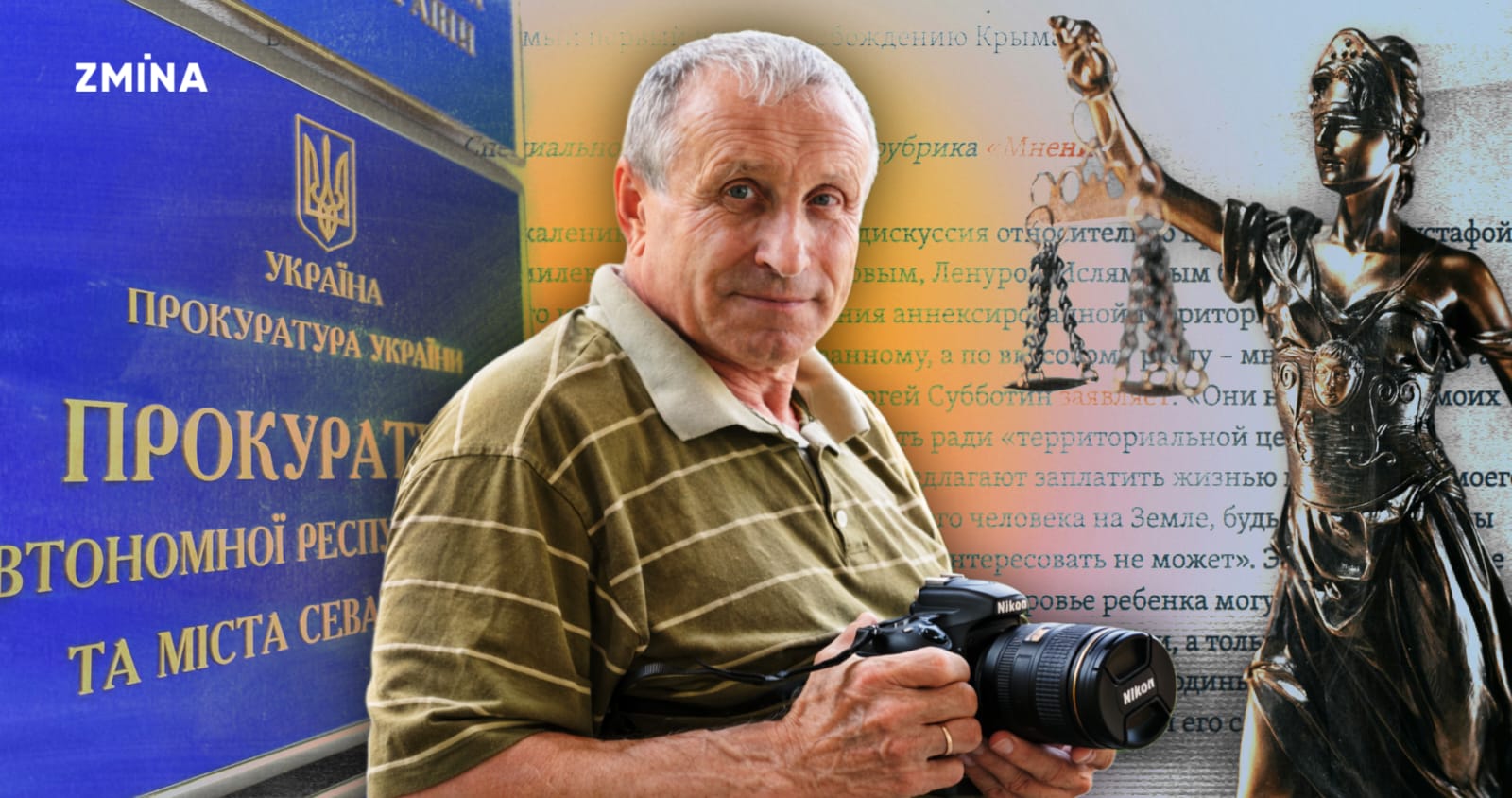
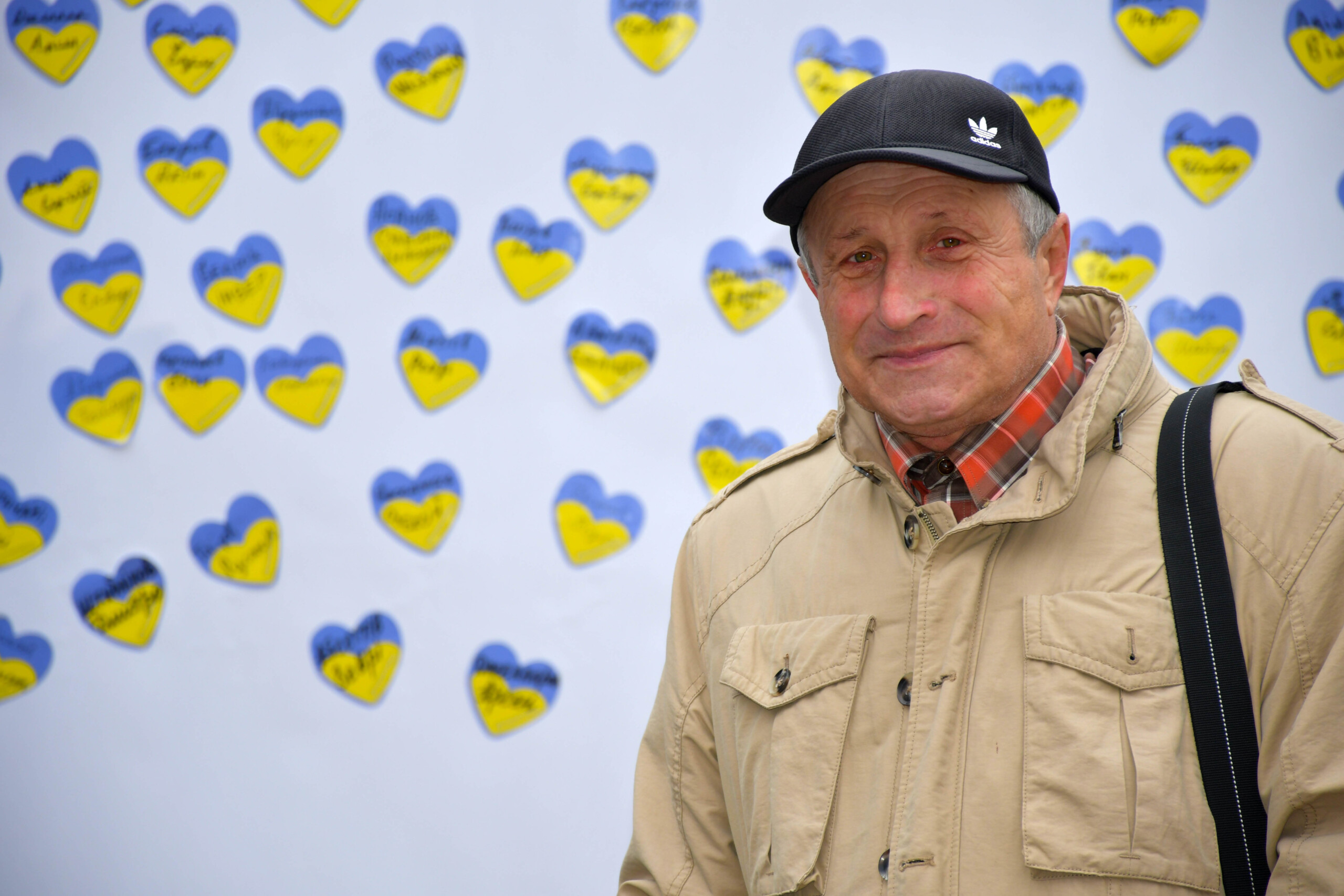 Mykola Semena, a Crimean journalist. Photo credit: ZMINA
Mykola Semena is recognised as the victim in the criminal case and has testified before the court. Speaking to ZMINA, he highlighted the systematic nature of the persecution carried out through the occupation judicial system:
“Shkolna has also tried many of our other political prisoners. When I testified before the Holosiivskyi District Court, I said that we were dealing with an ongoing crime. After betraying Ukraine, taking the oath of office as a judge of an unlawfully established court and handing down the judgment in my case, she was transferred to the ‘Supreme Court of Crimea’. There, she continues to hand down unlawful rulings that harm Ukraine and those who support it.”
Shkolna is also known to have been involved in other politically motivated proceedings. At the “Supreme Court of Crimea”, she upheld the continued detention of Crimean businessman Dmytro Kozlia, who was charged with “discrediting the Russian army” over social media posts. She also upheld the conviction of Oleksandr Tarapon, a resident of Alushta, sentenced to two and a half years in a penal colony for putting up leaflets in Crimea bearing the words “War criminal”. Tarapon openly opposed Russia’s war against Ukraine, put up anti-war leaflets in Alushta, and compared the attack on Ukraine to Nazi actions during World War II.
For Semena, it is important not only to see the proceedings through to their conclusion but also to restore justice:
“From the very beginning of my persecution, Radio Liberty and I decided that we would prove that we were right. At the time, I was effectively silenced. This matters to me because I believe that justice must be restored.”
At the same time, Mykola Semena notes that the trial has been ongoing for more than four years and that many of the hearings have been postponed for various reasons:
“I understand that the Kyiv courts currently have a huge caseload, but our trial just keeps dragging on. Most of the hearings in this case have not proceeded. Several hearings were postponed because of the defence lawyer. I remember one occasion when she did not attend because she had another hearing taking place at the same time in a different court. But priority should be given to whichever hearing was scheduled first. When the date was set, the lawyer did not tell [the court] that she had another hearing that day, so it must have been scheduled later.
In 2025, ZMINA decided to begin monitoring the trial. Since December, one of its journalists has been trying to attend the proceedings against Nadiia Shkolna, but two consecutive hearings have failed to take place.
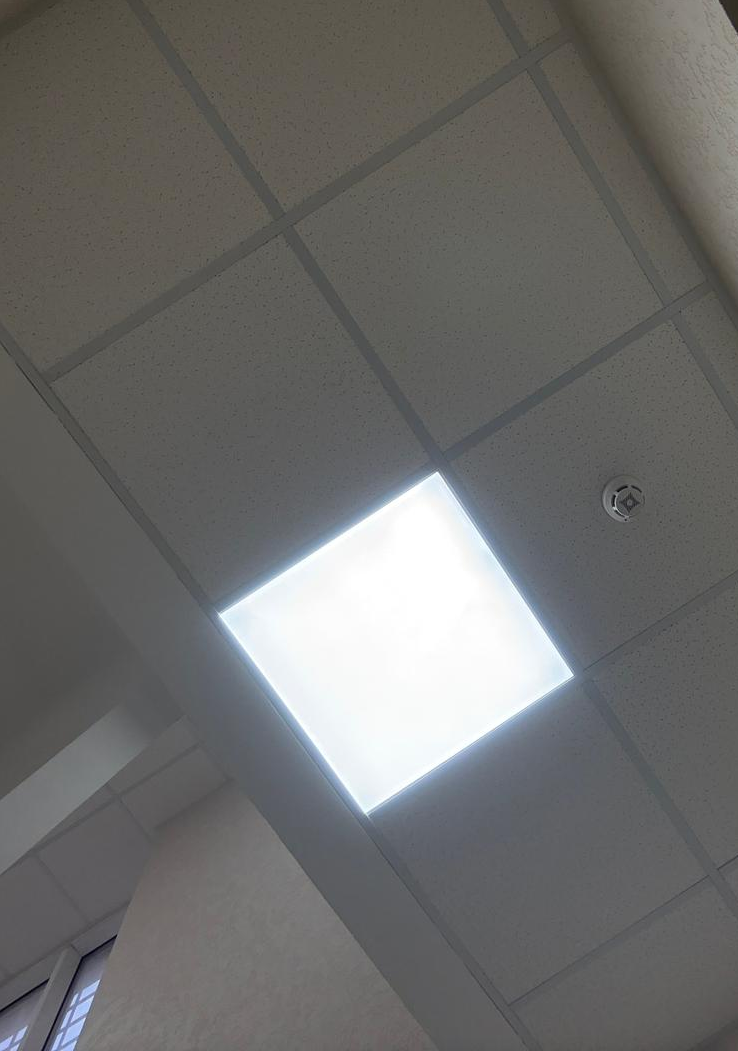 The lights were on in the corridor of the Holosiivskyi District Court on 18 December. Photo credit: Viktoriia Nesterenko
One of these hearings was scheduled for 18 December 2025. An hour before the closing arguments were due to begin, the court announced that the hearing had been cancelled because the building had no electricity. However, Viktoriia Nesterenko, a human rights advocate at the Human Rights Centre ZMINA, who was already inside the courthouse, reported that the court was running on a generator, electricity was available, and other hearings were proceeding as scheduled. She provided a photo of the court corridor to support her account.
Liked this article? Follow ZMINA on X, BlueSky and LinkedIn, and help shape our editorial focus by filling out our feedback form here.