Losing home for a second time: How Russian occupiers are “nationalising” flats and houses in Mariupol
Late last year, Russia formally legalised the mass seizure of Ukrainian housing in the temporarily occupied territories (TOT). Flats and houses belonging to people who fled the TOT or who refuse to take Russian passports are under threat. However, the practice of expropriating such property came much earlier, dating back to 2014. Once formally declared “ownerless”, the housing is handed over to new occupants loyal to the occupation authorities.
The practice is most widespread in Mariupol, a city [in Donetsk Oblast] that has become a symbol of destruction and civilian casualties caused by Russia’s war. Thousands of flats and houses in the city are already known to have been confiscated in this way.
A Mariupol family shared with ZMINA how they lost their home for a second time as a result of a decision by the occupation administration.
Using the experience of a displaced Mariupol family, the article explores how Russia has built a system for confiscating homes in occupied Ukraine, what happens once a property is declared “ownerless”, and what owners can do to preserve evidence for future legal claims.
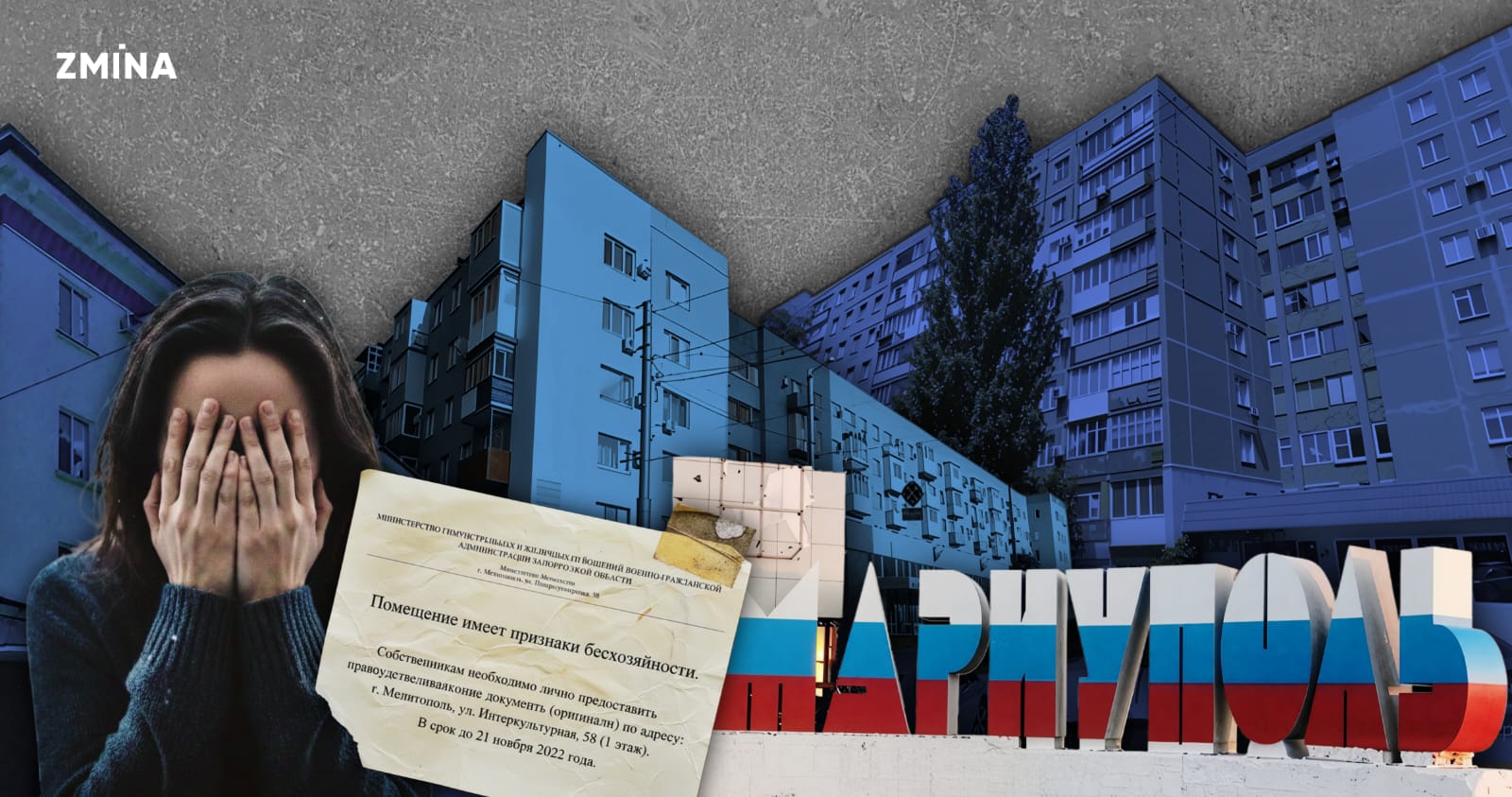
“My parents were born and grew up in Mariupol – they never lived in any other cities. I was also born there. I’ve lived in this flat since I was three. Mariupol was my place of strength. Every year, I would come back there with my children for a few months, and my eldest son took his first steps there,” says Anastasiia (name changed for safety reasons), who was born in Mariupol and left the city at 16 to study in Ukraine’s capital.
She recounts that in 2021 the flat in the city centre was renovated and the household appliances were replaced.
“Sometime in late January 2021, my parents said that ‘finally everything was ready, everything was done, everything worked – we won’t have to do anything for the rest of our lives, we’ll just rest and enjoy life.’ My parents left the city on 24 February, on the first day [of the full-scale invasion] – they were simply lucky that someone picked them up by car and they managed to get out.”
None of the family has returned to Mariupol since then.
You may also want to read: Interview with a journalist Olha Zvonariova on being injured and working in frontline Zaporizhzhia
Anastasiia’s story is one of thousands of Mariupol residents who have lost their homes twice: first due to Russian shelling, and later as a result of decisions by the occupation administration.
Chronicle of expropriation
On 10 December 2025, the Russian authorities adopted draft law No. 1052810-8, establishing at the federal level a mechanism for the mass seizure of Ukrainian housing in the TOT. This concerns flats and houses belonging to people who left the TOT or refuse to obtain a Russian passport. Formally, such housing is declared “ownerless” and transferred to new users – predominantly those loyal to the occupation administration.
Human rights defenders said at the time that this was not a new practice, but a formalisation of actions Russia had carried out in occupied territories for years.
In practice, the occupiers have been seizing housing from Ukrainians since 2014. There is extensive evidence of militants forcing people out of their homes or taking over flats left empty. In 2019, the occupation administrations of the so-called “DPR” and “LPR”і began using the term “ownerless property”, and following the start of the full-scale invasion, “decrees” on “nationalisation” were adopted across all occupied territories.
In March 2024, the occupation administration in Mariupol adopted so-called law No. 66-RZ “on ownerless property”, allowing flats to be officially declared “ownerless” without the owner’s involvement. Mariupol has become the main area where this mechanism has been applied on a mass scale.
That summer, the first large lists of “ownerless” property appeared in Mariupol – nearly 500 addresses. In October 2025, the French newspaper Le Figaro reported that in the Luhansk, Donetsk, Zaporizhzhia and Kherson regions, Russia considers at least 25,000 real estate properties to be “ownerless”.
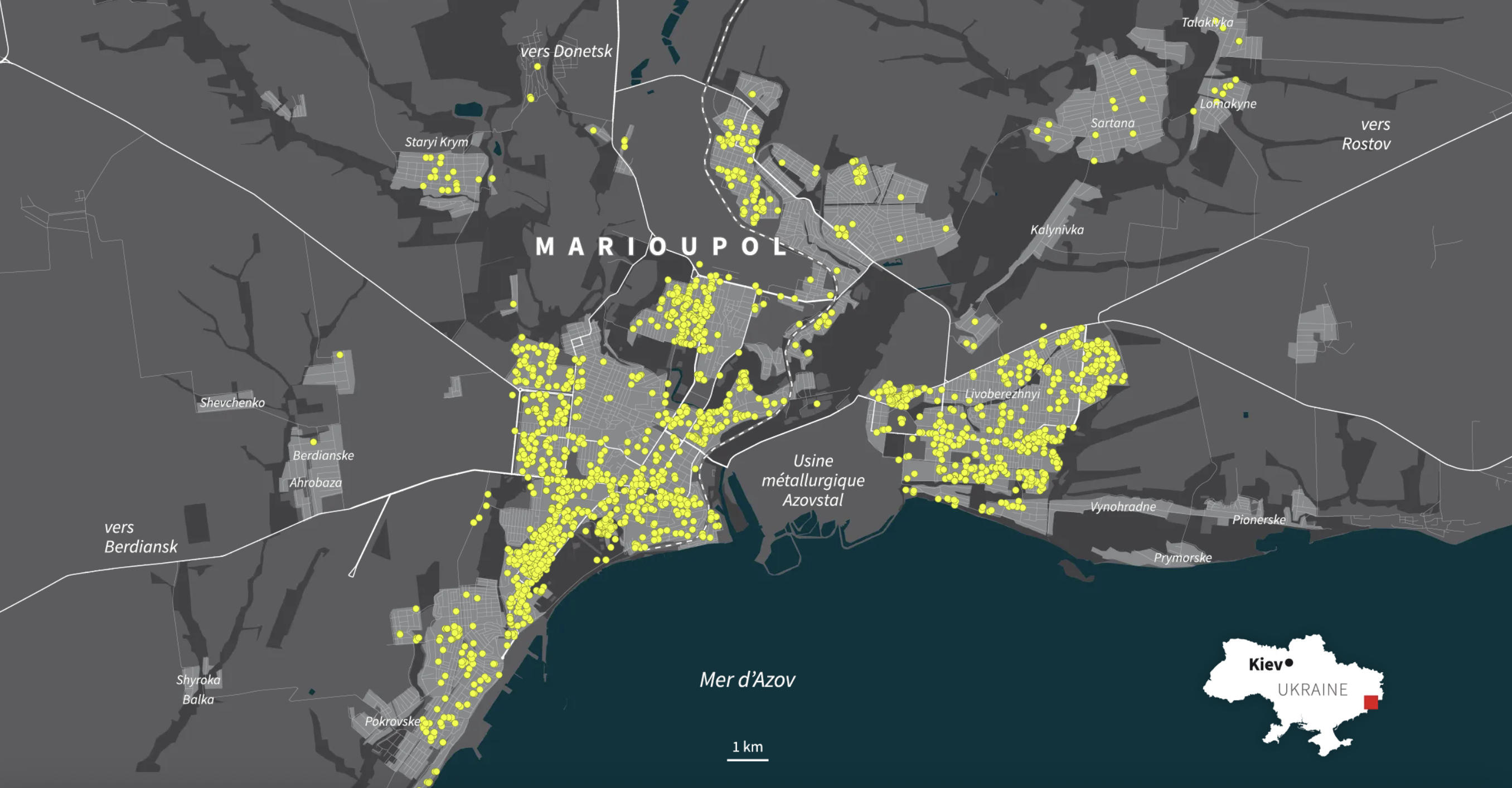 Illustration: Le Figaro
“In Mariupol, a martyred city on the coast of the Sea of Azov, where 26,000 people were killed during the Russian siege in spring 2022, expropriations have reached an unprecedented scale. Le Figaro has identified at least 13,000 properties, mostly flats, confiscated by Russia,” the report says.
The authors of the investigation stress that the real figures are likely to be significantly higher.
You may also want to read: “Mariupol is a pattern of Russian warfare” – how Russia destroyed the city
How can Ukrainians find out if their property has been “nationalised”?
There are several ways to find out whether a property has been added to lists of “ownerless” housing.
- The Russian occupiers publish lists of property they have declared “ownerless” to comply with a formal procedure (usually a 30-day period for the owner to come forward). These lists can be found on the pages of the so-called ministries of property and land relations or city “administrations”, typically on Telegram channels.
- If a property has already gone through the “nationalisation” process, it may appear in the Russian real estate register.
- In many cases, neighbours who remain in the city are the first to inform owners that their property has been lost, reporting the appearance of distinctive markings on doors or visits by “commissions” accompanied by armed individuals.
Anastasiia found out that her family’s flat had been declared “ownerless” through Telegram channels.
“Our flat was one of the first to be put on the lists as ‘ownerless’. At first, I didn’t know how to tell my parents – I was very worried. It turned out they had already seen everything. They had, in a way, made their decision and understood they would not return there until Ukrainian authorities were back in control. They always said: ‘Let this be the price we paid for being saved, for managing to leave.’ But you know, saying it is one thing – feeling it is another,” she says.
She adds that at first she saw several lists of “ownerless” flats, including their home. Later, a neighbour sent a photo of the “sealed” door:
“The notice said that ownership documents had to be presented by a certain date. But we found out that to register the flat there, you have to come in person, obtain a Russian passport, and present the ownership documents somewhere to have everything registered – and only then will you be issued utility bills and be expected to pay them.”
According to Anastasiia, her family found it difficult to take this information seriously.
“What did we feel? You know, it wasn’t something that hit us all at once. It built up gradually. I understood it could come to this, and my parents knew the flat could be taken, but you know – the flat is there, and we are here. It all felt distant, almost unreal,” she recounts.
However, when a neighbour sent them the photo, it became real.
“At one point, it felt like a blow to the head – it hit all of us hard, both my parents and me, even though I hadn’t lived there for a long time. There was a sense of disgust at the thought that someone would use your belongings, take photos off the walls, or even wear your clothes. Disgust, anger, a feeling of helplessness,” Anastasiia says.
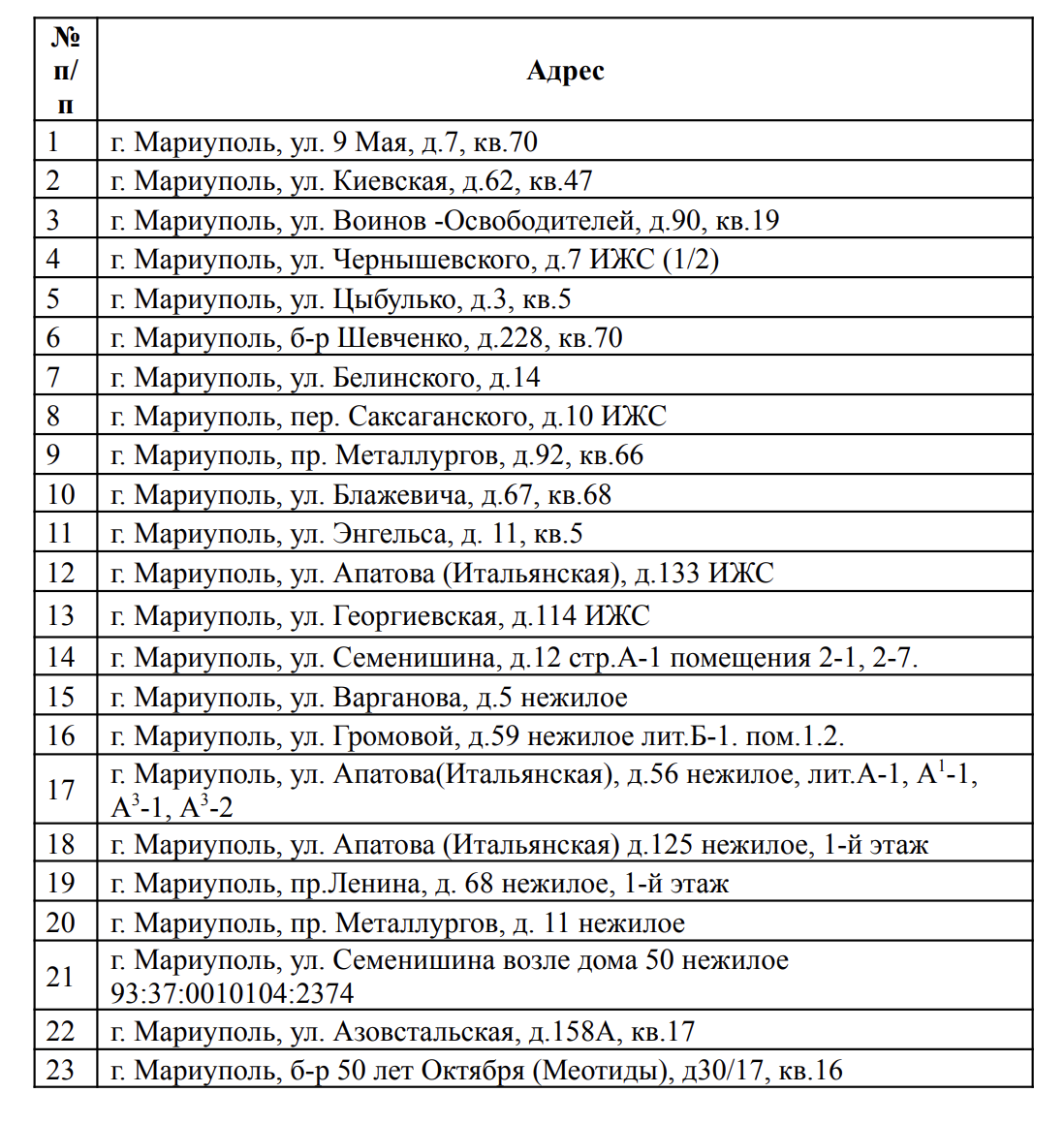 List of real estate properties considered to show signs of being ownerless, according to the “administration of the Mariupol urban district of the DPR”, 18 February 2026
The occupiers now regularly publish lists of so-called ownerless property, covering hundreds of flats. However, the term “ownerless housing” has recently fallen out of use – the expropriation of Mariupol residents’ private property is now referred to as the “expansion of the list of compensation flats”.
However, the mechanism remains unchanged: once such lists are published, Ukrainians who recognise their property have 30 days to apply to the occupation authorities and provide proof of ownership. ZMINA Human Rights Centre notes that such documentation cannot be obtained without a Russian passport. If no such application is made, the occupation authorities initiate the expropriation process.
Anastasiia is not considering returning to the temporarily occupied Mariupol to re-register the property under Russian law, not least due to security risks.
Their building’s chat included people who supported the Russian army – Anastasiia and her father came into conflict with them. In her view, it was precisely her family’s pro-Ukrainian stance that led to their flat being among the first added to the lists of “ownerless” property.
“My father and I have zero tolerance for this. We spoke out very strongly on the issue, and of course, in Ukrainian. That’s when we were effectively ‘flagged’ – in Getcontactі , tags appeared against my number such as ‘Banderite’, ‘kill the Banderite’, ‘do not let into Meriupol’, and so on. Because of this, we did not consider any possibility of sending a family member to Mariupol,” Anastasiia says.
Human rights defenders also warn against travelling to the TOT to re-register property, as such trips pose serious risks to life and health, and any documents issued by the occupation authorities have no legal force and are invalid.
The occupation authorities do not attempt to contact the owners of the flats. According to Anastasiia, when the occupiers sealed the flat, they simply told neighbours that the owners could come and re-register it under Russian law.
“The last thing I know is that they came and inspected the flat, because everything was still there – linen, dishes, books, photos. They said they would give us time to collect our belongings if we wanted to, but there is no one to collect them. From our friends’ experience, a woman living in Germany only found out afterwards that people had entered her flat and taken everything. Even forks and spoons were taken. Who took them – neighbours or the commission that came to seal the flat – is unclear, but the flat was emptied,” Anastasiia says.
Restoring justice
Anastasiia hopes for the de-occupation of Mariupol, but understands it will not happen quickly.
“It won’t happen quickly, maybe something could be returned in five years. But again, if someone is living there… I have friends who are Crimean Tatars; they told me how they were deported in the 1940s, and when they returned in the 1980s, other people were already living in their homes, having been given the property. So at this point, I have no reason to believe that this flat will be returned to us,” she says.
She says their flat is recorded in Ukrainian registers and the documents are available in digital form. However, she also does not believe they will receive compensation for property seized in the TOT.
“To be honest, I don’t even know where to turn with this problem or whether it will lead to any result. I have no faith in it. We registered the property damage in Diiaі and added the photos we had – the balcony is damaged, the windows are broken, there was a hit to the entrance. As for everything else, I don’t know, and overall I haven’t heard of anyone whose flat was taken receiving compensation,” she says.
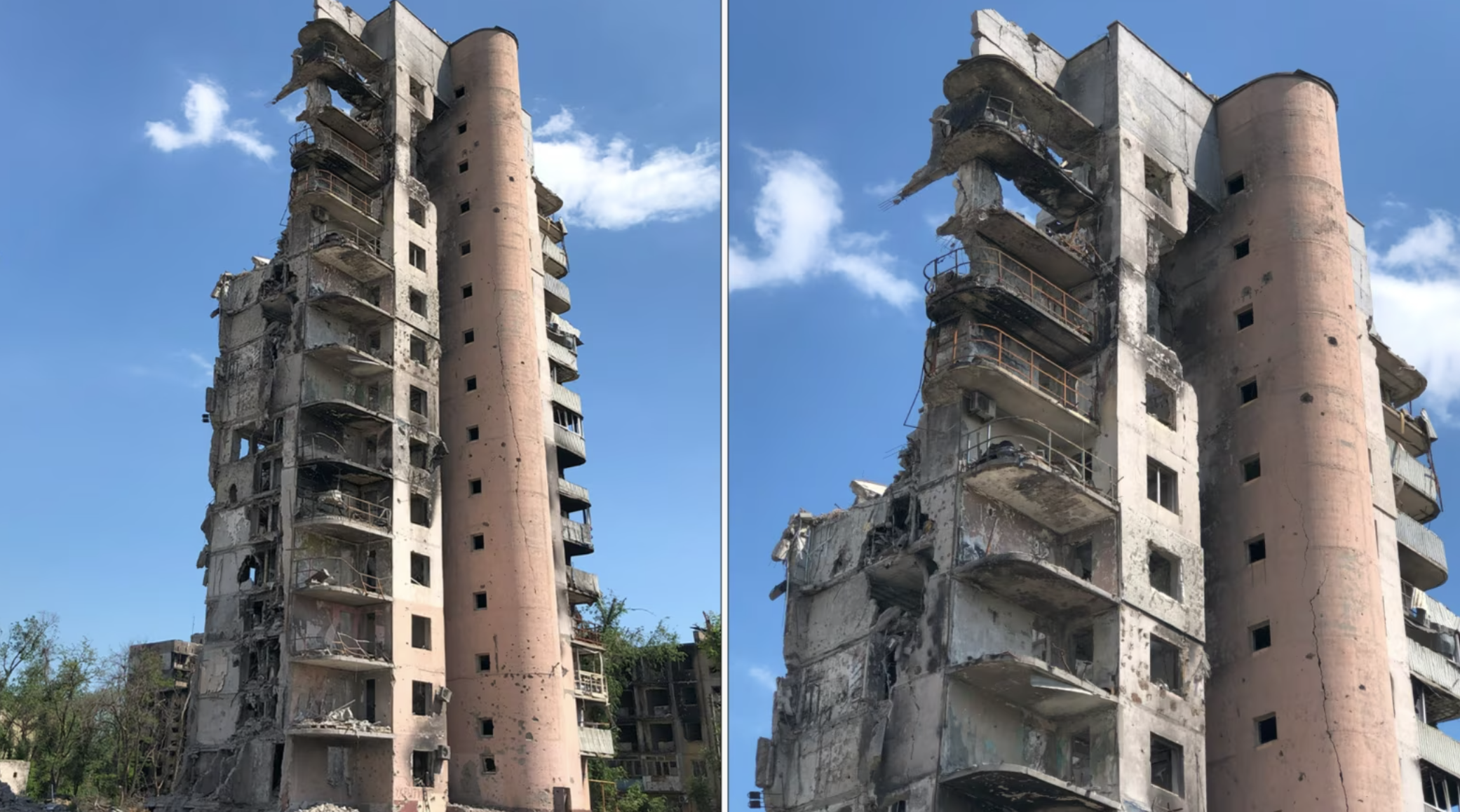 A residential building in Mariupol destroyed by shelling. Photo credit: Current Time TV
Anastasiia stresses that resolving the housing issue is a painful subject for Mariupol residents.
“Mariupol residents are completely unprotected. Those who have no one to return to are leaving the country and will not come back, because the authorities are not providing them with housing in any way. Even this idea that IDPs can receive compensationі of up to 2 million hryvnias applies only to military personnel,” Anastasiia says.
Human rights advocates also say that Ukraine still lacks a national compensation mechanism for housing lost in the TOT. In particular, Yaroslav Taranets, a senior lawyer at the East SOS charitable foundation, explains that the key state programme for compensating housing losses, “eRecovery”і , does not cover housing destroyed or lost in the TOT – this is stipulated in the relevant law.
Housing vouchers of up to 2 million hryvnias for certain categories of IDPs – combatants and people with war-related disabilities – are not a continuation of “eRecovery” and do not constitute compensation for housing destroyed in the TOT, Taranets highlights.
In November 2025, Ukraine’s Ministry for Development of Communities and Territories said it was “holding ongoing talks to secure resources for the programme and expand it to other categories of internally displaced persons whose homes remain in the TOT”, but there is currently no information about any such expansion.
Anastasiia says she wants to see those responsible for the expropriation of their property held accountable, but for now, the only way to restore justice, in her view, is to resolve the housing issue for Mariupol residents.
“Losing a home is not just about a flat or square metres. The city I lived in is gone. The streets I walked, the cafés we visited with the children, the parks – they’re no longer there. Physically, those square metres no longer have any value for me. My parents and I certainly won’t return, because I want to preserve the memories I still hold in my heart and not tarnish them with that ‘Russian world’. I don’t want to come back and see a Russian ‘drama theatre’.”
She believes that unless the housing issue is resolved, Mariupol residents who have left the country will not return.
“So many people have left, and the more time passes, the less likely they are to return, because they are building new lives there. It pains me deeply that Mariupol has once again been displaced by Russia and that the roots of its people have been lost”, Anastasiia says.
Language support: ZMINA volunteer Lisa DeHaven
Liked this article? Follow ZMINA on X, BlueSky, and LinkedIn, and help shape our editorial focus by filling out our feedback form here.