‘A rainbow in tricolour’: Crimean Polina Kustarova on growing up under the daily influence of propaganda
In Ukraine’s occupied territories, Russian propaganda systematically permeates every aspect of children’s lives – from schools and extracurricular activities to holidays, media and even family traditions. Children are drawn into militarised initiatives, “patriotic” projects and cultural events, where state ideology is imposed as the only acceptable norm. Schools have introduced hundreds of “desks of heroes” dedicated to Russian occupiers, regular “lessons on important matters” are held, and the educational and cultural space is gradually being replaced by Russian narratives.
Polina Kustarova, a 20-year-old from Crimea, experienced this system at every stage of her upbringing. Despite the pervasive propaganda and numerous barriers, she managed to leave the occupied peninsula for territory under Ukrainian control.
In an interview with ZMINA, Polina Kustarova shares her own experiences to explain how propaganda operates at the levels of schools, creative activities and family life – and how resistance can emerge even in such an environment.
“Polina, don’t rock the boat”. Propaganda at school
The occupation of Crimea began when Polina Kustarova was in the second year of school. She completed her first two years at a Ukrainian school in Kerch – “the city closest to Russia”, as she puts it. She remembers the early days of occupation mainly through the reactions of adults – arguments within her family and among relatives, as her parents held pro-Russian views and clashed with others. By the time she entered her third year, the education system was already changing. According to Polina Kustarova, the transition from Ukrainian to Russian textbooks happened gradually – for a time, the two systems coexisted.
“I still have a diary where some entries are in Ukrainian and others are already in Russian. In those first months, I still remembered what it had been like before, and I could see that something was changing“, Polina says.
Russian flags and state symbols quickly appeared in schools, while classrooms were decorated with portraits of the Russian president, Vladimir Putin. At the same time, new elements of ideological instruction began to be introduced.
You may also want to read: From “soft power” to torture chambers: patterns of Russia’s seizure of new states based on Ukraine’s experience
“They tried to teach us the Russian national anthem, which I still don’t know. How many verses does it have? About a hundred?” Polina laughs, adding that she probably remembers only the first verse, having heard it so often.
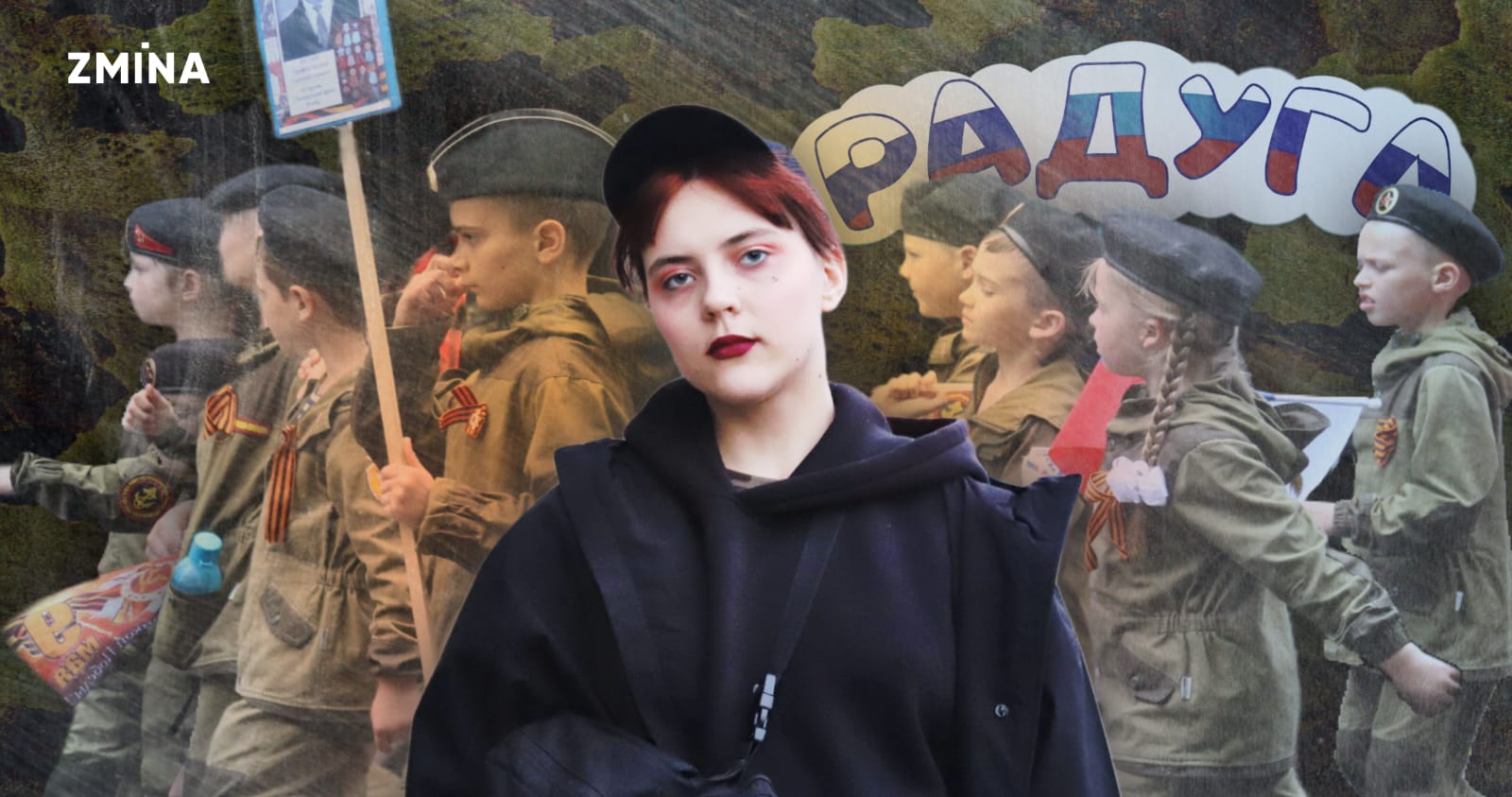
The changes also affected the student environment. According to Kustarova, a military style became fashionable – specifically in its Soviet form:
“It wasn’t modern Russian style that became popular, but Soviet military uniforms. Beyond the visual symbols, young people began repeating what they heard on Russian television. Talking points like ‘we are Russia now’, or that ‘Krushchev screwed Crimea over, but finally Russia has taken us back, hooray’, and they were almost identical even in how they were phrased. It was clear that young people were simply repeating what they had heard. Some of my classmates didn’t study history, they weren’t interested in it – how were they supposed to know whether what they were repeating was true”, she says.
The ideological pressure in schools was systematic. At first, it took the form of weekly “class hours”, at which students were presented with the official line without alternatives. In later years, these were replaced with so-called “conversations about important matters”.
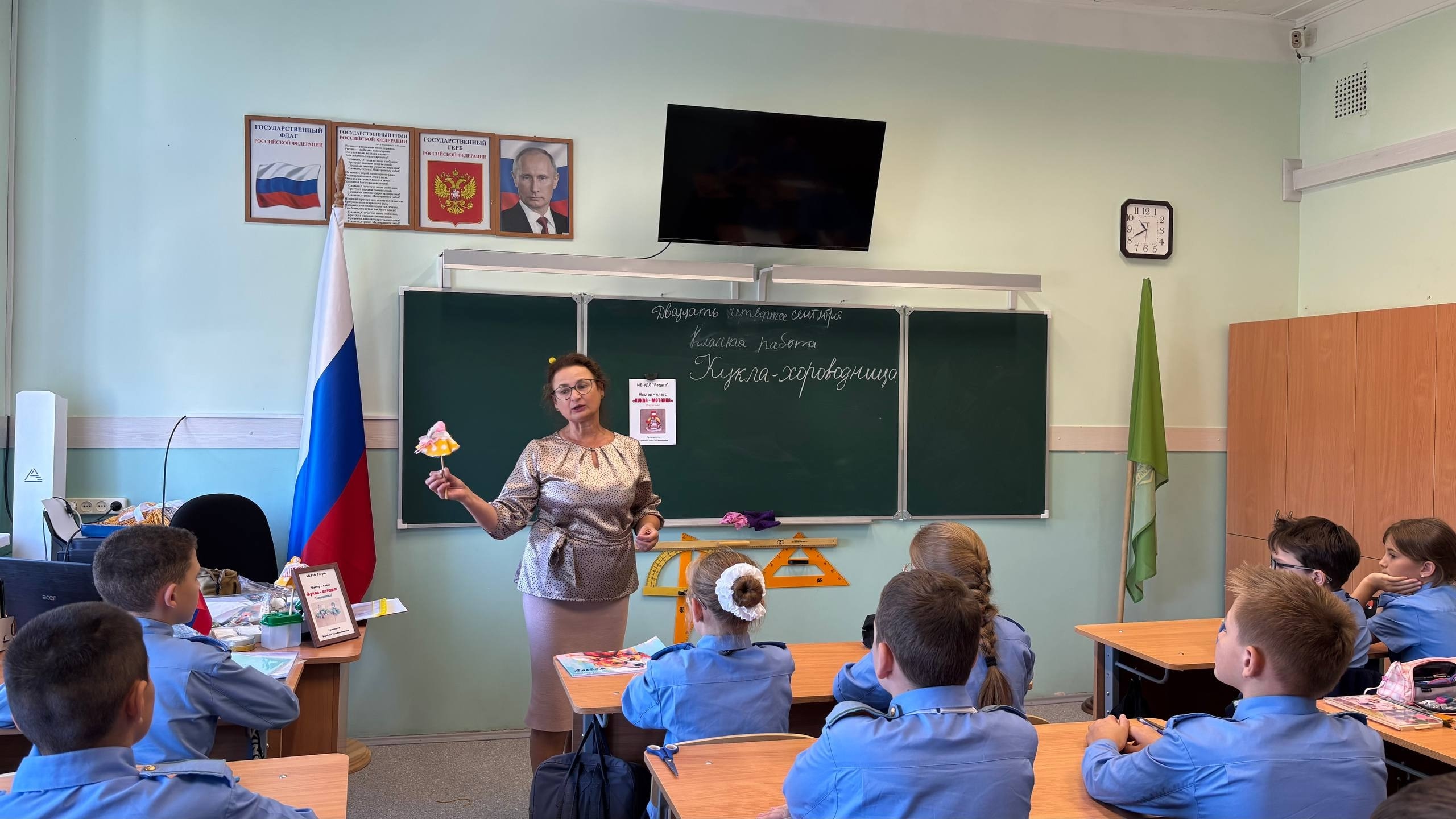 A creative arts lesson in occupied Crimea. Photo from the social media pages of the children’s centre where Polina studied
“When these ‘conversations about important matters’ replaced our class hours, nothing changed – it only got worse. During class hours, they would at least sometimes talk about fire safety, basic first aid, or what to do if you were attacked by a bear. ‘Conversations about important matters’ are pure, concentrated Russian propaganda, packaged as part of the school curriculum”, Polina says.
She studied at three schools in Crimea due to her family’s moves, changing twice during the occupation: first Kerch Gymnasium No. 2 named after Korolenko, and from Year 7 to Year 11, Secondary School No. 24 in Simferopol. Both institutions actively showcase elements of the state programme under occupation on social media. In March 2026 alone, the Kerch gymnasium, where Polina once studied, held at least three propaganda-style “conversations about important matters” – and these are only the ones published by the school’s administrators on social media.
Polina adds that she often deliberately skipped such sessions. However, conflicts regularly arose during history lessons because of her views:
“I’ve loved history since I was a child, and I’ve always been interested in politics. So after the occupation, in secondary and upper school, I openly expressed my views about ‘historically Russian Crimea’. It got to the point where it was almost absurd – my history teacher would ask me not to speak up or answer questions unnecessarily”.
“Polina, don’t rock the boat”, teachers would tell her, even forbidding her from answering in class. Reflecting on this, she says: “I think the only thing that protected me was the school’s concern for its reputation and its fear of inspections. Otherwise, I would have ended up speaking with the Russian police and the local FSB more than once because of my views“.
She also recounts an argument with her German teacher over her views, and says she particularly remembers a small bust of Vladimir Putin that stood on the teacher’s desk during lessons. Asked how she managed to resist Russian propaganda, Polina gives a brief answer: the internet. She tried to educate herself on her own terms – studying languages, learning Ukrainian history, reading Ukrainian authors and materials about them, and practising her English outside school.
“In occupation, it’s hard not to get caught up in it”. Propaganda in creative activities
For a time, Polina attended a music club, focusing on singing. She says it began as something she genuinely enjoyed, but over time, the nature of the classes changed.
“When you live under occupation for a long time, it’s hard not to get drawn into something compromising, no matter how firm your position is. I did too. My love of singing and my desire to get on TV ended up playing a bad joke on me“, she says.
According to Polina Kustarova, members of the group were invited to perform on 9 May 2019 with the song “Mir bez voiny”і . For teenagers, it was presented as a chance to appear on television.
“They told us TV would be there. I was 14, and I really wanted to be on screen. We went on stage – everything looked normal, no St George ribbons or anything like that. But when the segment aired, they had edited in footage from an ‘Immortal Regiment’ march. So in the video, there are elderly men with portraits, and there I am, singing. I’m still ashamed of it”.
Polina says she chose to share this story herself in the interview, adding that it was better for it to come from her. She also provided the footage from that broadcast.
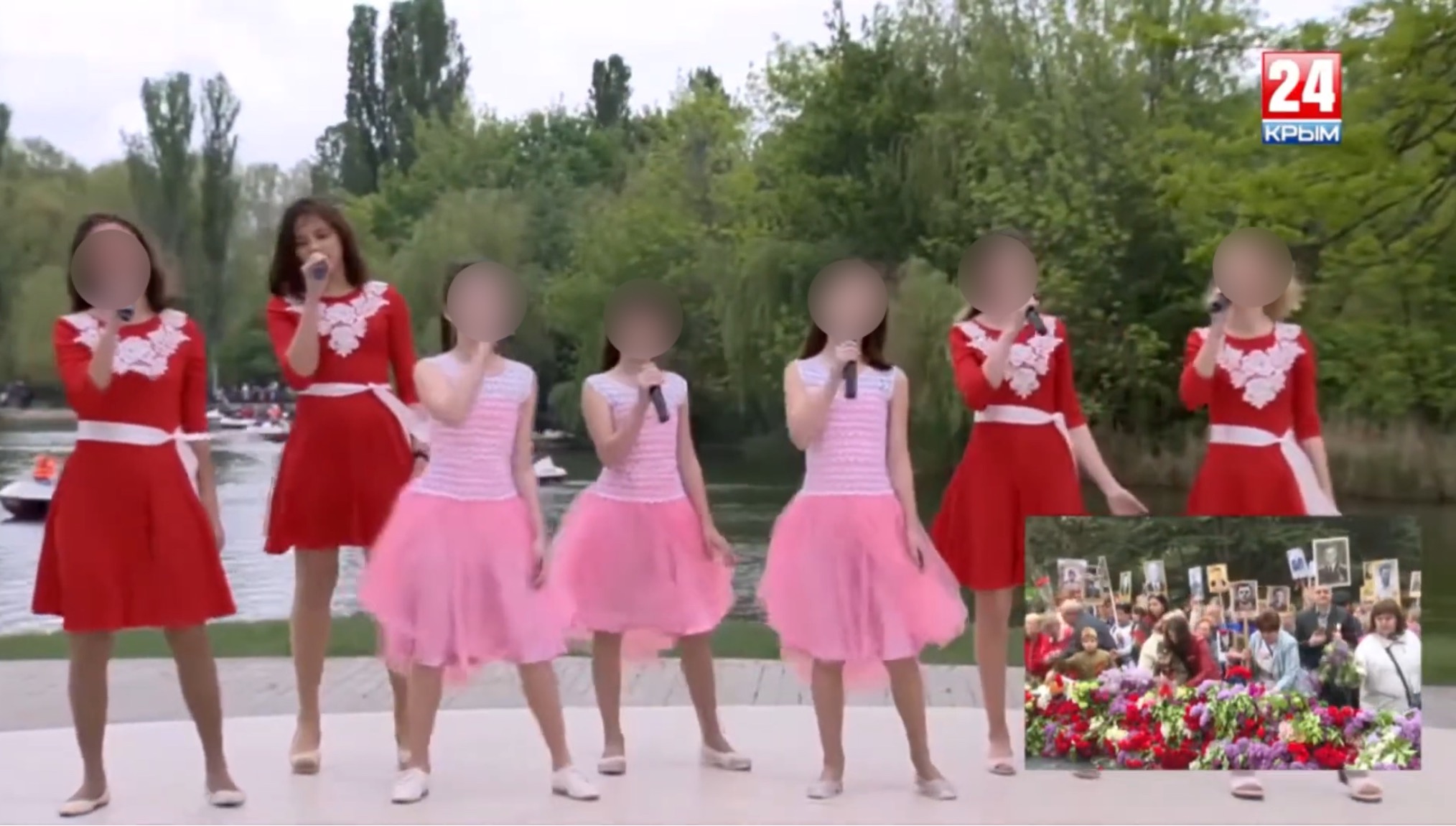 A performance on 9 May in Crimea. Screenshot from the pro-Russian channel “Crimea 24”
She also points to changes in symbolism within the very studio where she took vocal lessons following the start of the full-scale invasion. Polina says the children’s studio was called “Veselka”і , but over time its visual identity shifted – the traditional multicoloured rainbow was replaced with imagery in the colours of the Russian tricolour. According to Polina, such changes were systematic and extended beyond extracurricular activities.
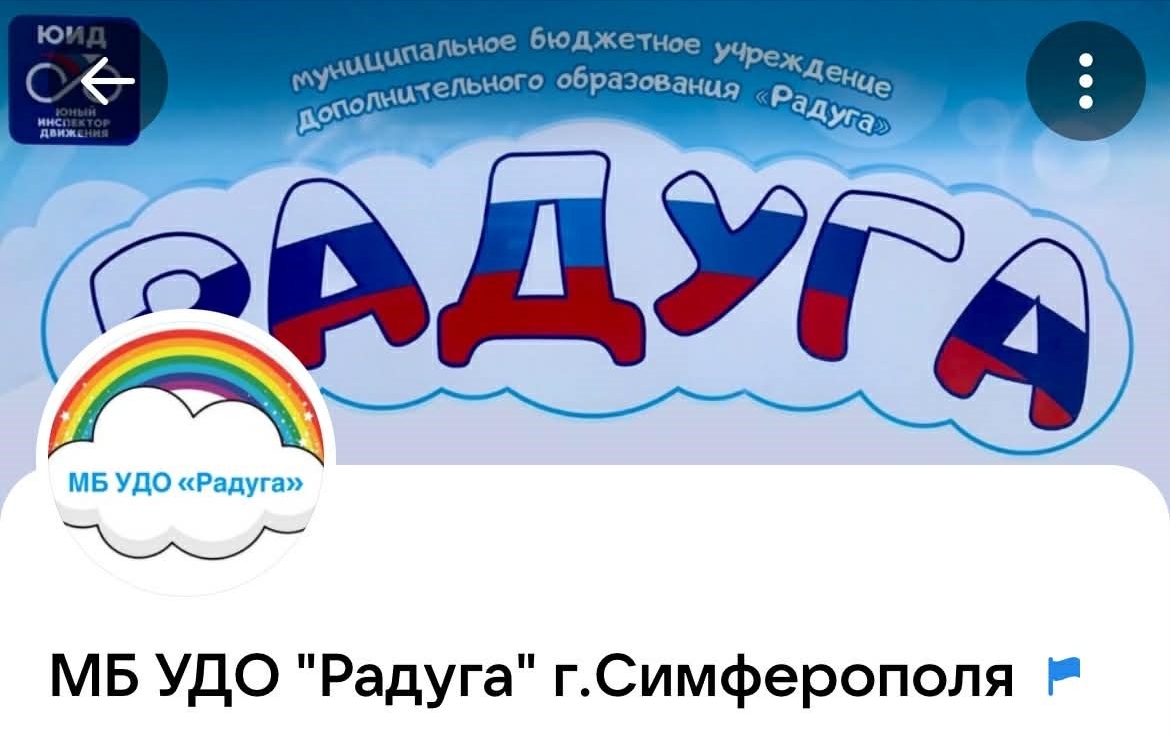 The sign of the “Veselka” children’s centre. Screenshot from the institution’s social media page
“All schools and kindergartens openly promote the militarisation of children and Russification, without even trying to hide it“, she says. For a long time, Russian music was part of Polina’s everyday life, but over time, it began to provoke a sense of rejection, tied to memories of the environment in which she grew up.
“I don’t like Russian music at all – because I lived in that environment, and those familiar songs no longer feel like something good to me, only something very negative“.
“They thought I would grow up and become pro-Russian too”. Propaganda at home
Polina was nine when the occupation began. The situation she found herself in within her family – sharply divided political views – is familiar to many people from Ukraine’s occupied territories. She describes it this way:
“I wouldn’t even call it propaganda. It was just a family way of life that had always been there. With the occupation and then the full-scale invasion, it simply became more intense. My mum would regularly say, as a counterargument to anything I said: ‘If you care so much about what’s happening in Ukraine, why don’t you think about children starving in Africa?’ Well, sorry, mum, but I’m a nationalist. I have my own country, and I care about it”.
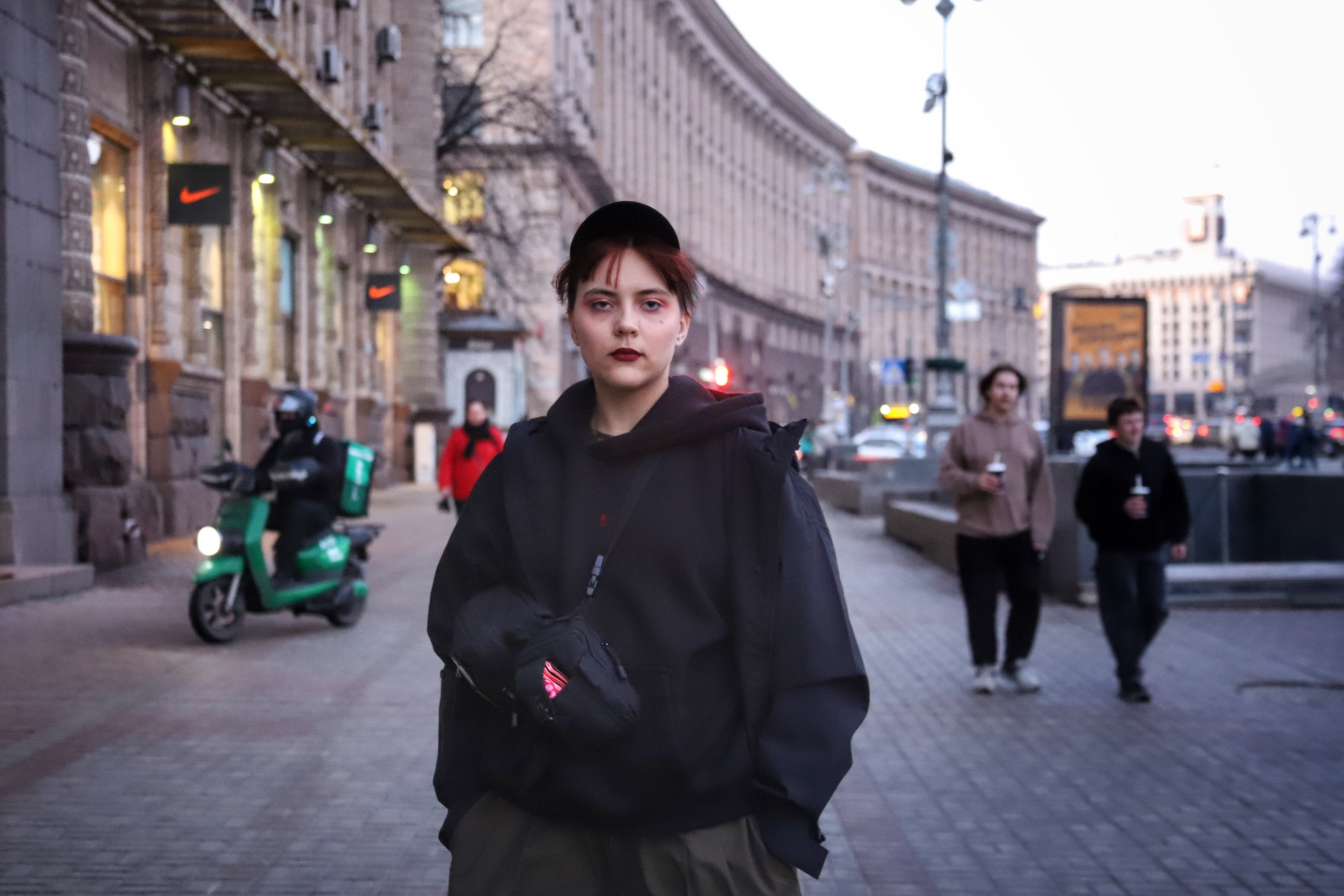 Polina Kustarova. Photo: Oleksandra Yefymenko
Polina illustrates Russification within her family through a number of everyday traditions. For example, in Crimea, New Year’s celebrations were held according to Russian time even before the occupation of the peninsula. She recalls: “We would always celebrate the New Year on Russian time first, and then again on Ukrainian time“.
In recent years, however, Polina has marked the occasion differently – she stays in her room with a glass of champagne, watching the Ukrainian president’s address. She also remembers family evenings gathered around the television, watching Russian news and discussing it. She adds that alongside these Russified habits, conspiracy theories were also common in her family: “These are people who seriously believe that the 11 September 2001 attacks were organised by the United States – that kind of thing“.
Speaking about her parents’ pro-Russian views, Polina remains calm:
“They thought I was just rebelling, that it was a phase, teenage rebellion. That I would grow up and become pro-Russian too”.
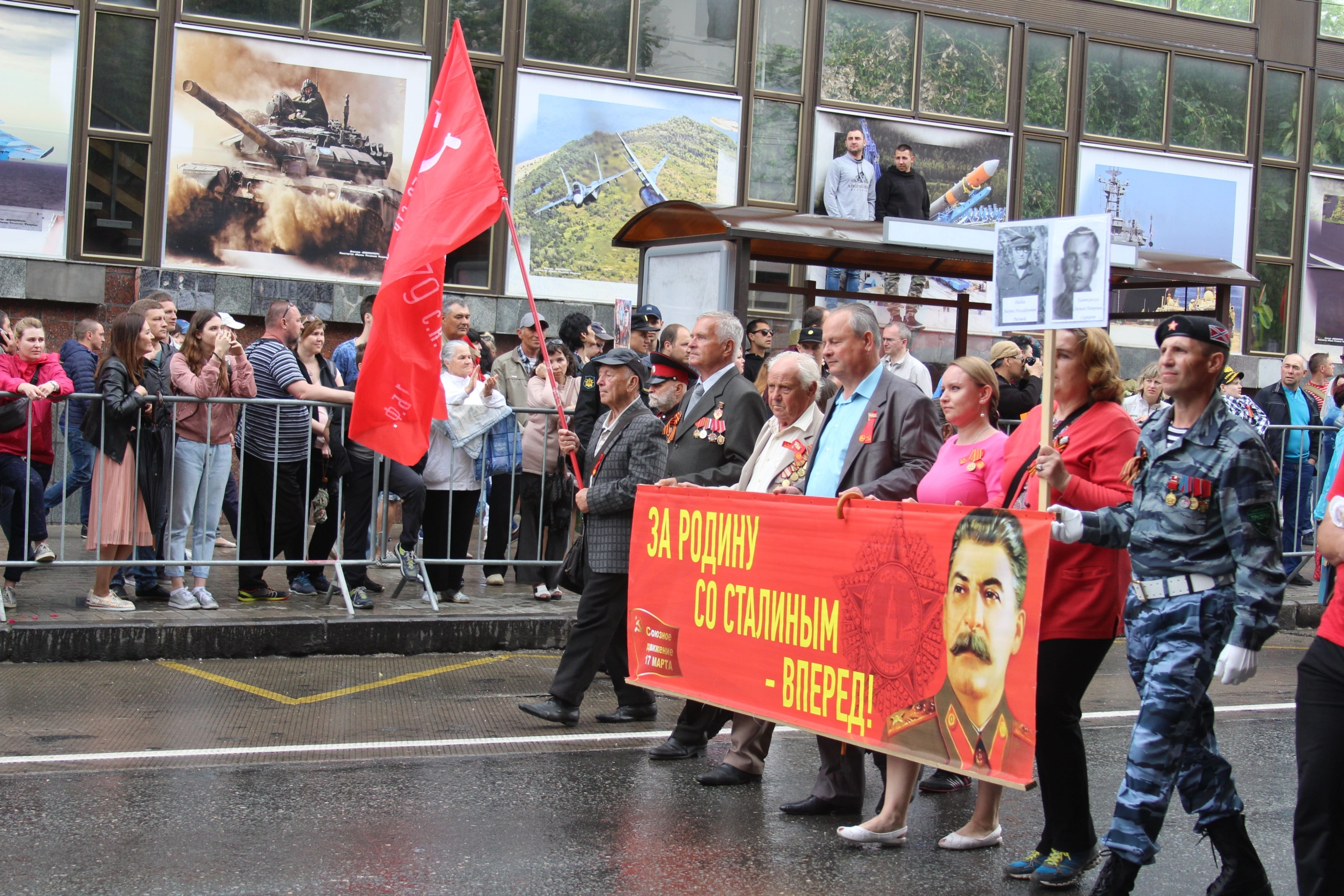 9 May 2018 in Sevastopol. Photo credit: Oleksandra Yefymenko
Polina grew up and, at the first opportunity, organised her departure from occupied Crimea. She first travelled to Kazakhstan, where she applied for political asylum. She says she could no longer remain in Crimea, understanding that her political views made it simply unsafe. In Kazakhstan, she spent several weeks waiting for her documents and asylum request to be processed, while also trying to obtain temporary travel documents. She later approached the Ukrainian consulate, expecting to receive a certificate allowing her to return to government-controlled Ukraine. Two months later, with the support of volunteers, she finally arrived in Kyiv. In January 2026, she received a Ukrainian passport for the first time and completed training as a drone engineer-pilot. She now works as an instructor at a centre training UAV operators and engineers. In the future, she plans to fully join the military to defend her country. She arrived for our interview straight from the training ground.
Language support: ZMINA volunteer Lisa DeHaven
Liked this article? Follow ZMINA on X, BlueSky, and LinkedIn, and help shape our editorial focus by filling out our feedback form here.