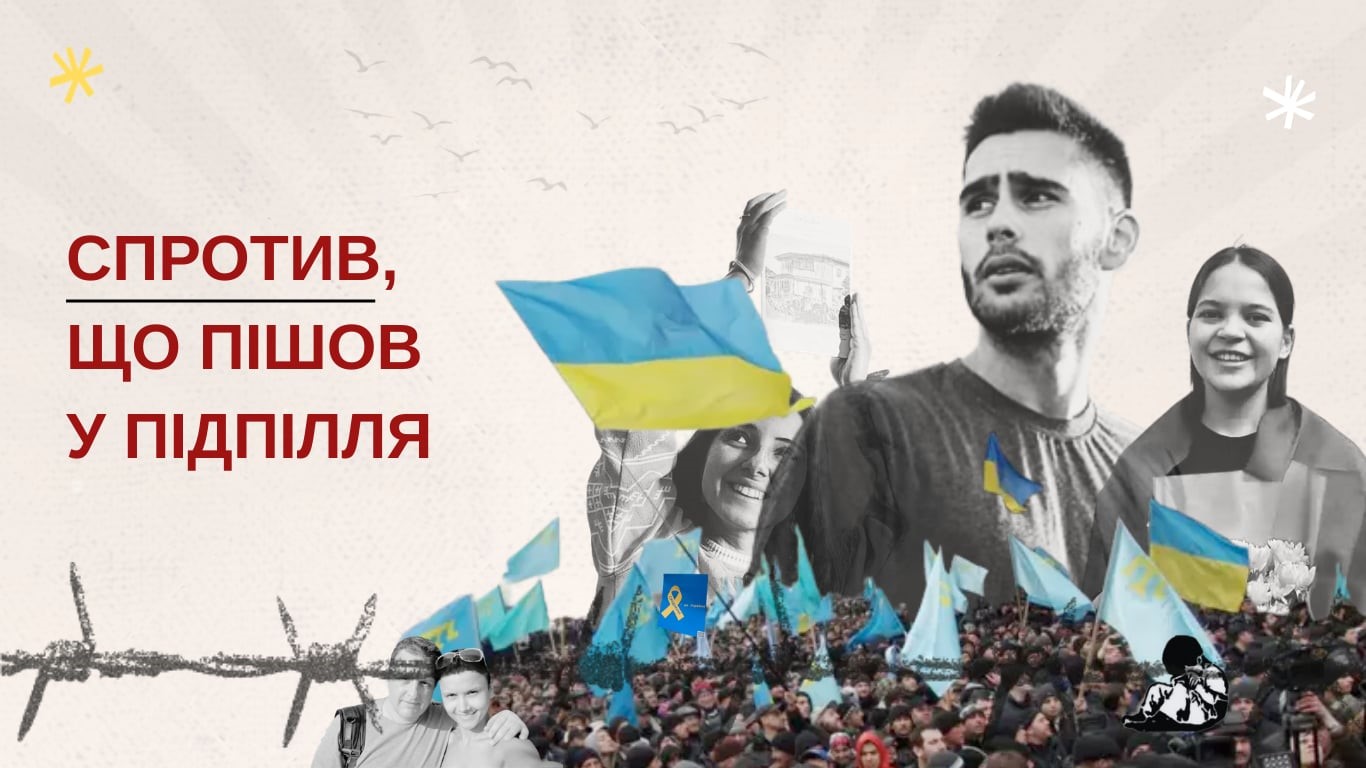
Resistance gone underground: How occupation punishes dissent
The Crimean Peninsula under occupation resembles an organism infected by a virus. Every attempt to erase Ukrainian identity, destroy cultural heritage, symbols of statehood and even faith is like an infection spreading through the body. Yet resistance seeks to stop it. From open rallies and peaceful protests, it has shifted into underground forms: leaflets, closed chats, donations, yellow-and-blue paint, emojis, comments and posts, loud statements and quiet dissent. Residents of Crimea continue to resist even when repression exhausts and traumatises them. It manifests even in the choice to remain there – simply because it is your home and your land. Temporarily occupied.
After years of occupation, repression in Crimea and other occupied territories has hardened into a systematic policy of control – targeting not only open resistance, but also Ukrainian identity itself, civic stance, and any sign of dissent against the occupying authorities. It is not only actions that are criminalised, but the very right to hold a view – or even to disagree in silence.
At the heart of this crackdown are politically motivated criminal cases on charges such as “high treason”, “terrorism” and “extremism”, alongside administrative cases for “discrediting the Russian armed forces”, which can lead to criminal prosecution if repeated. The law is often interpreted arbitrarily and expansively, allowing security forces to punish almost any behaviour deemed a threat to the regime. Alongside this, a network of control practices reinforces the system: denunciations, pro-Russian Telegram channels, staged detentions, public “apology” videos, and demonstrative punishments used to intimidate local residents.
Former political prisoner and Ukraine’s Ambassador to Türkiye, Nariman Dzhelial, once said: “Resistance is a highly effective vaccine against Russian occupation. Even when Crimea’s residents do not openly resist, they continue their silent protest and use every opportunity to affirm their national identity – that they are citizens of Ukraine. And that is something worth fighting for”.
To mark the Day of Resistance to the Occupation of Crimea, we look at cases of people being persecuted for expressing dissent and preserving their identity under occupation. These stories reveal not only the scale of repression, but also that resistance has not disappeared – it has changed form, yet continues despite constant pressure and risk.
In this article, we also examine how the intensity and nature of persecution have evolved over time, comparing the situation following the sharp rise in repression in 2022 with how this system of pressure operates today.
Imprisonment for donating to the Armed Forces of Ukraine
Under occupation, even a small financial transfer in support of the Ukrainian army is treated as a criminal offence. Actions that would be seen as acts of civic solidarity outside occupied territory become grounds for criminal prosecution and lengthy prison sentences, ranging from seven to 12 years, or even 17 years.
Below are examples of cases illustrating how this system of persecution operates.
Liudmyla Kolesnikova
Liudmyla had been living in Ireland since 2022, but in June 2024, the death of her mother forced her to return to the occupied peninsula. Russian security forces detained her directly at the cemetery.
She was later charged under Article 275 (“high treason”) of the Criminal Code of the Russian Federation and sentenced to 17 years’ imprisonment for purchasing NFT stampsі featuring a “Russian warship”, with proceeds from the sales used to support Ukraine.
Iryna Sukhovii
Iryna Sukhovii, a 65-year-old resident of Melitopol, Zaporizhzhia Oblasdt, is being held in a detention centre in Simferopol after transferring 1,400 Russian roubles to support the Armed Forces of Ukraine.
Despite serious chronic illnesses, an occupation court in the Zaporizhzhia Oblast sentenced her to 12.5 years’ imprisonment on charges of alleged high treason.
Appaz Kurtamet
Appaz Kurtamet returned to occupied Novooleksiivka to sort out paperwork for his house, fearing it could be seized by Russian authorities. After dealing with the documents, he decided to meet friends before leaving. Shortly afterwards, all contact with him was lost.
After three months with no information, his family learned that he was being held in a detention centre in Simferopol.
“He was pressured to cooperate and pushed to take Russian citizenship, being told he would be released if he agreed. Security officers told him: “You choose – freedom or 10–15 years in prison. We will find a reason to detain you. We’ll just check your phone”. However, my son refused“, his mother said.
Appaz was later sentenced to seven years’ imprisonment on charges of allegedly financing a Ukrainian volunteer battalion. The case against him was based on evidence that he had transferred 500 hryvnias to an acquaintance serving in the Krym Battalion.
Punishment for the smallest expressions of identity
Even the slightest expressions of Ukrainian identity under occupation can lead to persecution. People are punished for songs, symbols or minor acts of civic expression, facing administrative detention, fines and long prison sentences.
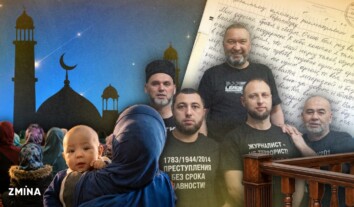
Bohdan Ziza
On 16 May 2022, in occupied Yevpatoriia, Crimean artist and civic activist Bohdan Ziza staged a protest, splashing the doors of the city administration with yellow and blue paint and throwing a “Molotov cocktail” into the building.
The activist was detained the same day, and his whereabouts remained unknown until 18 May. In June 2023, the Russian occupation authorities sentenced Ziza to 15 years in a penal colony.
Related: A letter from unfreedom. Read a message from Bogdan Ziza, an artist and a Crimean political prisoner
In December 2025, reports emerged that the political prisoner’s health had severely deteriorated at a Russian penal colony known as “Vladimir Central”. Due to serious dental problems and the lack of adequate medical care, any attempt by Bohdan to seek help from the prison medical unit has effectively become a form of torture.
Andrii Bilozerov
In September 2022, Russian-language teacher Andrii Bilozerov was dismissed from a local technical college in Bilohirsk. The decision followed a video showing him playing Taras Borovok’s song “Bayraktar” in a classroom.
Pro-Russian outlets began circulating claims that the teacher openly held pro-Ukrainian views and was waiting for Crimea’s de-occupation – reports said he had been denounced by his own students. Later that month, Bilozerov was sentenced to 13 days’ administrative detention on charges of displaying prohibited symbols.
On 28 October 2022, he was again placed under administrative arrest for 14 days for posting the song “Chervona Kalyna” on the social network “VKontakte”. He was beaten during his detention. In December 2022, an occupation court in Simferopol escalated the case to criminal proceedings, placing Bilozerov under house arrest for two months on charges of repeated “discrediting” of the occupying army (Part 1 of Article 280.3 of the Criminal Code of the Russian Federation).
In March 2023, Andrii Bilozerov was again charged with repeated “discrediting” of the occupying army. He was fined 100,000 roubles and banned from publishing content for two years.
Four people arrested and fined for singing “Chervona Kalyna” at a wedding
In September 2022, the Russian-installed Bakhchysarai District Court handed down sentences to participants of a Crimean Tatar wedding at the “Arpat” restaurant for playing the song “Oi u luzi chervona kalyna”. DJ Akhtem Hemedzhi, who played the track, was accused of discrediting the occupying forces over lyrics about the liberation of Ukrainians, as well as promoting the symbols of the OUNі , which Russia considers banned.
An illegitimate judge, Vasyl Koshelev, fined him 30,000 roubles and sentenced him to 10 days’ detention. The event organiser, Elvira Abdullaeva, was fined 30,000 roubles and given five days’ administrative detention by illegitimate judge and collaborator Ihor Yanin on similar charges.
Two more guests were later detained and fined. Liliia Abdullaeva was placed under arrest for 10 days, while Lilia Saifulaieva was fined 50,000 roubles. Both women were accused of the same offences as the other participants: “discrediting the Russian army” and promoting a banned organisation, under Articles 20.3.3 and 20.3 of Russia’s administrative code.
Anti-war actions
Any actions that may be interpreted as an anti-war stance or disloyalty to Russia’s military presence can lead to criminal prosecution. Collecting and sharing information about occupation troop movements, publicly speaking out against the war, or being suspected of assisting Ukraine may be classified as “espionage”, “extremism”, or other serious offences.
The cases below illustrate how this system of persecution operates in practice.
Maksym Makhno and Serhii Tkachenko
According to Russia’s Federal Security Service (FSB), in August 2022, 44-year-old Ukrainian Maksym Makhno contacted the Security Service of Ukraine (SBU) and used a messaging app to pass on information about occupying forces in the city of Kakhovka, Kherson Oblast. The Russian account claims he monitored troops, gathering details on personnel numbers and types of weaponry.
In October 2022, he allegedly involved 39-year-old Serhii Tkachenko in collecting and transmitting such information.
The circumstances of their detention remain unknown. However, in October 2024, the case was referred to the Rostov Regional Court. In November 2024, both men were sentenced to 12 years’ imprisonment on espionage charges: Makhno is to serve his sentence in a strict-regime penal colony, while Tkachenko was assigned to a special-regime colony.
Oleksandr Sokolov and Viktor Soldatko
Between October 2022 and February 2023, Oleksandr Sokolov, a 51-year-old resident of Luhansk Oblast, allegedly gathered information on the movements of Russian troops and the routes of military equipment, passing it on via messaging apps. In March 2023, he was also accused of posting online calls for reprisals against collaborators.
In September 2024, the Russian-installed Supreme Court of the LPR sentenced him to 16 years in a strict-regime penal colony on charges of “espionage” and “extremism”, also banning him from administering websites. In a video circulated by Russian sources, Sokolov appeared to admit passing information to Telegram channels and said he opposed the “special military operation”. Alongside him, 28-year-old Viktor Soldatko was sentenced to 13 years’ imprisonment on similar espionage charges linked to Telegram.
Mother and daughter sentenced to 12 years each for “high treason”
In September 2023, a resident of Sevastopol allegedly took photographs of sites that her 24-year-old daughter then passed to Ukrainian intelligence for payment.
Both women were detained on 3 October 2024, initially facing charges of “transferring data on a confidential basis”. In June 2025, however, the case was reclassified as “high treason”. In August 2025, a Russian-installed court sentenced the 42-year-old mother and her daughter to 12 years’ imprisonment each, with restrictions on their freedom of movement following release.
Father and daughter sentenced to 10.5 and 14 years on “espionage” charges in the Kherson Oblast respectively
An “espionage” case was also fabricated against a family from Henichesk, Kherson Oblast – Oleksii Demianenko and his daughter Anzhelika. According to the Russian Prosecutor General’s Office, the father gathered information on the location of Russian military equipment and passed it to his daughter, who then relayed it to Ukrainian intelligence.
Following his detention, Oleksii was held in the basement of a cultural centre in the village of Odradivka, where he was interrogated by FSB officers, while Anzhelika was placed in a detention centre in the village of Chonhar. A Russian-installed court in the occupied Kherson Oblast sentenced Oleksii Demianenko to 14 years’ imprisonment and his daughter to 10 years and five months.
Rise in politically motivated prosecutions in Crimea – comparing 2022 and 2025
A comparison of data by NGO “CrimeaSOS” for 2022 and 2025 shows a clear trend towards intensifying criminal prosecution of residents in occupied Crimea. While the repressive policy was still gaining momentum in 2022 following the start of Russia’s full-scale invasion, by 2025 it had become systematic and widespread.
In 2022, at least 54 victims of politically motivated persecution received convictions. Of these, 53 were sentenced to imprisonment, with a combined total of more than 637 years. At the same time, new criminal tools of repression were only beginning to be used: at least three criminal cases were opened under articles on so-called “fake news about the Russian armed forces” and “discrediting the Russian army”. As a result, criminal prosecution in 2022 remained selective and was often combined with administrative pressure, including mass fines for “discrediting the Russian army”.
By 2025, the situation had deteriorated significantly. Criminal prosecutions have become one of the key tools for controlling the population and suppressing any signs of disloyalty to the occupying authorities. In just one year, Russian-installed courts of first instance in occupied Crimea handed down unlawful and questionable verdicts against at least 70 people – already exceeding the figures recorded in 2022. The nature of the charges has also shifted: while earlier cases were dominated by those related to “discrediting the army”, by 2025 the most common charges were serious offences – “high treason”, “espionage” and “extremism”, carrying sentences of up to 20 years’ imprisonment.
Another emerging trend is the criminalisation of any expression of support for Ukraine. In 2025, even comments on social media – including those referring to Ukrainian strikes on Russian military targets – were classified as “calls for terrorism” or “extremism”. Charges are increasingly based on so-called linguistic examinations, which interpret pro-Ukrainian statements as criminal acts. In practice, this means that almost any public or private position that contradicts official Russian propaganda can serve as grounds for criminal prosecution.
Alongside the rise in numbers, the punitive nature of the judicial system also intensified in 2025. Systemic violations of the right to a fair trial have been documented, while appellate courts rarely overturn verdicts, effectively legitimising politically motivated decisions. Moreover, higher Russian-installed courts in occupied Crimea and Russian courts in Russia have used review procedures to increase sentences. This points to coordinated action by the occupation’s investigators, prosecutors and courts as part of a unified repressive policy.
Compared with 2022, there has been not only an increase in the number of politically motivated criminal cases, but a clear escalation in the severity of charges and the harshness of sentences. Criminal prosecution has become a systemic tool for suppressing pro-Ukrainian views and any form of dissent on the peninsula.
And yet, even under these conditions – despite the constant danger, the exhaustion of prolonged occupation, and total repression – resistance persists in quiet, everyday ways. Some tell their children Ukrainian bedtime stories, some hum Ukrainian songs on their way to work, some step out into the steppe and see the blue and yellow of the Ukrainian flag, quietly dreaming of freedom. Some write letters of support to political prisoners, some mark time by Ukraine’s clock, and some whisper in response to the news: “Glory to the heroes.”
As Yurii Matsiievskyi, a professor at the Ostroh Academy and a researcher of organised resistance in occupied territories, told NV: “Civil resistance has changed its form. In early 2022 it was visible in open protests, but by the summer it had moved underground. The Russians tightened control and repression, and many activists were detained. From individual interviews, we know that many members of the underground have been killed. Today, the focus is on safer forms: distributing leaflets, coordinating in closed chats, and above all gathering intelligence”.
This once again shows the world that Ukrainians have not accepted and will not accept Russian occupation. Resistance will remain a symbol of Ukraine’s struggle, even if fighting on the front line is frozen”, Matsiievskyi concluded.
These testimonies therefore speak not only to the scale of persecution, but also to the limits of repression. Loud or quiet, visible or unseen – resistance is still alive and its very existence remains the most consistent rejection of occupation.
Liked this article? Follow ZMINA on X, BlueSky, and LinkedIn, and help shape our editorial focus by filling out our feedback form here.