Government agencies have appointed officials responsible for the temporarily occupied territories: human rights advocate explains what this will change
In early October, the Ministry for Development of Communities and Territories of Ukraine announced that in order to ensure systematic work in the frontline regions and the temporarily occupied territories (TOT), the government was stepping up the activities of the coordination center for the management of these regions, which was established on January 10, 2025.
As part of this effort, Prime Minister Yuliia Svyrydenko obligated ministries and central executive bodies to appoint officials responsible for coordinating state policy in frontline and temporarily occupied territories. The government adopted the relevant decision at its meeting on October 3, 2025.
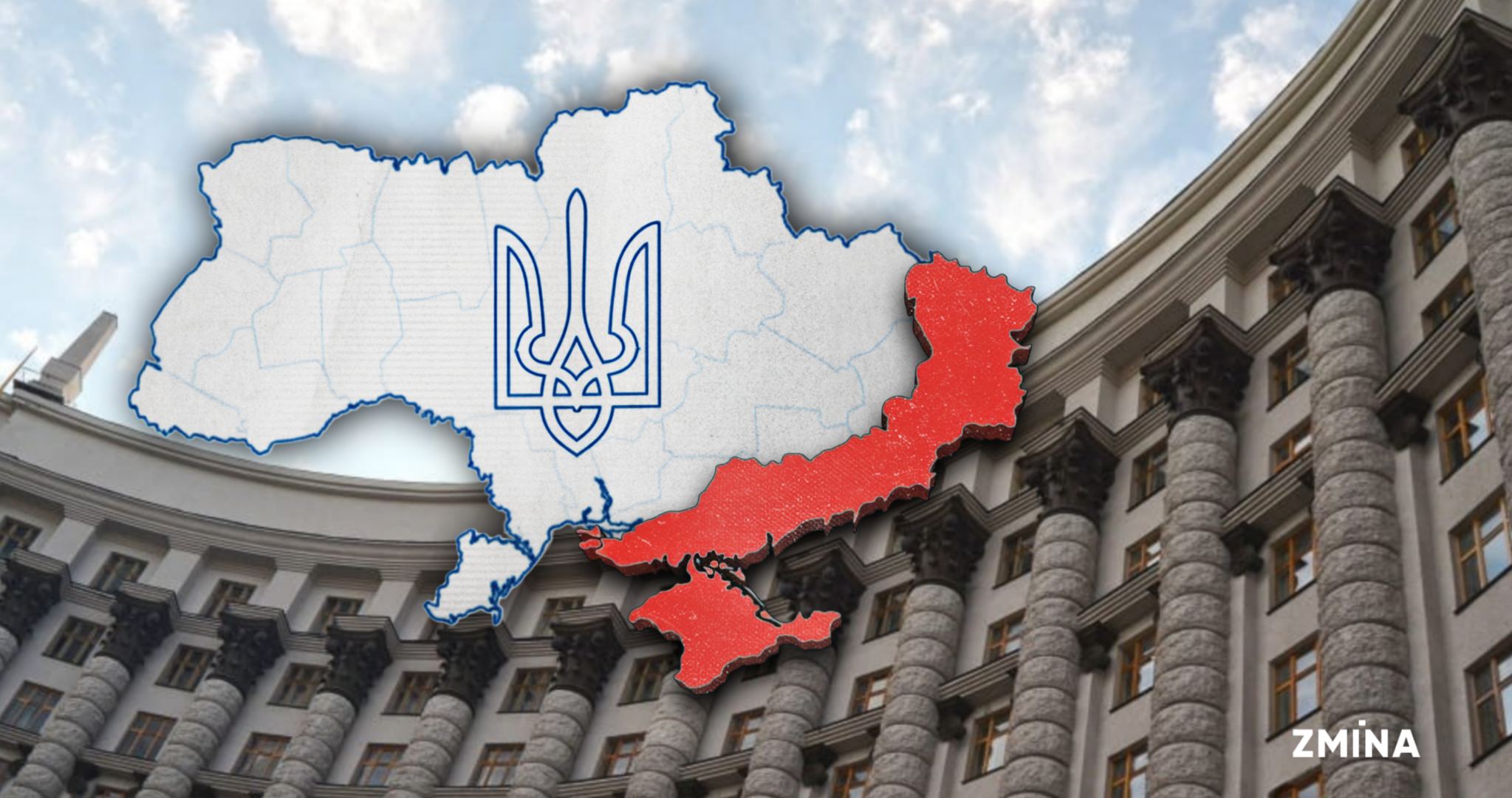
The resolution on the establishment of a coordination center, which will include newly appointed deputies, was made public on January 10, 2025. It is headed by the Deputy Prime Minister for the Restoration of Ukraine – Minister for Development of Communities and Territories.
The center includes heads of regional military administrations of Zaporizhzhia, Dnipropetrovsk, Donetsk, Luhansk, Mykolaiv, Sumy, Kharkiv, Kherson and Chernihiv regions, as well as representatives of the Ministry of Internal Affairs, Ministry of Defence, Ministry of Education and Science, Ministry of Social Policy, National Security and Defence Council, Office of the President and members of parliament, subject to their consent.
The ZMINA editorial team sent a request to the Secretariat of the Cabinet of Ministers seeking clarification on which ministries had been designated as responsible for policy on the temporarily occupied and frontline territories. In response, the Secretariat provided a list of designated representatives across 21 executive bodies, including ministries, the State Emergency Service, the Pension Fund, the State Property Fund, and other relevant institutions.
The Secretariat of the Cabinet of Ministers reported that on December 12, it forwarded ZMINA’s request to the Ministry for Development of Communities and Territories (Ministry for Development). In its request, the editorial office also asked for clarification on whether all authorities had fulfilled the government’s instructions and which had not yet appointed responsible deputies. As of the time of publication, ZMINA had not received a response from the Ministry for Development.
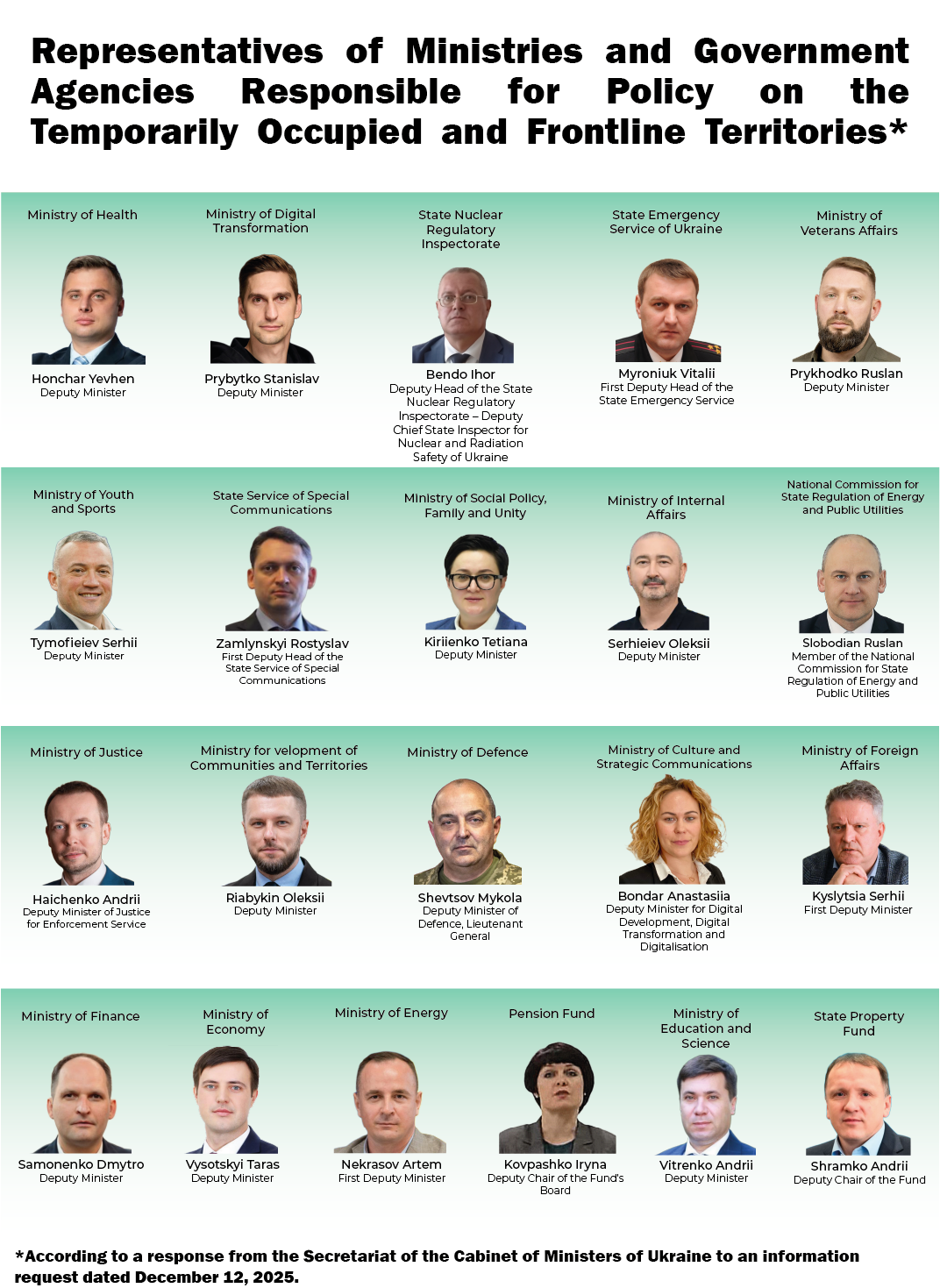
In most cases, this does not involve creating new positions, but rather assigning additional responsibilities to deputy ministers already overseeing other areas. Meanwhile, human rights defenders note that Ukraine still lacks a comprehensive state strategy for protecting the rights of the population affected by the war.
Previously, ZMINA analysed in detail the consequences of the liquidation of the Ministry for Reintegration of Temporarily Occupied Territories and the redistribution of its powers among other ministries. As a result, important powers to protect war victims were scattered, and some of the Ministry’s powers were simply “lost” and did not transfer to other ministries.
Alona Lunova, Advocacy Director of the Human Rights Centre ZMINA, points out that the appointment of deputy ministers responsible for these issues took place in the absence of a unified state policy on Ukraine’s temporarily occupied territories and frontline areas, meaning that the new appointees risk working without a clear strategic direction.
The human rights advocate acknowledges that the appointment of a formally responsible person in each ministry could simplify communication:
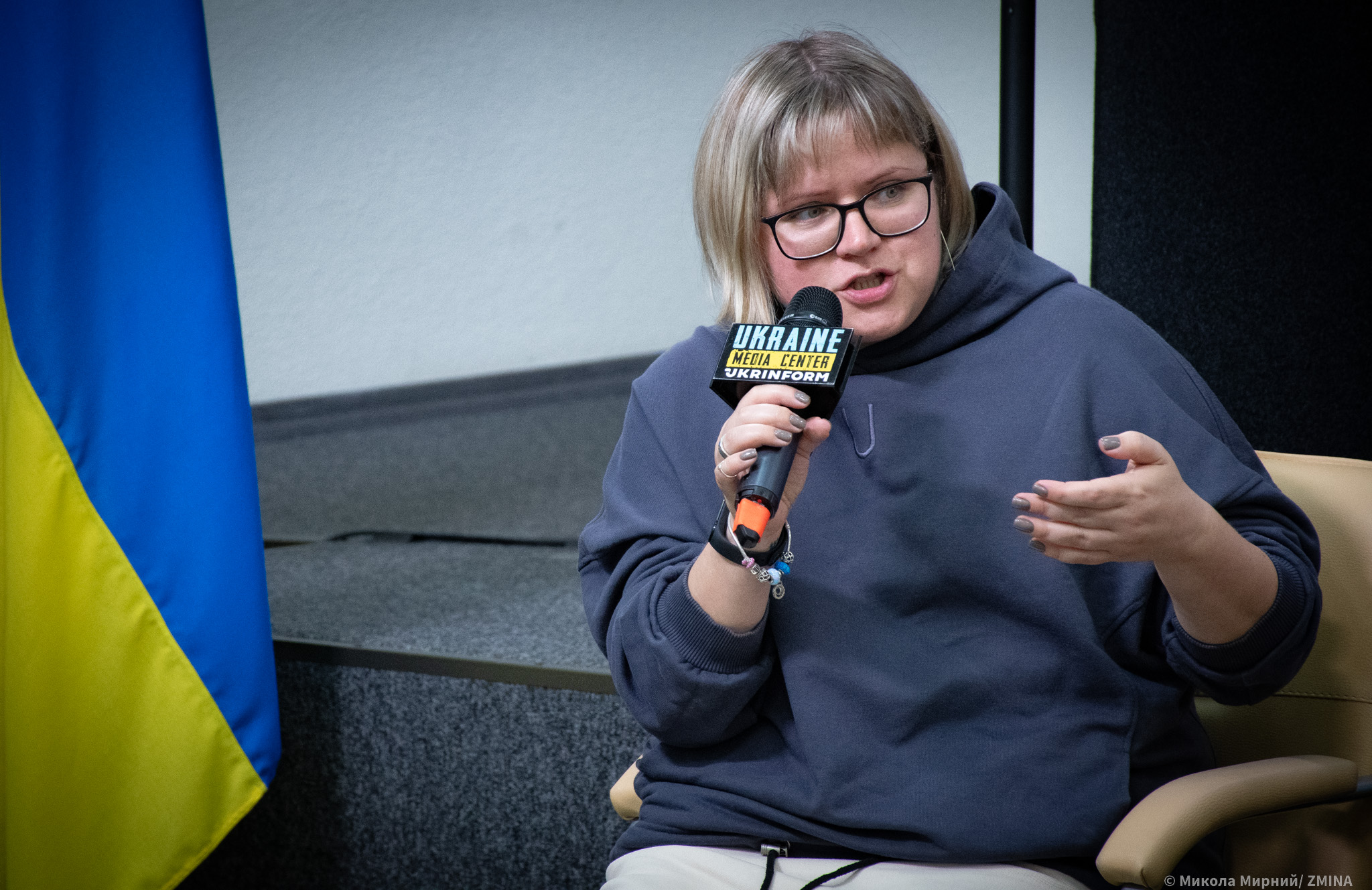 Alena Lunova
“It is good that each ministry has designated a person who, in theory, could answer questions about what the ministry is doing for people from the occupied territories.”
At the same time, according to Lunova, this format has potential only if the state formulates a transparent and adequate policy regarding the temporarily occupied territories and Ukrainian citizens who remain there.
“In order for the deputies responsible for frontline and occupied territories to be effective, there must be a center for shaping state policy. For example, when we talk about European integration, there is a Deputy Prime Minister for European Integration, and when we talk about digitalisation, there is a Deputy Prime Minister for Digital Transformation, who essentially formulates and coordinates cross-cutting state policy. However, we currently do not have such a policy for occupied or frontline territories,” the human rights defender noted.
In her opinion, in a situation where Ukraine lacks a central body responsible for shaping state policy on people from the temporarily occupied territories, deputy ministers are unlikely to be able to make any significant improvements.
The expert separately emphasises that frontline territories and the temporarily occupied regions require fundamentally different approaches.
“Frontline communities are very different. There are those that are actually on the front line, and there are, for example, Kharkiv and Zaporizhzhia, which are also, in essence, frontline communities. Therefore, policies regarding these territories can vary greatly – from ensuring evacuation to strengthening the capacity of frontline communities, reconstruction, and other measures. When we talk about the occupied territories, people are effectively invisible to the state until they leave and become internally displaced persons. So, how can deputies ensure the implementation of Ukraine’s policy on the occupied territories if we do not have such a policy in place? That remains an open question.”
To provide background, according to research data from the Partnership Fund for a Resilient Ukraine programme, only about 0.3% of posts on Facebook, YouTube, TikTok, and Telegram out of 86 million over the past year concerned the temporarily occupied territories. This indicates that the issue of the temporarily occupied territories has a limited presence in the Ukrainian information space.
Previously, ZMINA reported that following the liquidation of the Ministry for Reintegration, Russia began to exploit Ukraine’s lack of a unified state policy on the temporarily occupied territories. During the Crimea Platform, experts pointed out that the fragmentation of powers between agencies and the lack of a clear communication strategy regarding the TOTs create a vacuum that is filled by Russian narratives.
English-language support: ZMINA volunteer Lisa DeHaven
Liked this article? Follow ZMINA on X and LinkedIn, and help shape our editorial focus by filling out our feedback form here.