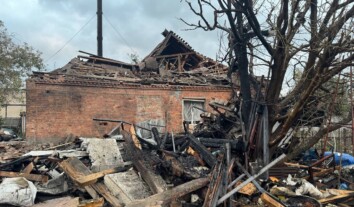
Protective arch over one of the power units of the Chornobyl NPP has lost its safety functions – UN watchdog
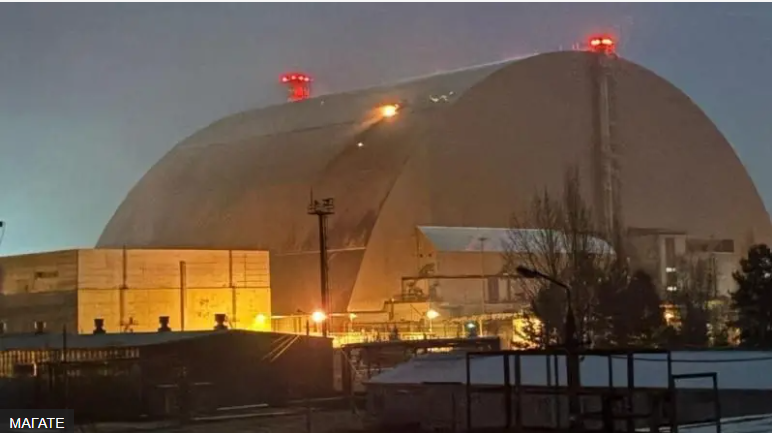 The damaged unit of the Chornobyl Nuclear Power Plant
The IAEA team completed a comprehensive safety assessment of the New Safe Confinement (NSC) last week, which covers the old sarcophagus and the destroyed Unit 4 at the Chornobyl Nuclear Power Plant.
Experts stated that while the arch lost its primary safety functions, including the ability to contain radioactive substances, the supporting structures and monitoring systems remained intact.
“Limited temporary repairs have been carried out on the roof, but timely and comprehensive restoration remains essential to prevent further degradation and ensure long-term nuclear safety,” Director General Rafael Grossi said.
Based on the mission findings, the IAEA recommends further restoration and protective work on the NSC structure, including humidity control measures and an updated corrosion monitoring program, as well as an upgrade of the integrated automatic monitoring system for the shelter object structure built on top of the reactor immediately after the accident.
IAEA reported that in 2026, with support from the European Bank for Reconstruction and Development (EBRD), the Chornobyl site will undertake additional temporary repairs to support the re-establishment of the NSC’s confinement function, paving the way for full restoration once the conflict ends.
Grossi also reported on December 6 that the Zaporizhzhia Nuclear Power Plant (ZNPP) temporarily lost all external power overnight — the 11th such incident since the start of Russia’s full-scale invasion. According to the IAEA, the ZNPP reconnected to the 330-kilovolt power line after a half-hour outage, but the 750-kilovolt line remained disconnected.
On the night of December 6, the Russian army once again attacked energy infrastructure in various regions of Ukraine, causing serious damage to equipment at thermal power plants.
To provide background, in February 2025, ZMINA reported that a Russian drone armed with a “high-explosive warhead” struck a protective shield over the Chornobyl nuclear plant. According to the IAEA, this event also caused a major fire in the outer cladding of the massive steel structure built to prevent any radioactive release from the reactor destroyed in the 1986 accident.
In late November 2025, operations at three NPPs — Khmelnytskyi, Rivne, and South Ukraine — returned to normal following Russian military strikes on energy infrastructure.
Earlier, ZMINA reported that the Special Tribunal for the Crime of Aggression against Ukraine will become a global mechanism — countries in Latin America, Africa, and Asia are invited to join it. Ukraine is finalizing the treaty for an international committee that will govern the tribunal and influence its operations, including the appointment of judges, according to Dr. Anton Korynevych, Director of the International Law Department of the Ministry of Foreign Affairs of Ukraine.
In the previous year, the secretary of the Committee on Fuel Energy, Nuclear Policies and Security at the International Center for Ukrainian Victory (ICUV), Viktoria Voitsitska, called on international politicians and decision-makers to stop using the International Atomic Energy Agency (IAEA) as an excuse to close their eyes to Russian terrorism. Experts urge the international community to revise international safety regulations concerning handling nuclear facilities in case of capture by militaries.
Follow ZMINA on X and LinkedIn for daily human rights coverage from Ukraine – we invite you to share your feedback on what you’d like to see more of in our survey here.