Ranking illegitimate “judges” in Crimea who illegally force the local population to serve in the Russian army
Within the first year of the occupation of Crimea, the “Russian-installed authorities authorities began conscripting local residents into the Russian army. Those who tried to evade conscription were prosecuted. To date, hundreds of Crimeans have become victims of such coercion.
At the same time, forced mobilisation (including any pressure and propaganda) of the population of the occupied territory into the armed forces of the occupying state is strictly prohibited by international humanitarian law. The Rome Statute of the International Criminal Court qualifies such mobilisation as a war crime, for which all those involved are criminally liable.
This ZMINA article examines the most active illegitimate judges who ensure “successful” conscription campaigns for the Russian armed forces in the temporarily occupied Crimea.
How it works
Evasion of military service in occupied Crimea is punishable under the Criminal Code of the Russian Federation. A wide range of penalties is provided for: a fine of up to 200,000 rubles, forced labour, up to six months’ arrest, or imprisonment for up to two years. However, as it turns out, the key feature of this provision is not the penalties themselves, but how they are applied in practice.
“If you don’t show up, the ‘court’ will usually give you a suspended sentence or a fine. But that doesn’t exempt you from military service. Once the court’s decision comes into force and you fail to show up again, you will face criminal liability again, only this time as a ‘repeat offender’. With a high chance of imprisonment. But there is another informal incentive that is promoted to potential conscripts at military registration offices. They explain that ‘draft dodgers’ are still conscripted, but sent to units that are little different from prison camps. Therefore, Crimean conscripts generally prefer not to create additional risks for themselves“, explains an expert from the human rights initiative Irade, who requested anonymity for safety reasons, describing how the occupation authorities coerce people into military service.
Model worker
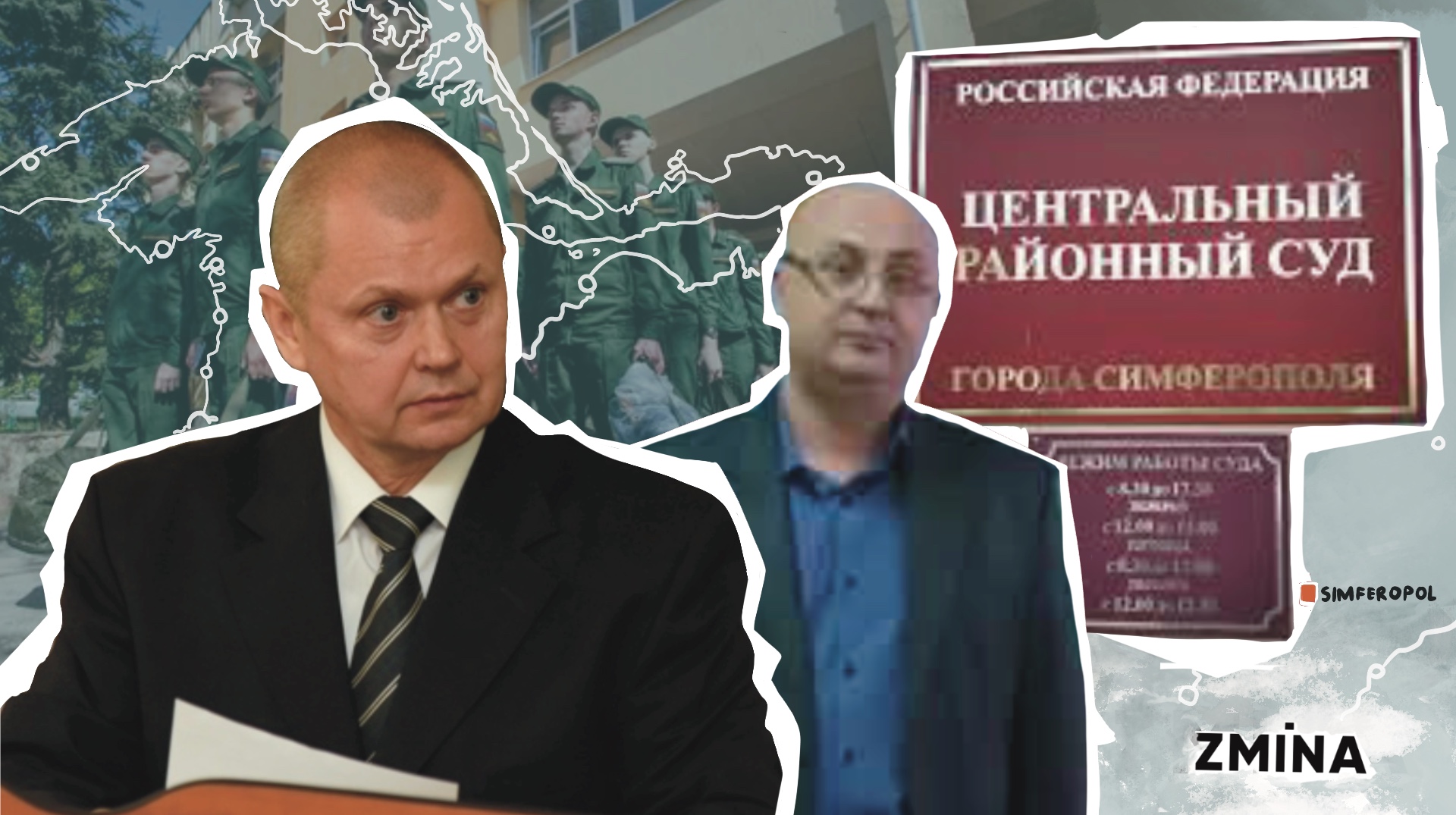
Local illegitimate “courts” are a key element of this enforcement system. Some of them have not had a single case of evasion during the entire period of occupation, while others, on the contrary, are approaching triple-digit figures. The clear leader in this “production” is the “Central District Court of Simferopol”, with 92 criminal cases as of the end of summer 2025.
More than a third of all these cases (35) were heard by one illegitimate “judge” – Serhii Demenok, who has long been known to human rights defenders and is wanted by Ukrainian law enforcement agencies for high treason. He is remembered for his role in the trial of the defendants in the “February 26” criminal caseі , when he openly sided with the prosecution. He then sentenced the ailing Crimean Tatar activist Edem Bekirov to seven years in prison, although in absentia, since Ukraine succeeded in securing his release in 2019.
Read also: List of recommended officials for inclusion on the sanction lists
Since the beginning of the full-scale invasion, Demenok has distinguished himself by arresting the well-known lawyer Emine Avamileva and then relentlessly persecuting critics of military aggression. One of Demenok’s most “textbook” decisions was in a case where a Simferopol resident stood by the roadside with a scythe that read: “Who is with me to Kievan Rus?” The “judge” saw these mysterious actions as discrediting the Russian army.
A “little tsar” on the district scale
The silver medalist in “packing” Crimeans into the Russian army can be considered the permanent “head” of the illegitimate “Krasnogvardeisky District Court”, Valentyn Shukalskyy, who has no fewer than 21 cases against “draft dodgers” to his credit. In addition to his high position, this “judge” has the status of a bearer of “special economic and other restrictive measures (sanctions)”. Also, according to feedback from local residents, he behaves like a “little tsar” who feels he is untouchable.
 Valentyn Shukalskyi
In addition to serving the interests of Russian military commissariats, Shukalskyi is known for his relentless fight against the discrediting of the Russian army, as well as his participation in religious persecution against Jehovah’s Witnesses Yurii Herashchenko and Serhii Parfenovych. Prior to the decriminalisation of the article on “inciting hatred or enmity”, this “judge” was among the few Crimean members of the judiciary who took part in trials against women expressing their opinions on social media during the 2014 occupation of Crimea. Specifically, Shukalskyy presided over the trial against Liliia Tatarisova.
Together – more than a platoon
“Judges” Vadym Vereskun of the “Leninsky District Court” and Viktor Mozhelianskyy of the “Central District Court of Simferopol” handled cases involving “draft dodgers” with minimal lag behind their colleagues. However, almost nothing is known about the former, as Vereskun was appointed as a “judge” after the occupation of Crimea began and thus did not betray his oath as a judge of Ukraine. This, however, did not prevent him from handing down guilty verdicts against people who claim that Crimea is Ukraine, or from “delivering judgments even without case materials.”
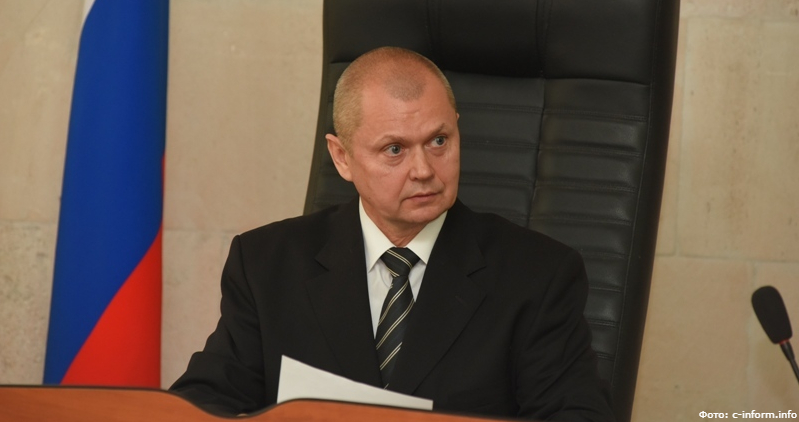 Viktor Mozhelianskyi
As for illegitimate “judge” Viktor Mozhelianskyi, perhaps the most telling detail about him is the list of countries that have imposed sanctions against him: Ukraine, the United States, the European Union, Switzerland, and even Japan. Mozhelianskyi is involved in a series of political persecutions of Crimeans, but he also serves the military interests of the occupiers. He might even have topped this ranking, but he was sent to establish an illegitimate “Russian judicial authority” in the occupied areas of the Kherson region.
Read also: “Blacklist of officials” involved in crimes against civilians in the temporarily occupied Crimea
In total, at least 103 Crimean “judges” took part in the prosecution of residents of occupied Crimea for evading service in the Russian army. Each of them will inevitably be held accountable for this as an accomplice to war crimes and violations of international humanitarian law.
Artem Hirieiev, ZMINA Correspondent in the temporarily occupied Crimea
Did you like this article? Stay connected via X and LinkedIn with ZMINA – and help build this platform with us by filling out our anonymous 5-minute survey here.