In Russia, parents of illegally arrested Crimean Tatars were detained five times on their way to the ombudsman
The parents of Crimean Tatar women arrested in the criminal case of Crimean Muslims — including Esma Nimetullayeva, mother of five; students Elviza Aliyeva and Nasiba Saidova; and shop worker Fevziye Osmanova — were detained five times in Russia while traveling to Moscow in order to meet with the Russian ombudsman, human rights grassroots initiative Crimean Solidarity reported.
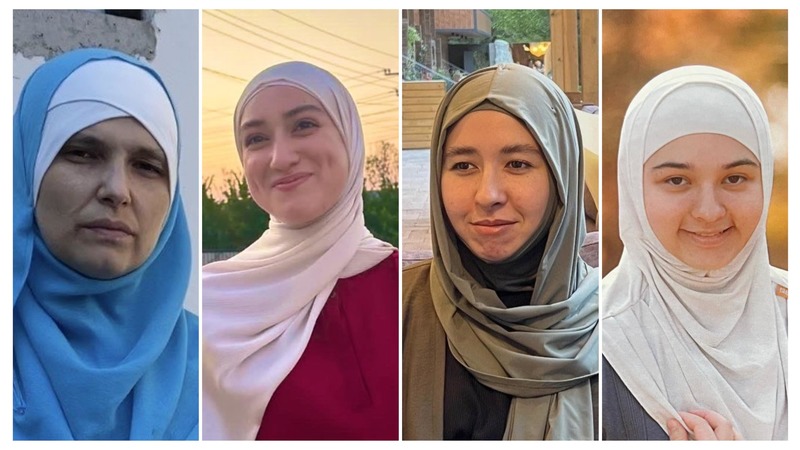 The defendants in the first female “Hizb ut-Tahrir case” in the temporarily occupied Crimea: Esma Nimetullayeva, Elviza Aliyeva, Nasiba Saidova, and Fevziye Osmanova. Collage: Crimean Solidarity
The detentions spanned from October 30 to October 31. The fifth time, Russian State Road Traffic Inspectorate employees stopped the taxi carrying the delegation members, who were only a five-minute drive from the office of Russian Commissioner for Human Rights Tatiana Moskalkova. Security forces took the passports of all passengers “for verification” and forced the car to drive to a gas station.
As of 11 a.m. Friday, October 31, 2025, the delegates were still without documents. Those detained include:
- Enver Mustafaiev, father of political prisoner Seidamet Mustafaiev and father-in-law of political prisoner Ruslan Asanov;
- Shukri Seitumerov, father of three political prisoners: Seitumer, Osman, and Abdulmedzhit Seitumerov;
- Eldar Azizov, father of a political prisoner and a respected elderі ;
- Emir Menadzhiyev, the driver of the minibus transporting the group to Moscow;
- Raim Khasanov;
- Refat Emirov.
The overall delegation consisted of 16 people, including the parents of the recently arrested women, lawyer Nazym Sheikhmambetov, activists, and respected elders of the Crimean Tatar people.
Since the night of October 29, Russian road traffic police and officers of the Russian Ministry of Internal Affairs (MIA) have stopped them four times on their way from the temporarily occupied Crimea to Moscow. The first check at the MIA department of the Bohuchar District of the Voronezh Oblast lasted four and a half hours. The second time, the group was held for six and a half hours at the MIA department of the Khlevensky District of the Lipetsk region.
The third time, the delegates were stopped 200 kilometers from Moscow in the city of Venev, Tula region. There, at the 171st kilometer of the M-4 highway, Elvira, the mother of Elviza Aliyeva, fell ill. She had problems with her blood pressure, and an ambulance was called for her.
 A Crimean Tatar delegation member — the mother of arrested Elviza Aliyeva — required an ambulance
The fourth stop occurred in Koltovo, a village in the Kashira Municipal District of the Moscow region, at midnight on October 31. The security forces, who introduced themselves as Criminal Investigation Department employees, were wearing masks and carrying automatic rifles. They confiscated the passengers’ passports, and a dog handler searched the delegates’ belongings.
Ministry of Internal Affairs employees demanded that the delegates sign official warnings stating that the delegation members could be prosecuted “in the event of actions that create conditions for committing crimes, administrative offenses, the resolution of which is within the competence of the police, as well as the continuation of anti-social behavior.”
Crimean Solidarity reported that the parents of one of the arrested women, Nasiba Saidova, had previously appealed to the illegitimate “Public Monitoring Commission” and the “Commissioner for Human Rights” in the temporarily occupied Crimea, asking them to investigate why their daughter was being prosecuted under a criminal article and why she was being held in improper conditions in the Pre-trial Detention Centre No. 1 in Simferopol.
The Crimean Tatar delegation ultimately submitted an appeal to the Prosecutor General’s Office and the Russian Ombudsman, requesting the release of those arrested, which garnered 6,500 signatures from Crimean Tatars.

Saidova is being held in a damp, unheated cell, as are the other defendants in the criminal case, without access to hot water. During inspections, she and the other arrested Crimean Tatar women are forced to remove their headscarves, which, for religious reasons, they cannot do in the presence of unrelated men.
Previously, ZMINA reported that the mothers of Elviza Aliyeva, Nasiba Saidova, and Fevziye Osmanova were denied the right to send parcels to their daughters, who are being held in the pre-trial detention center.
On October 15, ZMINA also reported that mass searches took place in the homes of Crimean Tatar women in the temporarily occupied Crimea, after which FSB employees detained four women: Esma Nimetullayeva, Nasiba Saidova, Elviza Aliyeva, and Fevziye Osmanova. This is the first “Hizb ut-Tahrir case” in Crimea initiated specifically against Crimean Tatar women; previously, such cases were filed only against men.
On October 29, the illegitimate “Supreme Court of the Republic of Crimea” rejected the appeal filed by the lawyers, keeping all the women under arrest.
Later, the mothers of Elviza Aliyeva and Fevziye Osmanova reported that their daughters were transferred to a psychiatric hospital late last week. They are scheduled to spend at least three weeks at the M. I. Balaban Crimean Republican Psychiatric Hospital No. 1.
The religious party Hizb ut-Tahrir has been banned in Russia since 2003; however, it operates legally in all territories of Ukraine, including the Autonomous Republic of Crimea, as well as in many other countries. Russia, in violation of the Geneva Convention, applies its own criminal legislation to the temporarily occupied territories of Ukraine.
Earlier, Freedom House pointed out that following the Russian annexation of Crimea in 2014, allegations of membership in Hizb ut-Tahrir have become a common pretext for criminal prosecutions there, and are one of many abuses of anti-extremism legislation against civic activists and others.
Also, take a look at this photo project: “I will always wait for you, my child!”
By way of background, in April 2023, Dunja Mijatović, the Council of Europe Commissioner for Human Rights, released report, “Crimean Tatars’ struggle for human rights.” Mijatović confirmed numerous serious human rights violations, namely persecution, discrimination, and stigmatization, by Russian occupying forces of representatives of the Crimean Tatar community and those who oppose the illegal occupation of Crimea.