Crimean political prisoner Lenur Khalilov, who was released from a Russian penal colony due to his health condition, has been taken into custody again
Russian authorities detained Crimean political prisoner Lenur Khalilov again after a regional court overturned his medical release, according to his lawyer Emil Kurbedinov, who was present at the hearing in the temporarily occupied Simferopol via video conference. The 57-year-old Crimean Tatar was freed from prison in early September due to liver cancer.
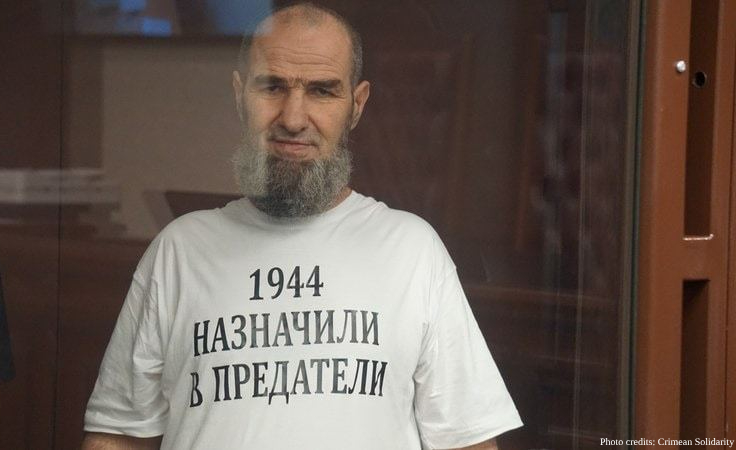 Lenur Khalilov
Read also: 11 years of oppression and repression: how human rights in occupied Crimea are approaching zero
In the state prosecutor’s opinion, the court’s conclusions, citing the medical commission’s finding that Khalilov could not be held in a correctional facility on general grounds, did not constitute an absolute necessity for his release from serving his sentence.
Kurbedinov said that at the Arkhangelsk Regional Court session, the state prosecutor justified his logic by claiming Khalilov was an “especially dangerous criminal” and that the “court did not take this into account.”
“The prosecutor’s office does not deny the illness itself… yet it says that Khalilov is a ‘terrorist’ and an especially dangerous criminal; he is dangerous to society, and releasing him means failing to adhere to justice toward society,” Kurbedinov stressed. “This is how the law, which provides for the release of such persons, was perverted. According to the prosecutor’s logic, the court did not consider these circumstances. This is an absolutely unfounded position that violates the constitutional rights of Lenur-agha Khalilov.”
He reminded the court that if a disease is on the list provided by the Russian government, “it does not matter the medical equipment in the hospital, the current satisfactory condition, or that the person can move independently.” The illness itself is the legal condition for release.
Kurbedinov explained that the court of first instance, when making the decision to release, only had to confirm that the person, while imprisoned, did not intentionally inflict the illness upon himself. “That is what was done in the court of first instance –there is no evidence that Lenur-agha inflicted self-harm or has no one to look after him,” the defense attorney added.
The lawyer called the decision of the Arkhangelsk Regional Court — to immediately take Lenur Khalilov back into custody — “inhumane” and “cruel.”
He clarified that the political prisoner’s defense team would file a cassation appeal.
“This decision is unlawful and unfounded. Moreover, it is simply sending Lenur-agha to his death in this colony with such a serious illness,” the lawyer said.
On June 10, 2019, following searches in the municipal district of the temporarily occupied city of Alushta, occupying security forces detained acting Imam Ruslan Nagayev and entrepreneur Eldar Kantimirov, as well as one of the founders of the Alushta religious community, Ruslan Mesutov, and the head of the community, Lenur Khalilov. All became defendants in another so-called “Hizb ut-Tahrir case.”
The organization has been banned in Russia since 2003; however, it operates legally in all territories of Ukraine, including the Autonomous Republic of Crimea, as well as in many other countries. Russia, in violation of the Geneva Conventions, applies its own criminal legislation to the temporarily occupied territories of Ukraine.
Earlier, Freedom House pointed out that following the Russian annexation of Crimea in 2014, allegations of membership in Hizb ut-Tahrir have become a common pretext for criminal prosecutions there, and are one of many abuses of anti-extremism legislation against civic activists and others.
On August 16, 2021, the Southern District Military Court in Rostov-on-Don handed down sentences: Nagayev and Kantimirov were sentenced to 13 and 12 years, respectively, while Khalilov and Mesutov were sentenced to 18 years in prison. The occupying authorities recognized the latter two as “organizers of a terrorist cell,” and Nagayev and Kantimirov as participants.
Russian authorities released Khalilov on August 21 due to his illness. He returned to Crimea shortly afterward.
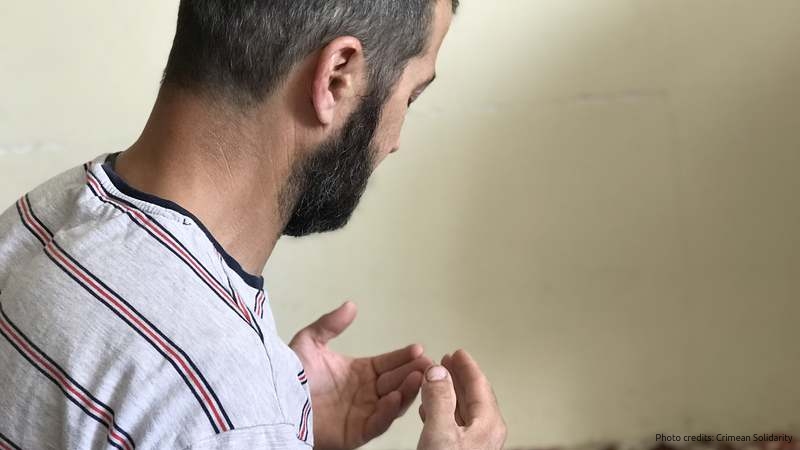 Lenur Khalilov
Earlier, Victoria Nesterenko, project manager for the Human Rights Centre ZMINA, stated that as of August 2025, 98 political prisoners from Crimea required urgent medical assistance in Russian penitentiary institutions or in temporarily occupied territories.
Among the political prisoners detained in temporarily occupied Crimea, 40 individuals have cases grouped by the Crimean Human Rights Group based on charges of espionage, sabotage, and terrorism — cases the Crimean rights defenders call the so-called “Ukrainian saboteur cases.”