Without international law, civilians pay enormous price – A UN legal expert Ben Saul
On 28 February 2026, after months of nuclear negotiations, the United States and Israel launched airstrikes on multiple military sites across Iran. Titled “epic fury” by U.S. President Donald Trump, Washington has offered several explanations for the strikes, with officials citing goals ranging from preventing nuclear weapons development to regime change.
The strikes followed brutal crackdowns by the Islamic Republic security forces against nationwide protests, which were sparked by severe inflation and widespread shortages, linked to international sanctions and government mismanagement. According to human rights organizations, including Amnesty International and Human Rights Watch, Iranian security forces machine-gunned protesters, executed them in hospital beds, and increased public executions.
The response from President Trump was threatening military intervention in Iran if the government decided to kill peaceful protesters. Expressing support for the Iranian anti-government protesters, he pledged, “Help is on the way”. As casualties mount under enforced internet blackouts, international human rights groups did their best to calculate the number of casualties.
According to the Human Rights Activists News Agency (HRANA), at least 6,488 protesters have been confirmed killed, including 236 children, along with 207 members of the military and government forces, bringing the total number of documented fatalities to around 7,000. The exact figures remain unconfirmed due to restricted access and Iranian authorities’ censorship.
The international response has been mixed, ranging from open condemnation to open support. Ben Saul, an Australian expert in international law and UN Special Rapporteur on Human Rights and Counter-Terrorism, has strongly condemned the joint military actions against Iran as illegal aggression. He has called for adherence to the UN Charter and its prohibition on the use of force, and has further condemned the Ukrainian Foreign Ministry’s position, drawing parallels between the actions of the Russian Federation and its own illegal invasion of Ukraine.
ZMINA spoke with Professor Ben Saul of the University of Sydney about the legality of the U.S.-Israeli strikes. In the interview, he also addresses the dysfunction of the UN Security Council and its veto system, as well as the effectiveness of sanctions as a human rights tool.
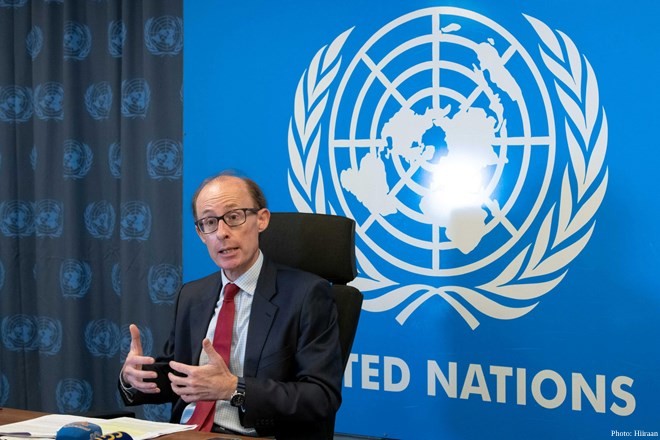 Ben Saul
Was the attack on Iran legal?
– How can the attacks by the U.S. and Israel be classified under international law?
– The U.S.-Israeli attack on Iran was not in self-defense under international law, and it was not authorized by the UN Security Council. That means it is a violation of the most fundamental rule of world order since 1945, which is the prohibition on the use of force. It makes it an illegal aggression.
Aggression is, of course, a crime for the military and political leaders who authorize it. It also gives Iran the right of self-defense against that armed attack.
Lots of reasons have been given for the attack, such as preventing nuclear weapons, combating sponsorship of terrorism, destroying ballistic missiles, et cetera. But none of those things are lawful reasons for using force under international law, unless Iran has first attacked another country. The widespread consensus is that there is no basis for the US and Israeli attacks.
– Does Israel have a stronger claim to self-defense due to Iran’s previously firing missiles and the supply and funding of Hezbollah, Hamas, and the Houthis?
– Under international law, an armed attack requires ongoing military operations by one country against another.
Iran, before this recent attack, was not actively attacking either the United States or Israel through its own military forces. The second way an armed attack can occur, of course, is if a state sends, controls, directs, or commands a non-state actor, in this case, like Hezbollah, to attack the United States or Israel.
The critical factor, according to the International Court of Justice, is that the foreign state has to be essentially commanding that group. Although, of course, there have been close links between Iran and Hezbollah. Ultimately, Hezbollah was in command of itself; it was calling the shots on when it attacked Israel or not.
The international court has made it very clear that in a world where lots of countries give various forms of support to non-state actors to commit acts against other states, it is only if the state itself is controlling that force that you can say there’s an armed attack by that foreign state. So Israel could certainly defend against Hezbollah, but that does not give it the right to also attack Iran unless Iran is commanding Hezbollah, and nobody says that that’s the case.
Why the UN Security Council cannot stop proxy wars
– How do you feel that international law should have responded to the rise and the use of proxy groups to attack other countries?
– Of course, that is illegal under international law, and there are very clear prohibitions on the use of force, the prohibition on intervention, and the principle of protection of sovereignty. All of that means that no state is allowed to provide money, weapons, logistical support, or intelligence to armed groups to attack any country. That includes, by the way, recent suggestions that the U.S. would support Kurdish armed groups to attack Iran as part of this suggestion of overthrowing the Iranian government.
The law is very clear. Unfortunately, the problem has been in enforcement, and the key institution tasked with preventing these kinds of attacks, such as the United Nations Security Council, has been paralyzed and dysfunctional due to great-power politics. The fact that the permanent five each have veto power, which they can exercise to prevent council action for any reason. They do not have to give reasons to complete discretion, and that’s led to all kinds of arbitrary blocking by great powers on the council of action.
Now, the United States has complained that the United Nations is unable to bring peace or address security risks, but the U.S. is part of the problem. The United States, along with Russia and China, has been using the veto power the most, including, for example, in the case of the United States, which vetoed six ceasefire proposals in Gaza. So, the U.S. said the UN didn’t bring peace to Gaza; well, that’s because the U.S. is in the way.
It was arming Israel, giving it political protection in the Security Council, and we saw what resulted in the 2.5 years of grave atrocities committed by Israeli forces in Gaza. So if countries are serious about wanting to stop proxy war or stop state sponsorship of terrorism, then give up your veto power. That’s the solution. Make the international system work.
Don’t just let individual countries arbitrarily commit aggression, escalate violence with incredibly unpredictable results, as we are seeing in Iran and as we saw in Iraq, Libya, and in many other cases before, where states that have used force have been disastrous. Hundreds of thousands of civilians have lost their lives. Those countries have not been made safer, and in the case of the invasion of Iraq, the invasion resulted in the creation of ISIS. So it does not usually work from a security standpoint, apart from being illegal under international law.
– How about making changes to the veto powers of the Security Council, if middle powers and smaller powers push the use of the rule already in the UN Charter that states you cannot veto if you’re directly involved?
– Unfortunately, it is the members of the Security Council themselves, including the Permanent 5, who control voting on and the use of the veto. Proposals for Security Council reform have been around forever. Everybody recognizes the system is broken. But until those Permanent 5 are willing to seriously address it, nothing is going to change.
That just makes the world more dangerous for everybody because it leads to a world of unilateralism by the great powers, with other countries as victims. It erodes the credibility and legitimacy of international law along the way.
Humanitarian intervention: A history of abuse
– Does a country that violates its human rights domestically, to such a horrifying degree, still rely on international protections against external attacks?
– There has been a long-running debate in international law about what we call humanitarian intervention. There was a version of it called the responsibility to protect, which was a kind of political agreement among states in recent decades that the international community should not stand by if serious human rights violations are happening in in any country and that collective action should be taken through responsibility to protect states agreed that the the appropriate way to take that action is not unilaterally, but instead through the collective security mechanism of the Security Council.
We have the capacity for peace enforcement, for peacekeeping, for peacebuilding. These are well-known processes under international law, but ultimately, it does require the political will of the member states of the United Nations to take that action.
The risk with unilateral humanitarian intervention is that it is abused for other reasons. This is the last couple of hundred years in which countries have claimed to be acting for humanitarian reasons. There are actually very few cases where that was actually true. It was mostly a pretext for other things, like overthrowing governments, controlling the resources of foreign countries, and subjecting them to hegemonic relationships of subordination by great powers.
The best possible example might be Kosovo. In 1999, I think it was a really genuine attempt to stop ethnic cleansing. There were also, of course, attempts that didn’t work as well in Rwanda, Bosnia, Somalia, and elsewhere. But ultimately, it’s a question of political will, not a lack of legal tools.
The other risk, of course, is that if you do not do it in the right way or you do it unilaterally without international support, then you see precisely the kinds of consequences we are seeing in Iran today or the kinds of unpredictable consequences we saw in Iraq. A bunch of countries overthrew Saddam Hussein, who was a terrible regime and killed many, many Iraqis, but the result of that war was at least half a million more Iraqis killed. That was more than Saddam Hussein ever killed in his lifetime. So was that a good thing for Iraq? I think the victims, the half million dead, probably would not say so.
– What role can the international community play in preventing human rights violations and atrocities, and what kind of response should we have when the country has killed, conservatively, 7,000 to 17,000 of its own people in two weeks?
– Certainly, it is vital to mobilize as much international pressure as possible to oppose those kinds of grave violations – condemnation at the diplomatic level through the General Assembly, the Human Rights Council, the Security Council, and unilaterally by world leaders. But it also requires concrete action.
Even if the Security Council is not willing to impose sanctions, countries can still individually impose Magnitzky-style sanctions, for example, to protect human rights, to raise the political price of these kinds of violations by Iran, suspending or expelling Iranian diplomatic representation, or imposing trade sanctions. There are many ways you can raise the heat on countries that commit these kinds of violations.
It’s important, of course, not to just single out Iran; you have to do it consistently, and if you’re going to do it to Iran, then you should, of course, do it to Israel and a bunch of other countries that are in serious violation of international law as well.
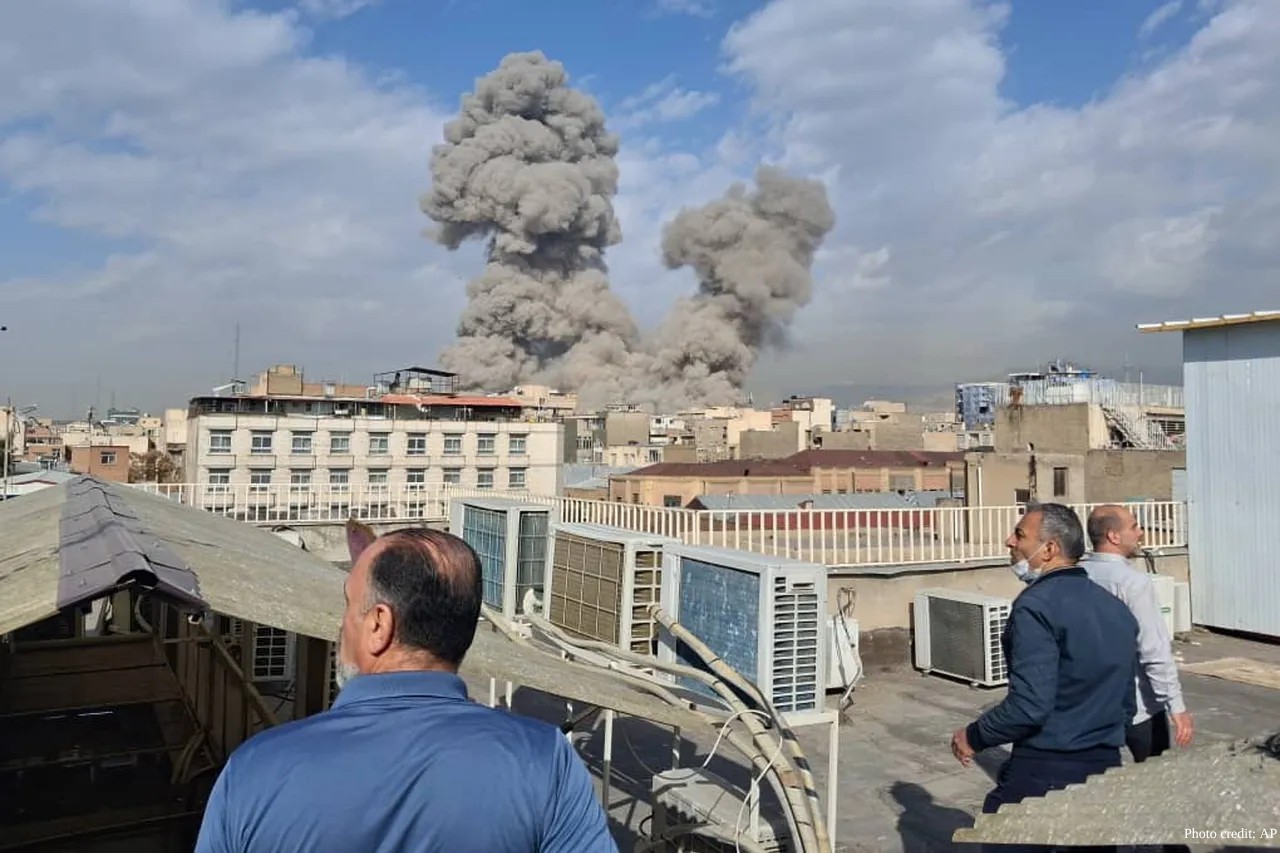 People watch as smoke rises on the skyline after an explosion in Tehran, Iran, Saturday, Feb. 28, 2026
You also need to strengthen the peaceful processes we have for resolving these kinds of disputes. The jurisdiction of the International Court of Justice, the International Criminal Court, I think all states have an interest in encouraging wider powers of international courts to intervene in these kinds of situations, precisely so that it does not result in military adventures with highly unpredictable consequences, which can make the human rights situation even worse.
Sometimes there are no good options. We live in a world where governments control their territories. If it were easy to stop governments from violating human rights in their own territories, I am sure we’d all like to do so. But unfortunately, the world is not that simple.
Sanctions, human rights, and the risk of harming civilians
– Given that Iran is already one of the most heavily sanctioned countries, how effective are the international sanctions and diplomatic pressures we apply, specifically in improving human rights conditions?
– Yes, certainly, sanctions have imposed a high price on Iran. I mean, you have to disentangle what the sanctions are for, because there are different kinds of them. A lot of them are targeted towards the nuclear program and less so on the human rights side. They certainly have constrained Iran’s ability to do things on both the nuclear and human rights fronts
You have to be careful with sanctions, because they, too, can pose human rights risks. If they are too broad or not primarily targeted at leadership or institutions, you end up inflicting pain on the population that does not necessarily support the government. We have seen that in places like Cuba, Venezuela, and a bunch of countries where the U.S. has unjustifiably imposed sanctions, it has resulted in inflicting huge pain on innocent people in those countries. People who have no capacity to somehow overthrow a government that controls the levers of power through force, coercion, and a large military, intelligence, security, and policing apparatus.
These kinds of fanciful suggestions from the U.S. and Israel are that the people of Iran should just rise up against the Iranian government and overthrow it. How are you going to do that? We saw in the face of protests not so long ago, Iran machine-gunned its own people. Is that seriously what the U.S. is asking the Iranian people to do? It is a really kind of childlike policy which stands no chance of success under the prevailing conditions in Iran.
So, too, with sanctions: states have to be careful not to combat human rights violations by violating human rights themselves against the foreign population. Sanctions are a long game; they do take a long time to create an impact and do not necessarily always work. But if the alternative is going to war with a country, killing lots of people, and not actually changing anything, I do not see how that is a better option.
– Can the international courts in any reasonable way hold Iranian officials accountable?
– Yeah, the difficulty is that the jurisdiction of international courts ultimately depends on the consent of the governments. So, giving consent in advance by agreeing that the International Court of Justice or the International Criminal Court can look at situations, including those internally within a country. Unfortunately, Iran has not accepted that kind of jurisdiction of either of those courts on human rights. Iran has itself sued other countries before the International Court of Justice to protect its own rights. It’s just not willing to allow other governments to sue it to protect the human rights of people within Iran.
There is another option: the Security Council has the power to refer situations to the International Criminal Court, even if that country does not agree. However, at the moment, the United States is doing its very best to destroy the International Criminal Court. It imposed sanctions on its judges and prosecutors. It refused to accept the court’s jurisdiction itself. So, of course, other states look at that and say, “Well, you know, why would Iran agree to submit to any international court if the U.S. is refusing to do that when it violates things, or Israel is refusing to do it as well.
Building these kinds of international institutions requires goodwill from all states. It requires all countries to be prepared to submit to the rules and to independent adjudication, ultimately to avoid war and escalation through violence. But unfortunately, time and time again, important countries like the U.S., China, and Russia have simply refused to accept international courts as a way of resolving their disputes.
Standing up to superpowers: The case for coalition-building
– What role can the middle player play at the table when it comes to our major powers breaking international law?
– I certainly think not just middle powers, but all countries, have an interest in enforcing international law because it provides stability and predictability, and protection against arbitrary uses of violent power by predatory states who simply have the power to do it. The way to do that is absolutely, as you suggest, for influential countries to build coalitions of like-minded states to push back and raise the price of these kinds of violations.
At the very least, it requires them to protest and denounce violations when they happen, not to just ignore them or transactionally bet that if you keep your head down, you will keep the U.S. on side and you will not face retaliation on tariffs, defense, security, or whatever else that matters to you. We know that does not work. We know that the U.S. is arbitrary and capricious at the moment. It can turn on its friends in a heartbeat, no matter what those friends have done. Keeping your head down does not guarantee you protection from that kind of mistreatment by the U.S.
To the contrary, there is evidence that if you stand up to the US, if you show strength, not weakness or appeasement, then the U.S. backs down. The U.S. backed down in its tariff war with China when China indicated it would inflict equal economic pain on the United States. When the Europeans finally stood up to Trump over Greenland, Trump backed down. Even a superpower cannot get what it wants all the time.
There are many things countries can do besides protesting. Countries can suspend various forms of cooperation with the U.S. to send signals to it – defense and security cooperation, diplomatic or trade relationships of various kinds, even without imposing sanctions.
Quite a few countries have leverage with the United States. The US has military bases in many countries and has an interest in many others. So it is not like no other country has levers to pull to influence U.S. behavior.
Ukraine’s Position on Iran
– I would like to return to specifically the comment you made towards the Ukrainian Ministry of Foreign Affairs. I think you said disappointingly that Ukraine was supporting the U.S. and Israeli aggression against Iran as a victim of Russian aggression, who also expects international support. I am curious about your rationale behind those comments.
– Of course, it is natural for us to push back against any country that appears to support aggression. Particularly, countries that are themselves victims of aggression would be expected to understand that it is important for all countries to support the prohibition on aggression.
Totally understandable that Ukraine does not feel friendly towards Iran, given that Iran itself has been breaking international law by providing weapons to Russia to support Russia’s illegal aggression against Ukraine. We know the manner in which Russia is illegally fighting that war, attacks on civilians, civilian infrastructure, and terrorizing the population of Ukraine.
But that does not mean you should support aggression against Iran when Iran is not itself launching an armed attack on Ukraine. Therefore, this does not fall within any self-defense paradigm, so far as Ukraine is concerned. Bear in mind also, you know, the U.S. and Israel are not attacking Iran to protect Ukraine. This is about Iran’s nuclear program, ballistic missiles, and support for Hezbollah terrorism. It has never been about somehow stopping Iranian-made drones from reaching Russia to attack Ukraine.
I think it is important that all countries support the international legal order, and when any country appears to give support for illegal aggression as an independent UN expert, it is my job to call that out.
– Given the experiences of Ukraine, Iran, and Palestine, does international law in its current state function?
– Looking at these examples, and when the United States has declared it does not care about international law, it certainly feels pretty bleak at the moment. The U.S. is going to operate as a superpower according to its own morality. It is withdrawn from a bunch of international institutions or defunds them, or, as I said, in some cases, actively attacks them. All of that is not helpful.
At the same time, I would say two things.
First, most of the international legal system is not about the use of force, and it continues to function effectively in the background across a wide range of day-to-day issues, from communications to trade to intellectual property to humanitarian assistance. These days, international law regulates so much of international life and the relations between countries. A few ruptures in the use of force in the situation in Gaza or Ukraine, or Iran, all of that does not really affect most of the international laws functioning most of the time.
Second thing, it is not like we haven’t been here before. International law is 500 years old. It will outlive a few years of a Trump presidency or a Netanyahu prime ministership.
The world looked even bleaker than it had previously. Politics and media often have a pretty short memory, but if you go back just to the 1990s, this was said to be the high watermark of international law, the Cold War ended, a new world order, lots of hope for international cooperation, and yet that’s when the Rwandan genocide happened. 800,000 people were killed. That is worse than Gaza, than Ukraine, than Iran. Yet it seemed to be the best time for international law to operate.
So the present always seems more important than any other time, but from a historical perspective, it is not necessarily the worst time. Of course, international law has to do better. Countries have to build back their support for international relations more precisely, because it ultimately guarantees more peace and security on balance than if they do not respect the international legal rules.
We have to remember that military force, although many countries and politicians seem tempted to use it, is not always the best solution and is very rarely a good option. It rarely works, and even if you win, it comes at an enormous price that usually outweighs whatever problem you were seeking to address in the first place. The problem is that the use of force is very selfish. If America achieves what it wants in Iran, it does not particularly care how many Iranians it kills in the process. International law tries to set boundaries so that we do not escalate into those kinds of situations of unbridled, uncontrollable violence, where ultimately the greatest victims are innocent civilians.
Professor Ben Saul was interviewed by ZMINA volunteer Kyle Swain