Journalists working in the kill zone: How military technology is changing safety rules and which protective measures are no longer effective
Getting to the people featured in a report can be more dangerous than filming it. The vehicle carrying a reporting team can become a target for a Russian drone, and familiar precautions – from protective equipment and PRESS markings to choosing when to travel – can become less effective as technology evolves. In a war where aerial surveillance and drone attacks have become everyday threats, journalists are having to rethink not only their safety precautions but also how they work.
An area where anyone travelling faces a constant risk of being detected and attacked is known as a kill zone. For journalists, this means that planning a reporting trip involves more than arranging interviews, choosing a route and checking camera equipment. They need to understand the current threats, what escort arrangements are available, the limitations of protective equipment and when they may have to abandon an assignment. A precaution that worked before, or in another part of the front, may not work on the next trip.
These changes were discussed during a panel titled “Kill Zone: How Technological Warfare Is Changing the Work of Journalists” at the Donbas Media Forum.
Participants discussed technological means of protection, access to equipment for newsrooms, PRESS markings and the possibility of using weapons for self-defence. Although they differed on specific measures, they agreed on one fundamental point: no device can replace proper training, and the desire to get a story should never deprive a journalist of the right to stop.
The danger extends beyond frontline positions
One of the main topics of discussion was the growing area in which drones pose a threat to journalists travelling near the front line. Iryna Rybakova, head of the communications department of the 93rd Kholodnyi Yar Brigade of the Armed Forces of Ukraine, described how the danger extends beyond frontline positions to the roads and settlements journalists must pass through to reach them. According to Rybakova, even areas 15–20 kilometres from the front line can be dangerous for journalists. There is no fixed distance at which a reporting team can consider itself safe. As military technology advances, this kill zone continues to expand.
 Photo credit: Roman Chornii
Under these conditions, travelling itself becomes the biggest challenge. Ordinary vehicles that journalists previously used to reach their reporting locations are increasingly at risk of attack. The danger is not limited to military vehicles or those used by journalists – it also affects civilian cars travelling through areas near the front line. As a result, whether journalists can reach the people they want to report on depends not only on their willingness to speak or permission to film, but also on whether it is possible to get there and return safely.
For journalists, this changes what it means to prepare for an assignment. A helmet, body armour, camera and microphone are still essential, but they are no longer enough. Journalists also need technological tools and an understanding of how modern threats work. They must consider more than their own safety: the presence of a reporting team can also put colleagues, local residents and the military personnel accompanying them at risk.
Oleksandr Matiushenko, a freelance correspondent at Radio Free Europe/Radio Liberty (RFE/RL), stressed the importance of listening to those accompanying journalists and to press officers. He also said journalists must have the right to decline a reporting trip or refuse to film if they believe the work is too dangerous. Making such a decision requires professional independence: agreeing to cover a story does not eliminate the risks, which may change even after the assignment has been planned.
According to Matiushenko, risks should be assessed before setting out and continually reassessed during the assignment. Teams should also discuss in advance where they can take shelter, what they will do if danger arises and who will accompany them. In an era of technology-driven warfare, these considerations directly affect whether journalists can carry out their assignments.
A drone detector provides information but cannot decide for you
Borys Budeianskyi, director of BlueBird Tech, said the company is working in two areas: developing solutions for military personnel on the front line and equipment for civilians, including journalists. Among the devices he mentioned were the “Chuika” drone detector and a net launcher. These are designed to help users detect threats in time and take protective action, but the equipment’s effectiveness depends on how well people understand how to use it.
“We are constantly thinking about how to give people more ways to protect themselves, travel safely or avert a threat. But training must come first. Even the devices we manufacture will be useless if people do not understand how to use them, the conditions in which they work or what information they can provide. Most importantly, they need to know what to do with that information. There are many situations where proper training is what really matters,” Budeianskyi explained.
This warning highlights a fundamental point about using drone detectors. Receiving an alert about a potential threat and knowing what to do next are two different things. A device cannot replace knowledge of the local terrain, agreed procedures or the judgement of those accompanying the team. Its capabilities also depend on the types of signals it is designed to detect.
During the panel discussion, Budeianskyi presented a version of the “Chuika” drone detector that, he said, operates across four frequency bands. Such upgrades make it possible to respond quickly to changing threats.
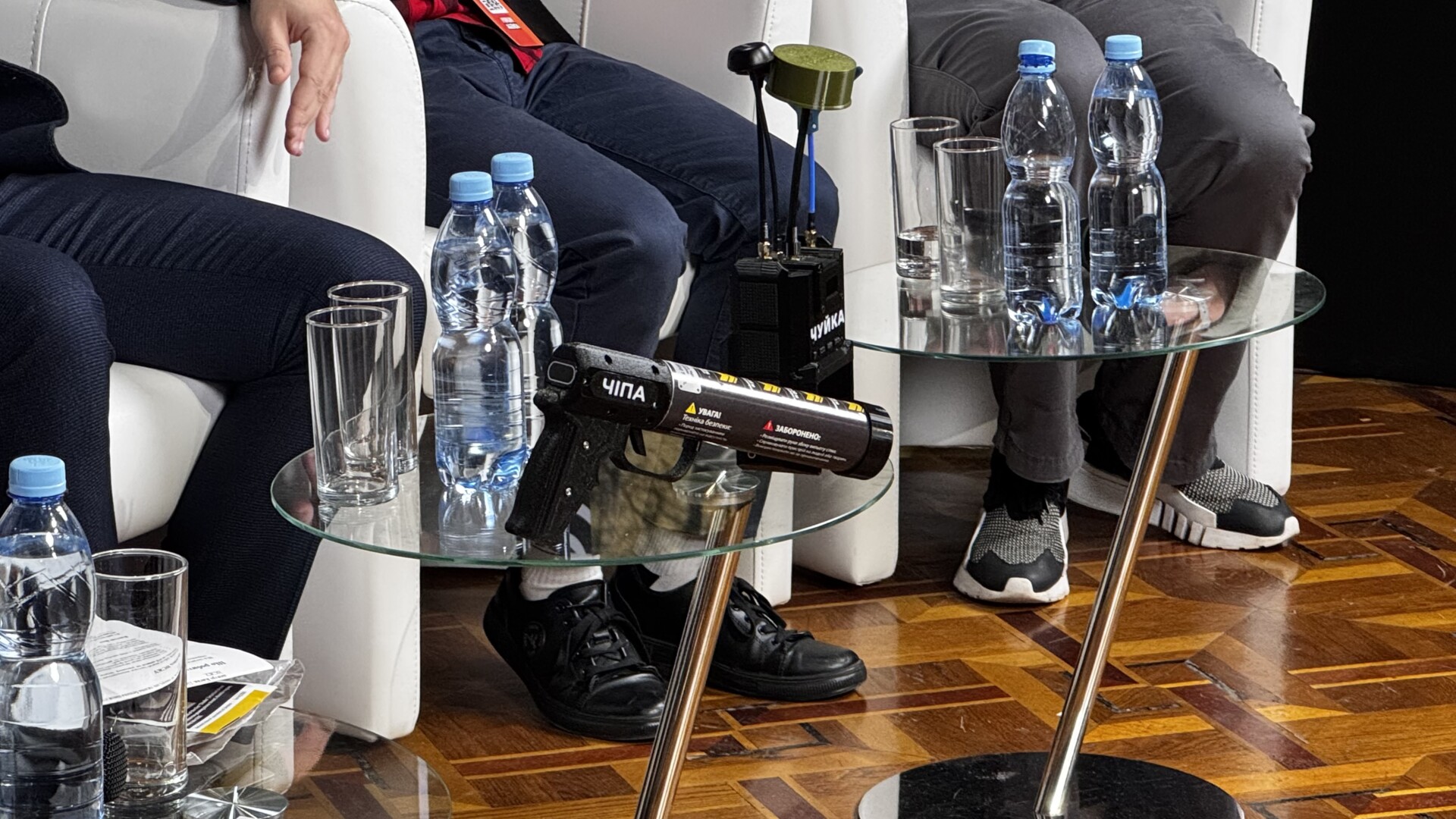 Ukrainian portable radio-electronic reconnaissance device “Chuika”. Photo credit: Liudmyla Tiahnyriadno
“Our priority is to explain how to use these devices as simply as possible. That is one of the most important factors in making sure they work effectively. It is not enough just to manufacture and distribute them – people also need to understand how to use them,” he said.
For local journalists, danger is part of everyday work
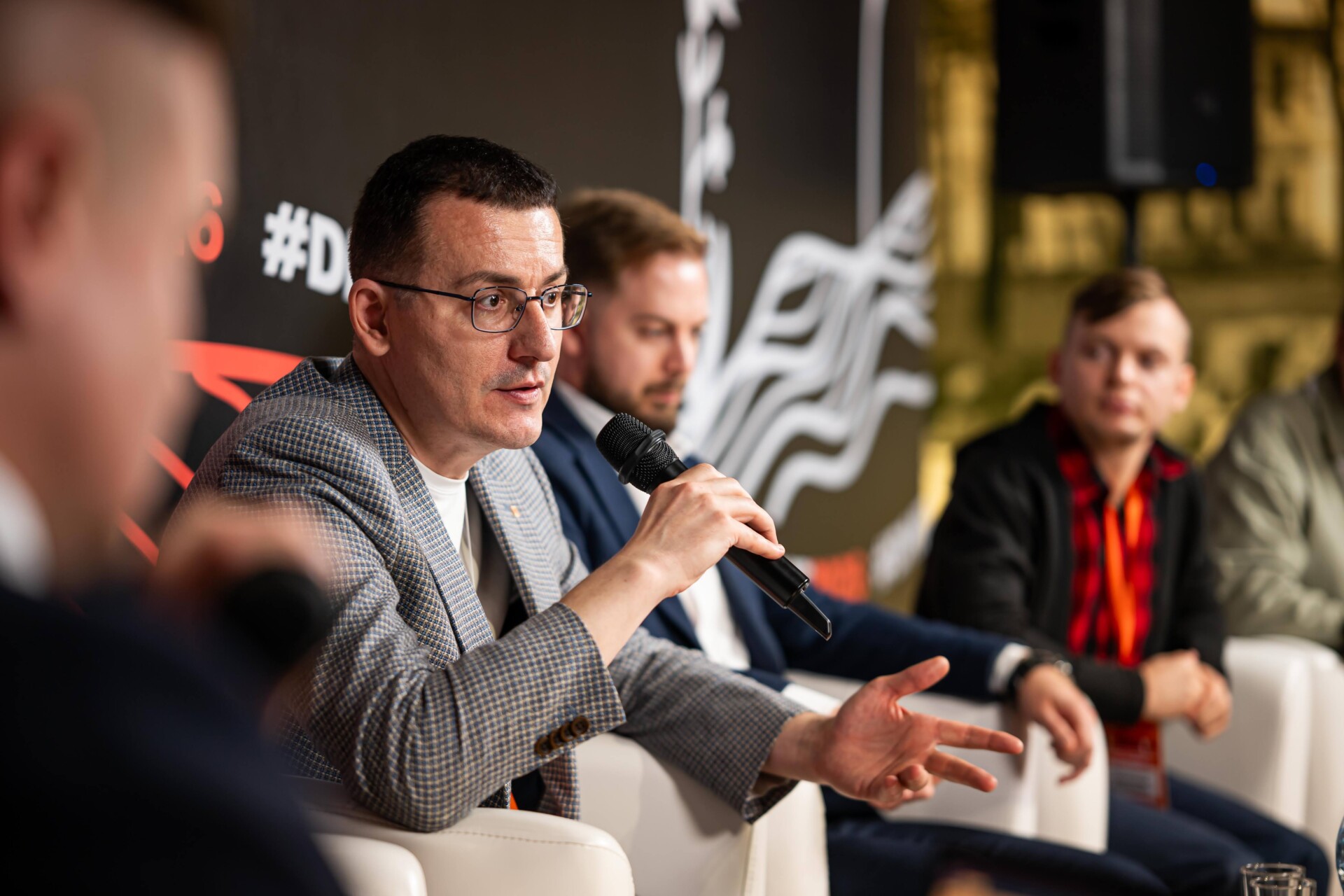 Serhii Tomilenko, head of the National Union of Journalists of Ukraine. Photo credit: Roman Chornii
Serhii Tomilenko, head of the National Union of Journalists of Ukraine (NUJU), described how the union supports journalists and provides them with drone detectors.
According to Tomilenko, international organisations now recognise drone detectors as a form of passive protection. The NUJU is currently awaiting a new batch of detectors from UNESCO headquarters, which will be distributed to Ukrainian journalists.
The union pays particular attention to regional media outlets, whose staff often live and work permanently in areas near the front line. For them, danger is not simply something they face during an occasional reporting trip before returning to a safer environment.
Tomilenko also highlighted the financial challenges of keeping journalists safe. Newsrooms and journalists cannot always afford to buy the equipment they need. Professional organisations are therefore looking for ways to make it available without journalists having to pay for it out of their own salaries. Otherwise, the ability to work in dangerous areas will increasingly depend on the financial resources of individual newsrooms or reporters.
At the same time, receiving a protective device can create unrealistic expectations.
“Media workers sometimes treat protective equipment almost like a lucky charm – something that makes them feel safe. But that emotional need for reassurance does not change the equipment’s technical limitations. It must be used alongside proper training and an up-to-date assessment of threats,” Tomilenko said.
According to Tomilenko, the NUJU uses requests received directly from journalists to make the case for this type of assistance when speaking with international partners.
Overall, Tomilenko said, the network of Journalists’ Solidarity Centres fulfilled more than 10,000 requests from journalists between April 2022 and summer 2026. Most requests were for body armour loans, protective helmets, other safety equipment and training.
PRESS markings: Balancing professional identification with the risk of being seen
The participants offered no single solution to the question of PRESS markings. Iryna Sampan, a journalist and executive director of the “On the Line of Fire” project, said her team had switched to green protective equipment and reconsidered its use of visible PRESS markings. She explained that the aim was to be less conspicuous in dangerous areas, as the team did not trust Russian forces to refrain from attacking journalists simply because they were clearly identified as members of the press.
According to Sampan, journalists remain divided on the issue. Some believe they should retain the traditional colours of protective equipment and PRESS markings, while others prefer olive, green or sand-coloured gear. Sampan said the choice depends on the circumstances: reporting in a city and travelling to dangerous frontline positions may call for different approaches.
Her experience also shows that there is no one-size-fits-all advice. The frontline sector, terrain, type of assignment and natural surroundings all matter. Equipment that makes journalists less conspicuous in one environment may stand out in another.
Oleksandr Matiushenko stressed the importance of making a clear distinction between journalists and military personnel. For him, this is a matter of professional principles and how journalists identify themselves. He also pointed to editorial requirements: international media outlets may take a more conservative approach to how journalists identify themselves through visible markings.
At the same time, Matiushenko stressed the need to assess the actual risks in a particular area and discuss them with those accompanying the team before setting out. From this perspective, clearly identifying journalists remains important, but decisions about visible markings must take the circumstances into account.
Iryna Rybakova explained how military personnel who meet and escort reporting teams view PRESS markings. Such markings help them identify journalists. However, she warned that large markings on vehicles, such as the word PRESS, could pose an additional risk by attracting the attention of an enemy drone operator.
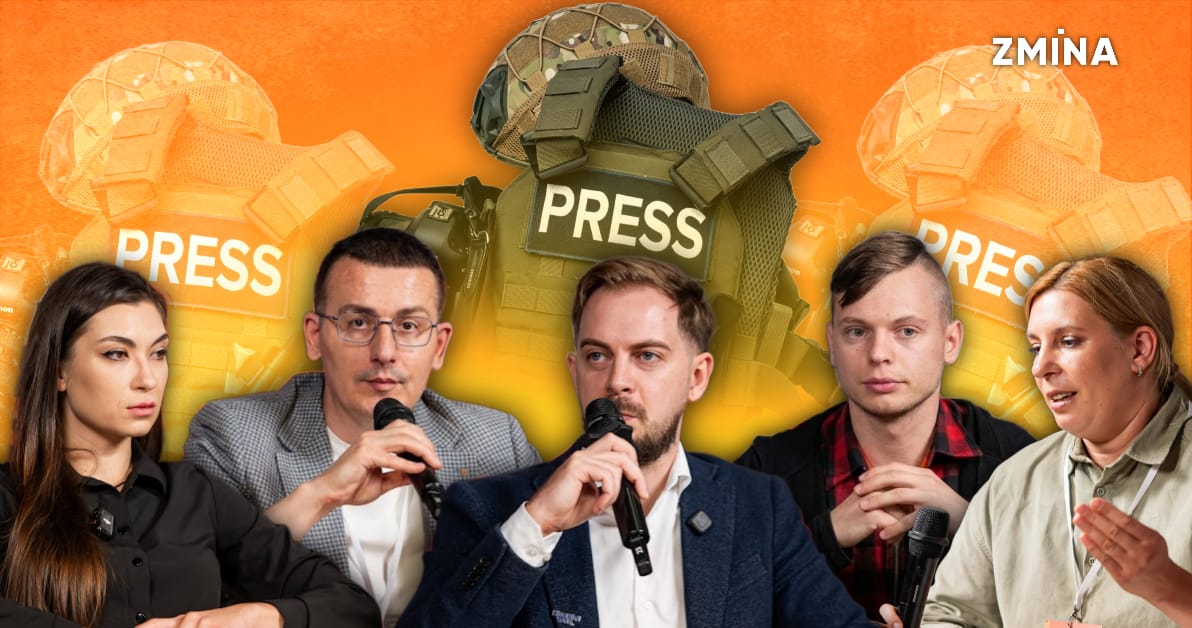
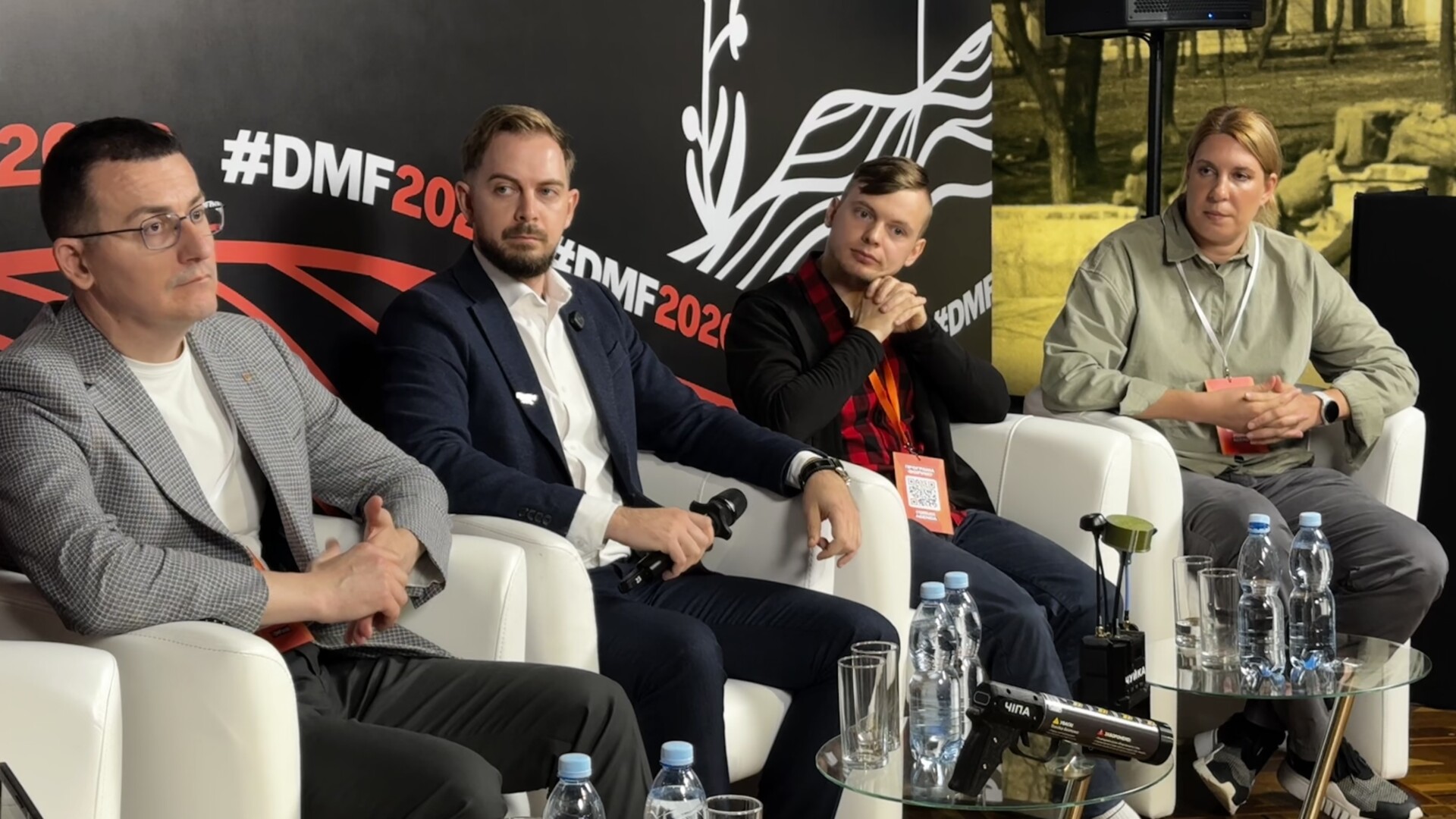 Serhii Tomilenko, head of the National Union of Journalists of Ukraine; Borys Budeianskyi, director of BlueBird Tech LLC; Oleksandr Matiushenko, freelance correspondent at Radio Free Europe/Radio Liberty (RFE/RL); and Iryna Rybakova, head of the communications department of the 93rd Kholodnyi Yar Brigade of the Armed Forces of Ukraine. Photo credit: Liudmyla Tiahnyriadno
Weapons for self-defence: a question of skills, professional roles and responsibility
The speakers also discussed whether journalists should use weapons for self-defence, including anti-drone guns and shotguns. One question was whether journalists would be willing to carry a weapon on assignment if it could help protect them against an FPV drone.
Iryna Sampan believes that journalists working in dangerous areas need more extensive training than a three-day course. Such training should help them understand weapons and recognise the sounds and threats they may encounter. However, understanding how weapons work and carrying one while reporting are two different things.
Oleksandr Matiushenko also opposed the idea of civilian journalists becoming involved in so-called “participation in hostilities” or using any weapons while reporting. He believes it is important for journalists to maintain their civilian role, uphold professional principles and preserve the distinction between covering a war and taking part in it.
Matiushenko acknowledged that Ukrainian journalists are deeply affected by what is happening to their country. However, he believes this does not relieve them of their responsibility to uphold their professional role and remain accountable for what they report.
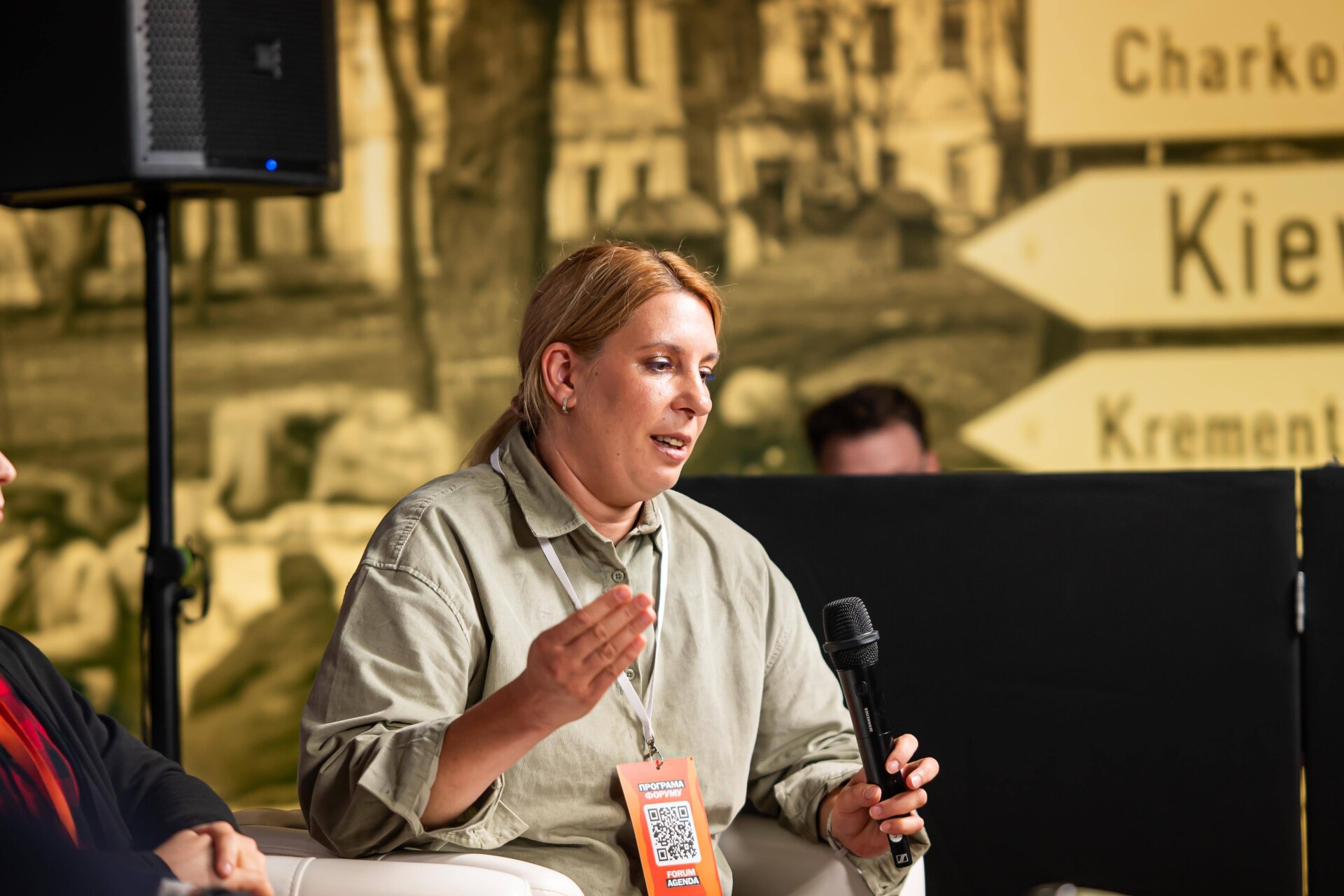 Iryna Rybakova. Photo credit: Roman Chornii
Rybakova also expressed reservations about civilian journalists carrying weapons, including anti-drone guns. She pointed to uncertainty about their level of training, the additional physical burden and the difficulty of performing two tasks at once. If a reporter concentrates on firing the weapon, the ability to film and document events becomes secondary.
She also noted that simply having a shotgun does not mean someone can shoot down a drone. Doing so requires specific skills and regular training, and a small, fast-moving target is difficult to hit even for someone who has been trained.
Rybakova also mentioned involving veterans with relevant skills to escort reporting teams as a possible way to improve their safety near the front line. This approach involves a clear division of responsibilities: journalists focus on their reporting, while a trained individual handles specific security duties.
Travelling at dusk can no longer be considered a reliable solution in all situations
Towards the end of the discussion, Rybakova gave an example of how technology is changing even the choice of when to travel. Previously, teams sometimes planned their journeys at dusk – a practice known as po-siromu (“travelling in the twilight”) – to take advantage of the transition between drones’ daytime and night-vision cameras. However, she said improvements in camera technology had made this approach less effective, and her team had stopped using it.
This does not mean that travelling during daylight hours is safe. Rybakova pointed out another factor: in the dark, a person may hear a drone without being able to see it, while the drone operator can still observe them. Teams must therefore consider both how visible they are to the enemy and how well they can detect threats themselves.
She also explained that escorting journalists can take an entire day because conditions must improve. If the situation is unclear, a drone can be heard or there is a threat of shelling, her approach is to wait until it is safer to move. Under such circumstances, the timing of the return journey depends on the situation on the ground, rather than just editorial schedules or prior arrangements.
“My rule is that if I’m accompanying a group rather than travelling alone, and we hear that shelling is expected, or we’re unsure what’s happening, or we hear a drone, it’s better to find somewhere to wait. Sometimes we wait for a long time, and escorting journalists can take much longer than planned. One thing that has changed is that we’ve stopped travelling at dusk, or ‘po-siromu’. People used to argue that we should arrive at and leave positions at dusk because that’s when operators of Mavic drones with daytime and night-vision cameras switch between them,” Rybakova explained.
As technology evolves, safety measures need to be constantly reassessed. What worked before may no longer be effective. Even areas relatively far behind the front line may now be at risk, while a short reporting trip can turn into a long wait for a safe opportunity to return.
For journalists, the main consequence of these changes is their impact on access to people and events. To report on the war, journalists need equipment, training, support from newsrooms and professional organisations, and escorts who understand the current threats. They also need to be able to make the hardest decision of all – to call off planned filming when conditions do not allow it to go ahead.
Liked this article? Follow ZMINA on X, Bluesky and LinkedIn, and help shape our editorial focus by filling out our feedback form here.