Majority of Ukrainians are against elections during the war – poll
Following U.S. President Donald Trump’s statement that “the time has come” for Ukraine to hold presidential elections, the Kyiv International Institute of Sociology (KIIS) released its survey results on Ukrainians’ attitudes to elections. According to them, more than 50% of Ukrainians have said that elections should be held only after a final peace agreement is reached and the war ends completely, while just 9% have supported holding elections “right now.”
 Photo credit: ratinggroup.ua
The survey shows that only 9% of Ukrainians believe that elections should be held before a ceasefire; in September, this figure was 11%.
In the event of a ceasefire and security guarantees, 25% support holding elections. This share has shown a tendency to grow, as it stood at 22% in September.
A majority – 57% (63% in September) – continue to insist that elections are possible only after a final peace agreement is reached and the war ends completely.
Anton Hrushetskyy, KIIS executive director, said that when it comes to internal issues, there is no demand among the absolute majority of Ukrainians for national elections before the end of active hostilities.
He added that trust in Volodymyr Zelenskyy remains high and that he retains his legitimacy as president in the eyes of Ukrainians:
“Therefore, the insistence on elections in Ukraine is critically perceived by the public and is regarded as an attempt to weaken the country,” he elaborated.
According to this survey, a total of 61% of Ukrainians trust President Volodymyr Zelenskyy, while 32% do not. The net trust balance stands at plus 29%.
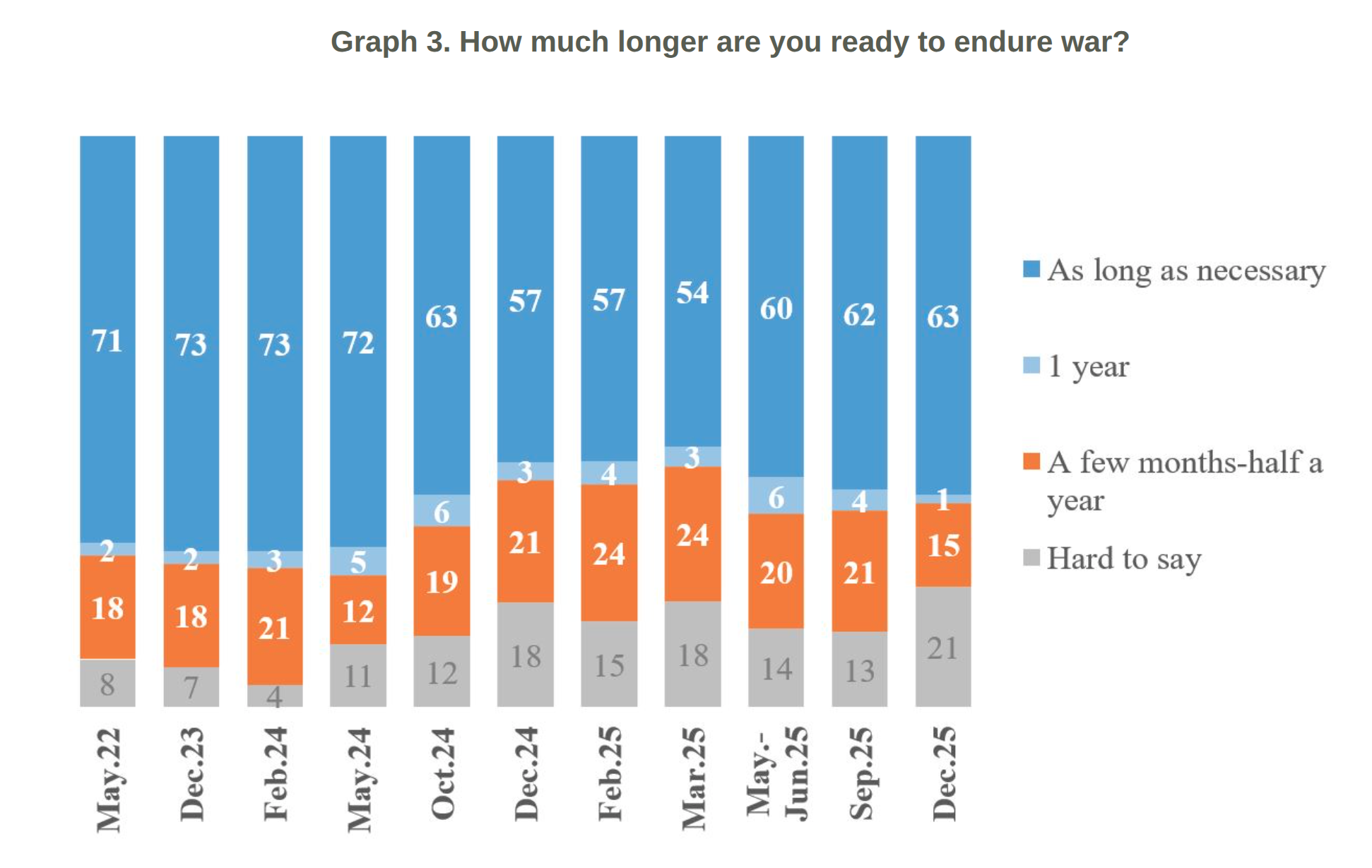
KIIS sociologists conducted the survey from November 26 to December 13, using telephone interviews based on a random sample of mobile phone numbers. The survey targeted 547 respondents aged 18 and over, all of whom live in territory controlled by the Ukrainian government. The sample did not include residents of territories temporarily not controlled by the Ukrainian authorities, although some respondents were internally displaced persons who had moved from occupied territories. Additionally, it did not include citizens who left Ukraine after February 24, 2022.
Under normal circumstances, the formal statistical margin of error for such a sample (with a probability of 0.95 and taking into account a design effect of 1.3) does not exceed 5.6% for indicators close to 50%, 4.8% for indicators close to 25%, 3.4% for indicators close to 10%, and 2.5% for indicators close to 5%.
Under wartime conditions, in addition to the stated formal margin of error, a certain systematic bias is present. However, sociologists believe the results nevertheless retain a high level of representativeness and allow for a fairly reliable analysis of public sentiment.
To provide background, following pressure from U.S. President Donald Trump, Ukrainian President Volodymyr Zelenskyy stated following the meeting of the “Coalition of the Willing” that Ukraine is ready to hold elections, but this is possible only under the condition of a full ceasefire, which the United States must negotiate directly with Russia.
Later, Zelenskyy discussed with representatives of the Ukrainian Parliament the possibility of holding presidential elections in a country at war and is now waiting for lawmakers to “present their perspective” to him. One Ukrainian lawmaker said that there are currently no “draft laws” or legislative initiatives in parliament on holding elections under martial law.
Following the full-scale invasion, Ukrainian political forces agreed to hold elections only after the war. The Constitution of Ukraine prohibits holding elections during martial law.
Despite statements by Russian propaganda and the new US presidential administration, the UN considers Zelenskyy a legitimate president, as does the EU.
In February this year, over 130 leading civil society organisations called on international partners to focus on security support for Ukraine rather than pushing for wartime elections, stressing that democracy requires even stronger protection during wartime when the cost of mistakes is extremely high.
Follow ZMINA on X and LinkedIn for daily human rights coverage from Ukraine – we invite you to share your feedback on what you’d like to see more of in our survey here.