The Russian occupiers teach our children that Ukraine does not exist at all – Human rights advocate Maria Sulyalina
Following the full-scale invasion, Russia has significantly intensified its propaganda efforts in the occupied territories of Ukraine through the education system. Specifically, Russian textbooks, which the occupying forces immediately replaced Ukrainian books with in schools, emphasise that Ukraine does not exist as an independent state.
This was stated by Maria Sulyalina, a human rights advocate and head of the Centre of civil education “Almenda”, during the First Crimea Week in Brussels, Belgium, as reported by ZMINA.
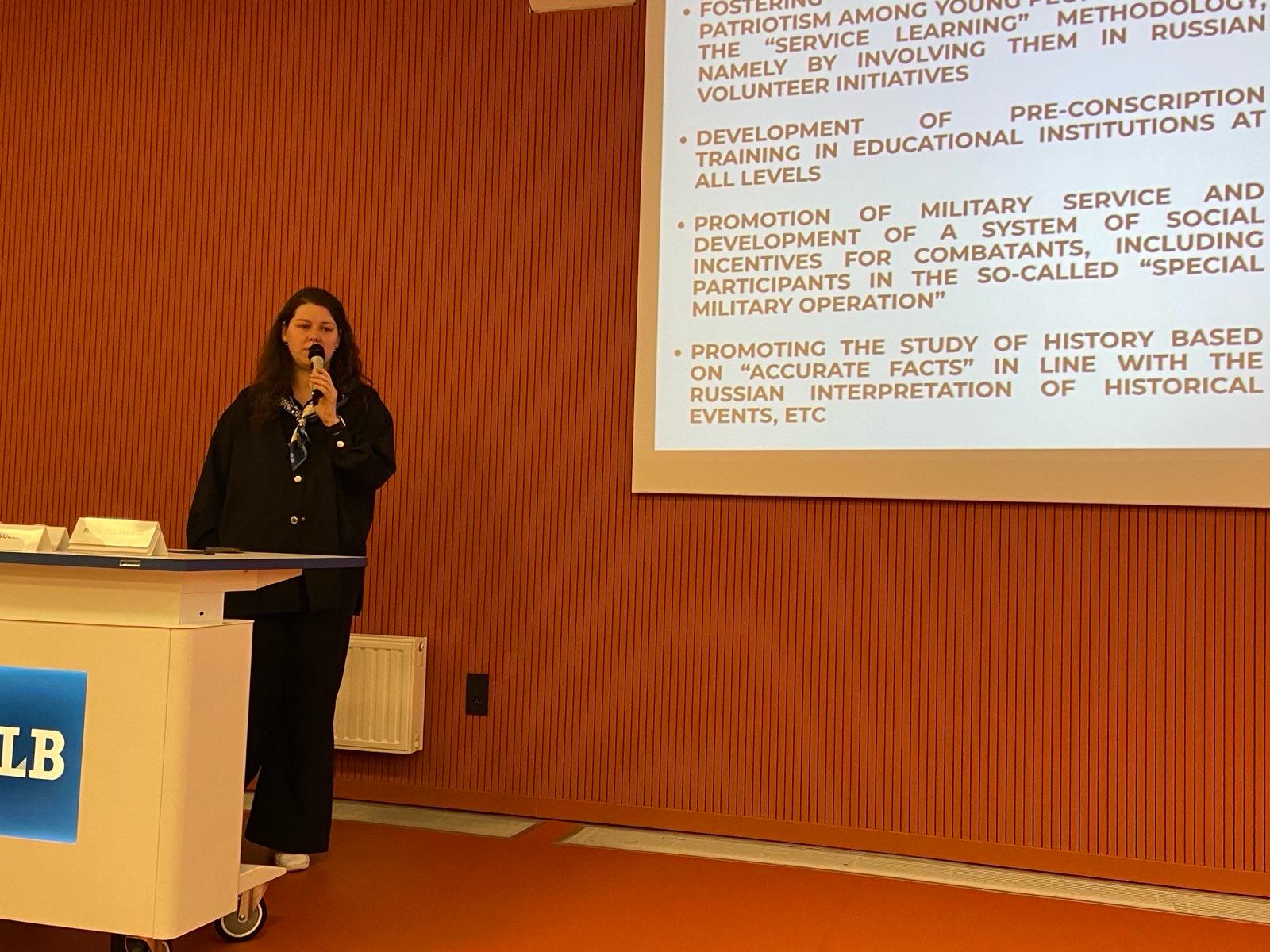 Maria Sulyalina performs in Brussels as part of the First Crimean Week. Photo: Viktoriia Nesterenko
“Ukraine is mentioned only in some historical sections as an artificially created state. The point is that our children are not brought up to believe that Ukraine is an enemy. They are raised to believe that Ukraine does not exist at all,” she said during a discussion titled “Children Under Occupation: Indoctrination, Militarisation, and Persecution of Ukrainian Youth in Occupied Crimea”.
The activist clarified that between 2014 and 2023, 131,000 children completed 11 grades in the illegally controlled by Russia Autonomous Republic of Crimea. This generation has never been in the Ukrainian education system, only the Russian one. Most of them cannot continue their lives in Ukraine because they lack Ukrainian educational documents.
Sulyalina noted that, according to the Ministry of Education of Ukraine, during this period, only 4% (3,922) of more than 500,000 Crimean children received Ukrainian educational documents.
She described what is happening to Ukrainian children under occupation as a systemic destruction of national identity.
“Why do we call this a system? Because we see how Russia systematically works on all levels. First and foremost, this occurs through formal education because children have no choice but to attend schools and be part of the Russian formal education system. However, they also build their network of informal education,” she explained.
These youth movements are integrated into formal education. For example, every Crimean school hosts a branch of “Yunarmia” (Youth Army), and students are also invited to participate in the propagandistic “Movement of the First.” The leaders of both organisations are individuals who have participated in the war against Ukraine.
Artur Orlov, the head of the “Movement of the First,” participated in Russia’s military campaign in the Kyiv region. The unit under his command in Ukraine stands accused of a war crime—the rape of a pregnant woman, after which she lost her child. This unit is currently under investigation, and its commander could be charged with a war crime under international law.
Orlov also participated in military campaigns in the Donetsk region, where his unit is accused of extrajudicial killings.
Vladislav Golovin, the head of “Yunarmia,” is a military officer of the occupying army who fought in the Mariupol direction and holds the title “Hero of Russia.”
The propaganda scheme, refined over the years in Crimea, is now being implemented by Russia in all other occupied territories, and even more harshly than on the peninsula.
“In these territories, there have been far more cases of abductions, direct pressure on teachers and parents who refused to send their children to Russian schools,” Sulyalina emphasised.
From the first year of school, Russia has been indoctrinating Ukrainian children under occupation to glorify Russian soldiers. Books intended to teach toddlers to read and write already contain examples about Russian soldiers, participants in the Chechen and Afghan wars, and the war in Ukraine. This information accompanies students in occupational schools from their first year until the end of their schooling.
This academic year, changes were introduced to Russian school curricula. Russia now has a mandatory “Defender of the Fatherland” lesson, during which children must learn to fight: shoot, mine, and de-mine territories, and so on.
“Parents cannot influence whether their child participates in these lessons because they are mandatory,” the human rights advocate noted.
The occupying forces widely applied the militarization of formal education by creating cadet classes. In these classes, children wear uniforms from the first grade and are under the patronage of various entities, including the Russian Federal Security Service (FSB) and the Investigative Committee.
The main goal of such classes is to prepare children to either immediately become soldiers or to enroll in military universities to become Russian officers. As of January 2025, 260 such classes have been opened in the occupied territories, and their number is expected to grow.
“This is one of the concrete ways they are trying to turn our children into Russian soldiers,” Maria Sulialina explained.
At the same time, the occupying forces create various types of military-patriotic camps and conduct numerous military-patriotic events where children acquire military skills. More and more children are participating in these activities.
“All of this is already showing results in the occupied territories. In Crimean schools, memorial plaques are being unveiled to former students who died in the Russian-Ukrainian war. They were children when Russia occupied their land and were subjected to a system of political indoctrination and militarisation. At some point, they began to believe in this system, then went to war against their own country and died,” the human rights advocate stated.
See also: From 2014 to 2023, only 4% of Crimean children received Ukrainian educational documents