United States pressed Ukraine to give up Kyiv-controlled Donbas areas during Berlin talks — AFP
AFP, citing a source familiar with the talks, reported that U.S. negotiators Steve Witkoff and Jared Kushner pressed Ukrainian representatives during talks in Berlin on December 14, 2025, to give up the part of Donbas still under Kyiv’s control, according to a source familiar with the talks.
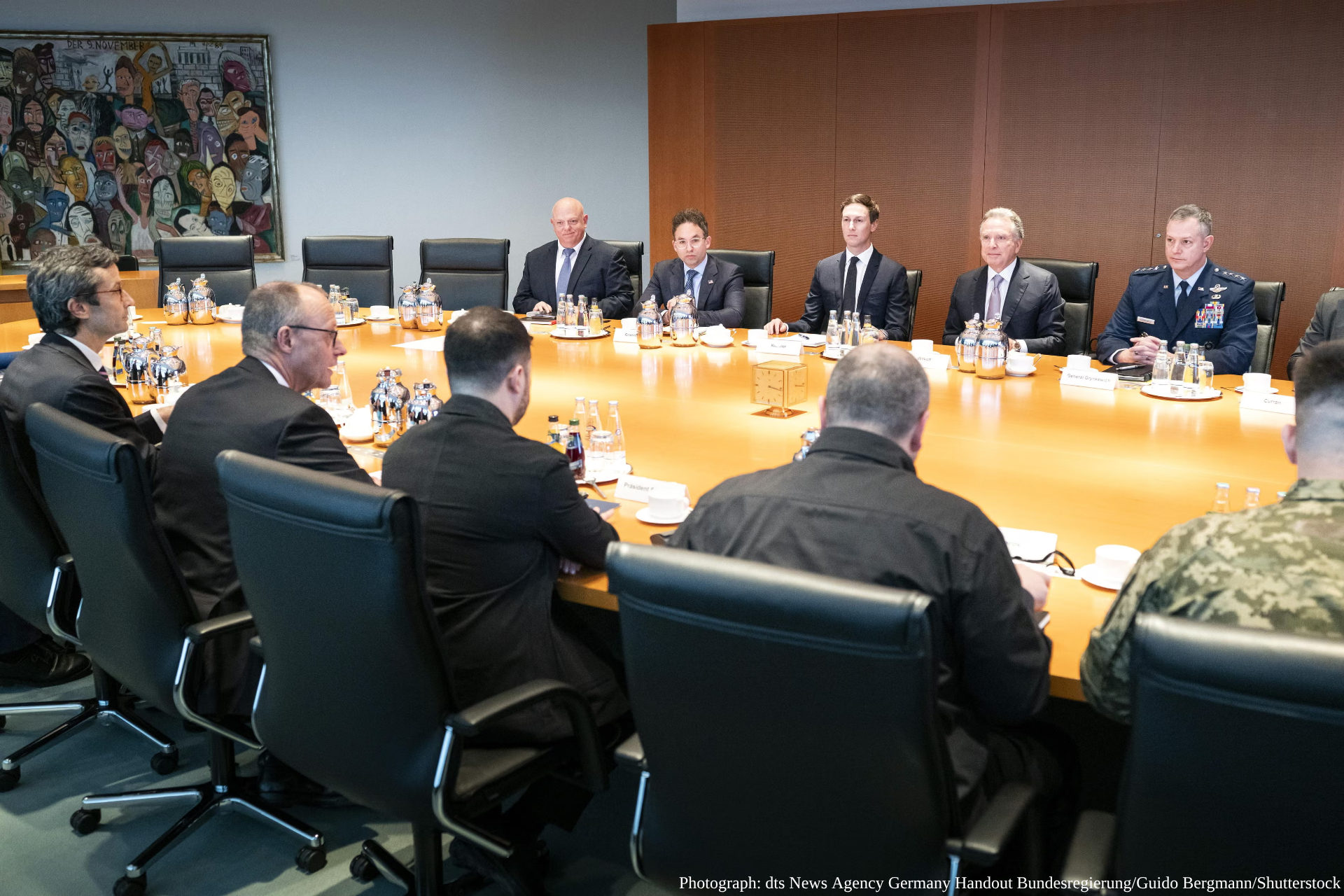 Volodymyr Zelenskyy and the Ukrainian delegation meet the US delegation led by Steve Witkoff and Jared Kushner on Sunday in Berlin
US Special Envoy Steve Witkoff stated that “a lot of progress” was made during the December 14 meeting, which also involved Donald Trump’s son-in-law, Jared Kushner. Ukraine, which has been fighting a “grinding war” since Russia invaded in February 2022, hopes to persuade the United States that any ceasefire must be agreed upon without prior territorial concessions to Russia.
However, an official familiar with the talks told AFP on December 15 that U.S. negotiators still want Ukraine to give up control of Donbas as a condition for talks with Russia.
Russian President Vladimir “Putin wants territory,” the official said, adding that the United States is demanding that Ukraine “withdraw” from these oblasts and that Kyiv is “not agreeing” to this demand.
“It’s a bit striking that the Americans are taking the Russians’ position on this issue,” the source said.
According to the Bild newspaper, Ukraine categorically rejected the US initiative regarding the creation of a so-called “demilitarized economic zone” in Donbas, considering it a threat to national security.
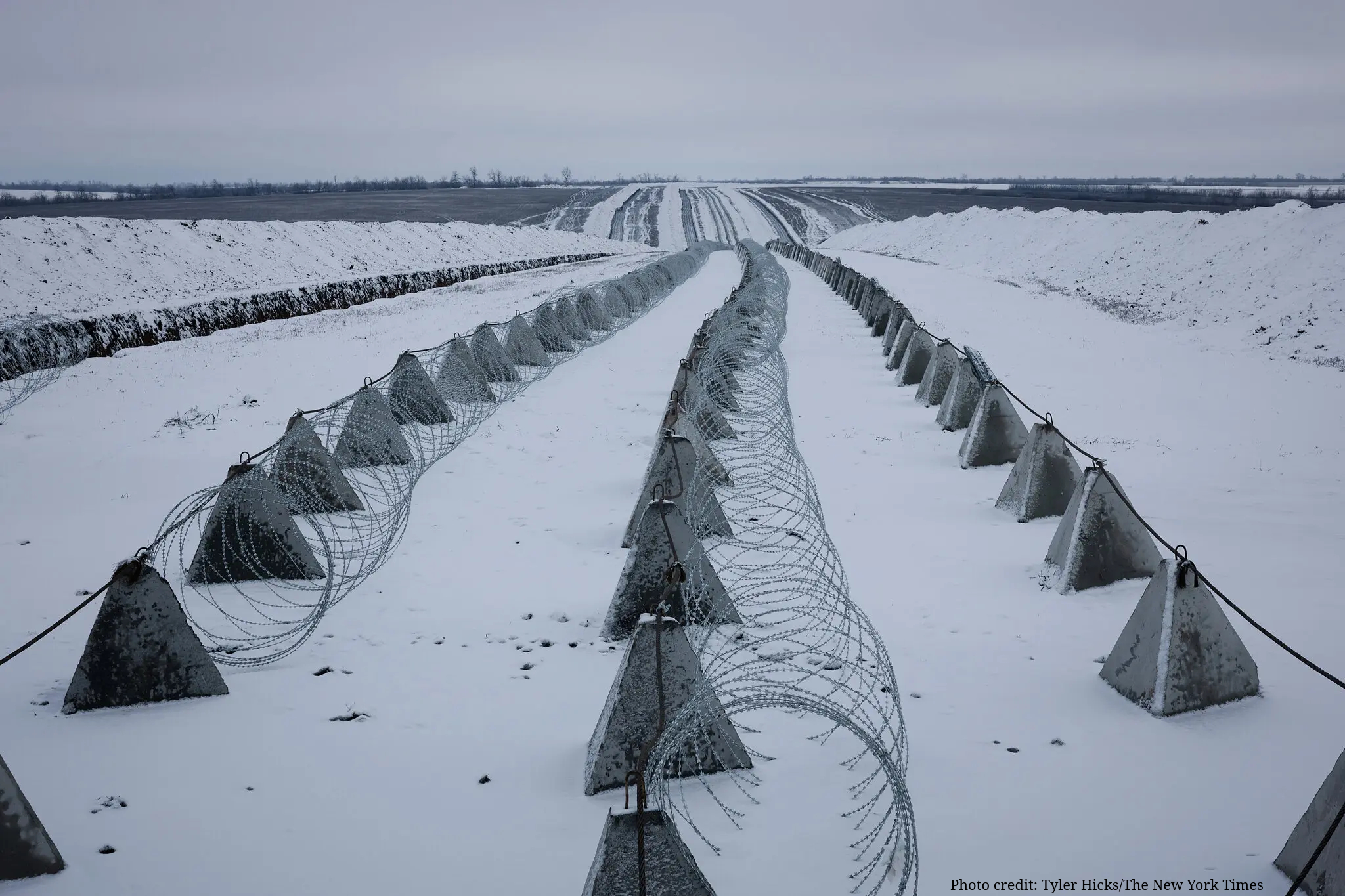 Ukrainian law prohibits ceding territory that had not been occupied by military force
The newspaper described the Ukraine-Russia negotiations in Berlin as complex and tense. At stake, according to the parties’ assessments, was a fundamental question: whether it would be possible to stop the active phase of hostilities after more than 3.5 years of full-scale Russian aggression, or whether the war would remain just as intense moving forward.
At the core of the negotiation process, according to Bild, lies a 28-point US plan for settling the war, which contains a number of provisions with a tangible pro-Russian bias. Among them is a requirement for Ukraine to effectively renounce its course toward NATO membership, as well as the holding of early elections within a tight timeframe — within 100 days.
You may also want to read: Majority of Ukrainians are against elections during the war – poll
BBC News reported that, ahead of the start of the meeting, Volodymyr Zelensky signalled that he would give up his ambitions to join NATO in exchange for security guarantees.
Point 21 of the proposed plan drew particular criticism in Ukraine. It notes, in particular, that temporarily occupied Crimea, as well as the Luhansk and Donetsk regions, are de facto recognized as Russian. It is proposed to “freeze” the Kherson and Zaporizhzhia regions along the current front line.
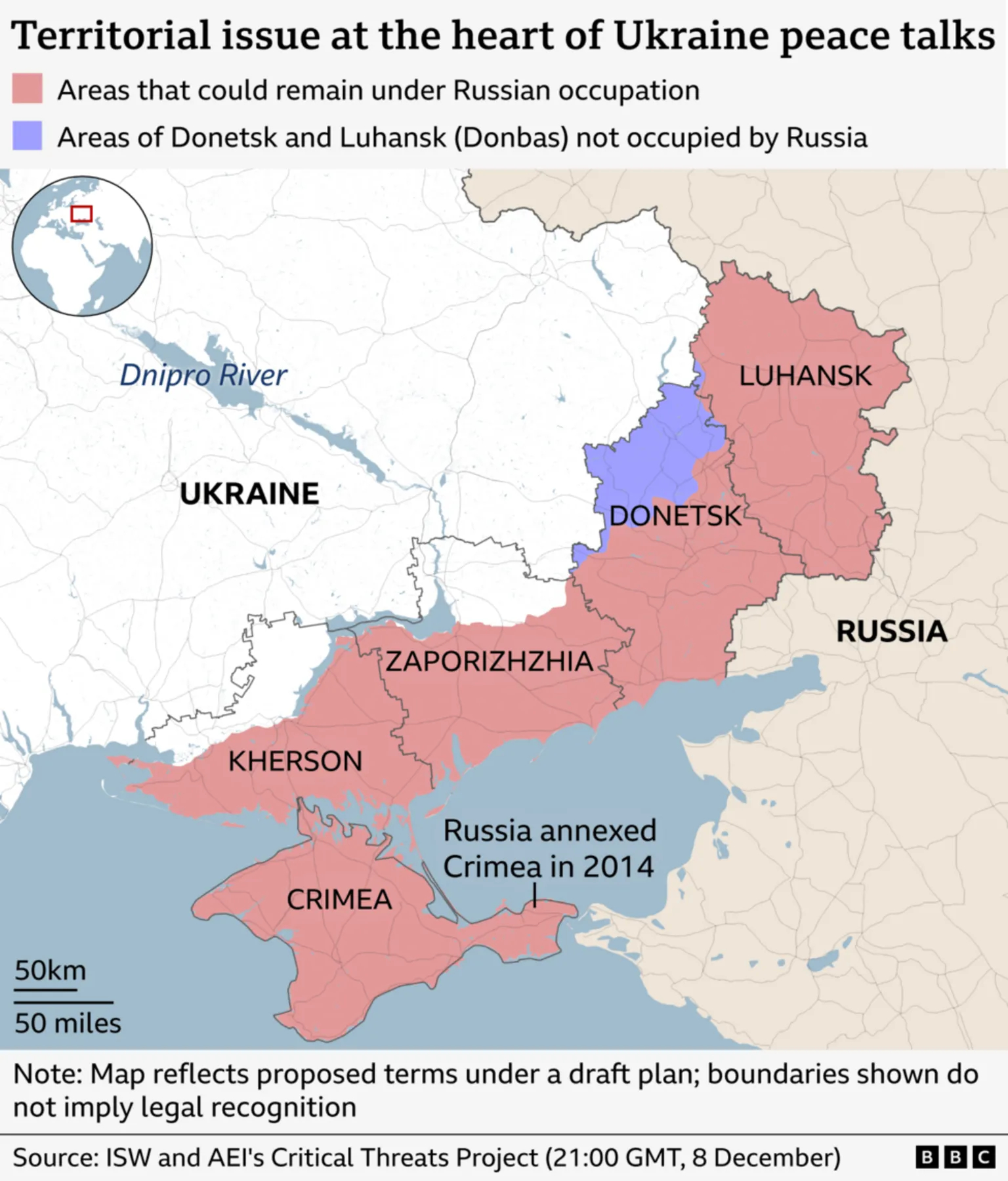
Furthermore, the document provides for the withdrawal of Ukrainian troops from the controlled part of the Donetsk region, which, according to the plan’s authors, would receive the status of a demilitarized territory with international recognition of Russian control.
Although, according to the Bild, Volodymyr Zelenskyy does not rule out the option of freezing the front and temporary de facto Russian control over already temporarily occupied territories — Crimea, and parts of the Donetsk, Luhansk, Zaporizhzhia, and Kherson regions — he considers the issue of a full withdrawal of the Armed Forces of Ukraine from the Donetsk region unacceptable under any circumstances.
As Bild writes, in response to this position, the United States put forward another idea — the withdrawal of Ukrainian troops from approximately 5,600 square kilometers of the Donetsk region with the subsequent creation of a “demilitarized economic zone” there. Formally, such territory would not pass under the control of the Russian army.
Russia, according to journalists, immediately supported this initiative, stating its readiness to send “only National Guard units” to the territories vacated by Ukraine. At the same time, Kyiv emphasizes that these forces are effectively a full-fledged element of the Russian war machine and participate directly in combat operations.
Also on December 14, Volodymyr Zelenskyy publicly reacted to such a proposal, stating that he considers it neither fair nor safe.
The President drew attention to the lack of a clear mechanism for managing such an “economic zone” and emphasized that there are no real guarantees that Russia will adhere to its obligations. In Kyiv, there are fears that after the withdrawal of Ukrainian troops, these territories could be quickly occupied under another pretext.
You may also want to read: Crimean Tatar leader responds to Trump’s remarks, citing international law: Only Ukraine and Crimean Tatars can determine Crimea’s fate
A high-ranking Ukrainian official emphasized in a comment to Bild that implementing such a scenario would effectively mean the defeat and capitulation of the Ukrainian army. According to him, Kyiv is not ready to agree to unilateral steps without symmetric actions from Russia.
Later in the evening of December 15, Zelenskyy accompanied German Chancellor Merz to the press briefing, where he stated that he doesn’t consider the United States of America to have demanded anything. He perceives the U.S. as a strategic partners.
“Therefore, I would phrase it this way: we heard the issue of territories regarding the Russian vision or Russian demands from the United States of America. We perceive this as the demands of the Russian Federation. I also could not demand anything from the United States of America, but I conveyed to my colleagues from the United States of America that they should convey our vision to the Russians. That is how I would answer your question. That is why I said there are sensitive issues. We exchanged thoughts, and we also hear the vision of the Russians, or their goals. Well, we are making efforts to explain our position. And I am glad that we are being heard,” the President said.
Earlier, eight Ukrainian human rights organizations called on all parties in the negotiation process to consider the interests of Ukrainian citizens living in the temporarily occupied territories (ТОТ) of Ukraine. In a joint statement, the organizations underlined the fact that ensuring the rights and interests of TOT residents must be part of the agreements within the negotiation process. The organizations also presented a ten-point list of specific steps that the occupying authorities must implement.
Among the specific steps that should be part of the negotiation process, the organizations highlighted:
- Release of all civilians arbitrarily detained by representatives of the Russian armed forces or the occupation authorities;
- Cessation of Russia’s unlawful practice of criminal and administrative persecution and detention of Ukrainian citizens in the TOT of Ukraine, which is used as an instrument of intimidation and political pressure;
- Determining the temporary line of contact and establishing temporary checkpoints to allow entry and exit from the TOT of Ukraine to areas that are controlled by the Ukrainian government and vice versa (humanitarian corridors);
- Granting humanitarian access for international organisations to the TOT of Ukraine by the Russian Federation, with the possibility of direct humanitarian assistance to Ukrainian citizens;
- Providing available information and access to the TOT of Ukraine to search teams to establish the location of persons missing under special circumstances;
- Ensuring the presence of international observation (monitoring) missions in all TOT of Ukraine, in particular to monitor the human rights situation;
- Demining of settlements and civilian infrastructure in the TOT of Ukraine;
- Ensuring that Ukrainian citizens can reside in the TOT of Ukraine without the need to obtain a Russian passport or any other documents granting the “right to reside” in the TOT of Ukraine, in accordance with the Russian legislation illegally extended to the TOT of Ukraine;
- Ensuring unimpeded access of Ukrainian citizens in the TOT of Ukraine to medical services, social and pension benefits, education, property rights, and freedom of movement, and independent sources of information;
- Ensuring that residents of the TOT of Ukraine who have been forcibly displaced to the territory of the RF or within the TOT of Ukraine are able to return to their homes or leave for the territory controlled by the Government of Ukraine.
Any delay in the liberation of the territories temporarily occupied by Russia will lead to the complete destruction of Ukrainian and Crimean Tatar identities there, Alena Lunova, advocacy director of the ZMINA Human Rights Center, stated live on “Radio Nakypilo.”
The human rights advocate called a proposal to discuss the de-occupation of the temporarily occupied territories in 49 years, as was voiced during talks with the aggressor country, unacceptable. She noted that the aggressor nation, in violation of international law, is demanding that Ukrainian citizens in the occupied territories obtain Russian passports or a foreigner’s document, among other things.
-
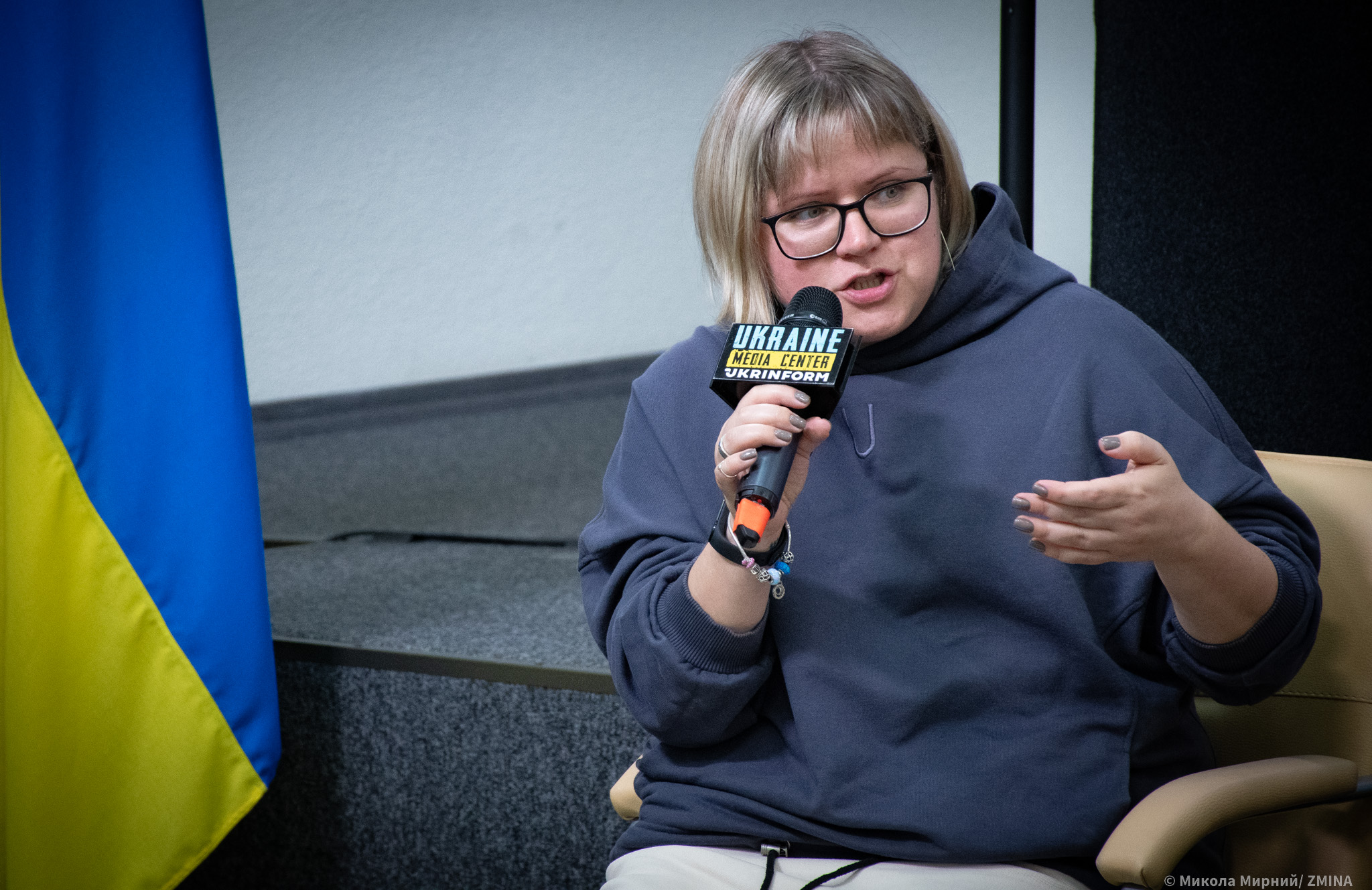 Alena Lunova
Follow ZMINA on X and LinkedIn for daily human rights coverage from Ukraine – we invite you to share your feedback on what you’d like to see more of in our survey here.