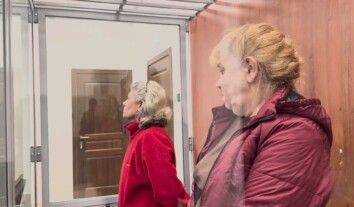
Ukrainian court orders pension fund to stop unlawful deductions from care home resident
Ihor Korshev, an evacuee from Kramatorsk living in a care home in the Poltava Region (Oblast), has challenged the unlawful deduction of 75% of his pension in court, disability rights organisation Fight For Right reported. People with Group I disabilities and internally displaced persons (IDPs) are entitled to receive residential social care free of charge.
 Ihor Korshev. Photo credit: Fight For Right
Korshev has a Group I visual disability as well as physical disabilities resulting from an illness and spinal surgery. In July 2023, he evacuated from Kramatorsk, in the Donetsk Region (Oblast). He chose a geriatric care home in the Poltava Oblast to live in, hoping to return to the Donetsk Oblast after just a few months.
After living independently at home, residing in the institution felt to Korshev like a “semi-prison regime”. According to Korshev, the facility lacks accessibility entirely. He said his rights were violated, including being denied the ability to know the names, expiry dates and instructions for the pills administered to him. Korshev was also prevented from reading his personal letters independently. His room has no television, radio or internet access.
Residents at the home are forbidden from preparing or even reheating their own groceries, such as dumplings or drinking water bought with their own money. For more than a year and a half, Korshev bought additional food and bottled water at his own expense.
The administration of the Horbanivka geriatric care home, where Korshev has lived since July 2023, deducted 75% of his pension to fund the facility. He was left with between 690 and 931 hryvnias per month. Over nearly three years, 81,686 hryvniasі was withdrawn from Korshev’s accounts.
Korshev took legal action. In April 2026, the Poltava District Administrative Court ruled that the Pension Fund of Ukraine’s inaction was unlawful and ordered it to stop the illegal 75% deductions and restore full 100% payments to Korshev. Under the Law on Social Services, people with Group I disabilities and IDPs are entitled to receive all residential social care services free of charge at the state budget’s expense.
During the court proceedings, it emerged that the basis for deducting 75% of the payments was an “application” dated 18 July 2023, submitted by the care home administration to the Main Directorate of the Pension Fund of Ukraine in the Poltava Oblast. The document bore Korshev’s purported signature, although he said he had not signed it.
“They have an established system: they cite the 2003 law on mandatory pension insurance, ignoring the 2019 Law on Social Services. There are 30–35 people with Group I disabilities here, and they take this money from everyone. I am fighting not only for myself,” Korshev said.
According to Korshev, the institution lacks proper care, subsidised medical care and mandatory health screenings.
“The barriers to accessing medicines and rehabilitation, along with the inadequate care described by Ihor, are not simply negligence by individual employees, but a systemic practice of inefficiently using budget funds,” Fight For Right pointed out.
According to a study by Fight For Right and the Institute of Analytics and Advocacy, titled The Value of the System Above the Value of the Person: The Economics of Institutions in Ukraine, maintaining a single person at the Horbanivka geriatric care home in 2025 cost the state 19,618 hryvnias per month (over 235,000 hryvniasі per year). However, about 67% of these funds were spent on staff wages and maintaining the facility itself. Only about 2–3% (400–600 hryvnias per month per person) was allocated for medicines and dressings, while up to 15% went towards food.
In seeking to recover material and non-pecuniary damages from the care home, Korshev encountered the bureaucratic formalism of the judicial system. The Shevchenkivskyi District Court of Poltava returned his claim because his representative was not a licensed lawyer. The courts disregarded the fact that a blind person may need a representative they trust and have chosen themselves, and failed to apply the principle of “reasonable accommodation” enshrined in Articles 2 and 13 of the UN Convention on the Rights of Persons with Disabilities. The case reached the Civil Cassation Court within the Supreme Court, and in September 2026, due to the courts’ disregard for the UN convention and the restriction of his right of access to justice, Korshev referred the case to the European Court of Human Rights (ECHR).
Korshev continues to fight from within the care home. His case clearly illustrates the consequences of an evacuation policy that is not geared towards protecting human rights, Fight For Right emphasised. A person with a disability seeking an independent life is thus trapped in a vicious circle of disempowerment, financial exploitation and the deprivation of fundamental rights.
At the end of 2024, the Ukrainian government approved a strategy for reforming psychoneurological and other residential care facilities and the deinstitutionalisation of care for adults with disabilities and older people until 2034, along with an operational action plan for 2025–2027. Implementing deinstitutionalisation reform is among the European Commission‘s requirements for Ukraine’s EU integration process.
ZMINA previously reported that the private care home Oberih for older people in Kharkiv had been violating residents’ rights to safety, human dignity, privacy, medical assistance and legal protection. Inspections of the facility since 2023 had failed to improve the situation, Ukraine’s Human Rights Ombudsman said.
Stay connected with us via X, Bluesky and LinkedIn – and while you’re here, please spare five minutes to fill out our survey and tell us what you’d like to see next.