The Mission of the President of Ukraine in the Autonomous Republic of Crimea named the key Russian and occupation agencies responsible for the deportation of Ukrainian children
Russian occupation authorities have established a comprehensive vertical of command that ensures systematic actions by the Russian Federation regarding the deportation, displacement, and assimilation of Ukrainian children, using the temporarily occupied Autonomous Republic of Crimea and the city of Sevastopol as key platforms, the research by the Mission titled “CRIMEA: A Transit Hub for the Transfer and Ideological Indoctrination of Children” concluded.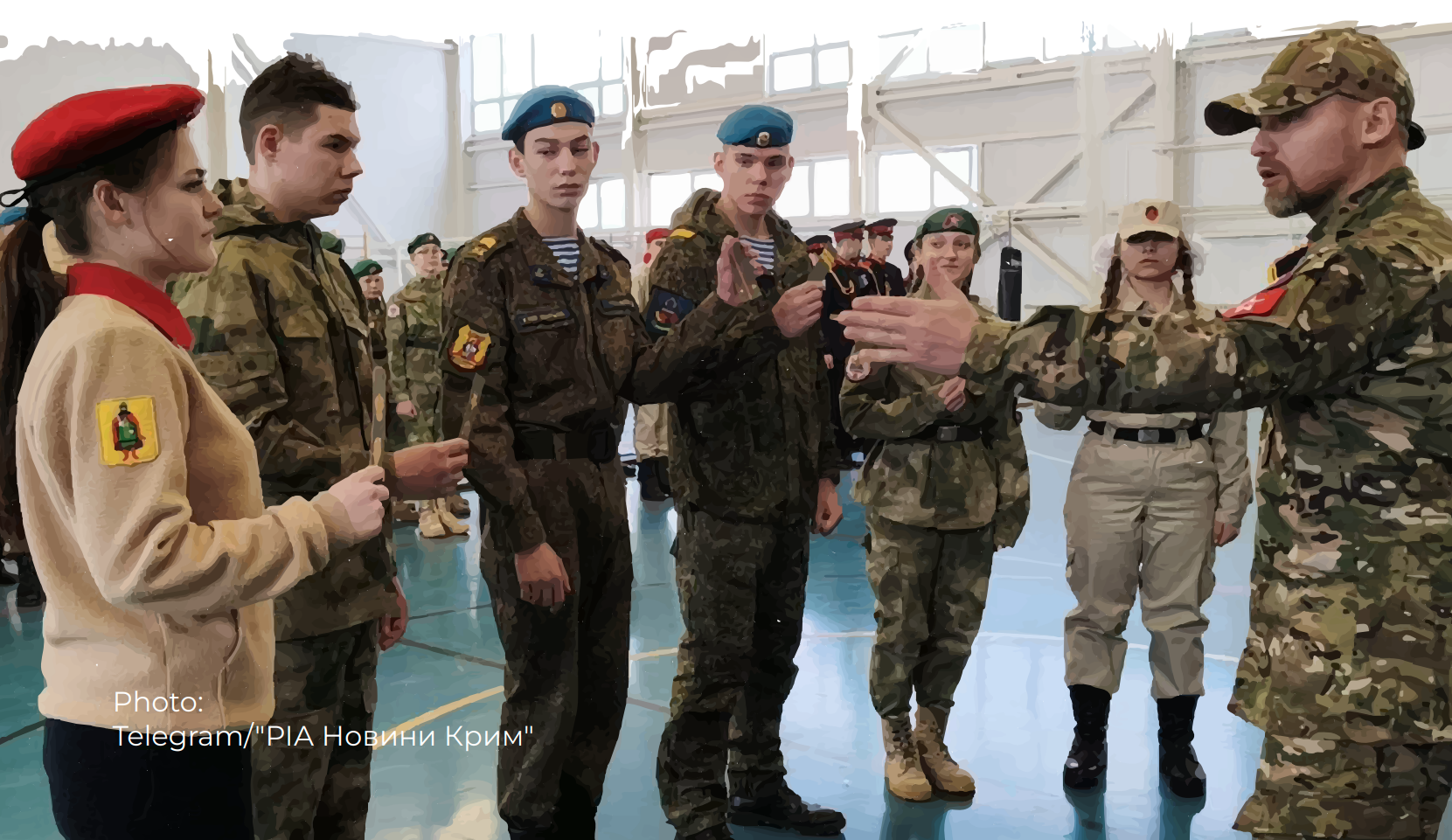
The Mission of the President of Ukraine in the Autonomous Republic of Crimea pointed out that the Russian occupiers have established this vertical by involving a number of institutional structures at both the federal level of the Russian Federation and the local occupation administrations.
The key executors of the deportation policy at the local level are the occupation administrations, specifically:
- So-called education, healthcare, and social protection authorities of the “Republic of Crimea”: They organize the educational process in facilities receiving the children, monitor their health, and ensure their “placement” in specialized institutions.
- Occupying “guardianship and care bodies”: They play a decisive role in determining the legal status of deported children, handling their registration and preparing documents for changing citizenship, adoption, or transfer under guardianship.
- “Administrations of municipal entities”: They are responsible for the local coordination of placing children in various districts of Crimea and ensuring the logistics and material support of children’s institutions.
A particularly important task of these bodies is the organization of programs that are officially presented as “recreation”, but in essence are ideological in nature. They are designed to transform children’s identities through their participation in cultural, educational, and patriotic activities.
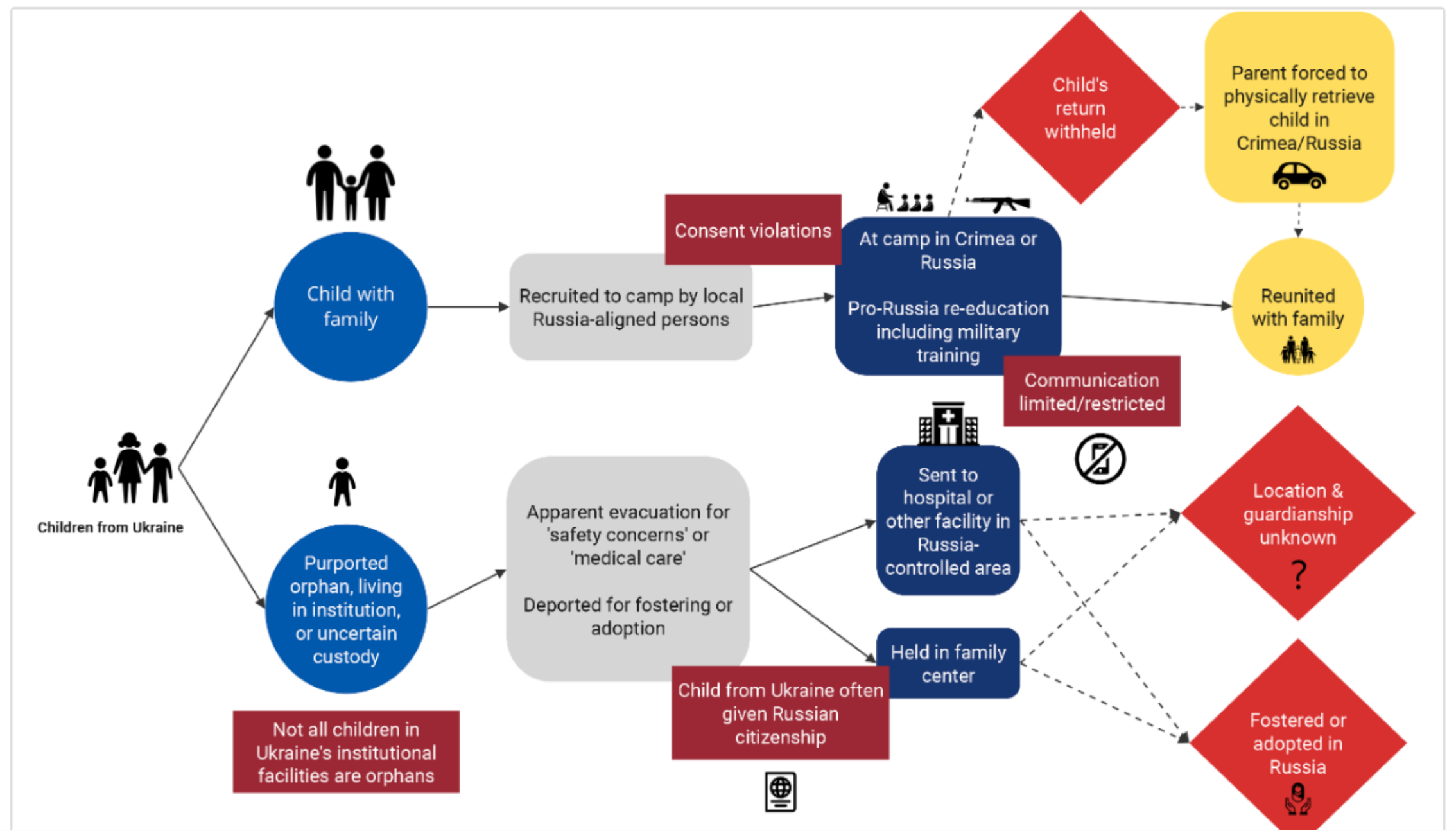 Yale Humanitarian Research Lab. Courtesy of Yale Humanitarian Research Lab
At the federal level, an important role in implementing the deportation policy is played by federal agencies, which cooperate closely with the Crimean occupying bodies. Among them are:
- The Ministry of Education of the Russian Federation, which defines learning standards, prepares educational materials with pro-Russian ideology, and coordinates educational programs implemented in Crimea.
- The Ministry of Defense of the Russian Federation, which participates in the child militarization program through support for military-patriotic camps and conducting joint actions involving children in exercises that simulate military operations;
- The Federal Security Service (FSB) of the Russian Federation, which ensures control over the security of deportation processes, conducts filtration procedures, escorts convoys with children, and controls information flows;
- The Commissioner for Children’s Rights under the Russian President, who plays a key role in the public justification of child deportation, maintains state registries of deported minors, and lobbies for the simplification of adoption procedures for Ukrainian children by citizens of the Russian Federation.
You may also want to read: The Council of Europe, the EU, and 38 countries called on Russia to return the kidnapped Ukrainian children without delay and any conditions
In addition to state structures, significant roles are played by so-called civil society organizations and volunteer movements, which often serve as a facade for state programs. Among them are:
- Charitable foundations and public associations that officially declare assistance to children but in reality are an instrument of displacement and manipulation;
- Youth organizations, such as “Yunarmiya”, which engage in training children within the framework of patriotic education and organize stays in military camps;
- Groups of “volunteers” who are involved in logistics — escorting convoys of children, providing “psychological assistance,” and helping them adapt to the new environment.
The institutional structure operates in a format of close interaction. At the federal level, key directions and policies are defined; at the local level, practical implementation is ensured; and public and pseudo-volunteer associations perform auxiliary functions.
“At the same time, all these elements are controlled from a single center and act synchronously to achieve the strategic goal – the denationalization of Ukrainian children through their physical, cultural, and psychological alienation from Ukraine,” emphasized the Mission of the President of Ukraine in the Autonomous Republic of Crimea.
Earlier, ZMINA reported that Russia systematically settles temporarily occupied territories with Russians, persecutes Ukrainians, and changes the national identity of Ukrainian children. To respond to any violations of international law by Russia, it is important that the Special Tribunal for the Crime of Aggression against Ukraine finally becomes operational.
You may also want to read: Ukraine refutes Russia’s claims of “fully processing” list of abducted children
In December 2025, the Russian State Duma adopted a law that lowered the age for the mandatory oath when acquiring Russian citizenship from 18 to 14 years. Commenting on this law, Onysia Syniuk, a legal analyst at the ZMINA Human Rights Center, noted that Russia deliberately creates conditions in the temporarily occupied territories where it is impossible to survive without Russian citizenship.
In particular, without it, it is difficult to confirm the completion of secondary education. This policy is aimed at cementing the children’s connection to Russia and the gradual erasure of their Ukrainian identity.
In addition, earlier, ZMINA reported that in 2025, the network of institutions in Russia and the temporarily occupied territories of Ukraine involved in the transfer of Ukrainian children to camps in Crimea and in Russia has expanded. This year, Russia removed nearly 11,000 Ukrainian children to 164 institutions.
In early December 2025, the UN General Assembly supported a resolution demanding that the Russian Federation return all Ukrainian children forcibly removed and deported since 2014.
Join our community on X and LinkedIn, and while you’re reading, let us know how we can serve you better – take our feedback survey here.