International Criminal Court declares Tajikistan’s failure to execute arrest warrant for Putin
The International Criminal Court has stated that Tajikistan failed to comply with its obligations to arrest Russian President Vladimir Putin during his presence on the country’s territory.
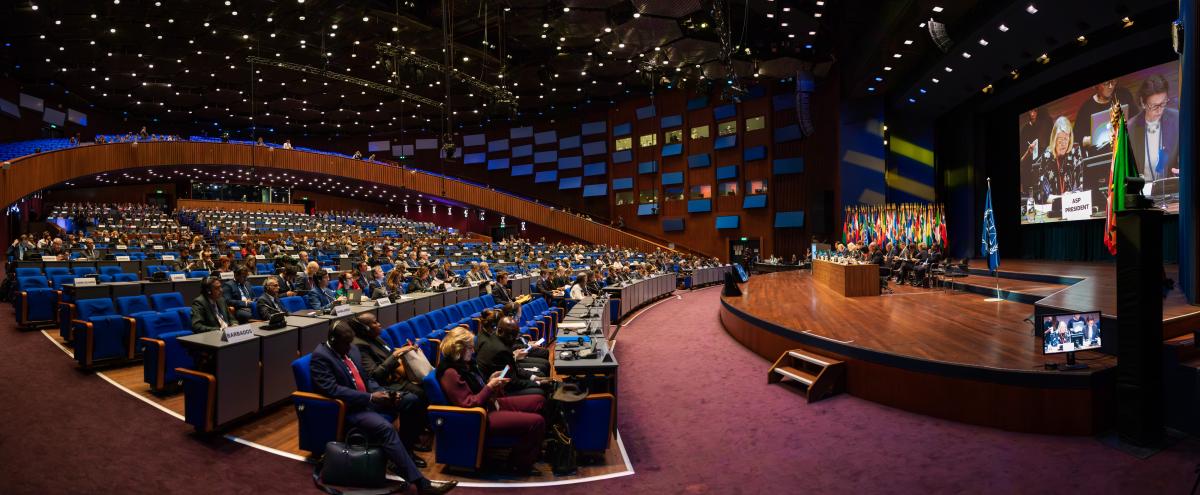 Photo credit: the International Criminal Court
Pre-Trial Chamber II found that Tajikistan failed to comply with its international obligations under the Statute by not executing the Court’s request for the arrest and surrender of Putin while he was on Tajikistan’s territory. The Pre-Trial Chamber referred Tajikistan’s non-compliance through the President of the Court to the Assembly of States Parties in accordance with regulation 109(4) of the Regulations of the Court.
A representative of Tajikistan was invited to a Bureau of the Assembly of States Parties meeting on May 6, 2026, to discuss the consequences of noncompliance with the court’s decision and future cooperation with the ICC. Following the meeting, the Bureau is expected to prepare a report and recommendations for the next Assembly session.
In its submissions, Tajikistan noted that Russia is not a party to the Statute and has not waived the immunity of its current Head of State. The country has also stated that it is a member state of the Commonwealth of Independent States (the “CIS”) since 10 October 2008, when it signed the “Agreement on Interaction among the States Parties to the Commonwealth of Independent States on Ensuring the Security of Persons Subject to State Protection”. Tajikistan indicated that, under this agreement, it “assumed an international obligation to ensure the security and unhindered movement of the heads of state of the CIS member states […] on its territory”.
The Court’s judges emphasized that the core of the issue isn’t about general international customs, but a specific obligation. They argue that once a country like Tajikistan joins the ICC, it agrees to play by its rules—specifically Article 27, which states that official titles (like ‘President’) provide no shield against prosecution.
Furthermore, the Chamber stated that a State Party that “enters into agreements or arrangements of any kind with other States with the view to uphold immunities of certain State officials who are sought by the Court, would act inconsistently with its duties and would remain duty bound to abide by the obligations under the Statute’. In this regard, the Chamber observed that Tajikistan deposited its instrument of ratification of the Rome Statute on May 5, 2000, and appears to have signed the CIS Agreement on October 10, 2008.
The Chamber also noted in passing that article 11 of the CIS Agreement – which is publicly available – appears to expressly acknowledge that the CIS Agreement does not affect the rights and obligations of each party arising from other international treaties to which it is a party.
“In light of the foregoing, clearly the CIS Agreement does not affect the obligation of cooperation that Tajikistan owes to the Court under the Statute. As to the second agreement relied upon by Tajikistan cited above, the Chamber notes that Tajikistan did not include a copy thereof in its submissions,” the ICC judges stated.
To provide background, the International Criminal Court issued an arrest warrant for Vladimir Putin in March 2023. The Russian President is suspected of the unlawful deportation of Ukrainian children from the temporarily occupied territories of Ukraine to the Russian Federation.
You may also want to read: Statement of non-governmental organizations addressed to the Members of the International Coalition for the return of Ukrainian children
In October 2025, Russian dictator Putin visited Tajikistan for a series of summits; however, the country’s authorities ignored the International Criminal Court’s requirements to arrest the Russian leader on suspicion of involvement in the deportation of Ukrainian children.
Follow ZMINA on X, BlueSky, and LinkedIn for daily human rights coverage from Ukraine – we invite you to share your feedback on what you’d like to see more of in our survey here.