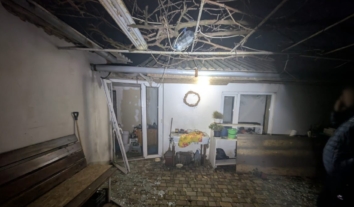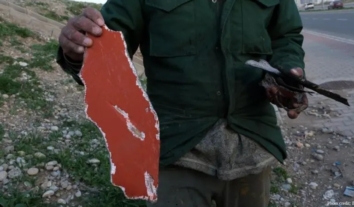
Russia’s aggression against Ukraine is a classic neo-colonial war for the enslavement of an entire people
Good morning, esteemed colleagues, distinguished ambassadors.
[…] Despite nearly 12 years of temporary occupation of the Autonomous Republic of Crimea and almost four years of full-scale Russian aggression, the world has remained committed to supporting Ukraine’s aspirations to restore sovereignty and territorial integrity within internationally recognized borders.
It is important to us that interest in Ukraine resonates not only in Europe or North America – we are known and supported by countries in Africa, Asia, and Latin America.
The annual Crimea Global conference, now taking place in Kyiv for the third consecutive year, has become a unique platform where representatives from various regions of the world discuss the issue of Crimea. Your interest proves that the consequences of Russian aggression affect not only Ukraine but global security.
It is very important that among the participants are many who have dedicated themselves to the protection of human rights. Indeed, ensuring fundamental human rights and freedoms is more relevant today than ever for residents of temporarily occupied Crimea. The same applies to other temporarily occupied Ukrainian territories, where Russia systematically violates international humanitarian law.
Russia attempts to convince the world that Crimea has always been Russian. But historical reality is different: imperial annexation at the end of the 18th century, colonization of the peninsula, Stalin’s deportation of Crimean Tatars in 1944, and decades of prohibition on their return.
Today, the occupation is accompanied by the closure of Ukrainian schools, environmental catastrophes, the removal of cultural treasures, mass human rights violations, and the indoctrination of Ukrainian children. For Russia, Crimea is a resource, a resource for imperial ambitions, military power in the Black Sea and Mediterranean, a resource for seizing new territories and attempting to return to a 19th-century world where a state’s greatness is supposedly determined not by the dignified lives of its citizens or technological development, but by nuclear weapons and the capacity to enslave people.
That’s why I would like to emphasize: Russia’s war against Ukraine is not simply a war for territory. This is a classic neo-colonial war, where the world’s largest country by area is fighting not for kilometers, not even for thousands of kilometers, but for the enslavement of an entire people.
For the Kremlin, Ukrainians are a resource for restoring an imaginary empire and further subjugation of peoples who once belonged to the imperial core. This is the mentality of past centuries, the same mentality from which colonized peoples suffered for many centuries and against which they fought.
The entire world understands that colonial empires are in the past, except for Russia.
Kenya’s Permanent Representative, my former colleague at the UN, Martin Kimani, speaking three days before Russia’s full-scale aggression at the Security Council regarding the situation in Ukraine, stated:
“We must complete our recovery from the embers of dead empires in a way that does not plunge us back into new forms of domination and oppression.”
The myth of the world’s second-strongest army has been destroyed. It has been proven that Russia is unable to uphold its agreements and that the treaties signed with it are not worth the paper they are written on.
The Kremlin also views its international partners as resources. We see how citizens of African, Asian, and Latin American states who come to Russia – as Ms. Iryna Mudra [Head of the Office of the President of Ukraine] mentioned – for education or work are recruited into the Russian army and defense sector. Those who manage to survive and are captured ask their governments to return them home. But it is better to prevent people from getting into such situations in the first place.
Hopefully, the media and experts who are here will bring home the truth to their citizens. Life is more valuable than money. Russia treats foreigners the same way it treats its own citizens—as expendable material. Despite the efforts of international partners, including President Donald Trump of the United States and European leaders, Russia has yet to demonstrate readiness for peace.
This year marks the 80th anniversary of the UN’s establishment. The fifth summit of the International Crimea Platform took place on the sidelines of the UN General Assembly high-level segment, reaffirming commitment to the principles of peaceful coexistence and the inadmissibility of aggression.
Eighty years ago, in November 1945, the Nuremberg Tribunal commenced its work. The result of its work was holding Nazi criminals accountable for crimes against peace, war crimes, and crimes against humanity committed during World War II.
Russia’s aggressive war must also end with those guilty of similar crimes being held accountable.
Ukraine contributes to global security not only on the battlefield. The Grain from Ukraine program demonstrates that, even under shelling, we help countries suffering the most from food shortages. This is our contribution to supporting the peoples of the southern nations, who understand well the price of freedom.
By destroying port infrastructure, Russia hinders Ukrainian grain exports. Russia deprives peoples suffering from hunger of Ukrainian grain and food […].
Lasting peace is possible only with unconditional adherence to international law. I would also like to conclude my speech with a reminder that by the will of the Almighty, Crimea has become a highly symbolic place.
It was in Crimea, not in San Francisco, that the United Nations was conceived. I continue to speak about this tirelessly both in New York and here. It was in Crimea that the foundations of the future organization’s mechanism were laid, which enabled the Soviet Union and the permanent members of the Security Council to exert global dominance. Later in San Francisco, these agreements were expanded and documented in writing.
It is no coincidence that Yalta was not only in 1945 a place of very dangerous agreements. I would like to remind you that in 1975, a summit was held in Helsinki, following which the Helsinki Final Act was signed.
 Photograph of President Gerald R. Ford Signing the Final Act of the conference on security and cooperation in Europe as It is Passed Among European Leaders for Signature in Finlandia Hall in Helsinki, Finland — NARA
One of the principles behind that treaty is the principle of the inviolability of borders. However, I would like to remind you that, in my opinion, it is no coincidence that the Helsinki summit was referred to as “Super-Yalta” by The New York Times in 1975. It will be a revelation for many of you that it was Moscow that insisted on the inclusion of the principle of the inviolability of borders in the Helsinki Final Act.
This is an evil irony. The inviolability of borders was championed by Moscow at a time when many Western countries opposed this principle being included in the Helsinki Final Act, when some countries were also indifferent to whether this principle should be in the document.
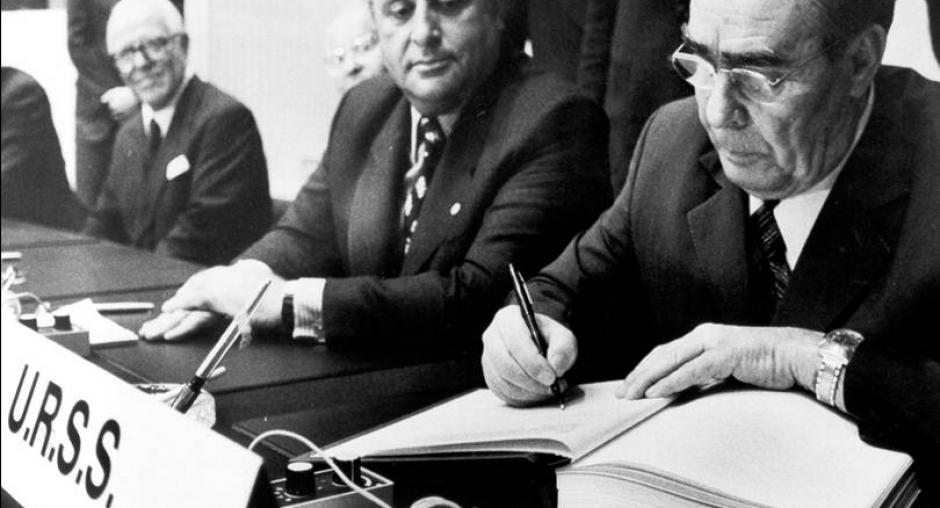 Leonid Brezhnev, General-Secretary of the Communist Party of the USSR, signing the Final Act, with Turkey’s Prime Minister Suleyman Demirel to the left, Helsinki, 1 August 1975. (AKG Photo Berlin)
It was laid down by Moscow and later violated by Moscow, which once again demonstrates that Moscow cannot be trusted to adhere to its word, that what Moscow signs cannot be trusted, and that policies and actions must be based solely on a sober assessment of Moscow’s actions.
Helsinki became a symbolic city not only because the Final Act was signed there in 1975, but also because, in 2019, as demanded by many European countries, despite fierce resistance and protests from Ukraine and the Baltic states, the Russian Federation was readmitted to the Parliamentary Assembly of the Council of Europe.
In a few weeks, an OSCEі ministerial-level summit will take place in Helsinki, and it is our duty to ensure that this meeting does not become Super-Yalta 2.
Therefore, I believe that the discussion that will unfold today at the [Crimea Global] conference should help politicians, experts, and journalists navigate the world of propaganda and fakes that dominate to this day.
Thank you very much.
English-language support: ZMINA volunteer Lisa DeHaven