A life in defence of dignity: Oleksandr Hatiiatullin’s legacy, devoted to human rights
On 16 September 2025, the human rights community in Ukraine was deeply saddened by the news that Oleksandr Hatiiatullin had been killed on the front line during a combat mission. He was a dedicated human rights advocate, co-founder and first Chair of the Board of the NGO Ukraine Without Torture, former representative of the Ukrainian Parliament Commissioner for Human Rights in custodial settings, and monitor of the National Preventive Mechanism (NPM).
In March 2022, Hatiiatullin joined the Armed Forces of Ukraine and rose through the ranks from soldier to senior sergeant, from driver to fire platoon commander, from cadet at a school of tactical medicine to combat medic. Oleksandr carried out combat missions in the Donetsk and Sumy regions. He was also awarded several distinctions and honors, including a commemorative badge from the 43rd Separate Artillery Brigade named after Hetman Taras Tryasyl, a “War Veteran” badge, and a “Cross of Valor” medal from the Ministry of Defense of Ukraine.
In a farewell post on social media, colleagues from the NGO Ukraine Without Torture remembered Oleksandr as a cheerful and positive person who, despite his military service, found time for community work even during brief leaves.
According to testimonies collected by ZMINA — from his colleagues, relatives, and friends – Oleksandr’s death is an irreparable loss for the human rights movement in Ukraine.
This article tells the story of how Oleksandr Hatiiatullin came to human rights work, the projects he led, the passions that inspired him, and how, through his own example, he motivated colleagues, friends, and even his daughter.
 Oleksandr Hatiiatullin
Path into human-rights work
Oleksandr Hatiiatullin, a young man from Mariupol in the Donetsk Oblast, served two prison sentences, experiences that gave him firsthand insight into the workings of the penitentiary system and the reforms it required.
When he was first sentenced to six years in prison, Oleksandr told ZMINA in a 2017 interview:
“I was angry. Especially since, as a former law enforcement officer, I could assess the real severity of the punishment, and it was not commensurate with what I received. I had no intention of rehabilitating myself. My sole goal was to be released and become the leader of a criminal group.“
The second time, the former criminal investigation officer was imprisoned and subjected to torture. For several hours each day, he endured gas masks, electric shocks through his fingers, handcuffs, and beatings with rubber batons. This abuse continued for a month.
“That is why I am currently working on reforming the penitentiary system of the criminal executive service. Had proper resocialisation measures been in place at that time, it is unlikely that they would have committed the crimes again,” Oleksandr said, drawing on his own experience. After these two life experiences, he decided to radically change his life.
In the early 2000s, prisons started to allow civil society organisations access. Programmes focusing on HIV prevention and social support were actively promoted. One such organisation visited the colony where Oleksandr was imprisoned. They were staff from the Donetsk organisation “Svitanok”, part of the All-Ukrainian Network of People Living with HIV (PLHIV Network). Through this, he met inspiring individuals and began to discover the world of human rights.
He later took part in the All-Ukrainian Conference of People Living with HIV. After that, he enrolled in the journalism department at Donetsk University and began writing articles for a local weekly newspaper. Soon afterward, Oleksandr began working as a social worker, visiting a local prison, and later established his own charitable organisation, Club “Maibutnie.”
Oleksandr also worked at the central office of the NGO 100% Life, learning about the National Preventive Mechanism for the Prevention of Torture in Places of Deprivation of Liberty. In 2016, he became the head of the organization of monitors of the NPM Ukraine Without Torture. It was important to him that the NPM continue to function regardless of the country’s political situation and its priorities. He believed that if the prevention of torture became official state policy, the practice itself could be eradicated. This goal is what he worked on in his civilian life.
Memories of colleagues and relatives about Oleksandr Hatiiatullin
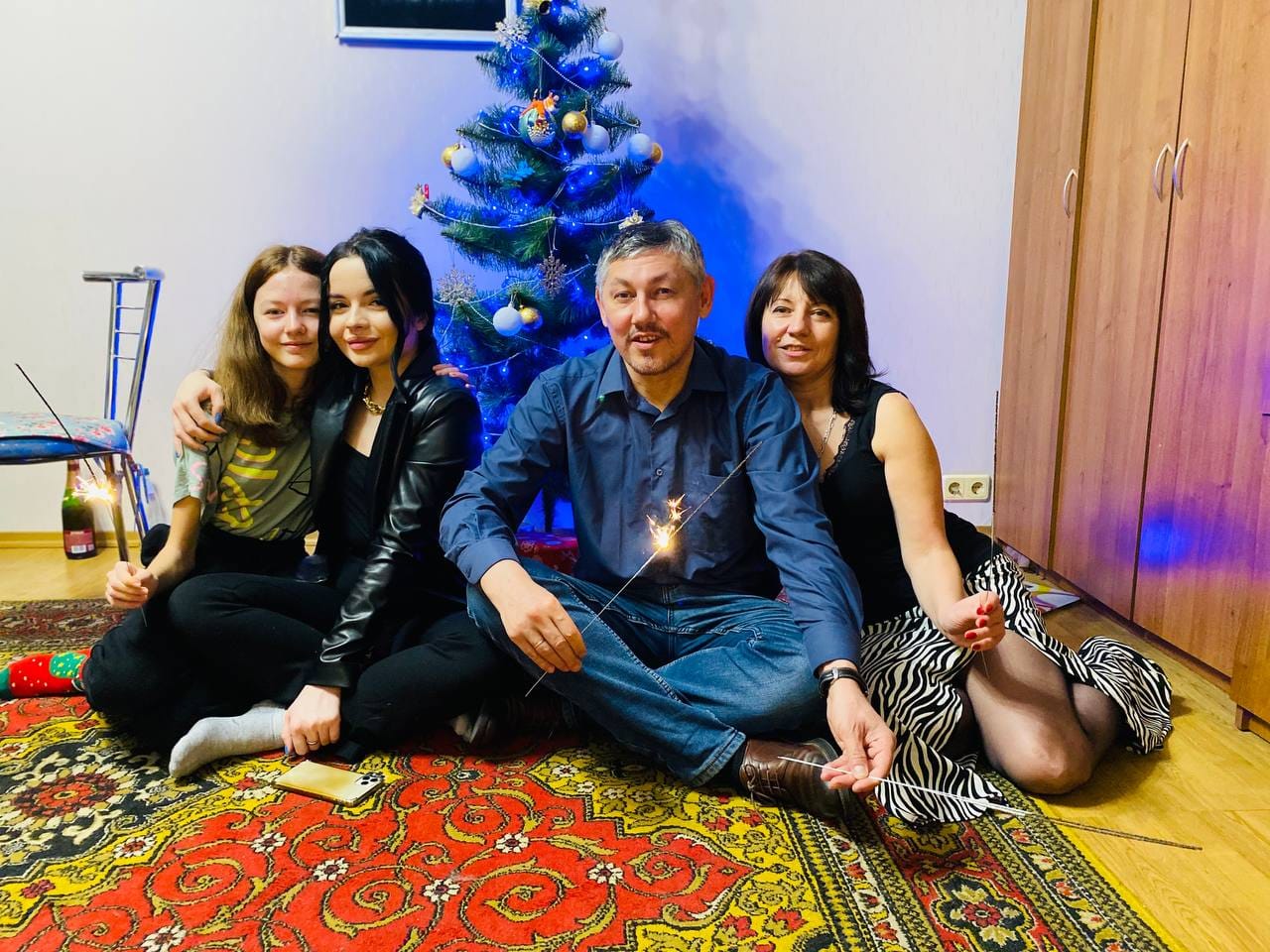 New Year 2022 celebration in the family circle of Oleksandr Hatiiatullin. Photo credit: Veronika Cherkez
Veronika Cherkez, the daughter of Oleksandr Hatiiatullin and currently the project manager of the NGO Ukraine Without Torture and an NPM monitor, says that her dad was, without exaggeration, a magnificent person. According to her, when he took on a task, he devoted himself to it entirely, giving one hundred percent. This was equally true of his human rights work, to which he devoted many years of his life.
Since 2013, he had been a monitor for the National Preventive Mechanism and had consistently advocated for a free, independent state governed by the rule of law. He often repeated, “I want my children to live in a normal, just country.”
Veronika Cherkez recalls: “When I was a child, he often took me with him to various events. We even went to Euromaidan together — I was fourteen at the time. I vividly remember standing in the centre of events, amid smoke and crowds. He smiled and said, ‘The main thing is don’t tell Mum we’re here, or she’ll stage her own Maidan at home for me.’ Perhaps it was at that moment that I realised I would one day be engaged in the same work he lived for. Dad was so passionate about his cause, so proud of what he did, that no other path existed for me.“
According to her, Oleksandr was one of those who initiated many important ideas within the NPM. In particular, in 2019, he launched the NPM regional groups project, which was later continued and scaled up by the organisation Ukraine Without Torture:
“The last time, we implemented a pilot in 20 regions — and he was the one who studied its effectiveness. This research, as it turned out, became his last. Even while serving in the Armed Forces, Dad remained engaged in human rights work — participating in activities, offering help, and finding time to visit custodial settings“.
Veronika recalls that when the war began, Oleksandr went to the military enlistment office on the very first day. Without hesitation, he said: “Girls, only old men are going into battle. Who, if not us, will protect you?”
“Could he have chosen not to go? Yes — but for him, that was unthinkable. He firmly stated that he would protect his family and his children to the very end. Dad dreamed of liberating Mariupol and believed that all our lands, including Crimea, would be free. When he went to his position for the last time, he said, “I’ll go — from there it will be closer to reach Mariupol”. He believed in our state, believed in the Armed Forces, believed in victory until the last minute of his life. And I also believe that his death — like the deaths of other fallen defenders — was not in vain”, says the human rights defender’s daughter.
 Oleksandr at work in the central office of the NGO 100% Life. Photo credit: Dmytro Sherembei
Dmytro Sherembei, chair of the Coordination Council of the charity organization 100% Life and now a military serviceman, remembers Oleksandr as a person with fantastic optimism and deep expertise based on his own life experience. This is how Dmytro will always remember him:
“His life story is a vivid example of how not to give up and how to turn trials into strength, experience, and help for others. Sasha was the perfect human rights defender because he managed to see life from different perspectives: he worked in law enforcement, experienced imprisonment, helped people from vulnerable communities, and engaged in advocacy by changing laws. This path made him a true expert who founded the organisation Ukraine Without Torture“.
Dmytro Sherembei adds that he and Hatiiatullin worked together for a long time at 100% Life:
“Sasha always remained optimistic and smiling, even in the most difficult moments. It was thanks to him that our office discovered new hobbies — we all looked with admiration at his photos from the mountain hikes he organised. Sasha had a wonderful family and raised beautiful children. War takes the best of us. I will always remember him — sincere, smiling, ready to help and protect“.
 Forum of monitors in 2016. Photo provided to ZMINA by Maryna Homeniuk
Maryna Homeniuk, public monitor of the NPM from 2012 to 2018 and programme director of the NGO Ukraine Without Torture from 2017 to 2018, says that when she thinks of Oleksandr, many vivid memories come to mind, like a film montage, full of bright and valuable moments.
“I cannot recall when exactly I first met Oleksandr or when he joined the NPM monitors. I do not even remember the year, but he very quickly became active in the community, a vivid personality, and everyone knew him at once. He had rare expertise in this field, charisma, and, as it later turned out, ambition“, Maryna Homeniuk recalls.
Oleksandr was a monitor of the NPM, later a member of the NPM initiative group, and soon became the executive director of the NGO Ukraine Without Torture.
“At first, we didn’t know about his diverse experience. But over time, he began to talk about his life and professional path in the community of monitors and openly in interviews. I don’t know what the turning point was for him, but his sincerity and straightforwardness resonated in this environment. I had the opportunity to know him in different roles and to work together. I recall how he encouraged me to move to Kyiv so that I could work on institutionalising the NGO Ukraine Without Torture“, Maryna Homeniuk says.
According to her, many people who had the opportunity to know Oleksandr and work with him recalled that he was genuine. He loved adventure.
“I remember how he became fascinated with rock climbing around 2018. After weekends, he would share his impressions with us, and it was clear that his new hobby had captivated him. He was also especially attentive to the team. Another vivid and strong trait of his was the ability to apologise when he lost his temper. His life was multifaceted and diverse, and this is just a small part of what we managed to see“, Maryna Homeniuk added.
 General Assembly of the NGO Ukraine Without Torture, 5 years of the NPM, 2017. Photo credit: Maryna Homeniuk
Kostiantyn Avtukhov, a member of the board of the NGO Ukraine Without Torture, considers Oleksandr to be a person who was sincerely concerned with the content and quality of human rights activities. His approach was always distinguished by a rare combination of practical orientation — particularly in his work within the National Preventive Mechanism (NPM) — and strategic thinking aimed at systemic change. Very often, his ideas were not spontaneous — they were elements of a clearly structured concept aimed at achieving a specific result.
“He always objectively assessed the available resources, potentials, and limitations, yet at the same time remained an irrepressible optimist who believed in people and in the possibility of changing the situation even in the most difficult circumstances. It was precisely this combination of professional depth, humanity, and faith in the future that made his figure so important for the entire human rights movement in Ukraine“, Kostiantyn Avtukhov says.
 Photo with Oleksandr when he joined the Armed Forces of Ukraine. Photo provided to ZMINA by Vira Yakovenko, founder of the NGO Ukraine Without Torture and monitor of the National Preventive Mechanism
Vira Yakovenko, founder of the NGO Ukraine Without Torture and a monitor of the National Preventive Mechanism (NPM), described Oleksandr as someone who dreamed of independent NPM monitors.
“For me, he was and will remain a friend with whom you can start something new, such as the NGO Ukraine Without Torture, regional NPM groups, and the development of the monitoring community. He was a person you could trust with the safety of your own child – he was my son’s mentor in NPM activities, visiting places of deprivation of liberty within the State Penitentiary Service, teaching, and supporting him. Oleksandr was a man of genuine truth — not always convenient, sometimes harsh, but always truthful. Complex, tough, loyal, always ready to help, with a sincere heart. A person who left behind not just a page, but an entire book entitled “Life”, Vira Yakovenko said.
For his part, Oleksandr Pavlichenko, the Executive Director of the Ukrainian Helsinki Human Rights Union, says that he and Oleksandr worked together to create a monitoring mechanism to safeguard the rights of convicted persons.
“It was 2018, and there was a threat of weakening the NPM due to the change of the Ombudsman for Human Rights that year. We worked together for several days, and during this time, Oleksandr proved himself to be a true master of his craft – he took on both the technical side of the work and worked on the development strategy for this initiative with humor, inspiration, and an understanding of the realities and problems. He was a universal player, driven to succeed, ready to overcome current problems, willing to admit previous mistakes and learn from them himself, and warn others. That was Oleksandr Hatiiatullin“, Oleksandr Pavlichenko recalls.
He believes that Oleksandr’s passion for mountaineering and rock climbing was entirely consistent with his professional and personal qualities, because “this sport requires constant self-testing and tempering to overcome obstacles”.
“Oleksandr would have made many more ascents to new heights after the war ended, but he has already departed for the heights forever“, Pavlichenko adds.
 During his holiday, Oleksandr participated in one of Ukraine Without Torture’s events. The photo was provided to ZMINA by human rights defender Olena Temchenko
Human rights defender Olena Temchenko recalls that she and Oleksandr first crossed paths in human rights work more than ten years ago.
“We developed the national preventive mechanism together: at different times, as employees of the NPM Department of the Ombudsman’s Office and as public monitors. Oleksandr always delved deeply into the problems of people in custodial settings and did everything in his power to protect their rights. He did this with inspiration and creativity. I remember how, in the spring of 2015, we visited nine institutions in Mariupol over the course of two days, checking whether there were shelters and evacuation options. Then, near a drug treatment centre, we found a person lying on the ground. As a local, Oleksandr was able to quickly find someone to contact so that not only this person but also others could receive the necessary assistance. It was then that I felt how much he loved his native Mariupol“, Olena Temchenko recalls.
She adds that for Oleksandr, the community of monitors was like a family.
“We all became friends, and even after difficult cluster visits, we could gather in our room and play various creative games. With him, it was always interesting and fun. For me, Oleksandr was positive and energetic. He was restless, thirsty for life, and always at the forefront of events. Unfortunately, I will no longer be able to climb Hoverla with him, where he repeatedly took monitors. I am infinitely grateful to him for his dedication to human rights and our protection and the protection of the country“.
 Oleksandr Hatiiatullin together with Yurii Bilousov during one of the public events. Photo credit: Tetiana Pechonchyk
Deputy Director of the Economic Security Bureau and representative of the Ukrainian Parliament Commissioner for Human Rights from 2012 to 2016, Yurii Bilousov had known Oleksandr for many years, as they had worked together at the Ombudsman’s Office.
“I was struck by his simplicity on the one hand, and on the other, by his extraordinary depth of perception of life. He had a very different life experience, which was breaking him and yet did not break him. He found the strength within himself to move on after such difficult challenges of fate, and I sincerely admired that. He sincerely believed in what he was doing. For him, human rights were not empty words. As someone who had himself suffered brutal violations of his rights, he dedicated his life to the fight against torture, inspired others, led a community of monitors, and supported each and every one of them. For me, he was a true colleague and a true friend. There is a great shortage of such genuine people as him“, Yurii Bilousov said.
 Oleksandr Hatiiatullin together with Tetiana Pechonchyk during one of their visits to the police station in the Holosiivskyi District of Kyiv. Photo credit: Tetiana Pechonchyk
The Head of the Board of the Human Rights Centre ZMINA, Tetiana Pechonchyk, believes that a film could be made or a book written about Oleksandr. After all, he devoted the last two decades of his life to the fight against torture and inhuman treatment in places of deprivation of liberty, and when full-scale war began, he immediately stood up to defend his country without hesitation.
“Even after joining the Armed Forces of Ukraine, Oleksandr did not abandon his human rights activities. While serving in the military, he participated online in meetings at the Ombudsman’s Office regarding the work of the NPM, making suggestions and contributing ideas, and was passionate about ensuring that this work of monitoring places of custodial settings did not stop for a single day. It is difficult to talk about him in the past tense – he was a person full of life and ideas. This is an irreparable loss for his family, friends, colleagues, and the entire human rights movement in Ukraine“, Tetiana Pechonchyk says.
The human rights defender emphasises that Oleksandr Hatiiatullin underwent difficult trials, but on this path, he constantly became a better version of himself.
Language support: ZMINA volunteer Lisa DeHaven