Russian strikes kill 12 civilians in Ukraine on 21 July
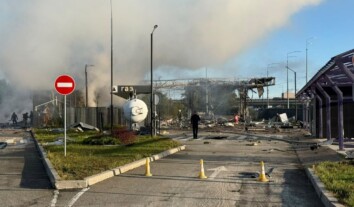
Russian military strikes on July 20 killed, 2026, 12 civilians in the Odesa, Zaporizhzhia, Kharkiv, Dnipropetrovsk and Donetsk Regions (Oblasts), while at least 82 others were injured in attacks that also struck the Sumy, Kherson and Chernihiv Oblasts, the National Police reported.
 Damage to a building following a Russian strike in the Kherson Oblast
The victims of Russian strikes on 20 July included:
- Four people in the Donetsk Oblast
- Three people in Odesa
- Two people in the Kharkiv Oblast
- Two people in the Dnipropetrovsk Oblast
- One woman in the Zaporizhzhia Oblast
At least 22 more civilians were injured in Russian attacks on the Kherson Oblast. The victims included a child, a teenager and hospital staff after Russian forces struck a hospital in Kherson during the day.
Russian attacks also injured 16 civilians in the Zaporizhzhia Oblast, most of them in the regional capital. Another 15 people were injured in the Kharkiv Oblast, while 13 civilians were wounded in the Donetsk Oblast.
In the Sumy Oblast, Russian forces injured six adults and four children. Five civilians were also injured in Odesa, while one person was wounded in the Dnipropetrovsk Oblast.
ZMINA also reported that on July 19, Russians killed 24 Ukrainian civilians.
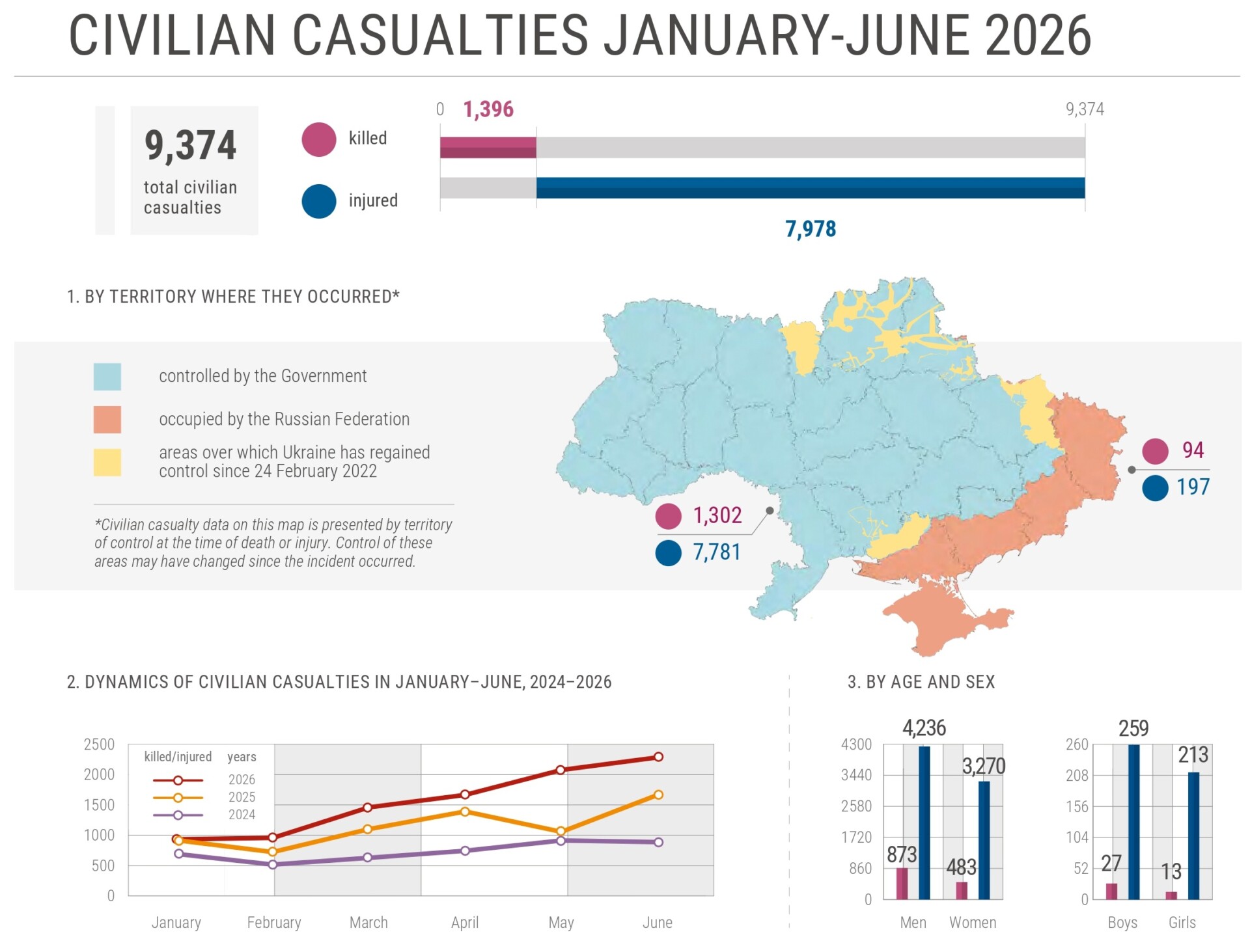
Meanwhile, the UN Human Rights Monitoring Mission in Ukraine (HRMMU) on 14 July stated in its monthly report that at least 293 civilians were killed in Russian strikes in June, 2026. It is the highest monthly death toll since the start of Russia’s full-scale invasion of Ukraine, UN human rights experts have said.
 Infographics by the UN Human Rights Monitoring Mission in Ukraine
“The figures show an alarming escalatory trend with mounting civilian toll, driven by the intensifying use of powerful weapons that are particularly deadly when used in densely populated urban areas,” said Danielle Bell, who heads HRMMU. “This trend should serve as a warning that the risks facing civilians are not only persisting but growing in both scale and complexity.”
HRMMU also reported that a total of 1,396 civilians were killed and 7,978 were injured over the first six months of this year, up 37% from the same period in 2025 and up 114% compared with the first half of 2024.
 Infographics by the UN Human Rights Monitoring Mission in Ukraine
Since 24 February 2022, the Office of the UN High Commissioner for Human Rights has verified that at least 16,431 civilians have been killed, including 803 children, and 48,613 civilians have been injured, including 2,960 children.
Human rights organisations and Ukrainian authorities emphasise that structural economic pressure remains a key tool to halt such atrocities. They urge every nation and individual government worldwide to strictly enforce global sanctions, close existing regulatory loopholes, and completely sever remaining commercial and technological ties with the Russian Federation. Civil society groups stress that any continued cooperation by foreign businesses directly contributes to the resources Moscow uses to sustain its ongoing war crimes and crimes against humanity in Ukraine.
The Economic Security Council of Ukraine (ESCU) reported that the European Union has imposed sanctions on the Chinese firm Xinxiang Richful Lubricant Additive Co., one of the largest suppliers of fuel additives to the Russian military-industrial complex.
According to the ESCU study, these Chinese activities improve the performance properties of aviation fuel and reduce engine wear in the Su-34 and Su-35S military aircraft. Russia independently produces only antioxidant additives, while it imports antistatic and anti-wear additives from India and China.
Xinxiang Richful Lubricant Additive Co. is the largest supplier of mineral-based additives to Russia. According to the ESCU, in 2023 alone, the Kremlin purchased goods from Xinxiang Richful worth more than $150 million – 33% of the company’s total annual sales.
Over the last four years, China has become a critically important partner for the Russian Federation. While Beijing officially declares its neutrality, Western intelligence and analytical studies indicate otherwise. For instance, China does not supply weapons directly to Russia, but it provides critically important components, including machinery, microelectronics, specialized chemicals, optics, gunpowder, and ammunition components.
You may also want to read: Chinese media expand their presence in Ukraine’s occupied territories and promote Kremlin narratives
Donald Trump announced several days ago that the United States would lower tariffs on Indian goods in exchange for India halting its imports of Russian oil.
Indian Prime Minister Narendra Modi thanked Trump but did not explicitly confirm the deal or disclose further details.
According to energy data firm Kpler, purchases have declined in recent months but still averaged approximately 1.2 million barrels per day in January.
Meanwhile, the Center for Strategic and International Studies found that in 2024 China increased sales of ammonium perchlorate — a key ingredient used to produce solid propellant for Iskander missiles. This assistance enabled Russia to triple its ballistic missile production, the report stated. Beijing’s support has bolstered Russia’s defense industrial base, enabling Russian forces to launch salvos of 13 to 18 Iskander-M ballistic missiles in 2026.
Overall imports from China have grown to represent one-third of Russia’s total imports, while Russian oil exports now account for 75% of all oil purchased by Beijing. Analysts specifically highlighted defense-related imports, which provided the Russian military-industrial complex with machine tools, components, and raw materials for weapons manufacturing.
Furthermore, Russia’s defense industry also received computer chips, machine tools, radars, and sensors from China, according to CSIS. These goods are part of a list of 50 items aiding weapons production, effectively compensating for Russia’s limited manufacturing capacity in its defense sector. Other areas of support include the supply of drone hulls, lithium batteries, and fiber-optic cables. CSIS reported that Russian imports from China rose from $190 billion in 2022 to $250 billion in 2024.
In 2024, then-U.S. Secretary of State Antony Blinken stated that 70% of heavy industrial equipment and 90% of all microelectronics are sourced from China, which then flows into Russia.
Furthermore, according to recent NATO intelligence data, 80% of all Russian drones consist of Chinese parts.
According to The Telegraph newspaper, Chinese firms supplied sanctioned Russian companies with at least £47 million ($57.4 million USD) worth of parts between 2023 and 2024. Almost a quarter of the value of these supplies went to firms that produce Shahed-type drones.
Moreover, the Foreign Intelligence Service of Ukraine stated that China is also providing intelligence to Russia. The Kremlin used this data to prepare missile strikes, particularly against objects belonging to foreign investors, though the specific targets were not clarified. China denies these accusations.
Following the imposition of Western sanctions, Beijing has become a key supplier to Russia of cars, clothing, raw materials, and a range of other goods. In 2023, Russia-China trade turnover set a historic record, exceeding $240 billion, which is more than 60% higher than before Russia’s invasion of Ukraine, according to Chinese customs data.
Reuters also reported that China is buying oil and gas from Russia. The average daily volume of oil is more than two million barrels per day. During Vladimir Putin’s visit to Beijing, the countries signed a document for the supply of 106 billion cubic meters of gas per year to China.
Reuters also reported that tens of thousands of cars are being exported from China to Russia under gray-market schemes that often circumvent Western and Asian government sanctions and automakers’ commitments to exit the Russian market, according to registration data reviewed by Reuters and interviews with five people involved in the trade.
Keep up with ZMINA on X, BlueSky, and LinkedIn – and help us improve by answering a few quick questions here about our English-language coverage.