Kyiv prepares to launch “Pulse of Accession” system to track Ukraine’s progress toward EU membership
The Ukrainian government has announced the launch of the “Pulse of Accession” system, a digital tool that will monitor Ukraine’s progress in the negotiation process for accession to the European Union (EU), ZMINA correspondent reported on September 24, 2025.
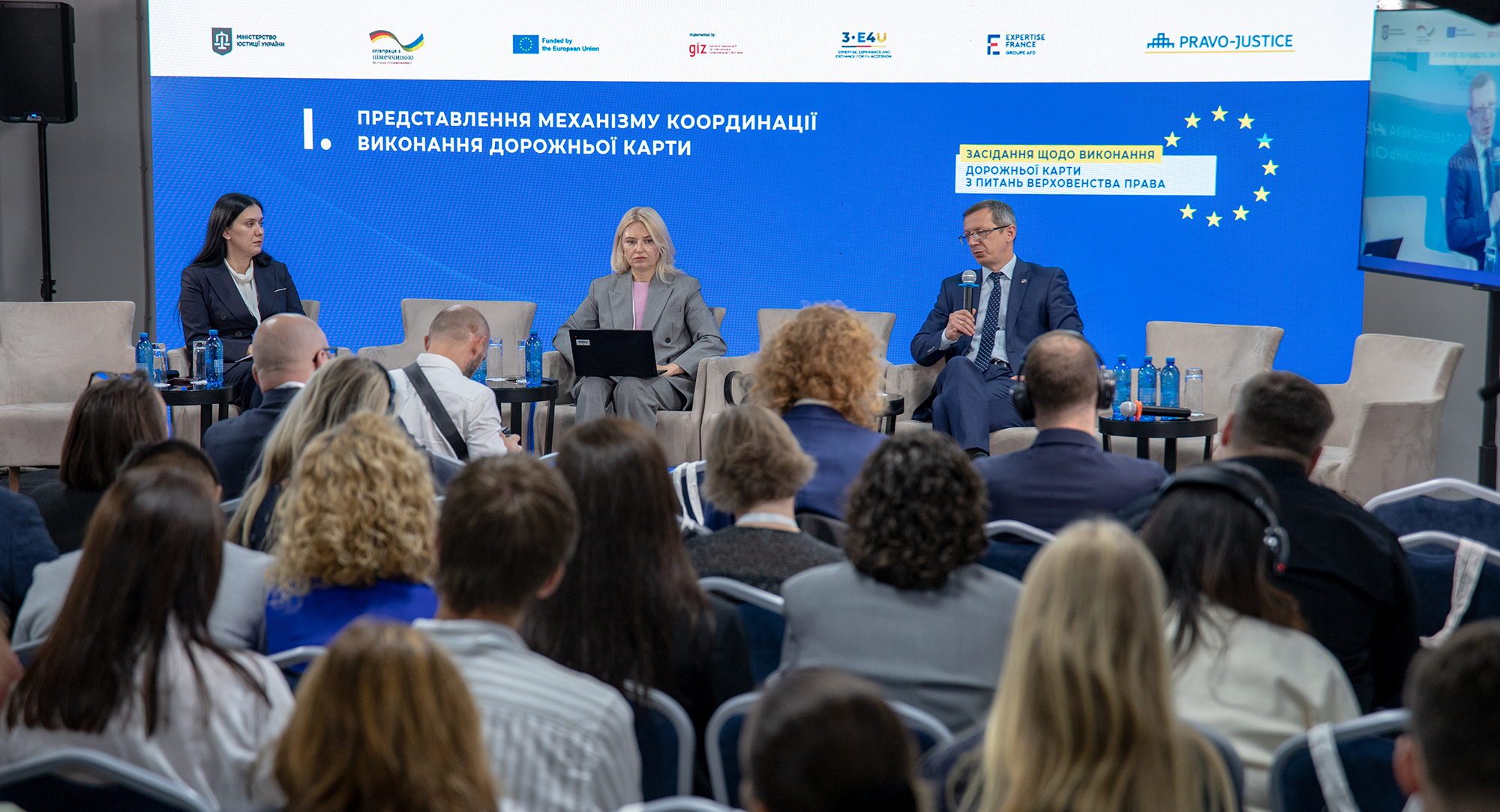 Photo credits: Ministry of Justice
On May 14, 2025, the Cabinet of Ministers of Ukraine approved a roadmap on the rule of law. The document defines the main areas of reform in the fields of judiciary, fundamental rights, anti-corruption, justice, freedom, and security. This set of reforms is envisaged within the framework of the negotiation process regarding Ukraine’s EU membership under EU accession Chapters 23 (“Judiciary and Fundamental Rights”) and 24 (“Justice, Freedom and Security”).
The roadmap on the rule of law is one of the key prerequisites for opening official negotiations on Ukraine’s accession to the EU within Cluster 1 (“Fundamentals of the EU Accession Process”), which opens first and closes last.
The document contains 529 measures and defines 124 strategic outcomes. Progress in implementing this roadmap will determine the dynamics of Ukraine’s negotiations on accession to the EU.
The Ministry of Justice has already analysed the progress in implementing the roadmap measures in 2025. Minister of Justice Herman Halushchenko noted that not all measures can be implemented within the approved time frame. In particular, according to Halushchenko, some 15 measures have been partially implemented, and must be completed on time through interagency coordination and with the support of international organisations and representatives of civil society.
The roadmaps, approved in May 2025, are internal documents of Ukraine, said Olexandr Ilkov, Director General of the Government Office for the Coordination of European and Euro-Atlantic Integration, at a meeting on the implementation of the roadmap on the rule of law. According to formal procedure, these roadmaps had to be approved after consensus was reached among EU member states, and Ukraine was officially invited to submit them.
“In May, by agreement with our partners, we took this unprecedented step and approved them so as not to become hostages to the lack of political consensus in the EU, not to waste time, and to achieve the ambitious goals that Ukraine has set for itself. We are moving forward on this path,” Ilkov said.
He explained that Ukraine developed the roadmaps in close cooperation with the European Commission. Ukraine received a decision of the Council of the EU, adopted by 26 member states in June, confirming that Kyiv has fulfilled practically all prerequisites for opening the first cluster of EU membership negotiations:
“This is another result of the fact that the roadmaps approved by Ukraine meet all the criteria set by the European Union.”
He added that of the more than 100 bodies involved in implementing the measures, a significant proportion are independent institutions. Ukraine’s government office is responsible for monitoring and reporting on the roadmaps’ progress.
To make Ukraine’s progress in implementing the roadmaps public, the government is preparing to launch the “Pulse of Accession” system, created in 2024 with the support of the EU. This should become a key IT tool that will monitor Ukraine’s progress in the negotiation process across all negotiation chapters, Ilkov said:
“The design of this tool was built around the National Program for Adaptation of Legislation, which is currently being developed and should be approved by the end of the year. We decided not to waste time and to start working on roadmaps and an action plan for the protection of minority rights in this IT tool.”
Once the Cabinet of Ministers approves this system as the main monitoring and reporting tool within the EU accession negotiation process, it will be made available to the public. The system will have two components: an internal one for the work of state bodies and a public domain for informing society.
The negotiating framework stipulates that Ukraine’s progress in implementing the roadmap will be monitored by the European Commission and EU member states. It was therefore agreed that reports would be submitted twice a year – Ukraine submitted its first report on September 9, and the next report is scheduled for March-April 2026, said Director General Ilkov.
Currently, the government office informs the EU monthly about progress in all areas of negotiations, with particular emphasis on the rule of law. Starting in October, it is planned to continue regular dialogue with the European Commission on thematic blocks of the roadmaps.
Negotiations on the accession of new countries to the European Union are divided into 35 chapters. Thirty-three of them are grouped into six thematic clusters, which are opened in turn. Cluster 1, “Fundamentals of the EU Accession Process,” is opened first and closed last. Sections 34 (“Institutions”) and 35 (“Other issues”) will be considered separately. For each of these sections, the European Commission first conducts an official screening of the compliance of Ukrainian and EU legislation.
Earlier, ZMINA reportedі that the Ministry of Justice of Ukraine, in conjunction with Ukraine2EU, had begun developing a National Program for the Adaptation of Legislation (NPAA) to European Union law (EU acquis). This is a key tool for reform management and monitoring Ukraine’s readiness for EU membership. The document will be filled out gradually as negotiations progress.
ZMINA also reported that the Cabinet of Ministers of Ukraine approved a Plan of Action to implement the European Commission’s recommendations, which are presented in the report on Ukraine’s progress within the 2024 EU Enlargement Package.
The document envisages over 380 measures aimed at implementing the European Commission’s recommendations in the report on Ukraine’s progress within the Enlargement Package 2024. It also provides for the continued implementation of the European Commission’s 2023 recommendations that have not yet been fully implemented.
Stay connected with us via X, BlueSky, and LinkedIn – and while you’re here, please spare five minutes to fill out our survey and tell us what you’d like to see next.