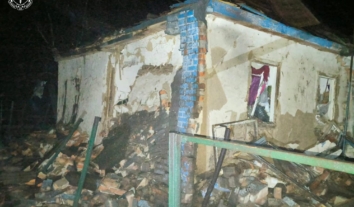
Yesterday, Russian shelling killed nine people in Ukraine
As a result of shelling by Russian troops on September 21, 2025, nine civilians were killed in the Donetsk, Zaporizhzhia, and Kharkiv regions (Oblasts). At least 17 were injured in the Dnipropetrovsk, Sumy, and Kherson Oblasts, according to the National Police of Ukraine.
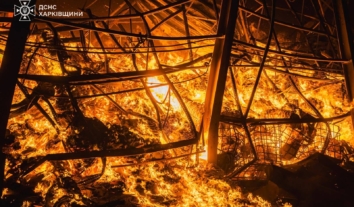
 Destruction of a residential building after a Russian strike in the Donetsk region
The highest number of deaths and injuries per day was in the Donetsk region. Four people were killed in Kostiantynivka, where another four were injured. Four more people were killed in cars in Yampil and Raiske, which were hit by drones.
In Donetsk Oblast, more than 2,400 Russian strikes in a single day also caused significant material damage, including dozens of destroyed residential buildings.
 A private house shelled by Russian forces in the Zaporizhzhia region
A private house in the Zaporizhzhia region was also shelled by the Russian Federation. The victims were three residents of Zaporizhzhia. Two others – a 16-year-old boy and a 20-year-old man – were injured.
In the Kharkiv region, a Russian airstrike killed a 47-year-old man in the Izyum district. Four others were wounded, including a volunteer in the city of Kupiansk.
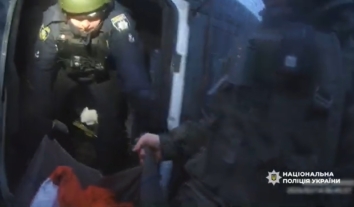
 A police officer talks to an elderly woman in the Sumy Oblast after a Russian strike on September 21, 2025
In the Kherson, Dnipropetrovsk, and Sumy regions, September 21 passed without fatalities, but three people were injured.
Among them were elderly residents of Bilozerka and Sukhanove, residents of several communities in Nikopol District, and one person in the Sumy region.
Ukraine urges the international community to unite to restore global security under the UN Charter and strengthen sanctions against Russia to enforce this country’s compliance with international law. Following Russia’s initial invasion in 2014, Ukraine has pursued the liberation of its territories within its internationally recognized 1991 borders while developing comprehensive reintegration strategies and policies for all liberated areas.
Earlier, Bohdan Bernatskyy, a member of the Sanctions Policy Working Group of the Crimean Platform Expert Network, revealed at the Third Parliamentary Summit in Latvia that over 1,300 Russian military companies and 2 million industrial workers continue to operate, many without international restrictions.
In related war news, GMK Center reported that, based on calculations from Eurostat data, the European Union imported 3.37 million metric tons of Russian metallurgical raw materials from January to July 2025, a 0.6% increase year over year.