US revising plan after ‘most productive’ talks with Ukraine — US Secretary of State Marco Rubio
As reported by Sky News, US Secretary of State Marco Rubio stated in Geneva, Switzerland, that Washington’s team is making “some changes” to the peace plan, seemingly based on Ukrainian suggestions.
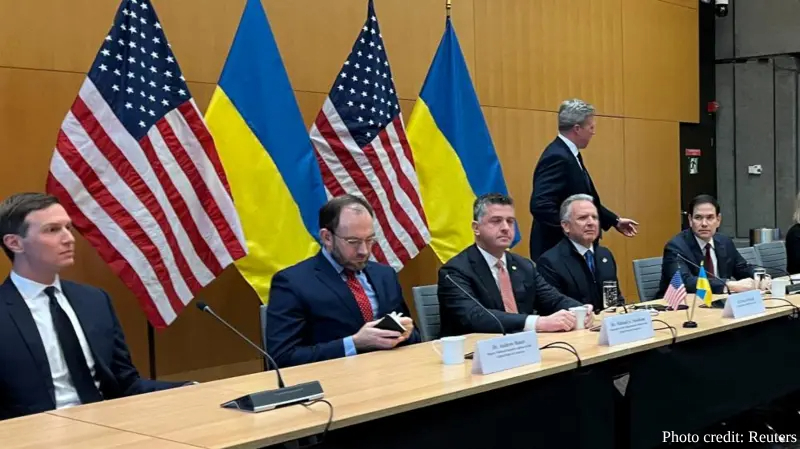
Marco Rubio said the meetings today have been “the most productive and meaningful” of the peace process so far for him. He added that there’s still work to do, and they may have a further update later.
“We have a very good work product that was already built on a foundation of input from all the relative parties involved here, and we were able to go through some of those items now, point by point. And I think we’ve made good progress. Our teams have now gone to their rooms as we’re working on some of the suggestions that were proffered to us, so we’re working through, making some changes in the hopes of furthering narrowing the differences and getting closer to something that both Ukraine and obviously the United States are very comfortable with,” he said.
Rubio stressed that any plan required Trump’s sign-off, and that Russia would offer its take, but he was “comfortable” about that.
Rubio said the talks were an “ongoing process” and they will come back “later tonight” and might be able to answer questions then, adding: “Let’s get back to work”.
Ukrainian President Volodymyr Zelenskyy said in a lengthy post on Facebook that Russia started the war, is refusing to end it, and is trying to preserve its ability to continue fighting “and not only against Ukraine”.
Zelenskyy reiterated that he appreciates “deeply” the efforts of so many countries in support of peace and that Ukraine is “grateful to the United States, to every American heart, and personally to President Trump for the assistance.”
He also thanks those in Europe and the G20 who are providing assistance, saying:
“It is important to preserve the support.”
Zelenskyy stressed that it is crucial not to forget the primary goal – to halt Russia’s war and prevent it from ever erupting again. And to achieve that, peace must be dignified.”
He stated this is not just a fight about territory for Russia, but about their “right to wage war” and to “subjugate”.
“That is why we work so carefully on every point, on every step toward peace. Everything must work out the right way – so that this war is truly ended and so that it does not happen again,” he said, before repeating his thanks to the U.S. and others.
The head of the Ukrainian negotiating team, Andriy Yermak, posted on Telegram that a second meeting will take place today, where they will continue working on joint proposals with the involvement of European allies.
“The second meeting will take place shortly today, where we will continue to work on joint proposals involving our European partners. The final decisions will be made by our presidents,” the Ukrainian official said.
Speaking to the press for the second time today, Marco Rubio stated that negotiators have had a “very good day” and have made a “tremendous amount of progress” in talks aimed at ending the war in Ukraine. According to Rubio, there has been extensive engagement with Ukraine over the last 96 hours. There was one goal on November 23, he said, to take the points of the plan, which he says were 26 or 28, depending on the version, and to try to narrow which ones were “open items.” He says the parties involved achieved that in a “substantial way”, but adds any final agreement will have to be agreed on by the presidents, and that there are still a couple of issues they need to continue to work on.
Previously, Keith Kellogg, US President Donald Trump’s special envoy for Ukraine, gave a positive assessment of Washington’s plan in an interview with Fox News, expecting the Russian-Ukrainian war to end soon. He was convinced that Donald Trump will end the war, which he described as “the longest war in Europe since World War II“.
Kellogg stressed that the United States must add supporting documents that will serve as security guarantees. He said he had recently held talks with the Ukrainian side and that the Ukrainians “really trust the Americans.”
In the same interview, Kellogg stated that the framework agreement is not yet final but is realistic for signing by Ukraine and Russia.
Earlier, eight Ukrainian human rights organizations called on all parties in the negotiation process to consider the interests of Ukrainian citizens living in the temporarily occupied territories (ТОТ) of Ukraine. In a joint statement, the organizations underlined the fact that ensuring the rights and interests of TOT residents must be part of the agreements within the negotiation process. The organizations also presented a ten-point list of specific steps that the occupying authorities must implement.
Among the specific steps that should be part of the negotiation process, the organizations highlighted:
- Release of all civilians arbitrarily detained by representatives of the Russian armed forces or the occupation authorities;
- Cessation of Russia’s unlawful practice of criminal and administrative persecution and detention of Ukrainian citizens in the TOT of Ukraine, which is used as an instrument of intimidation and political pressure;
- Determining the temporary line of contact and establishing temporary checkpoints to allow entry and exit from the TOT of Ukraine to areas that are controlled by the Ukrainian government and vice versa (humanitarian corridors);
- Granting humanitarian access for international organisations to the TOT of Ukraine by the Russian Federation, with the possibility of direct humanitarian assistance to Ukrainian citizens;
- Providing available information and access to the TOT of Ukraine to search teams to establish the location of persons missing under special circumstances;
- Ensuring the presence of international observation (monitoring) missions in all TOT of Ukraine, in particular to monitor the human rights situation;
- Demining of settlements and civilian infrastructure in the TOT of Ukraine;
- Ensuring that Ukrainian citizens can reside in the TOT of Ukraine without the need to obtain a Russian passport or any other documents granting the “right to reside” in the TOT of Ukraine, in accordance with the Russian legislation illegally extended to the TOT of Ukraine;
- Ensuring unimpeded access of Ukrainian citizens in the TOT of Ukraine to medical services, social and pension benefits, education, property rights, and freedom of movement, and independent sources of information;
- Ensuring that residents of the TOT of Ukraine who have been forcibly displaced to the territory of the RF or within the TOT of Ukraine are able to return to their homes or leave for the territory controlled by the Government of Ukraine.
Any delay in the liberation of the territories temporarily occupied by Russia will lead to the complete destruction of Ukrainian and Crimean Tatar identities there, Alena Lunova, advocacy director of the ZMINA Human Rights Center, stated live on “Radio Nakypilo.”
The human rights advocate called a proposal to discuss the de-occupation of the temporarily occupied territories in 49 years, as was voiced during talks with the aggressor country, unacceptable. She noted that the aggressor nation, in violation of international law, is demanding that Ukrainian citizens in the occupied territories obtain Russian passports or a foreigner’s document, among other things.
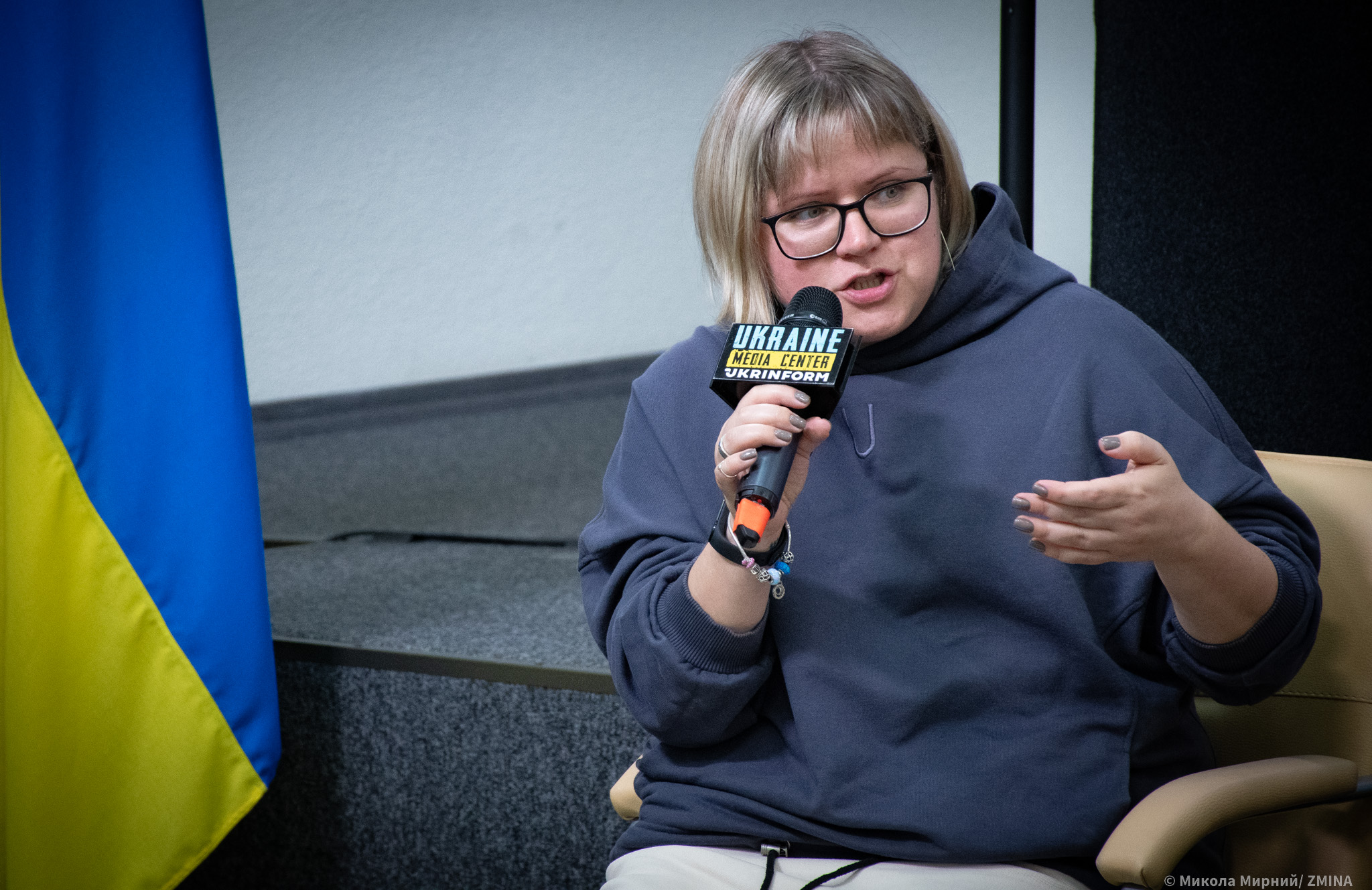 Alena Lunova
“We are documenting how the Russians are colonizing the temporarily occupied territories, settling them with their own citizens and thereby displacing the Ukrainian population from Ukrainian territory or destroying their identity. In 50 years, there will be no one there to talk to about de-occupation, because the policy of the Russian Federation is aimed at the extermination of Ukrainianness,” Alena Lunova stated.
“A description of the Russian Federation’s violations can serve as an argument as to why this option is not suitable for Ukraine, and we need to communicate to our partners that we cannot take a years-long pause in any de-occupation policy, because there will be no more Ukrainians there,” she added, drawing a historical parallel to when Moscow, after deporting the Crimean Tatars from the Crimean peninsula in 1944, forbade them from returning home for decades.
Stay connected via X and LinkedIn with ZMINA – and help build this platform with us by filling out our anonymous 5-minute survey here.