Ukrainian parliament supported the return of NABU and SAP independence
The Verkhovna Radaі passed a law restoring powers to Ukraine’s anti-corruption agencies – the National Anti-Corruption Bureau (NABU) and the Specialised Anti-Corruption Prosecutor’s Office (SAPO) on July 31, 2025.
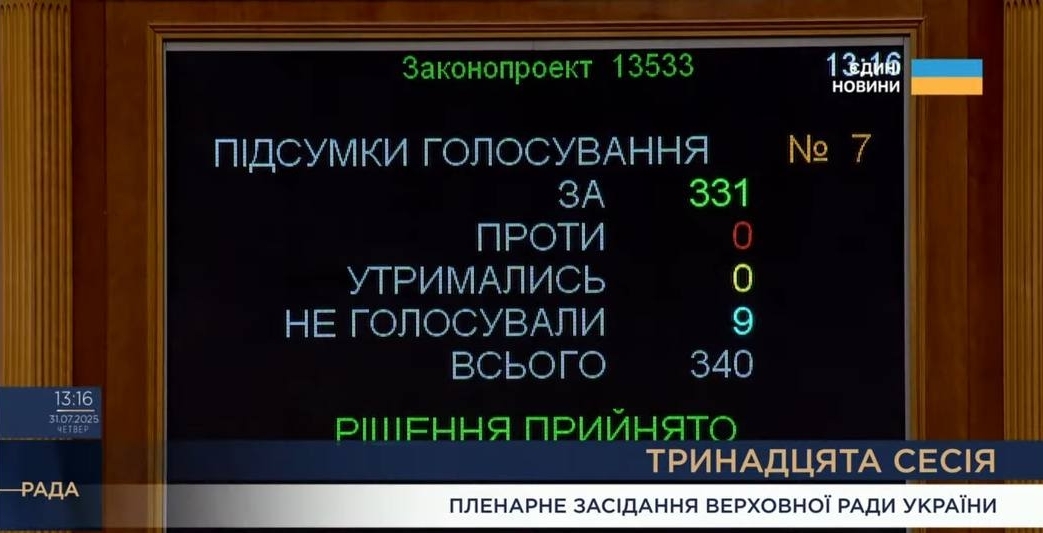
No MPs voted against the bill, and no one abstained. Nine MPs did not vote.
The new law grants SAPO independent oversight of the procedural supervision of NABU investigations – removing it from the Prosecutor General’s control.
Nevertheless, the law mandates that the Security Service of Ukraine must conduct background checks on employees of NABU, SAPO, and other agencies with access to state secrets within six months of the law taking effect to identify any possible cooperators with the aggressor state.
Additionally, these agencies will subject their staff to internal polygraph testing every two years, using a methodology the Security Service of Ukraine approves.
The voting was accompanied by a protest at the parliament. Its participants welcomed the positive result of the voting with applause, but also recalled other current issues.
President Volodymyr Zelenskyy signed the bill into law.
The president noted that “it is very important that the state listens to public opinion.”
“Ukraine is a democracy – there is no doubt about it. Government officials will also immediately inform Ukraine’s partners about this law,” Zelenskyy said.
European Commission spokesperson Guillaume Mercier has reiterated the EU’s expectations of Ukraine regarding progress in the fight against corruption through reforms, particularly by appointing a head of the Economic Security Bureau (ESB).
Mercier outlined other necessary steps, including the reinstatement of international experts in the High Qualification Commission for judicial selection, the appointment of four Constitutional Court judges who have passed international screening, the withdrawal of controversial amendments to the Criminal Code, and the adoption of a law on administrative procedure.
By way of background, Ukraine’s parliament voted in favor of draft law No. 12414 on July 22, making NABU and SAPO dependent on the prosecutor general’s decisions. Zelenskyy signed it into law that evening.
MPs and Zelenskyy’s decision sparked demonstrations in many cities across Ukraine. Following these rallies, Zelenskyy pledged to submit a draft law to the Verkhovna Rada that would “empower the law enforcement system” and preserve “all provisions necessary for the independence of anti-corruption institutions”.
NABU said the bill would reinstate all the powers and guarantees of independence for NABU and SAPO.
A political and legal controversy has erupted after the Ukrainian government rejected the winning candidate for the director of the Bureau of Economic Security (BEB), citing a negative assessment from the country’s security service.
Volodymyr Zelenskyy said that his intense focus on the war was the reason he did not hold a public discussion before signing a controversial law that limited the powers of the NABU and the SAPO.
When asked why he did not discuss the law prior to signing it, the president replied: “Probably, a dialogue should have been held. You always have to communicate. I am focused on the issue of war, because right now in Ukraine, the number one issue is the war. The main problem is the war. The main enemy is Russia.”
Zelenskyy added that while the war is the biggest challenge, “justice is important.”
“It’s very important what society says. I respect the opinion of society. I believe it is absolutely normal to react when people don’t want something, when people don’t like it,” the president said. “People have the right to say what they think. For me, it was very important that we heard and reacted adequately. People asked for changes. We reacted.”
Ukrainska Pravda and hromadske complained that the office of the President of Ukraine didn’t accredit them to a meeting with Volodymyr Zelenskyy.
On July 9, the selection commission published the Ukrainian government’s decision to reject Oleksandr Tsyvinskyy’s candidacy. In its official reasoning, it cited “information provided by the Security Service of Ukraine (SSU)” and Article 2 of the law on national security, which broadly outlines the legal basis for state policy in security and defense.
The move has drawn mixed reactions and accusations of political interference.
Prime Minister Yulia Svyrydenko, who was recently appointed, defended the government’s actions, stating her belief that the procedure used to reject the candidate “complied with laws and regulatory acts.”
However, Anastasiia Radina, the influential head of the parliament’s Committee on Anti-Corruption Policy, stated that the government may have violated the law on the BEB with its decision.
Tsyvinskyiy himself has forcefully resisted the rejection. He demanded to see the SSU assessment that formed the basis of the Cabinet’s decision, calling the information “false.” He also noted that he had successfully passed SSU security checks for the past 10 years.
In a direct appeal, Tsyvinskyy stressed that all stages of the selection competition had been completed, all documents had been submitted, and the selection commission’s decision in his favor was unanimous.
He therefore called on the Cabinet of Ministers to fulfill its obligations and complete the appointment process.
“A state institution that is supposed to protect the economy should begin not with maneuvers, but with principles,” Tsyvinskyi wrote.