Ukraine, EU prosecutors sign cooperation deal to prevent misuse of aid funds
The Specialised Anti-Corruption Prosecutor’s Office (SAPO) and the European Public Prosecutor’s Office in Luxembourg have signed a Memorandum of Cooperation, which provides for increased cooperation to prevent the misuse of EU funds allocated to Ukraine, according to the SAPO’s press service.
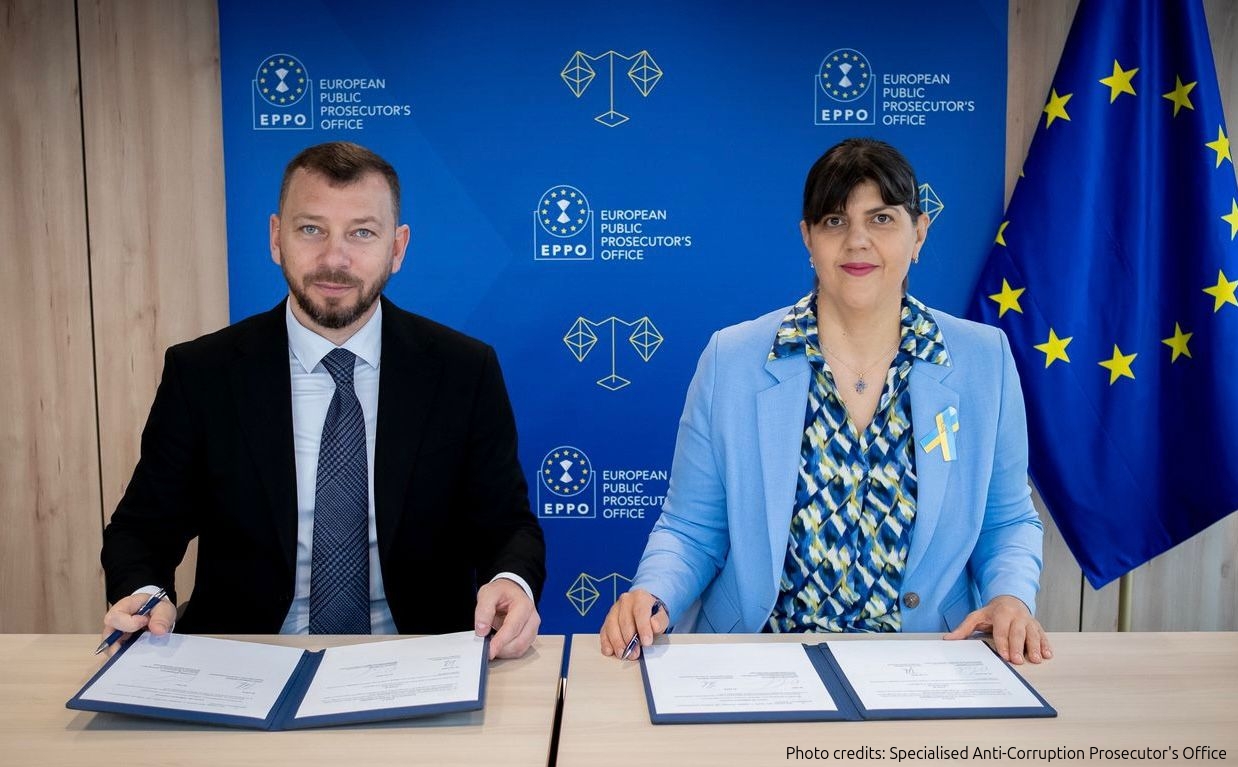 SAPO Head Oleksandr Klymenko and European Chief Prosecutor Laura Kövesi
“The document marks a new stage in cooperation between Ukrainian and European prosecutors. It provides, in particular, for the establishment of a permanent channel for joint responses to offences that may concern EU funds allocated for the support and reconstruction of Ukraine,” the statement reads.
The document was signed following a meeting between SAPO Head Oleksandr Klymenko and European Chief Prosecutor Laura Kövesi.
The Ukrainian prosecutor’s office emphasised that cooperation between SAPO and the European Public Prosecutor’s Office would provide an additional guarantee of the transparent use of international aid to Ukraine and prevent abuse in the areas of defence, humanitarian and reconstruction programmes.
Klymenko’s visit to Luxembourg took place with the support of the EU Anti-Corruption Initiative.
The European Public Prosecutor’s Office is an institution established to protect the EU budget from fraud and corruption.
By way of background, Ukraine’s anti-corruption community, the National Anti-Corruption Bureau of Ukraine, and SAPO have faced increased pressure in recent months, raising concerns among international partners and civil society in the country about potential backsliding on reform commitments.
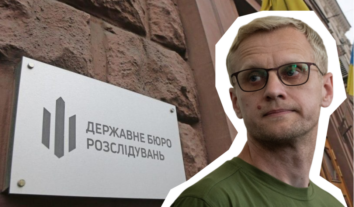
The State Bureau of Investigation (SBI) served a suspicion notice on Vitaliy Shabunin, head of the Anti-Corruption Action Center, for “evasion of military service” under Article 409, Part 4, and “fraud” under Article 190, Part 2, of the Criminal Code of Ukraine.
The SBI also conducted simultaneous searches at Shabunin’s place of service, east of Chuhuiv, and at the residence where his family currently lives in Kyiv. The SBI’s charges concern the period from September 2022 to February 2023, when Shabunin was seconded from his Territorial Defense (TrO) unit in Sukholuchchia, Kyiv region, to the National Agency on Corruption Prevention (NACP).
According to the Anti-Corruption Action Centre, the investigative actions were conducted with numerous violations by the SBI, which were recorded by lawyers who arrived at the scene after the fact:
- The absence of court orders;
- The organization of searches in such a way that lawyers were unable to arrive on time and take measures to ensure that rights were respected;
- The absence of video recording of the process of seizing equipment and items that could be used in the future for further discrediting;
- The seizure of items unrelated to the subject of the criminal proceeding, among other legal breaches.
During his NACP secondment, Shabunin worked on promoting anti-corruption changes and reforms, including those in the defense sector. Specifically, he was involved in restoring electronic asset declaration and developing solutions to reduce abuses in defense procurement.
Lawyer for NABU detective Ruslan Mahamedrasulov and board member of the Anti-Corruption Action Center, Olena Shcherban, sees the attacks on NABU, SAP, and anti-corruption activists as a coordinated and planned action by Ukrainian authorities. In the joint podcast of the ZMINA Human Rights Center and Radio Kyiv FM “Mayemo Pravo”і said that criminal cases by the Security Service of Ukraine (SSU) involving NABU detectives, where urgent searches were conducted days after they were deemed necessary, suggesting a deliberate timing to create a media narrative about “Russian influence” within NABU and to discredit the institution before the law limiting the powers of NABU and SAPO was passed.
Shcherban assessed that the SSU may have shifted its tactics, finding it easier to target specific individuals than institutions, as international bodies are less likely to intervene on behalf of individuals. According to her, this may cause a chilling effect, as detectives may fear repercussions for investigating high-profile figures.
On the morning of September 25, NABU stated that the SSU was conducting investigative actions against its former detectives, which may signal growing pressure on anti-corruption bodies. The SSU claimed in its commentary that Ukrzaliznytsia officials were being searched as part of a criminal investigation into abuses in the freight transport sector, which are not related to pressure on anti-corruption agencies. Ukrzaliznytsia is the Ukrainian state-run railway operator. Among these ex-detectives is Taras Likunov, the brother of Olena Shcherban.
“In its official communication, the SBU states that the searches were conducted ‘in a criminal proceeding regarding abuses in the field of freight transportation at Ukrzaliznytsia.’ But this is a total lie. The search warrant for my brother’s apartment does not mention ‘abuses at UZ [Ukrzaliznytsia].’ It states in black and white that the search took place within a criminal proceeding connected to the suspicion of lawmaker Khrystenko. How my brother is connected to this is unclear. The investigator could not explain it during the search either,” Olena Shcherban said.
The SBU published the full text of the search warrant for the rented apartment where Taras Likunov resides. As seen in the warrant text, the request for the search was personally approved by the Prosecutor General of Ukraine, Ruslan Kravchenko.
Previously, three independent sources of the Babel news outlet reported that the SBU is investigating the possible involvement of Oleksandr Klymenko in a case where Member of Parliament Fedor Khrystenko is providing testimony. Khrystenko is suspected of treason and was recently returned to Ukraine from Dubai.